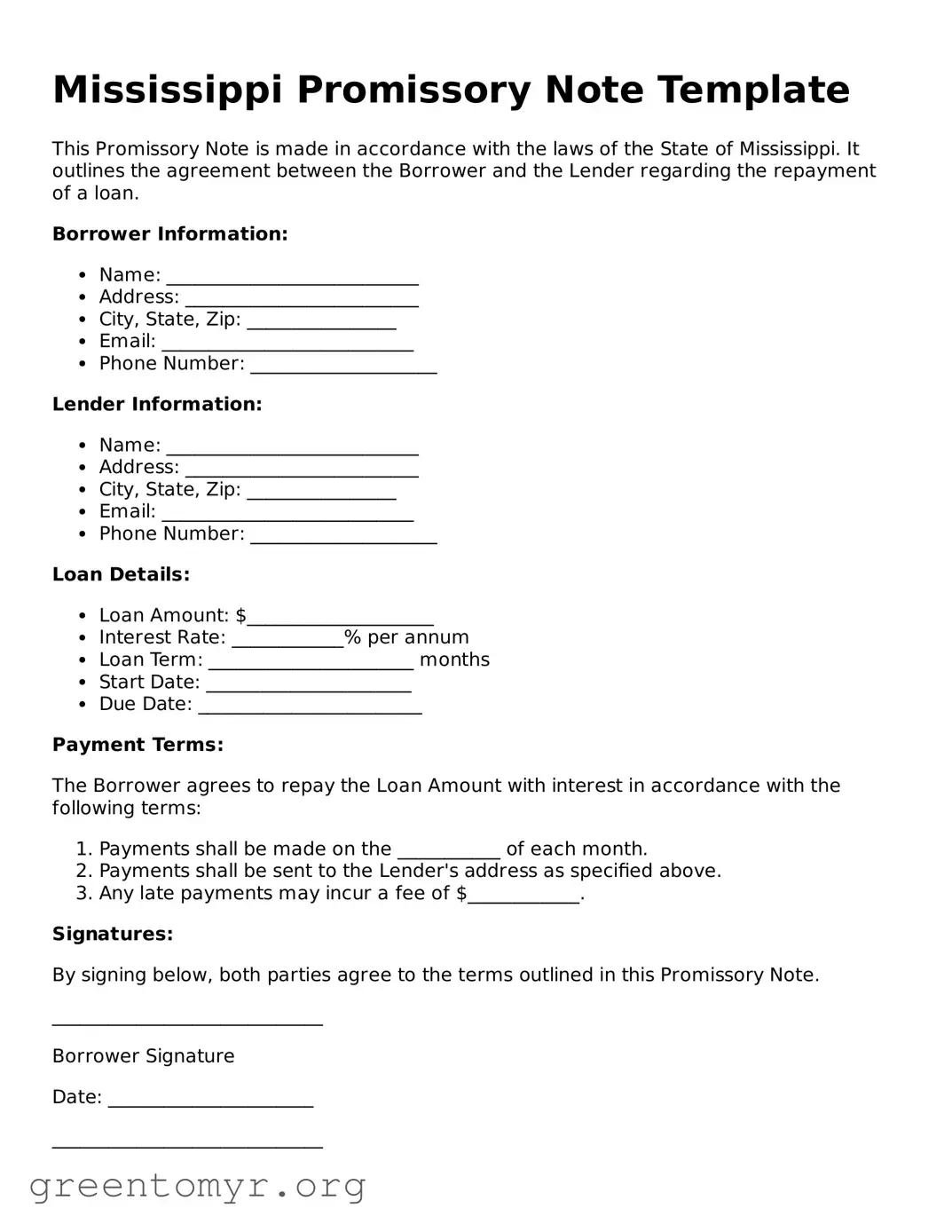
The Mississippi Promissory Note form serves as a crucial financial document in lending transactions. This legally binding agreement outlines the terms under which one party borrows money from another, specifying the amount borrowed, the interest rate, and the repayment schedule. Clarity is vital; thus, the form includes sections for both the lender and the borrower to provide their names and contact information. Additionally, it addresses the consequences of default, ensuring that both parties understand their rights and obligations. By detailing the terms of the loan, this form protects the interests of the lender while providing the borrower with a clear understanding of their responsibilities. Whether you are a lender seeking security for your investment or a borrower looking to formalize a loan agreement, the Mississippi Promissory Note is an essential tool in your financial toolkit.
Mississippi Promissory Note Template
This Promissory Note is made in accordance with the laws of the State of Mississippi. It outlines the agreement between the Borrower and the Lender regarding the repayment of a loan.
Borrower Information:
Lender Information:
Loan Details:
Payment Terms:
The Borrower agrees to repay the Loan Amount with interest in accordance with the following terms:
Signatures:
By signing below, both parties agree to the terms outlined in this Promissory Note.
_____________________________
Borrower Signature
Date: ______________________
_____________________________
Lender Signature
Date: ______________________
This Promissory Note is binding and enforceable under Mississippi law.
| Fact Name | Details |
|---|---|
| Definition | A promissory note in Mississippi is a written promise to pay a specific amount of money to a designated person or entity at a specified time. |
| Governing Law | The Mississippi Uniform Commercial Code (UCC) governs promissory notes, specifically under Title 75, Chapter 3. |
| Requirements | For a promissory note to be valid, it must be signed by the maker and include the amount to be paid, the payment date, and the interest rate, if applicable. |
| Enforceability | Promissory notes are legally enforceable in Mississippi, provided they meet all necessary legal requirements. |
| Transferability | Promissory notes can be transferred to another party, allowing for flexibility in financial transactions. |
After you have gathered the necessary information, you are ready to fill out the Mississippi Promissory Note form. This document requires specific details that will formalize the agreement between the borrower and the lender. Ensuring accuracy is crucial, as this form serves as a legal obligation.
Once completed, review the form for any errors or omissions. After ensuring that all information is correct, keep a copy for your records and provide the other party with their copy. This form is now an official document that reflects the terms of your agreement.
A Mississippi Promissory Note is a legal document that outlines a borrower's promise to repay a loan to a lender under specified terms. This note includes details such as the amount borrowed, the interest rate, repayment schedule, and consequences for defaulting on the loan. It serves as a formal agreement that protects both parties involved in the transaction.
Several important elements should be included in a Mississippi Promissory Note:
While it is not legally required to have a lawyer draft a Promissory Note, seeking legal advice can be beneficial. A lawyer can help ensure that the document meets all legal requirements and protects your interests. If both parties understand the terms and are comfortable drafting the note themselves, they can do so without legal assistance. However, clarity and completeness are essential to avoid potential disputes later on.
If the borrower defaults, meaning they fail to make payments as agreed, the lender has several options. These may include:
It is advisable for both parties to communicate openly to find a resolution that works for everyone involved.
Filling out a Mississippi Promissory Note form can be straightforward, but there are common mistakes that people often make. One significant error is not providing accurate information about the parties involved. It is crucial to include the full legal names and addresses of both the borrower and the lender. Omitting or misspelling this information can lead to confusion or disputes later on.
Another frequent mistake is failing to specify the loan amount clearly. The amount should be written in both numerical and written form. For example, if the loan is for $5,000, it should be noted as "5,000" and "Five Thousand Dollars." This helps prevent misunderstandings regarding the exact amount owed.
People also often overlook the importance of including the interest rate. The interest rate should be clearly stated, whether it is a fixed or variable rate. Without this information, the terms of repayment can become unclear, leading to potential issues in the future.
Additionally, some individuals neglect to outline the repayment schedule. It is essential to specify when payments are due and the method of payment. Whether payments are made monthly, quarterly, or on a different schedule, clarity is key to avoiding missed payments and penalties.
Finally, many forget to sign and date the document. A Promissory Note is not valid without the signatures of both parties. Ensure that both the borrower and the lender sign the document and include the date of signing. This step is critical for the enforceability of the agreement.
The Mississippi Promissory Note form is a crucial document for outlining the terms of a loan agreement between a lender and a borrower. However, several other forms and documents are commonly used in conjunction with this note to ensure that all aspects of the transaction are clearly defined and legally enforceable. Below is a list of related documents that may be necessary.
These documents serve to protect the interests of both the lender and the borrower. Ensuring that all necessary forms are completed accurately can help prevent disputes and misunderstandings in the future.
A Promissory Note is a vital financial document that outlines a promise to pay a specific amount of money to a designated person or entity. It shares similarities with several other documents. Here are four documents that resemble a Promissory Note, along with explanations of their similarities:
When filling out the Mississippi Promissory Note form, it's important to follow certain guidelines. Here are five things you should and shouldn't do:
Understanding the Mississippi Promissory Note form is essential for both lenders and borrowers. However, several misconceptions can lead to confusion. Here are six common misunderstandings:
Many people believe that all promissory notes function identically. In reality, the terms and conditions can vary significantly based on state laws and the specific agreement between the parties involved.
Some assume that a promissory note serves as a complete loan agreement. While it outlines the borrower's promise to repay, it does not encompass all the terms typically found in a comprehensive loan agreement, such as collateral or default consequences.
It is a common misconception that a promissory note can be valid without signatures. In fact, both parties must sign the document for it to be enforceable.
Some individuals think that promissory notes are only necessary for significant loans. However, they can be used for any amount, providing a clear record of the borrowing agreement.
Many believe that a verbal agreement is enough to constitute a loan. While oral agreements can be valid, having a written promissory note provides legal protection and clarity.
Some people think promissory notes only matter when a dispute arises. In reality, they serve as important documentation throughout the loan process, helping both parties keep track of their obligations.
By addressing these misconceptions, individuals can navigate the complexities of promissory notes more effectively, ensuring that both lenders and borrowers understand their rights and responsibilities.
When filling out and using the Mississippi Promissory Note form, it is important to understand several key aspects. Below are five essential takeaways:
Understanding these elements can help ensure that the Promissory Note serves its intended purpose effectively.