The Mississippi Quitclaim Deed form serves as a vital tool in real estate transactions, allowing property owners to transfer their interest in a property to another party without making any guarantees about the title. This form is particularly useful when the grantor is unsure about the property’s title status or when the transfer is between family members or friends, where trust is inherent. Unlike warranty deeds, which provide assurances about the title’s validity, a quitclaim deed simply conveys whatever interest the grantor has, if any. This lack of warranty makes it essential for the grantee to conduct thorough due diligence before accepting the transfer. The form typically requires essential details such as the names of both the grantor and grantee, a legal description of the property, and the date of execution. Additionally, it must be signed by the grantor and may need to be notarized to ensure its legal validity. Understanding the implications of using a quitclaim deed is crucial for anyone involved in property transactions in Mississippi, as it can significantly impact future ownership rights and responsibilities.
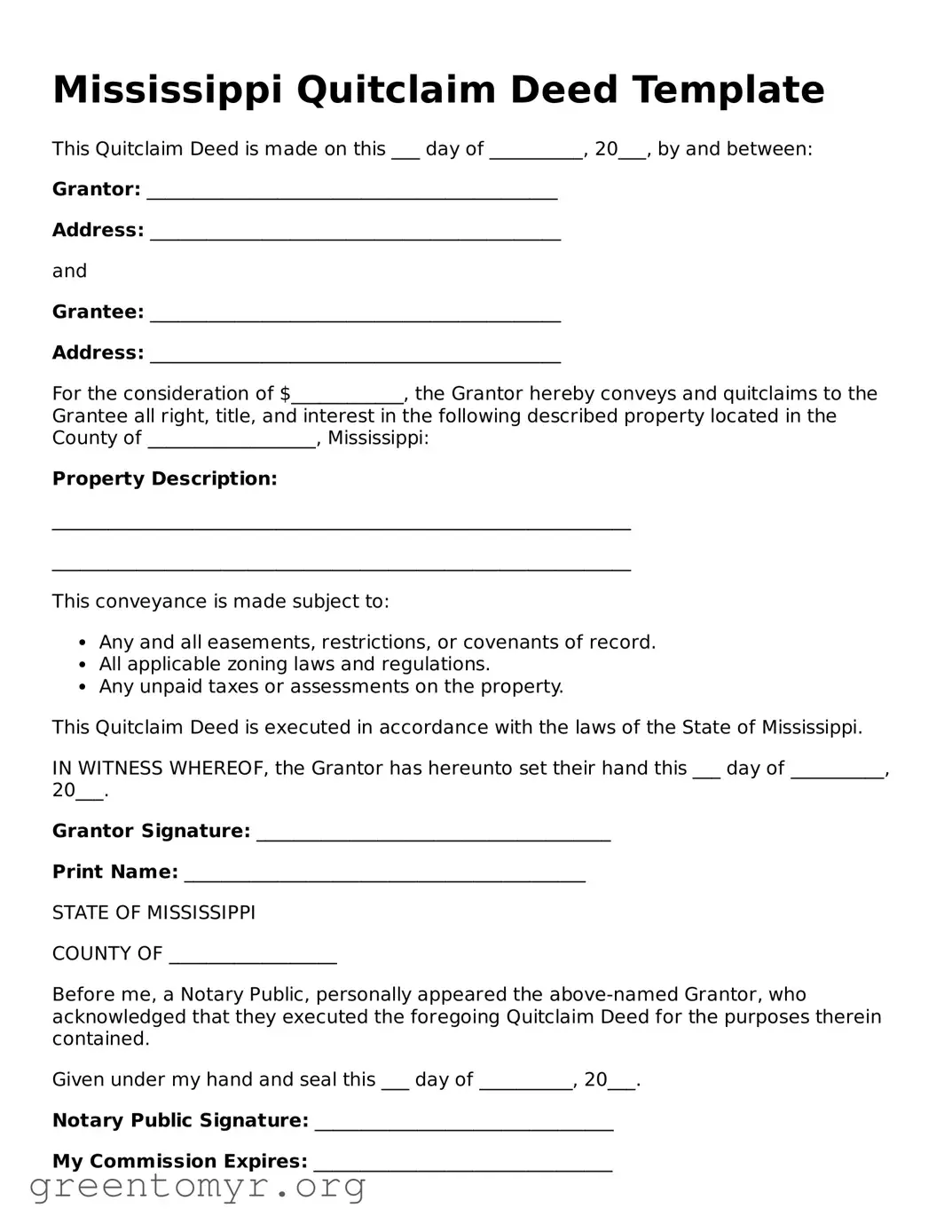
Mississippi Quitclaim Deed Template
This Quitclaim Deed is made on this ___ day of __________, 20___, by and between:
Grantor: ____________________________________________
Address: ____________________________________________
and
Grantee: ____________________________________________
Address: ____________________________________________
For the consideration of $____________, the Grantor hereby conveys and quitclaims to the Grantee all right, title, and interest in the following described property located in the County of __________________, Mississippi:
Property Description:
______________________________________________________________
______________________________________________________________
This conveyance is made subject to:
This Quitclaim Deed is executed in accordance with the laws of the State of Mississippi.
IN WITNESS WHEREOF, the Grantor has hereunto set their hand this ___ day of __________, 20___.
Grantor Signature: ______________________________________
Print Name: ___________________________________________
STATE OF MISSISSIPPI
COUNTY OF __________________
Before me, a Notary Public, personally appeared the above-named Grantor, who acknowledged that they executed the foregoing Quitclaim Deed for the purposes therein contained.
Given under my hand and seal this ___ day of __________, 20___.
Notary Public Signature: ________________________________
My Commission Expires: ________________________________
| Fact Name | Details |
|---|---|
| Definition | A quitclaim deed is a legal document used to transfer ownership of real estate without any warranties or guarantees. |
| Governing Law | The Mississippi Quitclaim Deed is governed by Mississippi Code Annotated, Title 89, Chapter 1. |
| Purpose | This deed is commonly used to transfer property between family members or in divorce settlements. |
| No Warranty | Unlike other types of deeds, a quitclaim deed offers no warranty regarding the title's validity. |
| Filing Requirements | In Mississippi, the deed must be signed by the grantor and notarized before being filed with the county land records office. |
| Tax Implications | Property transfer using a quitclaim deed may be subject to transfer taxes, depending on the county. |
| Revocation | A quitclaim deed cannot be revoked once it has been executed and recorded. |
| Consideration | While consideration (payment) is not required, it is often included to validate the transaction. |
| Common Uses | Quitclaim deeds are frequently used in estate planning and to clear up title issues. |
After obtaining the Mississippi Quitclaim Deed form, you will need to provide specific information to ensure it is completed correctly. This form is essential for transferring property rights. Follow these steps carefully to fill it out accurately.
A Mississippi Quitclaim Deed is a legal document used to transfer ownership of real property from one person to another. Unlike a warranty deed, a quitclaim deed does not guarantee that the property is free of liens or claims. It simply conveys whatever interest the grantor has in the property, if any. This type of deed is often used among family members or in situations where the parties know each other well.
Quitclaim Deeds are commonly used in several situations, including:
However, it is important to note that this deed does not provide any protection against future claims on the property.
To fill out a Quitclaim Deed in Mississippi, follow these steps:
Once completed, the deed should be filed with the local county clerk’s office to make the transfer official.
While it is not legally required to have a lawyer to create a Quitclaim Deed, consulting one can be beneficial. A lawyer can help ensure that the deed is completed correctly and that all necessary legal requirements are met. This is especially important if the property has any complexities, such as existing liens or multiple owners.
Yes, there are fees associated with filing a Quitclaim Deed in Mississippi. These fees can vary by county, but typically include:
It is advisable to check with the local county clerk’s office for specific fee amounts and any other requirements.
Once a Quitclaim Deed is executed and recorded, it generally cannot be revoked unilaterally. The grantor cannot simply change their mind after the deed has been filed. If the grantor wishes to regain ownership, they would need to execute a new deed transferring the property back to themselves or negotiate with the current owner. It is crucial to understand the implications of using a Quitclaim Deed before proceeding with the transfer.
When filling out the Mississippi Quitclaim Deed form, several common mistakes can lead to complications. First, one of the most frequent errors is failing to include the correct legal description of the property. This description must be precise and detailed. Without it, the deed may not be valid, causing potential issues down the line.
Another mistake often made is neglecting to sign the document in the appropriate places. Both the grantor and grantee must provide their signatures. If either party forgets to sign, the deed will not be recognized. This can delay the transfer process and create unnecessary stress.
Additionally, some individuals forget to include the date on the deed. While it may seem minor, the date is crucial for establishing when the transfer took place. This information can be important for tax purposes and other legal matters.
People also sometimes overlook the need for a notary public. In Mississippi, the Quitclaim Deed must be notarized to be legally binding. Skipping this step can render the document ineffective, leading to further complications in property ownership.
Another common error involves misidentifying the parties involved. It is essential to use the full legal names of both the grantor and the grantee. Inaccuracies can create confusion and may even result in legal disputes over property ownership.
Lastly, many individuals fail to double-check for typos or errors in the form. Simple mistakes can have significant consequences. Taking the time to review the document thoroughly can save time and prevent issues later on.
When dealing with property transfers in Mississippi, the Quitclaim Deed form is often accompanied by several other important documents. Each of these forms serves a specific purpose in ensuring a smooth and legally compliant transfer of property ownership. Below is a list of commonly used documents that may accompany a Quitclaim Deed.
In summary, these documents are essential for ensuring that property transfers are conducted smoothly and in accordance with the law. Each form plays a crucial role in protecting the rights of both buyers and sellers, making it important to understand their functions in the overall process.
A Quitclaim Deed is a legal document used to transfer ownership of real estate. While it serves a specific purpose, several other documents share similarities in their function or intent. Here’s a look at five documents that are comparable to a Quitclaim Deed:
Understanding these documents can help individuals navigate property transactions more effectively. Each serves a unique purpose but shares common elements with the Quitclaim Deed.
When filling out the Mississippi Quitclaim Deed form, it is essential to approach the task with care. This document transfers ownership of property from one person to another. Here are some important dos and don'ts to keep in mind:
By following these guidelines, you can help ensure a smoother and more efficient property transfer process in Mississippi.
When discussing the Mississippi Quitclaim Deed, several misconceptions often arise. Understanding these misunderstandings can help individuals make informed decisions about property transfers. Below is a list of common misconceptions about the Quitclaim Deed form in Mississippi.
Addressing these misconceptions can empower individuals to navigate property transactions more effectively. It is always advisable to seek professional guidance when dealing with legal documents and property transfers.
Filling out and using the Mississippi Quitclaim Deed form can be straightforward if you keep a few key points in mind. Here are some important takeaways to consider: