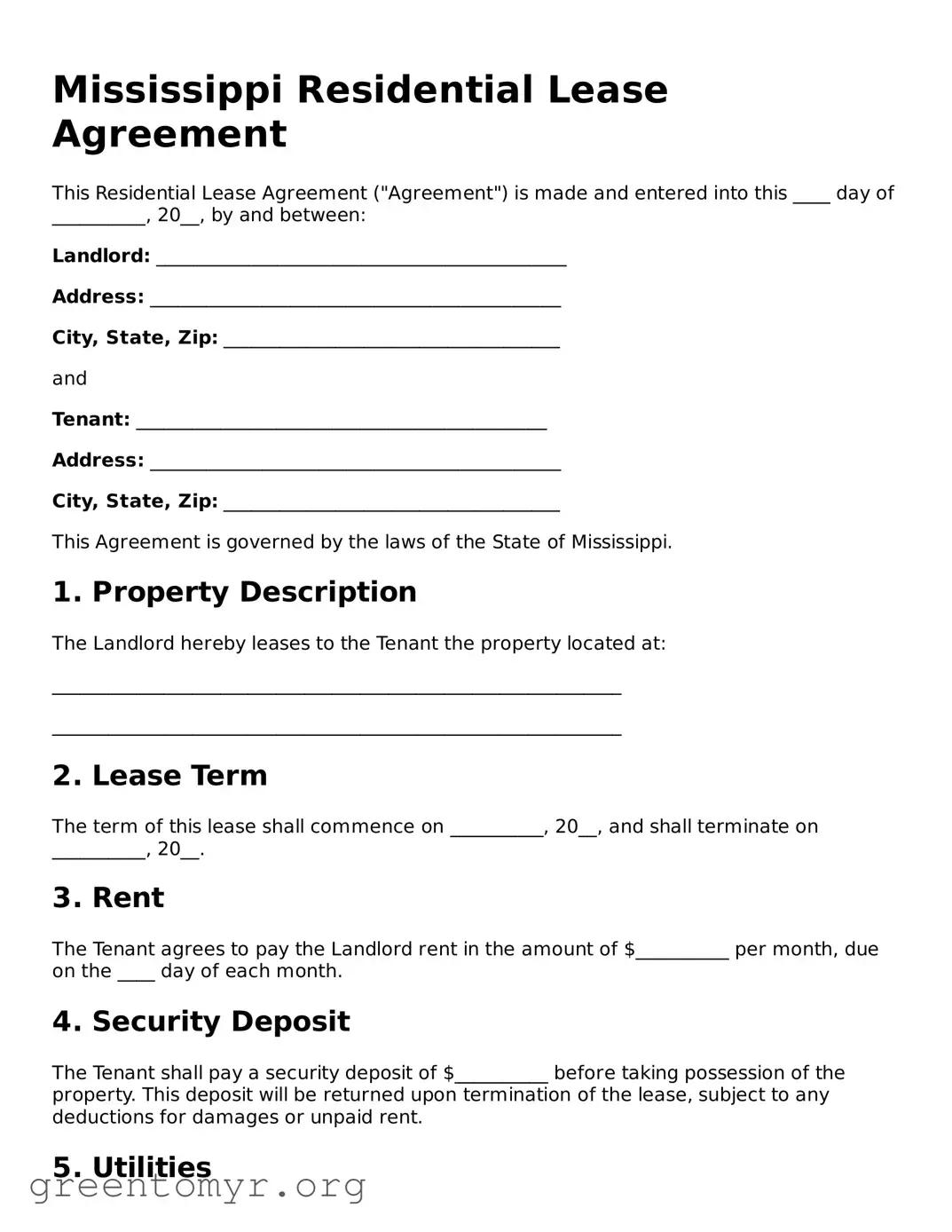
In the state of Mississippi, a Residential Lease Agreement serves as a vital document for both landlords and tenants, outlining the rights and responsibilities of each party involved in a rental arrangement. This form typically includes essential details such as the names of the landlord and tenant, the property address, and the duration of the lease. Rent payment terms, including the amount due and the payment schedule, are clearly specified to avoid misunderstandings. Additionally, the agreement addresses security deposits, maintenance responsibilities, and rules regarding pets, ensuring that both parties are aware of their obligations. Provisions for lease termination and renewal are also included, providing clarity on how either party can exit or extend the agreement. By establishing these key elements, the Mississippi Residential Lease Agreement fosters a transparent and respectful relationship between landlords and tenants, ultimately contributing to a more harmonious living environment.
Mississippi Residential Lease Agreement
This Residential Lease Agreement ("Agreement") is made and entered into this ____ day of __________, 20__, by and between:
Landlord: ____________________________________________
Address: ____________________________________________
City, State, Zip: ____________________________________
and
Tenant: ____________________________________________
Address: ____________________________________________
City, State, Zip: ____________________________________
This Agreement is governed by the laws of the State of Mississippi.
1. Property Description
The Landlord hereby leases to the Tenant the property located at:
_____________________________________________________________
_____________________________________________________________
2. Lease Term
The term of this lease shall commence on __________, 20__, and shall terminate on __________, 20__.
3. Rent
The Tenant agrees to pay the Landlord rent in the amount of $__________ per month, due on the ____ day of each month.
4. Security Deposit
The Tenant shall pay a security deposit of $__________ before taking possession of the property. This deposit will be returned upon termination of the lease, subject to any deductions for damages or unpaid rent.
5. Utilities
The Tenant is responsible for the payment of the following utilities:
6. Maintenance and Repairs
The Tenant agrees to keep the property in good condition and notify the Landlord of any needed repairs.
7. Use of Property
The property shall be used solely for residential purposes. No commercial activities are allowed without written consent from the Landlord.
8. Termination
Either party may terminate this Agreement by providing written notice at least ____ days prior to the intended termination date.
9. Governing Law
This Agreement shall be governed by the laws of the State of Mississippi.
IN WITNESS WHEREOF, the parties hereto have executed this Residential Lease Agreement as of the date first above written.
Landlord Signature: ___________________________ Date: ___________
Tenant Signature: ___________________________ Date: ___________
| Fact Name | Description |
|---|---|
| Governing Law | The Mississippi Residential Lease Agreement is governed by the Mississippi Code, specifically Title 89, Chapter 8. |
| Parties Involved | The agreement typically involves a landlord (lessor) and a tenant (lessee). |
| Lease Duration | Leases can be for a fixed term, such as one year, or for a month-to-month arrangement. |
| Security Deposit | Landlords may require a security deposit, which cannot exceed two months' rent for unfurnished properties. |
| Notice Requirements | Mississippi law requires landlords to provide a written notice of at least 30 days for lease termination in month-to-month agreements. |
| Habitability Standards | Landlords are obligated to maintain the property in a habitable condition, ensuring basic living standards are met. |
| Rent Payment | The lease should clearly outline the rent amount, payment due date, and acceptable payment methods. |
| Disclosures | Landlords must disclose any known lead-based paint hazards in properties built before 1978. |
Filling out the Mississippi Residential Lease Agreement form is an important step in establishing a rental arrangement. This document serves to clarify the terms between the landlord and tenant, ensuring both parties understand their rights and responsibilities. Follow these steps to complete the form accurately.
A Mississippi Residential Lease Agreement is a legal document that outlines the terms and conditions under which a landlord rents property to a tenant. This agreement includes details such as the rental amount, duration of the lease, and responsibilities of both parties. It serves to protect the rights of both the landlord and tenant.
The lease agreement generally includes the following information:
A typical lease term in Mississippi can vary. Most commonly, leases are signed for one year. However, shorter or longer terms, such as month-to-month agreements or multi-year leases, are also possible. The specific duration should be clearly stated in the lease agreement.
The landlord has several responsibilities, including:
Tenants also have specific responsibilities, which may include:
Yes, a lease agreement can be modified, but any changes must be agreed upon by both the landlord and tenant. It is advisable to document any modifications in writing and have both parties sign the updated agreement to avoid misunderstandings.
If a tenant wishes to terminate the lease early, they should refer to the lease agreement for any specific clauses regarding early termination. Often, tenants may need to provide notice to the landlord and possibly pay a fee or forfeit their security deposit. Open communication with the landlord is essential in this situation.
A security deposit is typically required by landlords in Mississippi. This deposit serves as protection for the landlord against potential damages or unpaid rent. The amount can vary but is often equivalent to one month's rent. The lease agreement should specify the terms regarding the security deposit, including how and when it will be returned to the tenant.
If a tenant fails to pay rent, the landlord may initiate eviction proceedings. The lease agreement should outline the steps the landlord can take in this situation, including any grace periods or late fees. It is important for tenants to communicate with their landlord if they are experiencing financial difficulties.
Mississippi Residential Lease Agreement forms can be obtained from various sources, including online legal document services, local real estate offices, or legal aid organizations. It is advisable to ensure that the form complies with Mississippi laws and is tailored to the specific rental situation.
Completing the Mississippi Residential Lease Agreement form requires attention to detail. Many individuals overlook critical sections, leading to confusion or disputes later. One common mistake is failing to include all necessary tenant and landlord information. Each party's full name, address, and contact details should be clearly stated. Omitting this information can result in miscommunication or legal issues down the line.
Another frequent error involves neglecting to specify the lease term. A clear start and end date is essential. If these dates are left blank or incorrectly filled in, it can create uncertainty regarding the duration of the lease. Such ambiguity can lead to disputes over rent payments and occupancy.
Additionally, people often misinterpret the security deposit section. The Mississippi law outlines specific rules regarding the amount and handling of security deposits. Failing to adhere to these regulations can result in financial penalties or the inability to retain the deposit. It is crucial to clearly state the deposit amount and conditions for its return.
Another mistake is not addressing maintenance responsibilities. The lease should outline who is responsible for repairs and maintenance. Without this clarity, tenants may assume the landlord will handle all issues, while landlords might expect tenants to take care of minor repairs. This misunderstanding can lead to frustration and conflict.
Some individuals also forget to include information about utilities. The lease should specify which utilities are included in the rent and which are the tenant's responsibility. This oversight can lead to unexpected expenses for tenants and disputes over payment responsibilities.
Moreover, people often fail to read the fine print regarding late fees. The lease should clearly state any penalties for late rent payments. If this section is vague or missing, tenants might not understand the consequences of late payments, leading to financial strain.
Another common mistake is not including provisions for early termination. Life circumstances can change, and both parties should understand the terms under which the lease can be terminated early. Without these provisions, one party may feel trapped in an unfavorable situation.
Additionally, individuals sometimes overlook the importance of signatures. Both the landlord and tenant must sign and date the lease for it to be legally binding. Failing to obtain the necessary signatures can render the agreement unenforceable.
Lastly, people often neglect to keep copies of the signed lease. After filling out the form, it is essential for both parties to retain a copy. This ensures that everyone has access to the agreed-upon terms, which can be vital in resolving any disputes that may arise.
When entering into a rental agreement in Mississippi, there are several other forms and documents that are often used alongside the Residential Lease Agreement. These documents help clarify the terms of the lease, protect both parties, and ensure compliance with state regulations. Below is a list of commonly used forms that may be beneficial in conjunction with the lease agreement.
Each of these forms plays a crucial role in the leasing process. Using them appropriately can help prevent misunderstandings and protect the rights of both landlords and tenants. It is always advisable to ensure that all documents are completed accurately and retained for future reference.
When filling out the Mississippi Residential Lease Agreement form, it’s important to be thorough and accurate. Here are some dos and don'ts to keep in mind:
Understanding the Mississippi Residential Lease Agreement is crucial for both landlords and tenants. However, several misconceptions can lead to confusion. Here’s a list of common misunderstandings:
Being aware of these misconceptions can help both landlords and tenants navigate their agreements more effectively. Always read your lease thoroughly and seek clarification when needed.
Filling out and using the Mississippi Residential Lease Agreement form is an important step for both landlords and tenants. Here are some key takeaways to keep in mind:
Following these guidelines will help create a clear and effective lease agreement that protects the rights of both landlords and tenants.