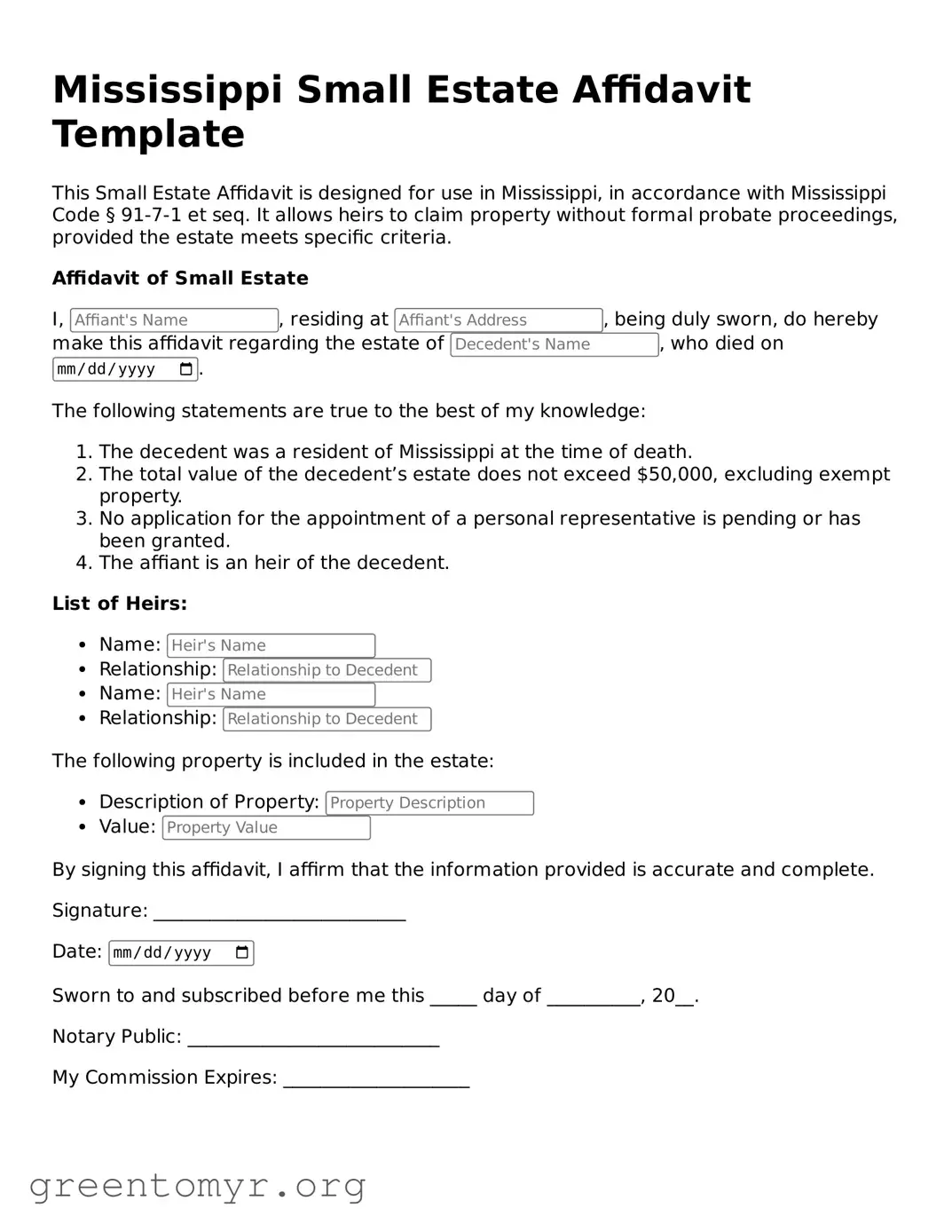
In Mississippi, the Small Estate Affidavit serves as a valuable tool for individuals navigating the often complex process of settling an estate without the need for formal probate proceedings. This form is particularly beneficial for estates that fall below a certain value threshold, allowing heirs or beneficiaries to claim assets more efficiently. By using the Small Estate Affidavit, individuals can assert their rights to the deceased's property, such as bank accounts, vehicles, and personal belongings, without the delays and costs associated with traditional probate. The form requires specific information, including the decedent's details, a list of assets, and the names of the heirs. Importantly, it also necessitates an affirmation that the estate qualifies under Mississippi law, ensuring that the process remains streamlined and accessible. For those managing the affairs of a loved one who has passed away, understanding the Small Estate Affidavit can ease the burden during a challenging time, providing a clear pathway to settling the estate efficiently.
Mississippi Small Estate Affidavit Template
This Small Estate Affidavit is designed for use in Mississippi, in accordance with Mississippi Code § 91-7-1 et seq. It allows heirs to claim property without formal probate proceedings, provided the estate meets specific criteria.
Affidavit of Small Estate
I, , residing at , being duly sworn, do hereby make this affidavit regarding the estate of , who died on .
The following statements are true to the best of my knowledge:
List of Heirs:
The following property is included in the estate:
By signing this affidavit, I affirm that the information provided is accurate and complete.
Signature: ___________________________
Date:
Sworn to and subscribed before me this _____ day of __________, 20__.
Notary Public: ___________________________
My Commission Expires: ____________________
| Fact Name | Details |
|---|---|
| Purpose | The Mississippi Small Estate Affidavit allows heirs to claim assets of a deceased person without formal probate. |
| Eligibility | This form is applicable when the total value of the estate is $75,000 or less, excluding certain assets. |
| Governing Law | The use of this affidavit is governed by Mississippi Code Annotated § 91-1-27. |
| Required Information | Heirs must provide information about the deceased, including name, date of death, and last known address. |
| Signature Requirement | The affidavit must be signed by all heirs entitled to inherit under Mississippi law. |
| Filing Process | There is no need to file the affidavit with the court, but it may need to be presented to financial institutions or other entities. |
| Asset Types | Common assets claimed include bank accounts, vehicles, and personal property. |
| Notarization | The affidavit must be notarized to ensure its validity and authenticity. |
| Limitations | This affidavit cannot be used for estates that include real property or certain other specific assets. |
After gathering all necessary information and documents, you will be ready to fill out the Mississippi Small Estate Affidavit form. This process is straightforward, but it requires attention to detail to ensure that all information is accurately recorded. Following these steps will help you complete the form correctly.
Once the form is completed, it should be submitted to the appropriate court or authority as specified by Mississippi law. Be sure to keep copies of the affidavit and any supporting documents for your records. This will be useful for future reference or if any questions arise regarding the estate.
The Mississippi Small Estate Affidavit is a legal document that allows heirs to claim property of a deceased person without going through the formal probate process. This form is typically used when the total value of the deceased's estate is below a certain threshold, making it a simpler and quicker option for settling the estate.
Any individual who is an heir or beneficiary of the deceased can use the Small Estate Affidavit. This includes spouses, children, parents, siblings, or anyone who is legally entitled to inherit under Mississippi law. It is important that the estate meets the value requirements set by the state.
As of the latest guidelines, the total value of the estate must be less than $50,000, excluding any real property. If the estate exceeds this amount, the formal probate process must be initiated instead of using the Small Estate Affidavit.
To complete the Small Estate Affidavit, follow these steps:
No, the Small Estate Affidavit does not need to be filed with the court. However, it may need to be presented to financial institutions or other entities holding the deceased's assets in order to claim those assets.
If the Small Estate Affidavit is not accepted by the institutions or entities holding the assets, you may need to consider filing for formal probate. This process can be more time-consuming and costly, so it is crucial to ensure that the affidavit is completed correctly.
No, the Small Estate Affidavit cannot be used to transfer real property. Real estate must go through the formal probate process, regardless of the estate's total value. However, personal property and other assets can still be claimed using the affidavit.
There is no specific deadline for using the Small Estate Affidavit. However, it is advisable to act promptly after the death of the individual to ensure a smooth transfer of assets and to avoid complications that may arise over time.
The Mississippi Small Estate Affidavit form can typically be found on the official state government website or at local courthouses. Additionally, many legal websites provide templates that can be downloaded and filled out.
Filling out the Mississippi Small Estate Affidavit form can be a straightforward process, but there are common mistakes that individuals often make. Understanding these pitfalls can help ensure that the form is completed correctly, which is crucial for the efficient handling of a small estate. Here are eight frequent errors to watch out for.
One common mistake is failing to provide accurate information about the deceased. The affidavit requires specific details such as the full name, date of death, and last known address of the deceased. Omitting or incorrectly entering any of this information can lead to delays in the estate settlement process.
Another frequent error involves misunderstanding the eligibility requirements for using the Small Estate Affidavit. Many individuals mistakenly believe that all estates qualify. In Mississippi, the estate must not exceed a certain value. It’s essential to verify that the estate falls within the specified limits before proceeding.
Some people overlook the requirement for signatures. The affidavit must be signed by the affiant, who is typically a person entitled to inherit under Mississippi law. Failing to include a signature can render the affidavit invalid, causing further complications.
Inaccurate asset listings are another common issue. The form requires a detailed account of the assets that are part of the estate. Individuals sometimes forget to include all relevant assets or misstate their values. This can lead to disputes among heirs or even legal challenges.
Not providing supporting documentation is also a mistake that can hinder the process. Attachments such as a death certificate or proof of ownership for certain assets are often necessary. Without these documents, the affidavit may not be accepted by the court.
Some people may rush through the completion of the affidavit, leading to typographical errors. Simple mistakes in spelling or numbers can have significant consequences. It’s advisable to review the form carefully before submission to catch any errors.
Another issue arises when individuals fail to notify all interested parties. Mississippi law requires that all heirs and beneficiaries be informed about the filing of the Small Estate Affidavit. Not doing so can lead to claims from individuals who feel they were overlooked.
Lastly, misunderstanding the timeline for filing can create problems. There are specific timeframes within which the Small Estate Affidavit must be filed after the death of the individual. Missing these deadlines can complicate the process and lead to unnecessary legal issues.
By being aware of these common mistakes, individuals can approach the Mississippi Small Estate Affidavit form with greater confidence. Taking the time to ensure accuracy and completeness will facilitate a smoother process for settling the estate.
When dealing with the Mississippi Small Estate Affidavit, several additional forms and documents may be necessary to ensure a smooth process. Understanding these documents can help streamline the administration of a small estate.
Gathering these documents will facilitate the completion of the Small Estate Affidavit process and ensure compliance with Mississippi laws. It is advisable to have all necessary paperwork ready to avoid delays in settling the estate.
The Small Estate Affidavit is a useful legal tool for settling the affairs of a deceased person's estate without the need for formal probate. Several other documents serve similar purposes, facilitating the transfer of assets or managing estate matters. Below are eight documents that share similarities with the Small Estate Affidavit:
When filling out the Mississippi Small Estate Affidavit form, it is essential to follow certain guidelines to ensure the process goes smoothly. Below is a list of things to do and avoid while completing this form.
Things You Should Do:
Things You Shouldn't Do:
Understanding the Mississippi Small Estate Affidavit can be confusing. Here are nine common misconceptions that people often have:
Addressing these misconceptions can help individuals better navigate the Small Estate Affidavit process in Mississippi.
When dealing with the Mississippi Small Estate Affidavit form, there are several important points to consider. This process can simplify the transfer of assets and help avoid lengthy probate procedures. Here are key takeaways to keep in mind:
Utilizing the Small Estate Affidavit can significantly streamline the process of settling an estate. Take these points into account to ensure a smooth experience.