Content Navigation

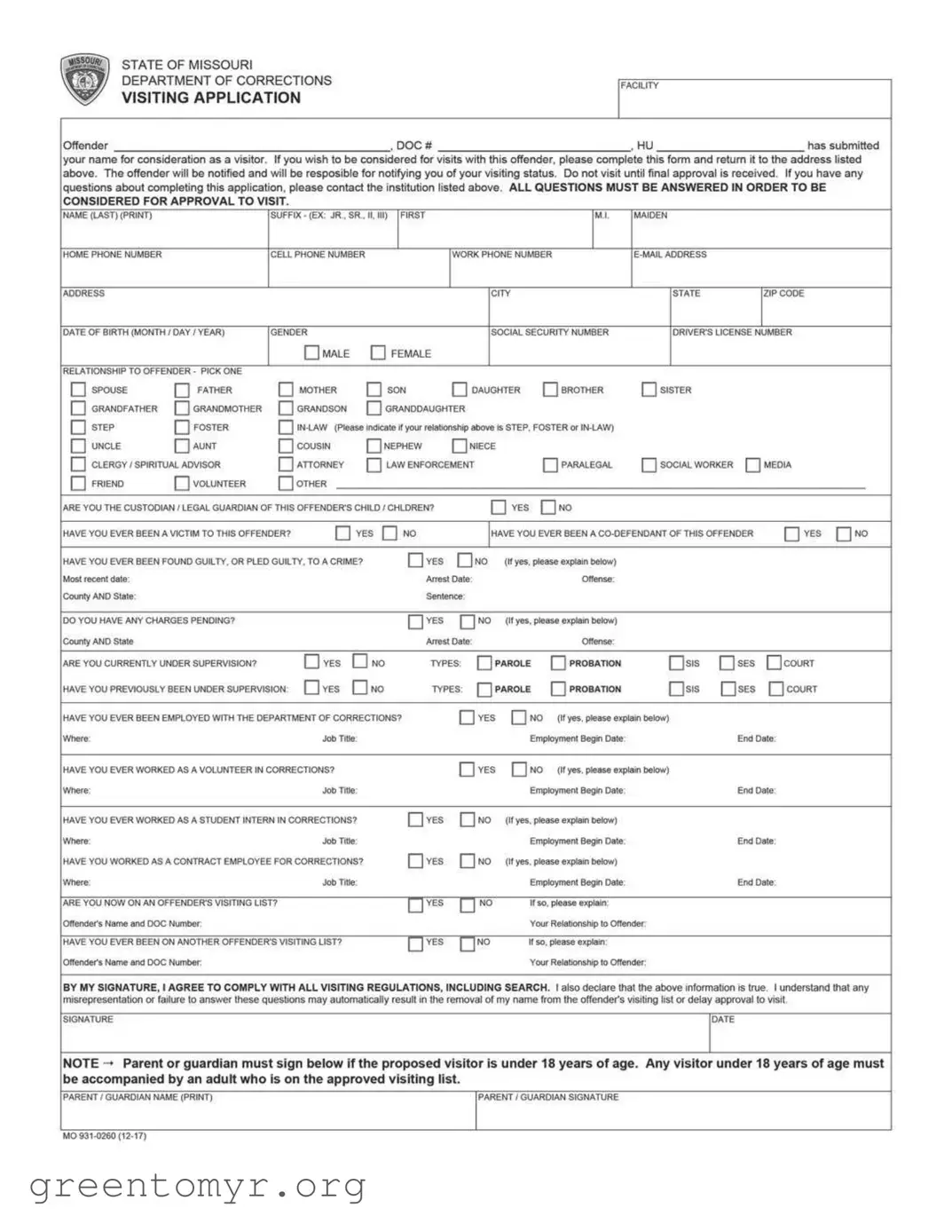
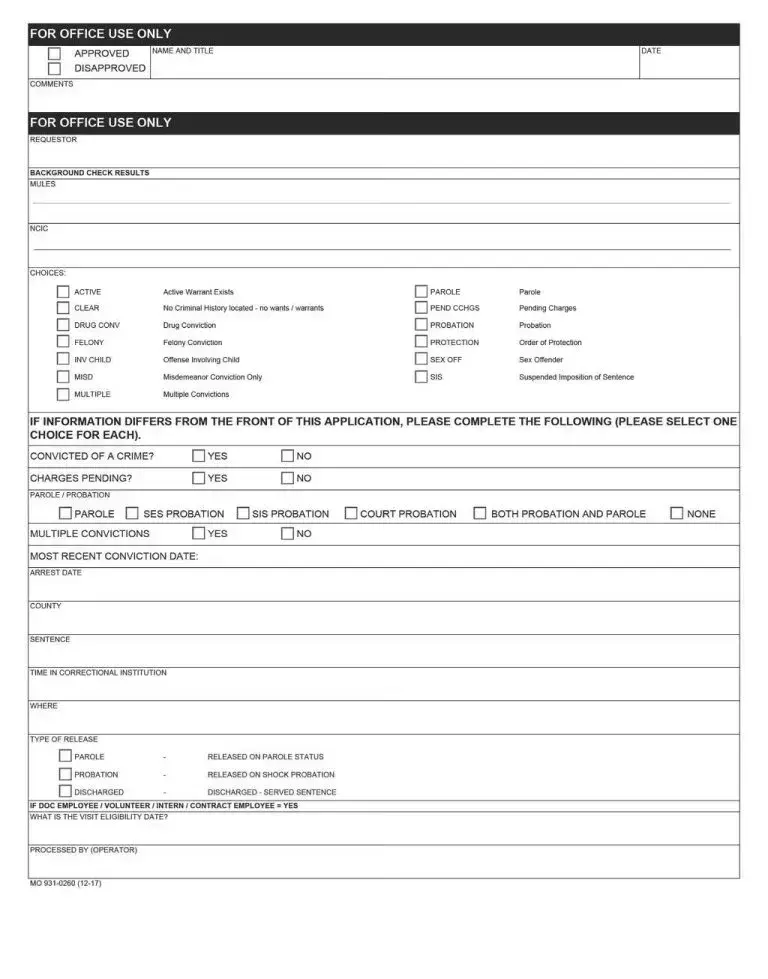
The Missouri Department of Corrections form is a crucial document used to assess the background and eligibility of individuals applying for various roles within the correctional system. This form collects essential information, including the applicant's name, title, and details regarding any criminal history. It provides options for indicating the status of background checks, including results from databases such as MULES and NCIC. Applicants must disclose any active warrants, felony convictions, or pending charges, particularly those involving children or drug offenses. The form also inquires about parole or probation status, ensuring that all relevant legal circumstances are considered. If there are discrepancies in the information provided, the applicant is prompted to clarify these details in a dedicated section. This thorough approach helps maintain safety and compliance within correctional facilities while allowing for a clear understanding of each applicant's legal standing.
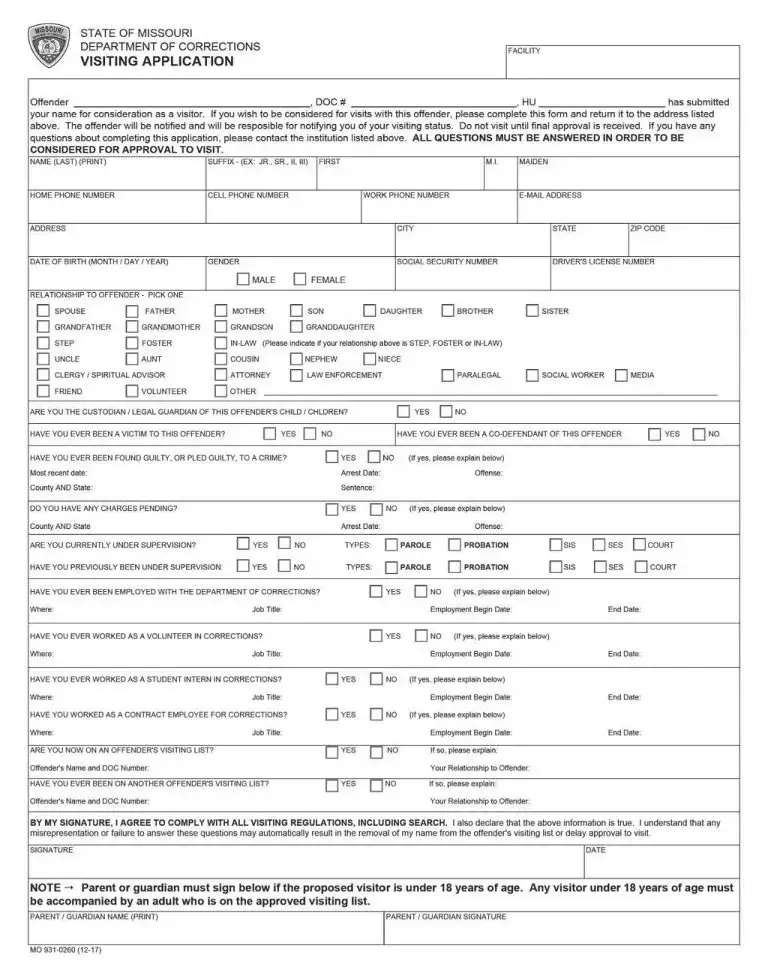
Missouri Dept Of Corrections Example

File Breakdown

Fact Name Description
Purpose of the Form This form is used to conduct background checks for individuals requesting access to the Missouri Department of Corrections facilities or programs.
Governing Laws The form is governed by Missouri Revised Statutes, specifically Chapter 217, which outlines the administration of corrections and related procedures.
Information Requirements Applicants must provide personal details, including conviction history, parole or probation status, and any pending charges.
Approval Process The form includes sections for office use only, where the request will be marked as approved or disapproved based on the background check results.
Eligibility for DOC Employees Individuals who are employees, volunteers, or interns at the Department of Corrections must also complete this form to ensure compliance with eligibility requirements.

Guide to Using Missouri Dept Of Corrections

Filling out the Missouri Department of Corrections form requires careful attention to detail. Each section must be completed accurately to ensure that your information is processed correctly. Follow the steps below to fill out the form properly.

  1. Begin by entering your name and title in the designated area at the top of the form.
  2. In the section labeled "Requestor Background Check Results," mark the appropriate choices for your background check. Indicate if you have a drug conviction, felony conviction, or any active warrants.
  3. If applicable, check the boxes for parole, probation, or any pending charges. Be sure to select only one option for each question.
  4. For "Multiple Convictions," if you have more than one conviction, indicate this by checking the relevant box.
  5. Fill in the details of your most recent conviction, including the date, arrest date, county, and sentence.
  6. Specify the type of release you had, such as parole, probation, or if you were discharged from a correctional institution.
  7. If you are a DOC employee, volunteer, intern, or contract employee, check the "YES" box and provide the visit eligibility date.
  8. Finally, ensure that the form is processed by an operator, and include their contact number if required.

Get Answers on Missouri Dept Of Corrections

What is the purpose of the Missouri Department of Corrections form?

The Missouri Department of Corrections form is primarily used to gather information about individuals involved with the corrections system. This includes details regarding criminal history, parole, probation, and any pending charges. The information collected helps the department assess eligibility for various programs and services within the corrections framework.

Who needs to fill out this form?

This form is typically required for individuals who are applying for positions within the Department of Corrections, including employees, volunteers, and interns. Additionally, it may be necessary for individuals who are seeking to participate in programs offered by the department or for those who are currently under supervision.

What information is required on the form?

The form requests a range of information, including:

  • Name and contact details
  • Criminal history, including any felony or misdemeanor convictions
  • Details about parole or probation status
  • Information about any pending charges
  • Specifics regarding previous incarceration and type of release

Completing the form accurately is crucial, as discrepancies can lead to complications in processing applications.

What happens if there is a criminal history?

If the individual has a criminal history, this must be disclosed on the form. The Department of Corrections will conduct background checks using databases such as MULES and NCIC to verify the information provided. Depending on the nature of the convictions, this may affect eligibility for employment or program participation.

What are the possible outcomes after submitting the form?

After processing the form, the Department of Corrections will either approve or disapprove the application based on the provided information and background checks. The results will be communicated to the applicant, indicating whether they are eligible for the position or program they applied for.

Can someone with pending charges still apply?

Yes, individuals with pending charges can still fill out and submit the form. However, it is important to note that pending charges may impact the decision-making process regarding eligibility. Full disclosure of any pending legal issues is essential to ensure a fair assessment.

What does "SIS probation" mean?

SIS stands for Suspended Imposition of Sentence. It is a type of probation where the court suspends the imposition of a sentence, allowing the individual to avoid a formal conviction if they successfully complete the terms of probation. This can be an important consideration when filling out the form, as it affects the individual's criminal record.

How is the information on the form used?

The information provided on the form is used by the Department of Corrections to assess an individual's suitability for employment, volunteer opportunities, or participation in correctional programs. It helps ensure that those involved with the corrections system meet the necessary criteria for safety and compliance.

What should I do if I notice an error on the form after submission?

If an error is discovered after submitting the form, it is important to contact the Department of Corrections as soon as possible. Providing accurate information is crucial, and the department may allow for corrections or additional information to be submitted to clarify any discrepancies.

Common mistakes

Filling out the Missouri Department of Corrections form can be straightforward, but many people make common mistakes that can lead to delays or issues with their applications. One significant error is not providing complete information. Omitting details such as arrest dates, conviction types, or the county where the crime occurred can raise red flags. Always ensure that every section is filled out accurately to avoid unnecessary complications.

Another frequent mistake is failing to check for discrepancies between the front and back of the application. If any information differs, it’s crucial to clarify it in the designated section. Ignoring this can lead to confusion and may result in the application being disapproved.

People often overlook the importance of answering all questions truthfully. Misrepresenting facts or leaving questions unanswered can have serious consequences. The form is designed to gather essential information, and being honest is always the best policy.

Additionally, many applicants forget to review their application before submission. Simple typos or errors in dates can cause significant delays. Taking a moment to double-check the form can save time and prevent potential issues down the line.

Lastly, not understanding the specific terms used in the form can lead to confusion. For instance, knowing the difference between parole and probation is essential. If you're unsure about any terms, seek clarification before filling out the form to ensure you provide the correct information.

Documents used along the form

The Missouri Department of Corrections form is an essential document for individuals involved in the correctional system. However, several other forms and documents may accompany it to provide a comprehensive understanding of an individual’s legal status and history. Below is a list of commonly used documents that may be relevant in conjunction with the Missouri Department of Corrections form.

  • Background Check Authorization Form: This document allows an individual to give permission for their criminal history to be checked. It is often required for employment or volunteer positions, especially in sensitive environments.
  • Probation Agreement: This is a legal document outlining the terms and conditions an individual must follow while on probation. It typically includes rules about reporting to a probation officer, curfews, and restrictions on travel.
  • Parole Application: This form is submitted by individuals seeking early release from incarceration. It includes details about the individual’s behavior while incarcerated and plans for reintegration into society.
  • Order of Protection: This legal document is issued by a court to protect an individual from harassment or harm by another person. It can be crucial in cases involving domestic violence or stalking.
  • Inmate Release Plan: This document outlines the steps and resources that will be available to an individual upon their release from a correctional facility. It often includes housing arrangements, employment opportunities, and support services.

Each of these documents serves a specific purpose and can significantly impact an individual’s experience within the correctional system. Understanding these forms can help ensure that individuals navigate their legal obligations effectively and with confidence.

Similar forms

  • Employment Application Form: Like the Missouri Dept of Corrections form, this document collects personal information and background checks. Both require applicants to disclose any criminal history, which can affect eligibility.
  • Background Check Authorization Form: This form authorizes employers to conduct background checks. Similar to the Missouri form, it often includes sections for previous convictions and pending charges.
  • Parole Application: This document is used by individuals seeking parole. It parallels the Missouri form in that it requires information about past offenses and current legal status.
  • Probation Agreement: Individuals on probation must sign this agreement, which outlines conditions and restrictions. Like the Missouri form, it addresses previous convictions and ongoing legal obligations.
  • Order of Protection Application: This document is filed to seek protection from an individual. It shares similarities with the Missouri form in requiring details about any past offenses related to the case.
  • Sex Offender Registration Form: Individuals required to register as sex offenders must complete this form. It is similar to the Missouri form in that it collects detailed information about criminal history.
  • Release of Information Form: This document allows organizations to share personal information. It mirrors the Missouri form in that it often includes a section for disclosing criminal history.
  • Volunteer Application for Correctional Facilities: This application is for individuals wishing to volunteer in prisons. It requires background information similar to the Missouri form to ensure safety and compliance.
  • Licensing Application for Certain Professions: Many professional licenses require applicants to disclose criminal history. This is akin to the Missouri form, as it assesses eligibility based on past offenses.
  • Child Care Background Check Form: This form is used by child care providers to ensure the safety of children. It is similar to the Missouri form in that it includes questions about criminal history and pending charges.

Dos and Don'ts

When filling out the Missouri Dept Of Corrections form, follow these guidelines:

  • Provide accurate personal information.
  • Use clear and legible handwriting or type your responses.
  • Double-check all entries for spelling errors.
  • Answer all questions completely; do not leave any blanks.
  • Sign and date the form where required.
  • Submit the form by the specified deadline.
  • Keep a copy of the completed form for your records.
  • Contact the department if you have questions before submission.
  • Do not provide false information or omit relevant details.

Additionally, avoid these common mistakes:

  • Do not use abbreviations or slang.
  • Do not rush through the form; take your time.
  • Do not forget to check the eligibility date if applicable.
  • Do not submit the form without reviewing it first.
  • Do not ignore instructions specific to your situation.
  • Do not assume all information is correct without verification.
  • Do not leave questions unanswered unless instructed.
  • Do not submit the form late.
  • Do not rely solely on others to fill out the form for you.

Misconceptions

Misconceptions about the Missouri Department of Corrections form can lead to confusion for those filling it out. Here are seven common misconceptions along with clarifications:

  • All applicants must have a clean criminal record. Many believe that any prior conviction disqualifies them from approval. However, the form allows for various types of convictions and does not automatically disqualify applicants based solely on their history.
  • The form is only for individuals with felony convictions. This is not true. The form is applicable to individuals with misdemeanor convictions, pending charges, or those currently on parole or probation.
  • Submitting the form guarantees approval. Approval is not guaranteed. The form is a request for consideration, and the final decision is made based on the review of the provided information.
  • All information must be completely accurate. While accuracy is crucial, the form allows for updates if information differs from what was initially provided. Applicants can clarify discrepancies as needed.
  • Only current employees need to fill out the form. This is a misconception. The form is also required for volunteers and interns, not just for those employed by the Department of Corrections.
  • Pending charges will automatically disqualify an applicant. Pending charges do not necessarily lead to disqualification. Each case is assessed individually, considering the nature of the charges and the applicant's overall background.
  • The form is only relevant for those seeking employment. In reality, the form is used for various purposes, including volunteering and internships, making it relevant for a broader audience.

Understanding these misconceptions can help individuals navigate the application process more effectively. It is essential to read the form carefully and provide all necessary information to ensure a smooth review process.

Key takeaways

When filling out the Missouri Department of Corrections form, it is important to follow specific guidelines to ensure accuracy and completeness. Here are key takeaways to keep in mind:

  • Provide Accurate Information: Ensure all personal details, including your name and contact information, are correct.
  • Review Background Check Results: Pay close attention to the background check results section to verify any criminal history listed.
  • Understand the Choices: Familiarize yourself with the different options related to parole, probation, and convictions before making selections.
  • Complete Additional Sections: If there are discrepancies between the front and back of the application, fill out the additional information section thoroughly.
  • Check for Pending Charges: Clearly indicate if you have any pending charges, as this can affect your application status.
  • Be Aware of Release Status: Specify your release status accurately, whether it is parole, probation, or discharged.
  • Follow Submission Guidelines: Ensure you submit the form according to the instructions provided, including any deadlines.