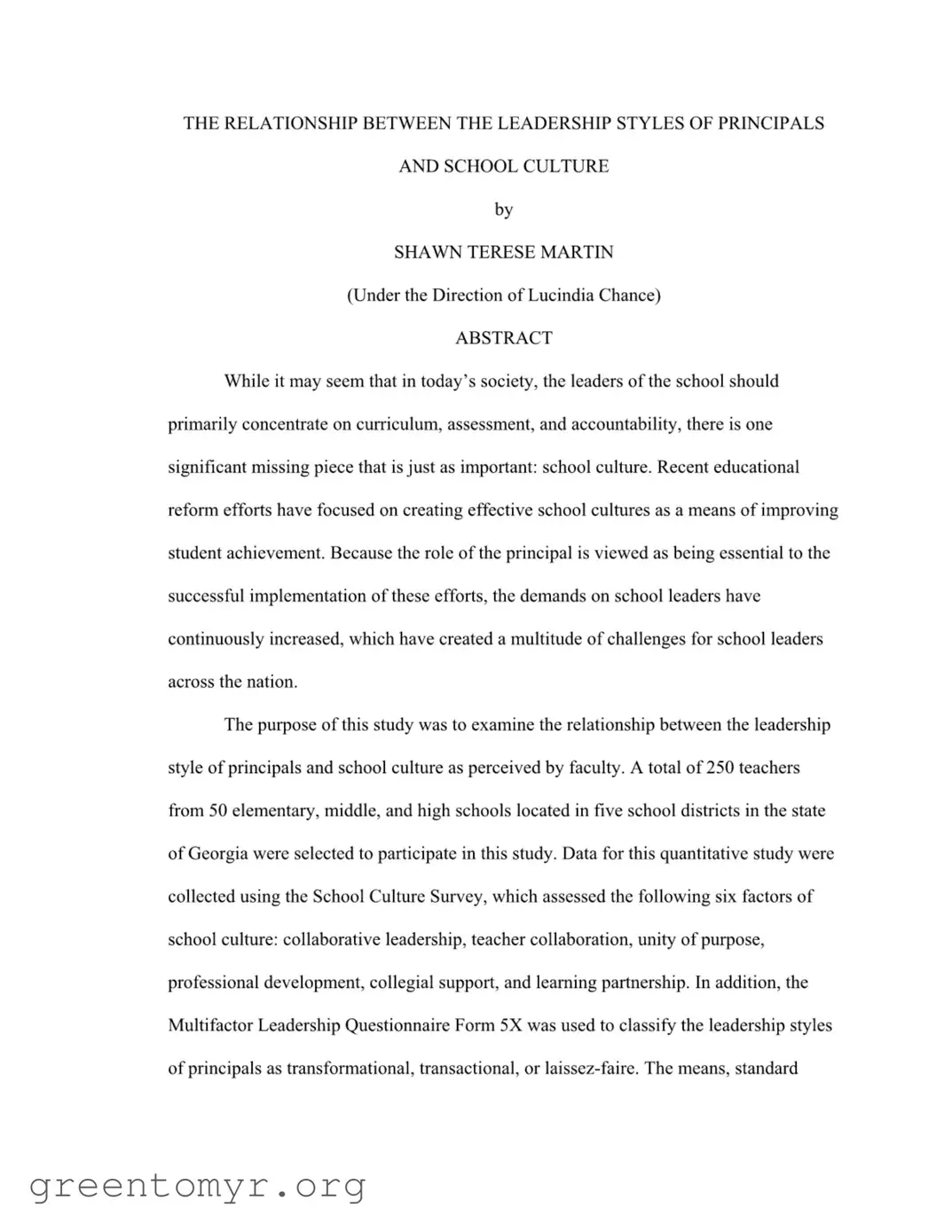
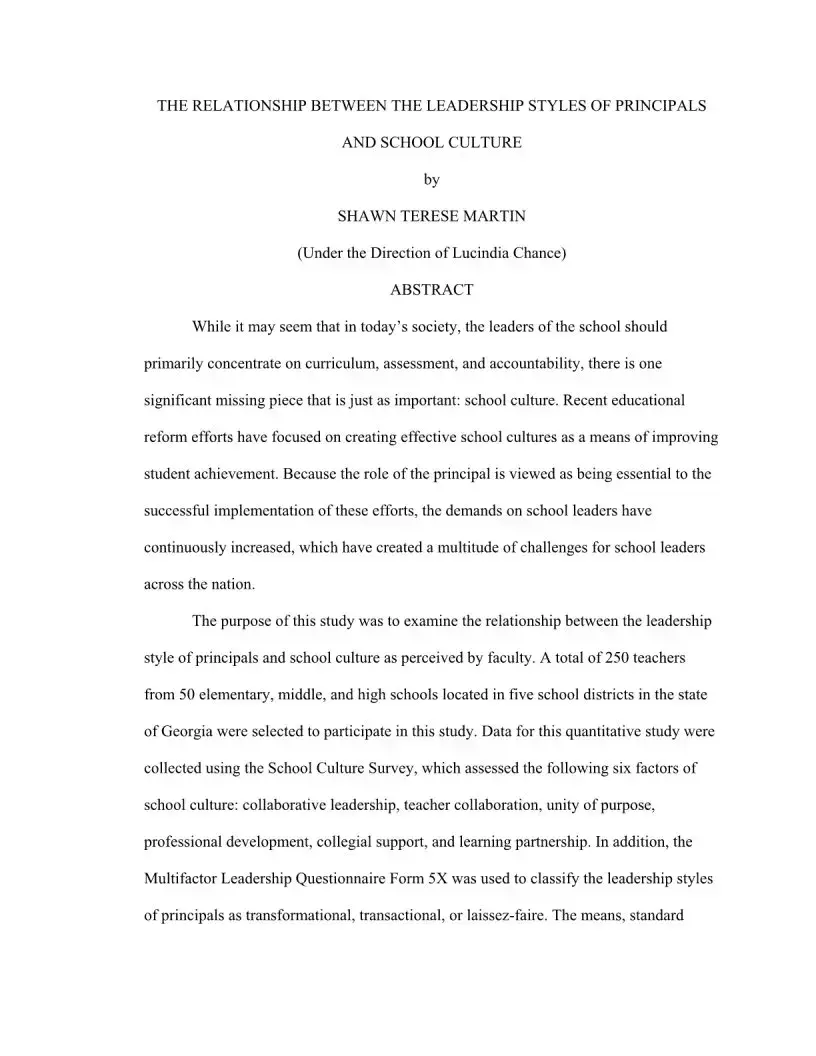
The MLQ 5X form plays a crucial role in understanding the dynamics of leadership within educational settings, particularly how principals' leadership styles influence school culture. This form, developed as part of the Multifactor Leadership Questionnaire, categorizes leadership into three distinct styles: transformational, transactional, and laissez-faire. Its application in research, such as the study conducted by Shawn Terese Martin, highlights the importance of examining these leadership styles in relation to various factors of school culture, including collaborative leadership and professional development. The study involved a robust sample of 250 teachers across 50 schools in Georgia, utilizing the MLQ 5X alongside a School Culture Survey to gather comprehensive data. The findings revealed significant correlations, demonstrating that transformational leadership positively impacts school culture, while laissez-faire leadership tends to have a detrimental effect. This exploration not only sheds light on effective leadership practices but also emphasizes the need for principals to foster a positive school environment to enhance student achievement.


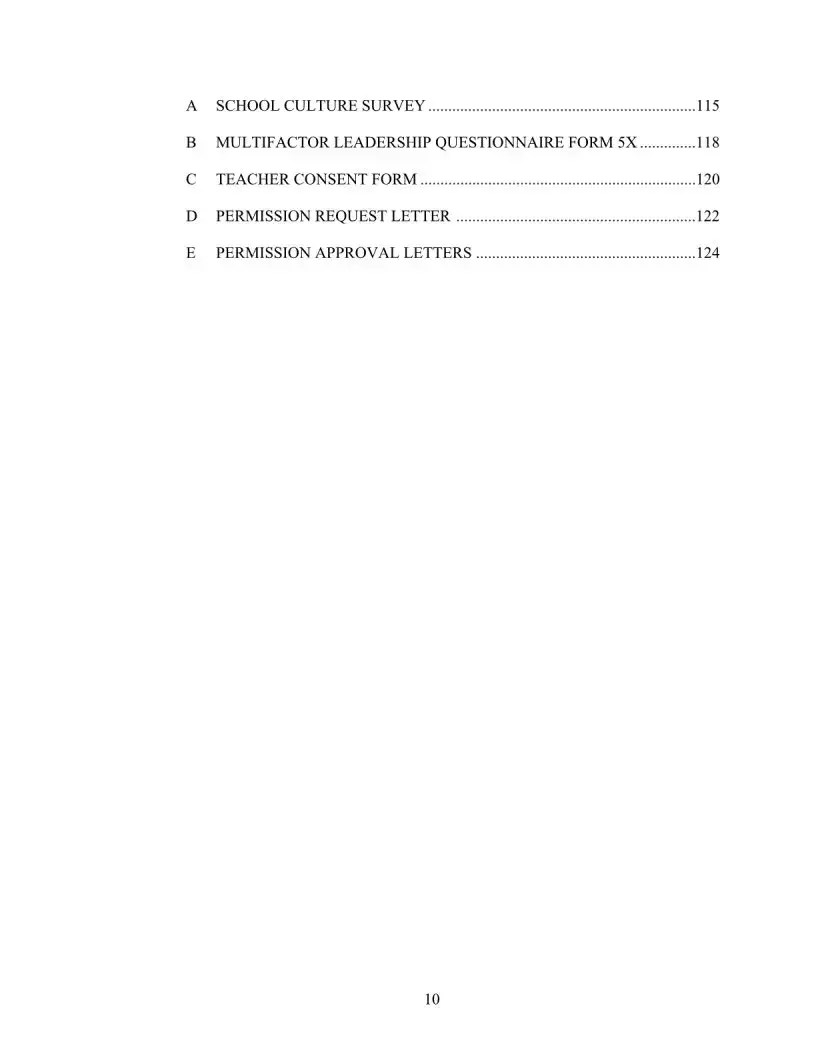
| Fact Name | Description | Governing Law |
|---|---|---|
| Purpose of the MLQ 5X | The Multifactor Leadership Questionnaire Form 5X is designed to assess the leadership styles of principals, categorizing them into transformational, transactional, or laissez-faire. | Not state-specific; based on general educational leadership principles. |
| Study Context | This form was utilized in a study involving 250 teachers across 50 schools in Georgia to analyze the relationship between leadership styles and school culture. | Georgia law regarding educational research and data collection. |
| Key Findings | The study found a significant positive relationship between transformational leadership and school culture, while laissez-faire leadership showed a negative correlation. | Applicable under Georgia's educational reform laws. |
| Data Collection Method | The MLQ 5X was part of a quantitative study that also included the School Culture Survey to evaluate various factors of school culture. | Guidelines for educational research ethics in Georgia. |
Filling out the MLQ 5X form is a straightforward process, but it requires attention to detail to ensure accuracy. Follow the steps below to complete the form correctly. Once submitted, the data will be analyzed to understand the leadership styles of principals in relation to school culture.
The MLQ 5X form, or Multifactor Leadership Questionnaire Form 5X, is a tool used to assess leadership styles. It categorizes leadership into three main styles: transformational, transactional, and laissez-faire. This questionnaire helps in evaluating how these styles impact various factors within an organization, such as school culture.
The MLQ 5X was developed by Bernard M. Bass and Bruce J. Avolio. Their research focused on understanding the dynamics of leadership and its effects on followers and organizational culture.
In educational settings, the MLQ 5X form is often utilized to assess the leadership styles of school principals. By collecting data from teachers, the form helps identify how different leadership approaches influence school culture and, ultimately, student achievement.
The MLQ 5X measures several factors related to leadership styles, including:
Each of these styles is further broken down into specific components that reflect the leader's behavior and its impact on the organization.
Using the MLQ 5X form offers several benefits:
Transformational leadership is significant in schools because it fosters an environment of collaboration and support. Research indicates that transformational leaders positively influence school culture, which can lead to improved student outcomes. This style encourages teachers to work together towards a common goal, enhancing professional development and collegial support.
Research indicates that laissez-faire leadership has a negative relationship with school culture. This style is characterized by a lack of direction and support from leaders, which can result in confusion and disengagement among faculty. Such an environment may hinder collaboration and overall school effectiveness.
Data for the study using the MLQ 5X form was collected through a survey administered to teachers across 50 schools in Georgia. The survey assessed various aspects of school culture and leadership styles, allowing for a comprehensive analysis of their relationship.
The findings suggest that school leaders should adopt transformational leadership practices to enhance school culture. By fostering collaboration and supporting teachers, principals can create a positive environment that promotes student achievement. The study underscores the importance of leadership style in shaping the educational landscape.
When completing the MLQ 5X form, individuals often overlook the importance of accurately reflecting their leadership style. One common mistake is failing to provide specific examples that illustrate their leadership behaviors. Without concrete examples, the responses may lack clarity and fail to convey the true nature of the individual's leadership style.
Another frequent error is misunderstanding the terminology used in the form. Participants may confuse different leadership styles or fail to grasp the nuances between transformational, transactional, and laissez-faire leadership. This misunderstanding can lead to inaccurate self-assessments, which ultimately affect the validity of the data collected.
In addition, individuals sometimes rush through the questionnaire without taking the time to consider each question carefully. This hurried approach can result in inconsistent answers or a lack of thoughtfulness in responses. Taking the time to reflect on each question can provide a more accurate picture of one’s leadership style and its impact on school culture.
Lastly, some participants neglect to review their answers before submitting the form. Failing to double-check responses can lead to typographical errors or misinterpretations of the questions. A thorough review can help ensure that the information submitted is both accurate and representative of the individual’s leadership practices.
When working with the MLQ 5X form, several other documents and forms may be relevant to the research or evaluation process. These documents can help provide a comprehensive understanding of leadership styles, school culture, and the overall educational environment. Below is a list of commonly used forms and documents that complement the MLQ 5X form.
These documents can provide valuable insights into the dynamics of school leadership and culture. Together with the MLQ 5X form, they create a comprehensive framework for assessing and improving educational environments.
The MLQ 5X form, or Multifactor Leadership Questionnaire Form 5X, plays a crucial role in assessing leadership styles, particularly in educational settings. Several other documents share similarities with the MLQ 5X form, primarily in their purpose of evaluating leadership and organizational culture. Here are ten such documents:
When filling out the MLQ 5X form, it is important to approach the task with care and attention. Here are some guidelines to follow to ensure that you provide accurate and helpful information.
By following these guidelines, you can contribute valuable insights into the relationship between leadership styles and school culture. Your thoughtful participation is crucial for the success of the study.
Understanding the Multifactor Leadership Questionnaire Form 5X (MLQ 5X) is crucial for educators and school administrators alike. However, several misconceptions surround this tool. Here are six common misunderstandings:
By addressing these misconceptions, educators can better utilize the MLQ 5X to enhance leadership practices and foster a positive school culture.
When filling out and using the MLQ 5X form, consider these key takeaways: