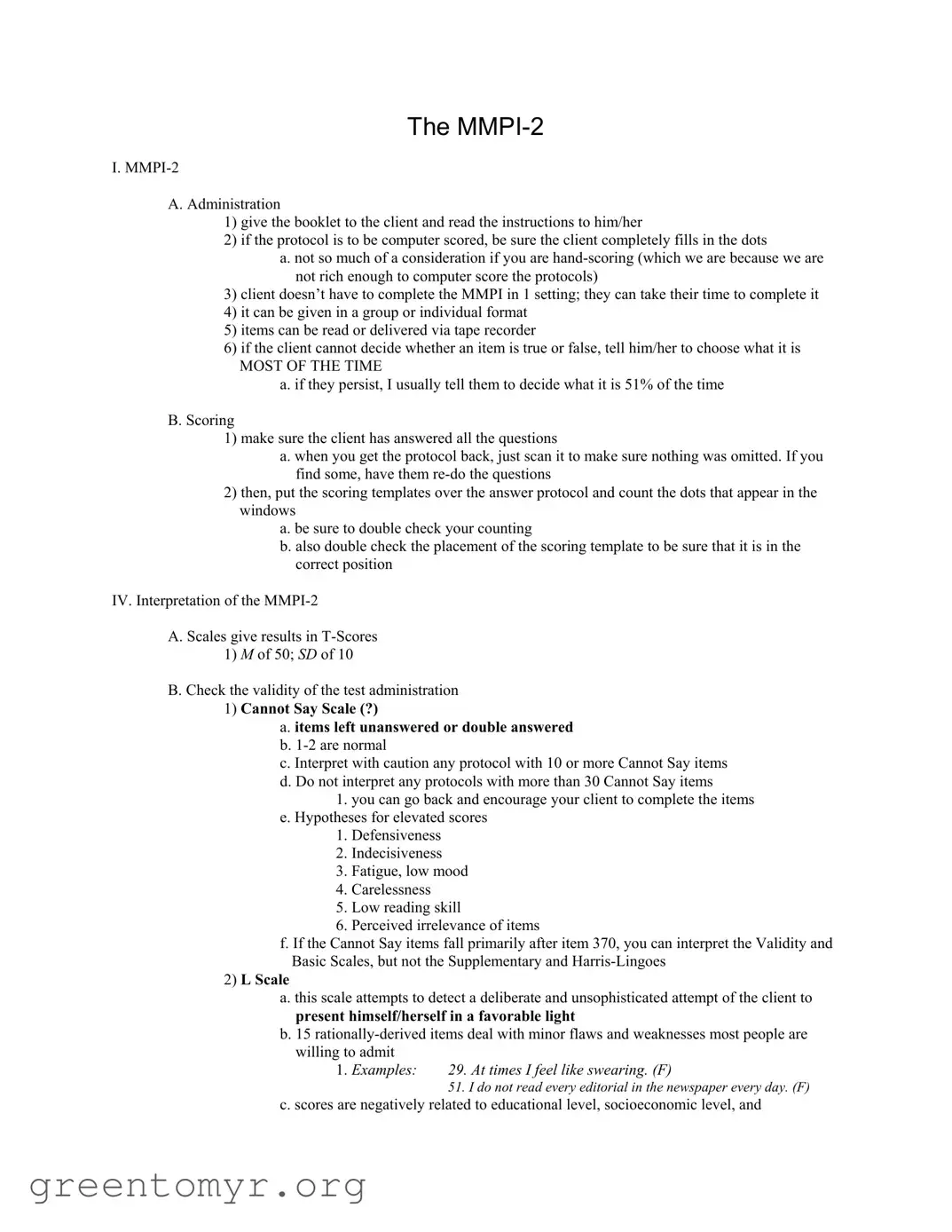
The MMPI-2 Score Interpretation form is an essential tool for professionals seeking to assess psychological profiles accurately. This comprehensive form provides guidance on the administration, scoring, and interpretation of the Minnesota Multiphasic Personality Inventory-2 (MMPI-2), a widely recognized psychological assessment. Proper administration involves giving the booklet to the client, ensuring they understand the instructions, and allowing them the flexibility to complete the assessment at their own pace. Scoring requires careful attention to detail, including verifying that all questions have been answered and accurately counting responses using scoring templates. The interpretation section is critical, as it translates raw scores into T-scores, which help identify potential psychological issues. Key scales, such as the Cannot Say Scale, L Scale, F Scale, and K Scale, each provide unique insights into the client's self-presentation and psychological state. For instance, the L Scale assesses the tendency to present oneself favorably, while the F Scale measures symptom exaggeration. The form also highlights the importance of validity checks and offers guidelines for interpreting scores, ensuring that practitioners can draw informed conclusions from the data. Understanding these aspects is vital for delivering accurate assessments and effective interventions.
THE
I.
A.Administration
1)give the booklet to the client and read the instructions to him/her
2)if the protocol is to be computer scored, be sure the client completely fills in the dots
a.not so much of a consideration if you are
3)client doesn’t have to complete the MMPI in 1 setting; they can take their time to complete it
4)it can be given in a group or individual format
5)items can be read or delivered via tape recorder
6)if the client cannot decide whether an item is true or false, tell him/her to choose what it is
MOST OF THE TIME
a.if they persist, I usually tell them to decide what it is 51% of the time
B.Scoring
1)make sure the client has answered all the questions
a.when you get the protocol back, just scan it to make sure nothing was omitted. If you find some, have them
2)then, put the scoring templates over the answer protocol and count the dots that appear in the windows
a.be sure to double check your counting
b.also double check the placement of the scoring template to be sure that it is in the correct position
IV. Interpretation of the
A. Scales give results in
1)M of 50; SD of 10
B. Check the validity of the test administration
1)Cannot Say Scale (?)
a.items left unanswered or double answered
b.
c.Interpret with caution any protocol with 10 or more Cannot Say items
d.Do not interpret any protocols with more than 30 Cannot Say items
1.you can go back and encourage your client to complete the items
e.Hypotheses for elevated scores
1.Defensiveness
2.Indecisiveness
3.Fatigue, low mood
4.Carelessness
5.Low reading skill
6.Perceived irrelevance of items
f.If the Cannot Say items fall primarily after item 370, you can interpret the Validity and Basic Scales, but not the Supplementary and
2)L Scale
a.this scale attempts to detect a deliberate and unsophisticated attempt of the client to present himself/herself in a favorable light
b.15
1. Examples: |
29. At times I feel like swearing. (F) |
|
51. I do not read every editorial in the newspaper every day. (F) |
c. scores are negatively related to educational level, socioeconomic level, and
psychological sophistication
d.
1.trying to create favorable impression of themselves by not being totally honest
2.may be defensive, denying, and repressing
3.may be confused
4.may be
5.show little awareness of consequences to other people resulting from their behavior
6.tend to overvalue their own worth
7.tend to be conventional and socially conforming
8.are unoriginal in thinking and inflexible in problem solving
9.are rigid and moralistic
10.have poor tolerance for stress and pressure
11.may be unsophisticated and are trying to make a favorable impression
12.profiles with
e.
1.are more conforming than usual
2.have a tendency to resort to denial mechanisms
f.Normal Range:
g.
1.probably responded frankly to the items
2.are confident enough about themselves to be able to admit minor faults
3.in some cases, may be exaggerating negative characteristics
4.are perceptive and socially reliant
5.are seen as strong and relaxed
6.are
7.can function effectively in leadership roles
8.communicate ideas effectively
9.may be described by others as cynical and sarcastic
h.caveat: ministers sometimes will have elevated L Scales because they truly do not do the behaviors
3)Infrequency Scale (F)
a.60 items reflecting infrequently endorsed items
1. Examples: |
36. I have a cough most of the time. (T) |
78.I am liked by most people who know me. (F)
b.a measure of symptom exaggeration
1.faking bad
c.
1.may have responded randomly to
2.may have responded either all True or all False
3.may have been faking bad responses
4.if hospitalized psychiatric patients, may manifest:
a)delusions
b)visual and/or auditory hallucinations
c)reduced speech
d)withdrawal
e)poor judgment
f)short attention span
g)lack of knowledge of reasons for hospitalization
h)psychotic diagnosis
i)some other signs of organicity
d.
1.may be malingering
2.may be exaggerating symptoms and problems as a plea for help
3.may be quite resistant to the testing procedure
4.may be clearly psychotic by the usual criteria
e.
1.may have very deviant social, political, or religious convictions
2.may manifest clinically severe neurotic or psychotic disorders
3.if relatively free of psychopathology, are usually described as:
a)moody
b)restless
c)dissatisfied
d)changeable, unstable
e)curious, complex
f)opinionated
g)opportunistic
4.have endorsed items relevant to some particular problem area
5.typically function adequately in most aspects of their life situations
f.Low scores on the F Scale (T < 50) are indicative of individuals who:
1.answered items as most normal people do
2.are likely to be free of disabling psychopathology
3.are socially conforming
4.may have faked good
g.
4)Infrequency Back (Fb)
a.assesses the endorsement of low frequency items on the latter part of the
b.measures the same constructs as the F Scale
c.
1.indicate an invalid protocol, especially if F Scale is > 110
d.
1.if F Scale
2.if F Scale
e.Use the hypotheses for the F Scale when considering reasons for elevated scores, but also consider:
1.a recording error
2.client is responding randomly to items
3.client is exaggerating existing symptoms
4.client is faking a psychological problem
5.client is malingering
6.client has severe psychopathology
7.client was tired of the test
5)K Scale
a.measures of test defensiveness
b.assesses the willingness of the client to disclose personal information and to discuss his/her problems
1. Examples: |
83. I have very few quarrels with members of my family. (T) |
110.Most people will use somewhat unfair means to gain profit or an advantage rather than to lose it. (F)
c.K score is used to adjust Hs, Pd, Pt, Sc, and Ma Scales
d.
1.may have responded false to most of the items
2.may have tried to fake good
3.may be trying to give an appearance of adequacy, control, and effectiveness
4.are shy and inhibited
5.are hesitant about becoming emotionally involved with people
6.are intolerant and unaccepting of unconventional attitudes and beliefs in
others
7.lack insight and
8.are not likely to display overt delinquent behavior
9.if clinical scales are also elevated, may be seriously disturbed psychologically but have no awareness of it
10.if not seriously disturbed psychologically, may have
e.
1.are being defensive and unwilling to acknowledge psychological distress
2.may exhibit denial and hysteroid defenses (especially in lower SES)
f.
1.maintain a healthy balance between positive
2.are psychologically
3.show few overt signs of emotional disturbance
4.are independent and
5.are capable of dealing with problems in
6.exhibit wide interests
7.are ingenious, enterprising, versatile, and resourceful
8.are clear thinking and approach problems in reasonable and systematic ways
9.are good mixers socially
10.are enthusiastic and verbally fluent
11.take ascendant roles in relationships
g.
1.are experiencing severe distress that is being openly acknowledged
2.have poor
3.may tend to be excessively open and revealing
4.in lower SES, may indicate a moderate disturbance
5.in higher SES, indicates more serious distress
f.
1.may have responded true to most of the items
2.may have faked bad
3.may be exaggerating problems as a cry for help
4.may exhibit acute psychotic or organic confusion
5.are critical of self and others and are dissatisfied with the self
6.are ineffective in dealing with problems of daily life
7.show little insight into their own motives and behaviors
8.are socially conforming
9.are overly compliant with authority
10.have a slow personal tempo
11.are inhibited, retiring, and shallow
12.are socially awkward
13.are blunt and harsh in social situations
14.are cynical, skeptical, caustic, and disbelieving
15.are suspicious about the motivations of others
6)
a.
1.consistently is the weakest predictor of malingering
2.continues to be used probably due to clinical folklore
b.
c.
d.some folks argue that you need to use a higher cutoff for a forensic population (e.g., 15
&
e. others split the difference and go with 12
1.I argue that a conservative approach would be to use 12 as the cutoff
e.
1.because the F scale was decreased by 4 points and the K scale remained the same
7)Item Response Inconsistency Scales: TRIN and VRIN
a.each of these scales suggests that the client is not consistent in his/her answers or approach to the test
b.TRIN
1.is sensitive to people who have a tendency to answer either true or false without careful consideration of how the question was asked
2.
a)indicates an inconsistent responding to the items
b)client has a tendency to respond either true or false when pressed
c)the scale allows you to check the direction of the responses
3.
a)is suspect and suggests a response set
4.a high K Scale
a)client was mostly answering false on the test
b)may not be psychopathology; just answering false
c.VRIN
1.reflects a general tendency to disregard item content in the answers
2.
a)inconsistent random responding; invalid protocol
3.
a)possible invalid protocol due to inconsistent responding
C. Scale 1: Hypochondriasis (Hs)
1)32 items which focus on bodily concerns with a physiological basis or individuals who exaggerate bodily concerns
a. Examples: |
53. Parts of my body often have feelings like burning, tingling, |
|
crawling, or like “going to sleep.” (T) |
255.I do not often notice my ears ringing or buzzing. (F)
2)developed on a group of neurotic patients who showed an excessive concern about their health, presented a variety of somatic complaints with little or no organic basis, and rejected repeated assurances that there was nothing physically wrong with them
3)has no associated
4)
a.have excessive bodily concerns
b.may have conversion disorder or somatic delusions
1.especially if T > 80
c.describe somatic complaints that generally are vague
1.if the somatic complaints are specific, they tend to be epigastric in nature
d.complain of chronic weakness, lack of energy, and sleep disturbance
e.if medical patients, they may have a strong psychological component to their illness
f.are likely to be diagnosed as having somatoform, somatoform pain, depressive, or anxiety disorders
g.are not likely to act out in psychopathic ways
h.seem selfish,
i.Have a pessimistic, defeatist, and cynical outlook toward life
j.are unhappy and dissatisfied
k.make others miserable
l.complain
m. communicate in a whiny manner n. are demanding and critical of others o. express hostility indirectly
p. are described as dull, unenthusiastic, and unambitious q. lack ease in oral expression
r. generally do not exhibit much manifest anxiety
s. seem to have functioned at a reduced level of efficiency for long periods of time t. see themselves as medically ill and seek medical treatment
u. lack insight and resist psychological interpretations
v. are not very good candidates for psychotherapy or counseling w. become critical of their therapist
x. terminate therapy prematurely when the therapist suggests psychological reasons for symptoms or when the therapists are perceived as not giving enough attention and support
5)
a.have some concern about bodily functioning
b.are likely to be seen as immature, stubborn, and lacking drive
c.scores in the lower end of this range are typical for individuals with physical handicaps and individuals with actual physical disease
6)Normal range
7)
a.are free of somatic preoccupation
b.are alert, sensitive, and insightful
c.are generally effective in their daily lives
d.scores in this range are typical of individuals in helping professions D. Scale 2: Depression (D)
1)57 items reflecting the feelings of discouragement, pessimism, and hopelessness, as well as the personality features of
high personal standards, and intrapunitiveness
a. Examples: |
127. Criticism or scolding hurts me terribly. (T) |
117.I have never vomited blood or coughed up blood. (T)
142.I have never had a fit or convulsion. (F)
2)scale developed on psychiatric patients with various forms of symptomatic depression
3)
a.subjective depression
b.psychomotor retardation
c.physical malfunctioning
d.mental dullness
e.brooding
4)
a.display depressive symptoms
1.especially if
b.feel blue, unhappy, and dysphoric
c.are quite pessimistic about the future
d.have
e.may cry, refuse to speak, and show psychomotor retardation
f.often are given depressive diagnoses
g.report bad dreams, physical complaints, fatigue, weakness, and loss of energy
h.are agitated and tense
i.Are described as irritable,
j.lack
k.feel useless and unable to function
l. give up easily
m. feel like failures in school and work
n. have lifestyles characterized by withdrawal and lack of involvement with other people
o. are introverted, shy, retiring, timid, seclusive, and secretive p. are aloof and maintain psychological distance from others q. have a restricted range of interests
r. withdraw from activities in which they previously participated s. are very cautious and conventional
t. have difficulty making decisions
u. feel overwhelmed when faced with major life decisions v. are overcontrolled and deny their own impulses
w. avoid unpleasantness and make concessions to avoid confrontations x. because of high personal distress, are likely to be good candidates for
psychotherapy and counseling
y. may terminate therapy when the immediate crisis is over
5)
a.are dissatisfied with something or with themselves but may not recognize this state as depression
i. mild degree of depression may not appropriately represent the situation
b.may not be overly concerned about what is happening to them
c.may have learned to adjust to a chronically depressed existence
6)Normal range:
7)
a.do not experience much tension, anxiety, guilt, or depression
b.feel relaxed and at ease
c.are
d.are emotionally stable and capable of effective functioning in most situations
e.feel cheerful and optimistic
f.have little difficulty in verbal expression
g.are alert, active, and energetic
h.are competitive and seek out additional responsibilities
i.Are at ease in social situations
j.seek out leadership roles
k.create favorable first impressions
l.are seen as clever, witty, and colorful
m.may be impulsive and undercontrolled
n.are
o.may arouse hostility and resentment in other people E. Scale 3: Hysteria (Hy)
1)60 items some of which reflect physical complaints and troubling disorders
and others which reflect denial of problems and a lack of social anxiety
a. Examples: 44. Once a week or oftener I suddenly feel hot all over, for no reason.
(T)
176.I have very few headaches. (F)
2)scale constructed on patients who exhibited some form of sensory or organic motor disorder for which no organic basis could be established.
3)
a.denial of social anxiety
b.need for affection
c.
d.somatic complaints
e. inhibition of aggression
4)
a.react to stress and avoid responsibility through the development of physical symptoms
b.may report headaches, stomach discomfort, chest pains, weakness, and tachycardia
c.have symptoms that may appear and disappear suddenly
d.do not report severe emotional turmoil
e.rarely report hallucinations, delusions, or suspiciousness
f.lack insight concerning causes of symptoms
g.lack insight about their own motives and feelings
h.are psychologically immature, childish, and infantile
i.if psychiatric patients, receive diagnoses of conversion disorder or psychogenic pain disorder
j.are
k.expect a great deal of attention and affection from others
l.use indirect and devious means to get attention and affection
m.do not express resentment and hostility openly
n.tend to be emotionally involved, friendly, talkative, and alert
o.have superficial and immature interpersonal relationships
p.are interested in what other people can do for them
q.occasionally act out in a sexual or aggressive manner with little apparent insight into their actions
r.initially are enthusiastic about treatment
s.view themselves as having medical problems and want medical treatment
t.are resistant to psychological interpretations
u.are likely to terminate treatment if their therapists insist on examining psychological causes of symptoms
v.may be willing to talk about psychological problems as long as they are not conceptualized as causing their symptoms
w.often respond well to direct advice and suggestion
x.when involved in therapy, often discuss worry about failure at work and school, marital unhappiness, lack of acceptance, and problems with authority figures
y.have histories of rejecting fathers
5)
a.are likely to be exhibitionistic, extroverted, and superficial
b.are naive,
c.they prefer to look on the optimistic side of life and avoid any unpleasant issues
6)Normal range:
7)
a.do not worry excessively about their health
b.do not present somatic symptoms
c.are constricted, conventional, and conforming
d.are described as unadventurous, lacking industrialness, and having a narrow range of interests
e.are cold and aloof
f.may display blunted affects
g.have limited social interests and participation
h.avoid leadership responsibilities
i.are seen as unfriendly,
j.are suspicious and have difficulties trusting others
k.are realistic, logical, and
l. are not likely to make impulsive decisions
m. seem to be content with dull, uneventful
F. Scale 4: Psychopathic Deviate (Pd)
1) 50 items which assess a lack of concern about most social and moral
standards of conduct |
|
a. Examples |
54. My family does not like the work I have chosen (or the work I intend |
|
to choose for my life work). (T) |
79.I do not mind being made fun of. (F)
2)scale developed on individuals who were referred to a psychiatric service for a clarification of why they had recurring troubles with the law even though they suffered no cultural deprivation and despite their possessing normal intelligence and freedom from other psychological disorders
a.tried to get at the Conduct Disorder/Antisocial Personality Disorder folks
b.not too sure they made it
1.standardization with gangs?
3)
a.familial discord
b.authority problems
c.social impurturbability
d.social alienation
e.
4)
a.have difficulty incorporating values and standards of society into their lives
b.may engage in social and antisocial acts, including lying, cheating, stealing, sexual acting out, excessive use of alcohol and/or drugs
1.especially if
c.are rebellious toward authority figures
d.have stormy relationships with their families
e.blame family members for their difficulties
f.have histories of underachievement
g.tend to experience marital problems
h.are impulsive and strive for immediate gratification of impulses
i.do not plan their behavior well
j.tend to act without considering the consequences of their actions
k.are impatient; have limited frustration tolerance
l.show poor judgment; take risks
m.tend not to learn from experience
n.are seen by others as immature and childish
o.are narcissistic,
p.are ostentatious and exhibitionistic
q.are insensitive to the needs and feelings of others
r.are interested in others only in terms of how they can be used
s.are likable and create good first impressions
t.have shallow and superficial relationships
u.seem unable to form warm attachments with others
v.are extroverted and outgoing
w.are talkative, active, adventurous, energetic, and spontaneous
x.are judged by others to be intelligent and
y.have a wide range of interests but lack a clear direction
z.tend to be hostile, aggressive, resentful, rebellious, antagonistic, and refractory
aa. have sarcastic and cynical attitudes
ab. may act in aggressive ways
ac. if female, may expression aggression in more passive, indirect ways ad. may feign guilt and remorse when in trouble
ae. are not seen as overwhelmed by emotional turmoil
af. may admit feeling sad, fearful, and worried abou the future ag. experience absence of deep emotional response
ah. feel empty and bored
ai. if psychiatric patients, are likely to receive antisocial or passive- aggressive personality disorder diagnoses
aj. have poor prognosis for psychotherapy or counseling
ak. may agree to treatment to avoid something more unpleasant al. tend to terminate therapy prematurely
am. in treatment, tend to intellectualize excessively and to blame others for their difficulties
5)
a.may be genuinely concerned about social problems and issues
b.may be responding to situational conflicts
c.may have adjusted to a habitual level of interpersonal and social conflict
i.if the conflict is situational, the score should return to normal levels once the conflict is resolved
6)Normal range:
7)
a.tend to be conventional, conforming, and accepting of authority
b.are passive, submissive, and unassertive
c.are concerned about how others will react to them
d.tend to be sincere and trusting in relationships
e.have a low level of drive
f.are concerned about status and security but tend not to be competitive
g.have a narrow range of interests
h.are not creative or spontaneous in their approach to problems
i.are persistent in problem solving
j.are moralistic and rigid in their views
k.if males, may not have much sex drive
l.are
m.accept advice and suggestions
n.may become overly dependent on treatment
o.seem to be afraid to accept responsibility for their own behavior G. Scale 5:
1)50 items which were intended as a measure of gender role development, including emotional reactions, interests, attitudes and feelings in which men and women differ
a.did not make it
b.tends to measure androgyny, which also correlates with SES
c. Examples (male): |
74. I would like to be a florist. (T) |
|
|
103. |
I enjoy a race or a game more when I bet on it. (F) |
d.(female): |
112. |
I like dramatics (T) |
120.I frequently find it necessary to stand up for what I think is right. (F)
2)scale constructed on men who sought psychiatric help to control their homoerotic feelings and to cope with problems of gender confusion
a. originally intended to be able to determine homosexuality (before it was thrown out as a diagnostic category)
1.doesn’t work
3)No
| Fact Name | Description |
|---|---|
| Administration Guidelines | The MMPI-2 can be administered individually or in groups. Clients are encouraged to take their time and can complete the test over multiple sessions. |
| Scoring Process | After collecting the protocol, it's crucial to ensure all items are answered. Scoring templates must be placed accurately over the responses to count the dots correctly. |
| Validity Checks | Validity scales, such as the Cannot Say Scale, must be interpreted with caution. Protocols with a high number of unanswered items may indicate issues with test validity. |
| Interpretation of T-Scores | T-scores are used to interpret results, with a mean of 50 and a standard deviation of 10. Elevated scores may suggest various psychological conditions or tendencies. |
| State-Specific Regulations | In some states, the administration and interpretation of psychological tests like the MMPI-2 are governed by specific licensing laws and regulations, which vary by jurisdiction. |
Completing the MMPI-2 Score Interpretation form is a crucial step in assessing psychological conditions. Following these steps will help ensure accurate scoring and interpretation of the results. After filling out the form, the next phase involves analyzing the scores to draw meaningful conclusions about the individual's psychological state.
For scoring, follow these steps:
Next, interpret the results using the T-scores, which have a mean of 50 and a standard deviation of 10. Begin by checking the validity of the test administration. Pay close attention to the Cannot Say Scale, as it indicates unanswered or double-answered items. Use caution when interpreting protocols with a high number of Cannot Say items, as this may affect the overall validity of the results.
The MMPI-2 Score Interpretation form is a tool used to analyze the results of the Minnesota Multiphasic Personality Inventory-2 (MMPI-2), a psychological assessment that evaluates personality traits and psychopathology. This form helps professionals interpret the scores obtained from the test, providing insights into an individual's psychological state and behavior patterns.
The MMPI-2 can be administered in various settings, either individually or in a group. The booklet is given to the client, and the administrator reads the instructions aloud. Clients can take their time to complete the assessment, and items can be read to them if necessary. It is important for clients to answer all questions, and if they are unsure about an item, they are encouraged to choose the answer that feels most accurate most of the time.
T-scores are standardized scores that indicate how far a person's score deviates from the average score of the normative population. In the MMPI-2, a mean score of 50 with a standard deviation of 10 is used. Higher T-scores may indicate potential psychological issues or personality traits that require further exploration.
When reviewing the completed MMPI-2 protocol, it is crucial to check for unanswered items. If a client has left a significant number of questions unanswered (10 or more), the results should be interpreted with caution. If more than 30 items are unanswered, the protocol should not be interpreted at all. Encourage the client to complete the items to ensure a valid assessment.
The L Scale, or Lie Scale, assesses the tendency of clients to present themselves in an overly favorable light. Higher T-scores on this scale may indicate that the individual is trying to create a positive impression by denying minor flaws. Scores above 65 suggest an overly virtuous presentation, while lower scores indicate more honesty in self-assessment.
Elevated scores on various scales can indicate different psychological conditions or traits. For example, high scores on the Infrequency Scale (F) may suggest symptom exaggeration or faking bad. In contrast, elevated scores on the K Scale may indicate defensiveness or a reluctance to disclose personal issues. Each scale has specific interpretations that can inform the overall assessment of the individual.
The K Scale measures defensiveness and the willingness of the client to disclose personal information. A high K score may suggest that the individual is trying to present themselves as more adequate or controlled than they truly feel. This scale helps to adjust the scores of other clinical scales, providing a more nuanced understanding of the client's psychological profile.
TRIN (True Response Inconsistency) and VRIN (Variable Response Inconsistency) scales assess the consistency of responses in the MMPI-2. High T-scores on these scales indicate that a client may not be responding thoughtfully or consistently to the questions, which can suggest an invalid protocol. These scales help ensure that the results reflect genuine responses rather than random or careless answering.
Interpreting MMPI-2 results in a clinical setting requires careful consideration of the scores across various scales. Professionals should look for patterns and inconsistencies, considering the context of the client's situation and any relevant history. It is essential to approach the results holistically, integrating them with other assessment tools and clinical observations to form a comprehensive understanding of the individual.
Filling out the MMPI-2 Score Interpretation form can be a complex process, and there are several common mistakes that individuals may make. One significant error is failing to answer all questions completely. When clients skip questions or provide inconsistent responses, it can lead to inaccurate interpretations. It is essential to ensure that every item is addressed. If any questions are left unanswered, the protocol may need to be redone to achieve valid results.
Another mistake occurs when individuals rush through the assessment. The MMPI-2 does not have to be completed in one sitting. Clients should take their time to reflect on each question. This thoughtful approach helps in providing more accurate responses, leading to a better understanding of their psychological state. Rushing can result in careless answers that do not truly reflect the individual's experiences or feelings.
Misunderstanding the instructions can also lead to errors. For example, clients might not realize that if they are unsure about whether a statement is true or false, they should choose what is true most of the time. This misunderstanding can skew the results and lead to an inaccurate assessment of their psychological profile. Clear communication of the instructions is vital to avoid this pitfall.
Additionally, clients may overlook the importance of the validity scales, such as the Cannot Say Scale and the L Scale. These scales help identify whether the test results are reliable. If a client leaves too many items unanswered, especially more than 30, the protocol becomes invalid. Therefore, understanding the significance of these scales is crucial for accurate interpretation.
Another common error involves the interpretation of the T-scores. Clients may misinterpret their scores, especially if they are not familiar with the scoring system. For instance, a T-score above 65 may indicate an overly virtuous presentation, but this can be misunderstood as a positive trait. It is important to recognize that elevated scores can suggest defensiveness or an attempt to present oneself in a favorable light.
Finally, clients might not consider the context of their responses. Factors such as fatigue, low mood, or carelessness can influence how they answer the questions. These external factors should be taken into account during interpretation. Without this consideration, the results may not accurately reflect the individual’s true psychological state.
In summary, avoiding these common mistakes—ensuring all questions are answered, taking time with the assessment, understanding the instructions, recognizing the validity scales, correctly interpreting T-scores, and considering external factors—can lead to a more accurate and meaningful interpretation of the MMPI-2 results.
The MMPI-2 Score Interpretation form is a critical tool for understanding psychological assessments. However, it is often accompanied by several other forms and documents that provide additional context and insights. Below is a list of these essential documents, each serving a specific purpose in the assessment process.
These documents collectively enhance the utility of the MMPI-2 Score Interpretation form, ensuring a comprehensive understanding of the client's psychological profile. Each plays a vital role in the assessment process, contributing to more accurate interpretations and effective interventions.
The MMPI-2 Score Interpretation form shares similarities with several other psychological assessment documents. Below is a list of six documents that have comparable features, along with a brief explanation of each.
When filling out the MMPI-2 Score Interpretation form, it’s important to follow certain guidelines to ensure accuracy and reliability. Here’s a list of things you should and shouldn't do:
Here are seven common misconceptions about the MMPI-2 score interpretation form, along with explanations to clarify them.
Many believe the MMPI-2 has to be finished in one go. In reality, clients can take their time and complete it over multiple sessions if needed.
While high scores can suggest problems, context matters. Factors like defensiveness, fatigue, or carelessness can affect results. Not every high score means a severe disorder.
Some think that only computer scoring yields valid results. Hand scoring is equally valid, provided it’s done carefully and accurately.
A high L scale score may suggest a desire to present oneself positively, but it doesn’t automatically mean dishonesty. It can reflect a tendency to conform to social norms.
Low F scores might suggest typical responses, but they can also indicate faking good or a lack of insight into one’s problems. It’s not a definitive indicator of mental health.
While a high number of Cannot Say items can raise concerns, having a few does not necessarily invalidate the test. Interpretation can still proceed with caution.
The K scale is important as it assesses defensiveness. It can provide insight into a client’s willingness to disclose personal information and discuss their problems.
Filling out and utilizing the MMPI-2 Score Interpretation form requires attention to detail and an understanding of the scoring and interpretation process. Here are ten key takeaways to consider: