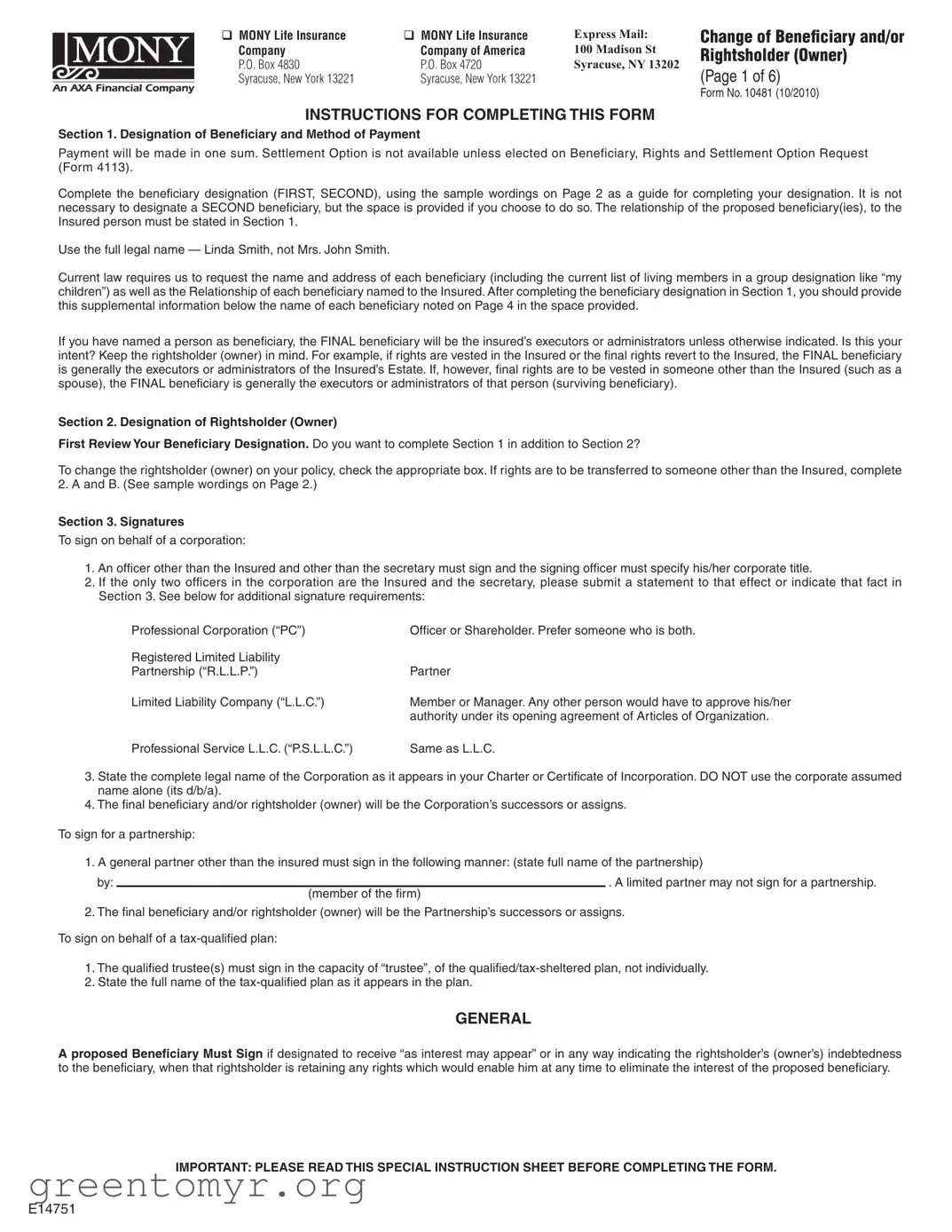
The Mony Change Beneficiary form is an essential document for policyholders looking to update their beneficiary designations or change the rightsholder of their insurance policy. This form is divided into several sections, each designed to capture specific information. In Section 1, you will designate your primary and, if desired, secondary beneficiaries, including their full legal names and relationships to the insured. It's crucial to provide accurate details, as this ensures that the intended individuals receive the policy benefits. Section 2 allows you to change the rightsholder, which could be an individual, corporation, or partnership, and requires similar attention to detail. The form also includes signature requirements, ensuring that the rightsholder or their authorized representative properly executes the document. Additionally, there are important instructions regarding tax identification numbers and compliance with legal requirements, especially for non-U.S. citizens. Understanding these aspects will help streamline the process and ensure that your wishes are clearly documented and legally binding.

MONY Life Insurance |
MONY Life Insurance |
Express Mail: |
Change of Beneficiary and/or |
|
Company |
Company of America |
100 Madison St |
Rightsholder (Owner) |
|
P.O. Box 4830 |
P.O. Box 4720 |
Syracuse, NY 13202 |
||
(Page 1 of 6) |
||||
Syracuse, New York 13221 |
Syracuse, New York 13221 |
|
||
|
|
|
Form No. 10481 (10/2010) |
INSTRUCTIONS FOR COMPLETING THIS FORM
Section 1. Designation of Beneficiary and Method of Payment
Payment will be made in one sum. Settlement Option is not available unless elected on Beneficiary, Rights and Settlement Option Request (Form 4113).
Complete the beneficiary designation (FIRST, SECOND), using the sample wordings on Page 2 as a guide for completing your designation. It is not necessary to designate a SECOND beneficiary, but the space is provided if you choose to do so. The relationship of the proposed beneficiary(ies), to the Insured person must be stated in Section 1.
Use the full legal name — Linda Smith, not Mrs. John Smith.
Current law requires us to request the name and address of each beneficiary (including the current list of living members in a group designation like “my children”) as well as the Relationship of each beneficiary named to the Insured. After completing the beneficiary designation in Section 1, you should provide this supplemental information below the name of each beneficiary noted on Page 4 in the space provided.
If you have named a person as beneficiary, the FINAL beneficiary will be the insured’s executors or administrators unless otherwise indicated. Is this your intent? Keep the rightsholder (owner) in mind. For example, if rights are vested in the Insured or the final rights revert to the Insured, the FINAL beneficiary is generally the executors or administrators of the Insured’s Estate. If, however, final rights are to be vested in someone other than the Insured (such as a spouse), the FINAL beneficiary is generally the executors or administrators of that person (surviving beneficiary).
Section 2. Designation of Rightsholder (Owner)
First Review Your Beneficiary Designation. Do you want to complete Section 1 in addition to Section 2?
To change the rightsholder (owner) on your policy, check the appropriate box. If rights are to be transferred to someone other than the Insured, complete 2. A and B. (See sample wordings on Page 2.)
Section 3. Signatures
To sign on behalf of a corporation:
1.An officer other than the Insured and other than the secretary must sign and the signing officer must specify his/her corporate title.
2.If the only two officers in the corporation are the Insured and the secretary, please submit a statement to that effect or indicate that fact in Section 3. See below for additional signature requirements:
Professional Corporation (“PC”) |
Officer or Shareholder. Prefer someone who is both. |
Registered Limited Liability |
|
Partnership (“R.L.L.P.”) |
Partner |
Limited Liability Company (“L.L.C.”) |
Member or Manager. Any other person would have to approve his/her |
|
authority under its opening agreement of Articles of Organization. |
Professional Service L.L.C. (“P.S.L.L.C.”) |
Same as L.L.C. |
3.State the complete legal name of the Corporation as it appears in your Charter or Certificate of Incorporation. DO NOT use the corporate assumed name alone (its d/b/a).
4.The final beneficiary and/or rightsholder (owner) will be the Corporation’s successors or assigns.
To sign for a partnership:
1. A general partner other than the insured must sign in the following manner: (state full name of the partnership)
by: |
|
. A limited partner may not sign for a partnership. |
|
(member of the firm) |
|
2.The final beneficiary and/or rightsholder (owner) will be the Partnership’s successors or assigns. To sign on behalf of a
1.The qualified trustee(s) must sign in the capacity of “trustee”, of the
2.State the full name of the
GENERAL
A proposed Beneficiary Must Sign if designated to receive “as interest may appear” or in any way indicating the rightsholder’s (owner’s) indebtedness to the beneficiary, when that rightsholder is retaining any rights which would enable him at any time to eliminate the interest of the proposed beneficiary.
IMPORTANT: PLEASE READ THIS SPECIAL INSTRUCTION SHEET BEFORE COMPLETING THE FORM.
E14751
(Page 2 of 6)
SAMPLE WORDINGS
If you need help in wording a designation or if your designation is too long for this form, send us details of the change desired and we will prepare the form for you based on our interpretation of the information, it will then be subject to your approval.
SAMPLE WORDINGS FOR COMPLETING FIRST AND SECOND BENEFICIARY DESIGNATIONS IN SECTION 1.
If you wish to designate . . . |
Please use this language . . . |
SINGLE BENEFICIARY |
|
a person |
— Spouse, Jane Doe |
Insured’s estate |
— Insured’s executors or administrators |
corporation |
— XYZ Corporation, or its successors or assigns. |
partnership |
— Smith and Jones, a partnership, or its successors or assigns. |
GROUP (more than one person) BENEFICIARY |
|
children |
— children, John Doe, Susan Doe and Frank Doe (will not include any other children) |
|
— children of Insured including John Doe, Susan Doe and Frank Doe |
|
— children of marriage of Insured and spouse, Mary Doe |
|
— children of marriage of Insured and spouse, Mary Doe, including John |
|
Doe and Susan Doe |
parents |
— Father, James Doe and mother, Frances Doe |
named brothers and sister |
— Sister, Jane Doe, and brothers John Doe, Frank Doe. |
(nieces and nephews, aunts and uncles, etc.) |
|
TRUST BENEFICIARY |
|
Trustee under written trust (living trust) |
— John Jones (XYZ Bank) as trustee or his (its) successor trustee under an Agreement |
Provide the names of Trustee(s), the name of |
dated May 1, 1978 made by and between the Insured and said trustee. |
living trust, date of living trust, the name(s) of |
|
grantor(s). If all identifying trust information is |
|
not provided, a Statement as to Trustee/ |
|
Beneficiary Form 3559 will be required. |
|
Testamentary Trust (Trust created in a Will) The terms of trust must be fully contained in the Will and the Will must be probated to effectuate the trust.
—the trustee or successor trustee under a trust created under the Instrument probated as the Last Will and Testament of the Insured or, if the Insured shall die intestate or shall leave a will not creating a trust, the
Insured’s executors or administrators.
NOTE: If your Will specifies that some portion (or all) of your estate must be distributed (“poured over”) to a trust that is already in existance, (a living trust), then you can designate the trustee under the written trust agreement as the beneficiary, you need not designate the executor or a trustee under a testamentary trust.
SAMPLE WORDINGS FOR COMPLETING RIGHTSHOLDER (OWNER) DESIGNATIONS
IN SECTION 2.A and 2.B, IF APPLICABLE.
If you wish to designate . . . |
Please use this language . . . |
|
SINGLE RIGHTSHOLDER |
|
|
a person |
— Jane Doe, spouse |
|
corporation |
||
— XYZ Corporation, or its successors or assigns. |
||
partnership |
||
— Smith and Jones, a partnership, or its successors or assigns. |
||
|
||
TRUST RIGHTSHOLDER |
|
|
Usually no other rightsholder, and no FINAL |
— John Jones (or XYZ Bank) as trustee or his (its) successor trustee under an Agreement |
|
rightsholder, needs to be named after this (an |
dated May 1, 1978 made by and between the Insured and said trustee. |
|
irrevocable trust) designation; but, if there is a |
|
|
need to do so, (a revocable trust) complete the |
|
|
FINAL rights (Section 2B) or send us full details |
|
|
and we will propose a designation for you. |
|
GROUP (more than one person) RIGHTSHOLDER
Group rightsholders must act jointly and ownership interests cannot be apportioned.
children |
— Insured’s children |
|
— children, Jane Doe, John Doe and Mary Doe |
|
— children of marriage of Insured and spouse, Mary Doe |
|
— children of marriage of Insured and spouse, Mary Doe, including John |
|
Doe and Susan Doe |
parents |
— Mother, Jane Doe and Father, James Doe |
|
Mother and Father of Insured, Jane and James Doe, respectively. |
E14751 |
Continued Next Page |
(Page 3 of 6)
SAMPLE WORDINGS CONTINUED ..........
SINGLE PRIMARY RIGHTSHOLDER AND SINGLE CONTINGENT RIGHTSHOLDER
spouse, followed by child |
— Spouse, Mary Doe, if living, if not, daughter, Jane Doe |
SINGLE PRIMARY RIGHTSHOLDER AND GROUP CONTINGENT RIGHTSHOLDER |
|
spouse, followed by unnamed children |
— Spouse, Mary Doe, if living, if not, Insured’s children |
spouse, followed by named children |
— Spouse, Harry Doe, if living, if not, son, Frank Doe and daughter, Jane Doe |
GROUP PRIMARY RIGHTSHOLDERS AND SINGLE CONTINGENT RIGHTSHOLDER |
|
children, followed by spouse |
— Insured’s children, if none is living, spouse, Mary Doe |
General Information for Change in Ownership
•If the new Owner is a U.S. citizen, they must have a primary residence in the United States. If the person is a U.S.
Citizen but lives abroad, the change of ownership will require the approval of the AXA Equitable
•If the new Owner is not a U.S. citizen, they must have a primary resident address in the U.S. and have an unexpired visa or Green Card. Copies of the unexpired visa or Green Card must be submitted with this request. We will accept an unexpired visa in the following visa categories: A, E, G, H, I, K, L, N, NATO, P, R, S, T, TN, TD, U TPS or V. We will also need a copy of an unexpired visa and
•A
•For Legal Resident Aliens: A copy of the unexpired Green Card or acceptable visa and
•For Trusts: Taxpayer Identification Number of the Trust and a copy of a Trust certification or significant pages and signature page of the Trust Agreement that proves the existence of the Trust, the name and date of the Trust Agreement,
as well as the name of the Trustee(s).
•For Partnerships: Pertinent page from the Partnership agreement that proves the Partnership exists and indicates the names of the Partners.
•For Private Corporations: Articles of Incorporation or copy of business license and documentation indicating the acting party has the authority to act on behalf of the Corporation.
•For Publicly Traded Corporations: No additional requirements need to be submitted.
•All
General Information for New Owner(s) concerning Taxpayer Identification Number
•Federal Law requires you to provide to us the correct Taxpayer Identification Number which matches your name.
•If you fail to provide the correct Taxpayer Identification Number, tax withholding may be required and penalties may apply.
•Your Taxpayer Identification Number is your Social Security Number if you are an individual and a U.S. person. A
U.S. person is a U.S. citizen, or a
•In the case of a minor, the minor.s Social Security Number must be provided. If the minor does not have a Social
Security Number, the natural guardian for the minor owner may obtain one by applying to the Social Security Administration on Application Form
E14751
(Page 4 of 6)
General Information on USA PATRIOT Act – Customer Identification Program
•Section 326 of the USA PATRIOT Act outlines important information about procedures for opening new accounts
•To help the government fight the funding of terrorism and money laundering activities, Federal law requires all financial institutions to obtain, verify, and record information that identifies each person who opens an account.
•To comply with Section 326, AXA Equitable/AXA Life and Annuity/MONY Life Insurance Company of America will ask for your name, address, date of birth, and other information necessary to allow us to identify you when opening an account. We may also ask to see your driver.s license or other identifying documents.
You May Use This Form:
To change either the beneficiary or the rightsholder (or both).
For any number of policies, provided you are requesting an identical change for each policy.
To change the beneficiary for proceeds payable at the Insured’s death only for Family Plan policies issued prior to 1968. The beneficiary of the proceeds payable upon the death of the insured wife and insured children will remain as stated in the policy or previous family plan endorsement.
You may NOT use this form:
To change the beneficiary on any MONY Employee or FU Pension or Benefit Plans, Disability Insurance Policies. Send us details of changes required for such policies and we’ll prepare a request for the rightsholder’s signature.
For settlement options on non - qualified policies. Use BENEFICIARY, RIGHTS and SETTLEMENT OPTION REQUEST (Form 4113), which may be obtained from your MONY Field Underwriter. (Settlement Options are not available on qualified policies.)
To release an assignment. Assignment of Policy/Release of Assignment (Form 3600) is required and may be obtained from your MONY Field Underwriter.
TAX CONSEQUENCES
An attorney should be consulted about possible tax consequences in the following instances:
(a)if the rightsholder is not the Insured and is not the beneficiary; (b) if the rightsholder designates joint rights to two or more individuals, as a gift; (c) if the rightsholder is a corporation and is not a beneficiary; (d) if rights are changed on an annuity issued after April 22, 1987; (e) a transfer to a person two or more generations younger than the transferor (generation skipping); (f) if the policy has a loan and the rights are being transferred as a gift.
INFORMATION ON DIVORCE
If you are required to designate an
is the beneficiary and you do not want him/her to be a beneficiary, then you should submit a change of beneficiary request.
E14751

MONY Life Insurance |
MONY Life Insurance |
Express Mail: |
CHANGE FORM |
|
|||
Company |
Company of America |
100 Madison St |
(RIGHTS, BENEFICIARY, |
P.O. Box 4830 |
P.O. Box 4720 |
Syracuse, NY 13202 |
METHOD OF PAYMENT) |
Syracuse, NY 13221 |
Syracuse, NY 13221 |
|
(Page 5 of 6) |
|
(Not licensed in WY and NY) |
|
|
|
|
Form No. 10481 (Rev. 10/2010) |
|
|
|
|
Agency
Code
Policy Numbers
Insured’s Name (as it appears on policy)
If Insured’s name has changed, state new name and reason for change :
If more space is required, please print “See Attached”. The form and attachment(s) must include the policy number(s), have the same date, and be signed by the owner. Joint beneficiaries will receive equal shares proportionate to the number of those beneficiaries who survive the Insured. Proceeds will be payable in one sum.
1. PRIMARY |
Are any named beneficiaries a Viatical or Life Settlement Company? |
|
Yes |
No |
|
|
|
|
|
|||||||||||||||||||||||||||||
BENEFICIARY(IES) |
|
|
|
|
|
|
|
|
|
|
|
|
|
|
|
|
|
|
|
|
|
|
|
|
|
|
|
|
|
|
|
|
|
|
|
|
|
|
if living, if not |
|
|
|
|
|
|
|
|
|
|
|
|
|
|
|
|
|
|
|
|
|
|
|
|
|
|
|
|
|
|
|
|
|
|
|
|
|
|
(Relationship(s) |
|
|
(Names of First Beneficiary(ies) |
|
|
|
|
|
(Date(s) of Birth) |
|
|
|
|
|
||||||||||||||||||||||||
|
|
|
|
|
|
|
|
|
|
|
|
|
|
|||||||||||||||||||||||||
Please type or print full |
|
|
|
|
|
|
|
|
|
|
|
|
|
|
|
|
|
|
|
|
|
|
|
|
|
|
|
|
|
|
|
|
|
|
|
|
|
|
name and indicate the |
|
|
|
|
|
|
|
|
|
|
|
|
|
|
|
|
|
|
Phone number: |
|
|
|
|
|
|
|
|
|
|
|
||||||||
|
|
|
|
|
|
|
|
|
|
|
|
|
|
|
|
|
|
|
|
|
|
|
|
|
|
|
|
|
|
|
||||||||
relationship to the |
|
|
|
|
|
|
|
|
|
|
|
|
|
|
|
|
|
|
|
|
|
|
|
|
|
|
|
|
|
|
|
|
|
|
|
|
|
|
insured person |
|
|
|
|
|
|
|
|
|
|
|
|
|
|
|
|
|
|
|
|
|
|
|
|
|
|
|
|
|
|
|
|
|
|
|
|
|
|
Beneficiary(ies) Address: |
|
|
|
|
|
|
|
|
Beneficiary(ies) Social Security # : |
|
|
|
|
|
||||||||||||||||||||||||
|
|
|
|
|
|
|
|
|
|
|
|
|
|
|
||||||||||||||||||||||||
|
|
|
|
|
|
|
|
|
|
|
|
|
|
|
|
|
|
|
|
|
|
|
|
|
|
|
|
|
|
|
|
|
|
|
|
|
|
|
CONTINGENT |
|
|
|
|
|
|
|
|
|
|
|
|
|
|
|
|
|
|
|
|
|
|
|
|
|
|
|
|
|
|
|
|
|
|
|
|
|
|
BENEFICIARY(IES) |
|
|
|
|
|
|
|
|
|
|
|
|
|
|
|
|
|
|
|
|
|
|
|
|
|
|
|
|
|
|
|
|
|
|
|
|
|
|
(Relationship(s) |
|
|
(Names of First Beneficiary(ies) |
|
|
|
|
|
(Date(s) of Birth) |
|
|
|
|
|
||||||||||||||||||||||||
if living, if not |
|
|
|
|
|
|
|
|
|
|
|
|
||||||||||||||||||||||||||
|
|
|
|
|
|
|
|
|
|
|
|
|
|
|
|
|
|
|
|
|
|
|
|
|
|
|
|
|
|
|
|
|
|
|
|
|
||
Please type or print full |
|
|
|
|
|
|
|
|
|
|
|
|
|
|
|
|
|
|
|
|
|
|
|
|
|
|
|
|
|
|
|
|
|
|
|
|
|
|
|
|
|
|
|
|
|
|
|
|
|
|
|
|
|
|
|
|
Phone number: |
|
|
|
|
|
|
|
|
|
|
|
|||||||||
name and indicate |
|
|
|
|
|
|
|
|
|
|
|
|
|
|
|
|
|
|
|
|
|
|
|
|
|
|
|
|
|
|||||||||
|
|
|
|
|
|
|
|
|
|
|
|
|
|
|
|
|
|
|
|
|
|
|
|
|
|
|
|
|
|
|
|
|
|
|
|
|
||
relationship to the |
|
|
|
|
|
|
|
|
|
|
|
|
|
|
|
|
|
|
|
|
|
|
|
|
|
|
|
|
|
|
|
|
|
|
|
|
|
|
Beneficiary(ies) Address: |
|
|
|
|
|
|
|
|
Beneficiary(ies) Social Security # : |
|
|
|
|
|
||||||||||||||||||||||||
insured person. |
|
|
|
|
|
|
|
|
|
|
|
|
|
|||||||||||||||||||||||||
|
|
|
|
|
|
|
|
|
|
|
|
|
|
|
|
|
|
|
|
|
|
|
|
|
|
|
|
|
|
|
|
|
|
|
|
|
||
|
|
|
|
|
|
|
|
|
|
|
|
|
|
|
|
|
|
|
|
|
|
|
|
|
|
|
|
|
|
|||||||||
FINAL |
If no beneficiary named above is living at the Insured’s death, the beneficiary is the Insured’s executors or administrators, |
|||||||||||||||||||||||||||||||||||||
BENEFICIARY |
unless checked: |
|
|
|
|
|
|
|
|
|
|
|
|
|
|
|
|
|
|
|
|
|
|
|
|
|
|
|
|
|
|
|
|
|
|
|||
|
|
The executors or administrators of the survivor of all beneficiaries (the last designated beneficiary to die) |
||||||||||||||||||||||||||||||||||||
To be completed for |
Is this ownership change in connection with a viatical or life settlement transaction? |
|
|
Yes |
No |
|||||||||||||||||||||||||||||||||
change of Rights |
Is the new owner a US citizen or a legal entity established under US law? |
|
|
|
|
|
Yes |
No |
||||||||||||||||||||||||||||||
(owner) |
If the new owner is a nominee, fiduciary or intermediary for a beneficial owner, |
|
|
|
|
|
|
|
|
|
|
|
|
|
|
|||||||||||||||||||||||
2. RIGHTS |
is the beneficial owner a US citizen or a legal entity established under US law? |
|
|
|
|
|
Yes |
No |
||||||||||||||||||||||||||||||
Rightsholder, |
Please change the Policy(ies) so that all rights provided in “Rights (Ownership) Under Policy” (refer to #5 on Page 6) |
|||||||||||||||||||||||||||||||||||||
Contract |
belong exclusively to (if naming joint rightsholders, the following information needs to be provided for all named rightsholders): |
|||||||||||||||||||||||||||||||||||||
holder (Owner) on |
|
|
a. |
Insured/Annuitant |
Individual |
Trust |
|
Partnership |
Corporation Other |
|||||||||||||||||||||||||||||
record remains |
|
|
|
Full Name of Proposed Rightsholder(s) |
|
|
|
|
|
|
|
|
|
|
|
|
|
|
|
|
|
|
|
|
|
|
|
|||||||||||
unchanged Unless |
|
|
|
Relationship to Insured/Annuitant |
|
|
|
|
|
|
|
|
|
|
|
Date of Birth |
|
|
|
|
|
|
|
|
||||||||||||||
this section is |
|
|
|
Legal Residence (Full Street, City, State, Zip) |
|
|
|
|
|
|
|
|
|
|
|
|
|
|
|
|
|
|
|
|
|
|
||||||||||||
completed. |
|
|
|
Mailing Address (if different from Legal Address) |
|
|
|
|
|
|
|
|
|
|
|
|
|
|
|
|
|
|
|
|
||||||||||||||
Where two or more |
|
|
|
Phone number |
|
|
|
|
|
|
|
|
|
|
|
|
|
|
|
|
|
|
|
|
|
|
|
|
|
|
|
|
|
|
|
|||
|
|
|
New Rightsholder Occupation and Type of Business |
|
|
|
|
|
|
|
|
|
|
|
|
|
|
|
|
|
|
|||||||||||||||||
Rightsholders are |
|
|
|
|
|
|
|
|
|
|
|
|
|
|
|
|
|
|
|
|
||||||||||||||||||
|
|
|
Soc Sec #/TIN (IRS Form |
|
|
|
|
|
|
|||||||||||||||||||||||||||||
Designated, those |
|
|
|
|
|
|
|
|
|
|||||||||||||||||||||||||||||
|
|
|
All |
|||||||||||||||||||||||||||||||||||
Living shall act jointly |
|
|
|
|||||||||||||||||||||||||||||||||||
|
|
|
Account: Name of Bank |
|
|
|
|
|
|
|
|
|
|
|
Account Number |
|
|
|
|
|
|
|
|
|
|
|||||||||||||
Unless otherwise |
|
|
|
|
|
|
|
|
|
|
|
|
|
|
|
|
|
|
|
|
|
|
||||||||||||||||
|
|
b. |
FINAL RIGHTSHOLDER (IF ALL PERSONS DESIGNATED IN a. PREDECEASE THE INSURED): |
|||||||||||||||||||||||||||||||||||
indicated. |
|
|
||||||||||||||||||||||||||||||||||||
|
|
|
The Insured / Annuitant - Final Rightsholder will be the Insured if no box is checked. |
|||||||||||||||||||||||||||||||||||
|
|
|
|
|
||||||||||||||||||||||||||||||||||
|
|
|
|
|
The executors and administrators of the rightsholder, if two or more rightsholders, the |
|||||||||||||||||||||||||||||||||
|
|
|
|
|
executors or administrators of the survivor of said rightsholders (the last to die). |
|||||||||||||||||||||||||||||||||
IRS Form |
|
IF AN |
|
The contractholder’s spouse. Only check this box if contract is an Annuity (see note). |
||||||||||||||||||||||||||||||||||
ANNUITY |
|
NOTE ON ANNUITIES: If the contract has a Contingent Annuitant Provision, and if the primary Annuitant |
||||||||||||||||||||||||||||||||||||
Completed by the |
|
|||||||||||||||||||||||||||||||||||||
|
|
|
is the Contractholder at the time of death, the Successor Contractholder must be designated as the |
|||||||||||||||||||||||||||||||||||
NEW RIGHTSHOLDER |
|
|
|
Primary Contractholder’s Spouse for the Contingent Annuitant Provision to continue the contract. At the |
||||||||||||||||||||||||||||||||||
and Submitted to the |
|
|
|
death of the Primary Contractholder, the contract MUST be surrendered and the proceeds paid out if the |
||||||||||||||||||||||||||||||||||
Company with new |
|
|
|
Contractholder’s Spouse DOES NOT then become the Contractholder. |
|
|
|
|
|
|
|
|
|
|
|
|||||||||||||||||||||||
|
|
c. |
If the policy(ies) provide for an endowment or life income at annuity commencement. The right to receive |
|||||||||||||||||||||||||||||||||||
Rightsholder’s TIN |
|
|
||||||||||||||||||||||||||||||||||||
|
|
|
such endowment or life income at annuity commencement belongs exclusively to the Insured/Annuitant. |
|||||||||||||||||||||||||||||||||||
|
|
|
|
|
||||||||||||||||||||||||||||||||||
|
|
|
|
|
|
|
|
|
|
|
|
|
|
|
|
|
|
|
|
|
|
|
|
|
|
|
|
|
|
|||||||||
3.SIGNATURES The undersigned Rightsholder (Owner) requests the Company to accept and record the designations above, to add the provisions on |
||||||||||||||||||||||||||||||||||||||
page 6 of this form his/her/its policy/contract (if necessary to update it), to issue an endorsement consistent with the above designations or to accept |
||||||||||||||||||||||||||||||||||||||
this form as an endorsement (whichever it deems appropriate), and to accept any material changes above that I have initialed or otherwise ratified. If |
||||||||||||||||||||||||||||||||||||||
signing on behalf of a corporation or partnership, see “Instructions” Page 1, Section 3 - “Signatures”. |
|
|
|
|
|
|
|
|
|
|
|
|
|
|
||||||||||||||||||||||||
Signature |
|
|
|
|
|
Witness |
|
|
|
|
|
|
|
|
|
|
|
|
|
|
|
|
|
Date |
|
|
|
|
|
|
|
|||||||
of Owner FIRST NAME |
INITIAL |
LAST NAME |
|
|
If Rightsholder (Owner) resides in Massachusetts, a Witness is mandatory |
|||||||||||||||||||||||||||||||||
|
|
|
|
|
|
|
|
and a named beneficiary may not be a witness. |
|
|
|
|
|
|
|
|
|
|
|
|||||||||||||||||||
Additional |
|
|
|
|
|
|
|
|
|
|
|
|
|
|
|
|
|
|
|
|
|
|
|
|
|
|
|
|
|
|
|
|
|
|
|
|
|
|
|
Signature FIRST NAME |
INITIAL |
LAST NAME |
|
Rightsholder’s (Owner) Daytime Phone Number |
|
|
|
|
|
||||||||||||||||||||||||||||
FOR HOME OFFICE USE: Form Recorded and Endorsement Waived: |
|
Date |
|
|
|
|
By |
|
|
|
|
|
MONY Life Insurance Company |
|||||||||||||||||||||||||
|
|
|
|
|
|
|
|
|
|
|||||||||||||||||||||||||||||
|
|
|
|
|
|
|
|
|
|
|
|
|
|
|
|
|
|
|
|
|
|
|
|
|
|
|
|
|
|
|
|
|
||||||
For Agency Use Only: |
Pending Transaction: contact |
Policyowner |
FU |
Agency F.U. Full Address if not at Agency of Record |
||||||||||||||||||||||||||||||||||
|
|
Completed Transaction: contact |
Policyowner |
FU |
Agency |
|
|
|
|
|
|
|
|
|
|
|
|
|
|
|
||||||||||||||||||
Print F.U. or ASA Name
E14751

GENERAL PROVISIONS |
(Page 6 of 6) |
1.DEFINITIONS
(a)“WE”, “US”, “OUR” and “Company” refer to The MONY Life Insurance Company or any of its insurance subsidiaries.
(b)“insured wife” and “insured child”
3. TRUST PROVISIONS IN LIVING TRUSTS AND WILLS
A written trust or will cannot change the terms of your policy or otherwise bind the Company. Further, the Company cannot determine at any time whether a trust or will is valid. Accordingly, the Company cannot assume any responsibility for the trustee’s performance or failure to perform any trust duties and the Company will not have any further obligations under a policy if it has made a payment to (or honored a specific request by) a trustee.
(c)HOME OFFICE. Our Operations Center in Syracuse, New York and our World Headquarters in New York, New York are included within the meaning of Home Office.
(d)RELATIONSHIPS. All relationships used in the beneficiary and rights designations refer to the Insured unless otherwise indicated.
(e)“Policy”, “Insured” and “Policyholder”. For annuities, wherever these words appear in this form, they mean “Contract”, “Annuitant” and “Contractholder”, respectively. For Group Universal Life, whenever Policy and Policyholder appear in
this form they mean Certificate and Certificateholder, respectively.
(f)RIGHTSHOLDER (OWNER) A person who can exercise rights is a rightsholder. In contrast, a person designated as contingent rightsholder can only act upon the death of the primary rightsholder and is not considered a rightsholder until the happening of that event. Wherever “Rightsholder” appears on this form, it means “Rightsholder”, “Owner” and “Policyholder”.
2.DETERMINATION OF BENEFICIARY. The beneficiary in Section 1 will become entitled to the amount payable (proceeds) in the order and proportion stated. For proceeds payable at the Insured’s death:
Payment made in one sum: Unless otherwise stated, a beneficiary will not be considered “living” unless the beneficiary is living on the earlier of (a) the day due proof of the Insured’s death is received by us at our Home Office and (b) the 14th day after the Insured’s death. The share of the death proceeds of any beneficiary who is not living on the earlier of these two dates will be payable to the remaining beneficiaries in the manner provided.
4. POLICY ASSIGNMENT
The interest of any beneficiary or other person will be subordinate to any assignment whenever made. We may rely solely on the assignee’s statement as to the amount of its interest in the death benefit proceeds, which will be payable in one sum.
5. RIGHTS (OWNERSHIP) UNDER POLICY
Subject to the rights of any assignee, during the Insured’s lifetime and prior to the date of any endowment proceeds or life income at maturity becoming payable, the right to change the beneficiary, the right to assign, the right to receive any endowment proceeds or life income at maturity or to change the payee thereof, and all other rights, benefits, options, and privileges conferred by the Policy or allowed by the Company belong exclusively as designated in the application for this Policy unless otherwise provided by endorsement or as designated in Section 2 on Page 5.
6. CHANGES IN BENEFICIARY AND RIGHTSHOLDER (OWNER)
These changes may be made during the Insured’s lifetime by written request to us at our Home Office. The Policy need not be presented for endorsement unless requested by us. Any such change will take effect as of the date the notice was signed, upon acceptance and recording at the Home Office, subject to any payment made by us or action taken by us before receipt of the request at our Home Office.
7.SETTLEMENT OPTIONS
Use BENEFICIARY, RIGHTS AND SETTLEMENT
OPTION REQUEST (Form 4113) which may be obtained from your MONY Field Underwriter. (Settlement Options are not available for Qualified policies).
FOR HOME OFFICE USE ONLY
Endorsement No. |
|
|
|
Endorsement to Agency |
DO NOT DESTROY |
||||||||
|
|
|
|
|
|
|
|
||||||
PD 99 |
10481 |
|
|
Endorsement sent to |
File with App # |
|
|
||||||
10660 |
12388 |
|
|
|
|
||||||||
|
|
|
|
|
|
|
|
|
|
|
|
||
PI 10 |
|
|
|
Policy/Statement Returned |
Servicer’s Name |
|
|||||||
|
|
|
|
|
|
|
|
|
|
||||
11330 LA |
12491 |
|
|
|
|
|
|
|
|
|
|||
|
|
|
|
|
|
|
|
|
|
|
|
||
11197 LA |
BART |
|
Agy |
|
|
FU # |
Date |
|
|
|
|||
|
|
|
|
|
|
|
|
|
|
|
|||
|
|
|
|
|
|
|
|
|
|
|
|||
E14751
| Fact Name | Description |
|---|---|
| Beneficiary Designation | The form allows for the designation of a primary and contingent beneficiary. It’s important to use full legal names and state the relationship to the insured. |
| Rightsholder Information | Section 2 of the form addresses the rightsholder (owner) designation. If the rights are transferred, the appropriate box must be checked, and additional details provided. |
| Signature Requirements | For corporate signings, an officer must sign. If only the insured and secretary are officers, a statement is needed. This ensures proper authority in executing the form. |
| Taxpayer Identification | Federal law mandates the provision of a Taxpayer Identification Number. This is crucial for compliance and to avoid potential tax withholding penalties. |
| State-Specific Laws | In Massachusetts, a witness is mandatory when signing the form. Additionally, a named beneficiary cannot act as a witness, reflecting state-specific legal requirements. |
| Divorce Implications | Divorce does not automatically revoke a beneficiary designation. If an ex-spouse is named, a change request must be submitted to prevent unintended benefit payments. |
Completing the Mony Change Beneficiary form is an important step in ensuring that your wishes regarding beneficiaries and ownership are clearly documented. After filling out the form, it will be submitted to Mony Life Insurance Company for processing. It is essential to ensure that all information is accurate and complete to avoid delays or issues in the future.
The Mony Change Beneficiary form allows policyholders to update or change the designated beneficiaries on their life insurance policy. This ensures that the correct individuals receive the benefits upon the policyholder's death. Additionally, it can be used to change the rightsholder or owner of the policy.
Beneficiaries can include individuals, such as family members or friends, as well as entities like corporations or trusts. It is important to provide their full legal names and relationships to the insured person. For example, instead of using "Mrs. John Smith," use "Linda Smith."
While it is not mandatory to name a contingent beneficiary, it is highly recommended. A contingent beneficiary will receive the benefits if the primary beneficiary is not alive at the time of the insured's death. This can help avoid complications and ensure that the benefits go to the intended recipient.
For each beneficiary, you must provide:
This information is essential for proper identification and processing of claims.
Yes, the form allows for changes to the rightsholder or owner of the policy. If you wish to transfer ownership to someone else, you must check the appropriate box and provide the required information for the new rightsholder.
If you do not change the beneficiary designation after a divorce, your ex-spouse may still be entitled to the benefits upon your death. Most states do not automatically revoke beneficiary designations after a divorce. It is advisable to submit a change of beneficiary request to avoid unintended consequences.
Yes, there may be tax consequences depending on the circumstances. For instance, if the rightsholder is not the insured or if the rights are transferred as a gift, it is wise to consult with an attorney. They can provide guidance on how these changes may affect tax obligations.
If you need help with wording or if your designation is too complex for the form, you can contact the insurance company. They can assist in preparing the form based on your instructions, ensuring that it meets legal requirements.
Once you have completed the form, send it to the designated address provided on the form. For express mail, use the address for the Mony Life Insurance Company listed on the form. Ensure that all required signatures are included to avoid delays in processing.
Filling out the Mony Change Beneficiary form can be straightforward, but mistakes can lead to complications. One common error is failing to use the full legal name of the beneficiary. For example, writing "Mrs. John Smith" instead of "Linda Smith" can create confusion and may result in delays or disputes.
Another mistake is neglecting to provide the relationship of the beneficiary to the insured. This information is essential for clarity. Omitting it can cause unnecessary complications during the claims process.
People often forget to complete both the primary and contingent beneficiary sections. If the primary beneficiary is not available, the contingent beneficiary is crucial for ensuring that the benefits go to the intended recipient. Leaving this section blank can lead to unintended consequences.
Additionally, many individuals do not review their beneficiary designations after significant life events, such as marriage or divorce. If an ex-spouse remains listed as a beneficiary, it could result in benefits being paid to someone contrary to the insured's current wishes.
Another frequent error is not signing the form properly. The signature must be that of the rightsholder or owner, and if signing on behalf of a corporation or partnership, specific requirements must be followed. Failure to adhere to these rules can invalidate the form.
People sometimes overlook the need for additional documentation, especially when designating trusts or partnerships. Providing insufficient information can delay processing and complicate the claims process.
It is also important to ensure that the form is submitted to the correct address. Sending it to the wrong location can cause delays in processing the change. Always double-check the mailing address before sending.
Lastly, failing to provide a correct Taxpayer Identification Number can lead to tax withholding and penalties. This number is essential for compliance with federal law, and inaccuracies can create significant issues down the line.
When completing the Mony Change Beneficiary form, several other documents may be required to ensure a smooth process. Each document serves a specific purpose and provides necessary information to support the beneficiary or ownership changes. Below is a list of commonly used forms and documents.
Understanding these documents can streamline the process of changing beneficiaries or ownership. Properly completing and submitting them ensures compliance with legal requirements and protects the interests of all parties involved.
When filling out the Mony Change Beneficiary form, it’s essential to ensure that you provide accurate and complete information. Here’s a helpful list of what to do and what to avoid:
This form can be used to change beneficiaries for various types of policies, including annuities, as long as the changes are identical across all policies.
While it is recommended to name a secondary beneficiary, it is not mandatory. The form provides space for it if you choose to include one.
A divorce does not automatically revoke a beneficiary designation. If an ex-spouse is named, a new designation must be submitted to ensure the intended beneficiary receives the benefits.
While U.S. citizenship is required for certain ownership changes, beneficiaries can be non-citizens as long as they meet other requirements.
This form cannot be used for certain policies, such as employee benefit plans or disability insurance. Specific forms must be used for those changes.
Depending on the situation, additional documentation may be necessary, such as proof of citizenship or a divorce decree.
The form requires that beneficiaries' full legal names be provided to ensure accurate identification and prevent disputes.
All required signatures must be present for the form to be valid. This includes the rightsholder and any necessary witnesses.
The rightsholder can be changed at any time by submitting the appropriate sections of the form, as long as the requirements are met.
Joint beneficiaries will receive equal shares only if specified. If not, the distribution may differ based on the instructions provided on the form.