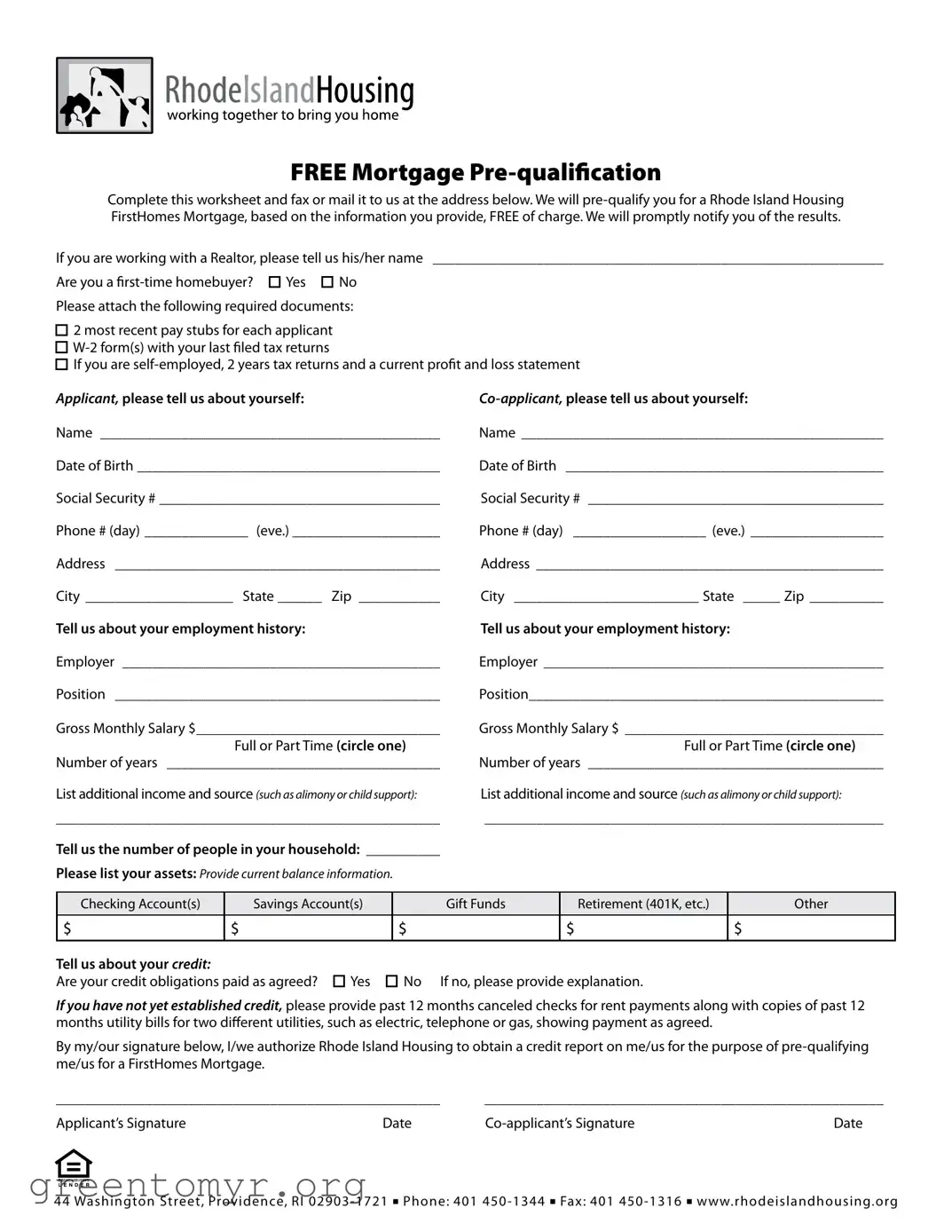
The Mortgage Prequalification Worksheet is a vital tool for prospective homebuyers seeking to understand their financial readiness before applying for a mortgage. This form facilitates a straightforward process, allowing individuals to submit essential information that will be used to assess their eligibility for a Rhode Island Housing FirstHomes Mortgage at no cost. Key components of the worksheet include personal details for both the applicant and co-applicant, such as names, dates of birth, and Social Security numbers. Employment history is also crucial, as it requires information about current employers, job positions, and monthly salaries. Additionally, the form requests documentation like recent pay stubs, W-2 forms, and tax returns, which provide a comprehensive view of the applicants' financial standing. To further evaluate financial health, applicants must disclose their assets, household size, and any additional sources of income, such as alimony or child support. Credit history is another significant aspect; applicants must confirm whether their credit obligations are being met and provide supporting documents if they are not. By signing the form, applicants authorize Rhode Island Housing to obtain their credit report, which is a necessary step in the prequalification process. This worksheet not only streamlines the prequalification process but also empowers potential homeowners with the knowledge needed to make informed decisions.

FREE Mortgage
Complete this worksheet and fax or mail it to us at the address below. We will
If you are working with a Realtor, please tell us his/her name _____________________________________________________________
Are you a |
Yes |
No |
Please attach the following required documents:
2 most recent pay stubs for each applicant
If you are
Applicant, please tell us about yourself: |
|
Name ______________________________________________ |
Name _________________________________________________ |
Date of Birth _________________________________________ |
Date of Birth ___________________________________________ |
Social Security # ______________________________________ |
Social Security # ________________________________________ |
Phone # (day) ______________ (eve.) ____________________ |
Phone # (day) __________________ (eve.) __________________ |
Address ____________________________________________ |
Address _______________________________________________ |
City ____________________ State ______ Zip ___________ |
City _________________________ State _____ Zip __________ |
Tell us about your employment history: |
Tell us about your employment history: |
Employer ___________________________________________ |
Employer ______________________________________________ |
Position ____________________________________________ |
Position________________________________________________ |
Gross Monthly Salary $_________________________________ |
Gross Monthly Salary $ ___________________________________ |
||||||
|
Full or Part Time (circle one) |
|
Full or Part Time (circle one) |
||||
Number of years _____________________________________ |
Number of years ________________________________________ |
||||||
List additional income and source (such as alimony or child support): |
List additional income and source (such as alimony or child support): |
||||||
____________________________________________________ |
______________________________________________________ |
||||||
Tell us the number of people in your household: __________ |
|
|
|
||||
Please list your assets: Provide current balance information. |
|
|
|
|
|||
|
|
|
|
|
|
|
|
Checking Account(s) |
Savings Account(s) |
|
|
Gift Funds |
Retirement (401K, etc.) |
Other |
|
|
|
|
|
|
|
|
|
$ |
$ |
|
|
$ |
|
$ |
$ |
Tell us about your credit: |
|
|
|
|
|
|
|
Are your credit obligations paid as agreed? |
Yes |
No |
If no, please provide explanation. |
|
|||
If you have not yet established credit, please provide past 12 months canceled checks for rent payments along with copies of past 12 months utility bills for two diferent utilities, such as electric, telephone or gas, showing payment as agreed.
By my/our signature below, I/we authorize Rhode Island Housing to obtain a credit report on me/us for the purpose of
____________________________________________________ |
______________________________________________________ |
||
Applicant’s Signature |
Date |
Date |
|
4 4 Wa s h i n g t o n S t r e e t , Pr o v i d e n c e, R I 0 2 9 0 3 - 1 7 2 1 n P h o n e : 4 0 1 4 5 0 - 1 3 4 4 n Fa x : 4 0 1 4 5 0 - 1 3 1 6 n w w w. r h o d e i s l a n d h o u s i n g . o r g
| Fact Name | Details |
|---|---|
| Form Purpose | This worksheet helps you get pre-qualified for a Rhode Island Housing FirstHomes Mortgage. |
| Cost | There is no charge for completing this worksheet and obtaining pre-qualification. |
| Required Documents | You need to attach recent pay stubs, W-2 forms, and tax returns if self-employed. |
| First-Time Homebuyer | The form includes a question to determine if you are a first-time homebuyer. |
| Household Information | You must provide details about the number of people in your household. |
| Governing Law | This form is governed by the laws of the State of Rhode Island. |
Completing the Mortgage Prequalification Worksheet is a crucial step in the home-buying process. Once you fill out the form, you will submit it to the relevant housing authority. They will review your information and notify you of your prequalification status. This process helps you understand your financial standing before you start looking for a home.
The Mortgage Prequalification Worksheet is designed to help potential homebuyers assess their financial readiness for a mortgage. By completing this form, individuals can provide necessary information to be pre-qualified for a Rhode Island Housing FirstHomes Mortgage at no cost. This process can give applicants a clearer understanding of their financial situation and potential borrowing capacity.
To complete the worksheet, applicants must attach the following documents:
Once the completed worksheet and required documents are submitted, Rhode Island Housing will review the information provided. They will evaluate the financial details, including income, assets, and credit history. After this assessment, applicants will be notified of the results, indicating whether they qualify for a mortgage and, if so, the amount they may be eligible to borrow.
Applicants should include the following details regarding their employment history:
No, there is no fee to complete the Mortgage Prequalification Worksheet. This service is offered free of charge to assist potential homebuyers in understanding their mortgage options.
The worksheet specifically asks whether applicants are first-time homebuyers. This information helps Rhode Island Housing tailor their services and provide relevant guidance to those who may be unfamiliar with the homebuying process.
As part of the prequalification process, applicants authorize Rhode Island Housing to obtain a credit report. This report will provide insights into the applicant's credit obligations and payment history. If there are any issues, such as missed payments, applicants are encouraged to explain these circumstances.
If you have not established credit, you can provide alternative documentation. This includes past 12 months of canceled checks for rent payments and copies of utility bills from two different services (e.g., electric, telephone, or gas) that demonstrate timely payment.
After the review process is complete, Rhode Island Housing will promptly notify applicants of the prequalification results. This notification will include details about whether the applicant qualifies for a mortgage and any next steps that may be required.
The completed Mortgage Prequalification Worksheet, along with the required documents, should be mailed or faxed to the following address:
Rhode Island Housing
44 Washington Street
Providence, RI 02903-1721
Phone: 401-450-1344
Fax: 401-450-1316
Filling out the Mortgage Prequalification Worksheet is an important step in the home-buying process. However, many people make mistakes that can delay their application or lead to inaccurate assessments. One common error is providing incomplete personal information. Applicants often forget to include essential details such as their full names, dates of birth, or social security numbers. This missing information can hinder the prequalification process, causing unnecessary delays.
Another frequent mistake is misreporting income. Some individuals may not accurately reflect their gross monthly salary or fail to include additional income sources, like alimony or child support. Inaccurate income reporting can result in a lower prequalification amount than what the applicant may actually qualify for. It is crucial to provide precise figures and to list all relevant income sources to ensure an accurate assessment.
People also tend to overlook the importance of documenting their employment history. Failing to provide adequate details about their current employer, position, or length of employment can lead to complications. Lenders rely on this information to evaluate job stability and income reliability. Without a clear employment history, the application may be flagged for further review, which can extend the timeline for prequalification.
Lastly, some applicants underestimate the significance of their credit history. While the form asks whether credit obligations are paid as agreed, individuals may not provide explanations for any negative marks. If there are issues with credit, it is vital to be transparent and provide context. This honesty can help lenders understand the situation better and may lead to more favorable outcomes during the prequalification process.
When preparing for a mortgage application, it's essential to gather various documents alongside the Mortgage Prequalification Worksheet. Each document plays a crucial role in assessing your financial situation and eligibility. Here’s a list of common forms you might need:
Collecting these documents can streamline the mortgage prequalification process. Having everything ready will not only make it easier for lenders to evaluate your application but also help you understand your financial standing better. Stay organized, and good luck with your mortgage journey!
When filling out the Mortgage Prequalification Worksheet, consider the following guidelines to ensure accuracy and completeness.
Many people have misunderstandings about the Mortgage Prequalification Worksheet form. Here are nine common misconceptions, along with clarifications to help you understand the process better.
Understanding these misconceptions can help you approach the mortgage prequalification process with more confidence. Make sure to provide accurate information to receive the best possible assessment.
When filling out and using the Mortgage Prequalification Worksheet form, consider the following key takeaways: