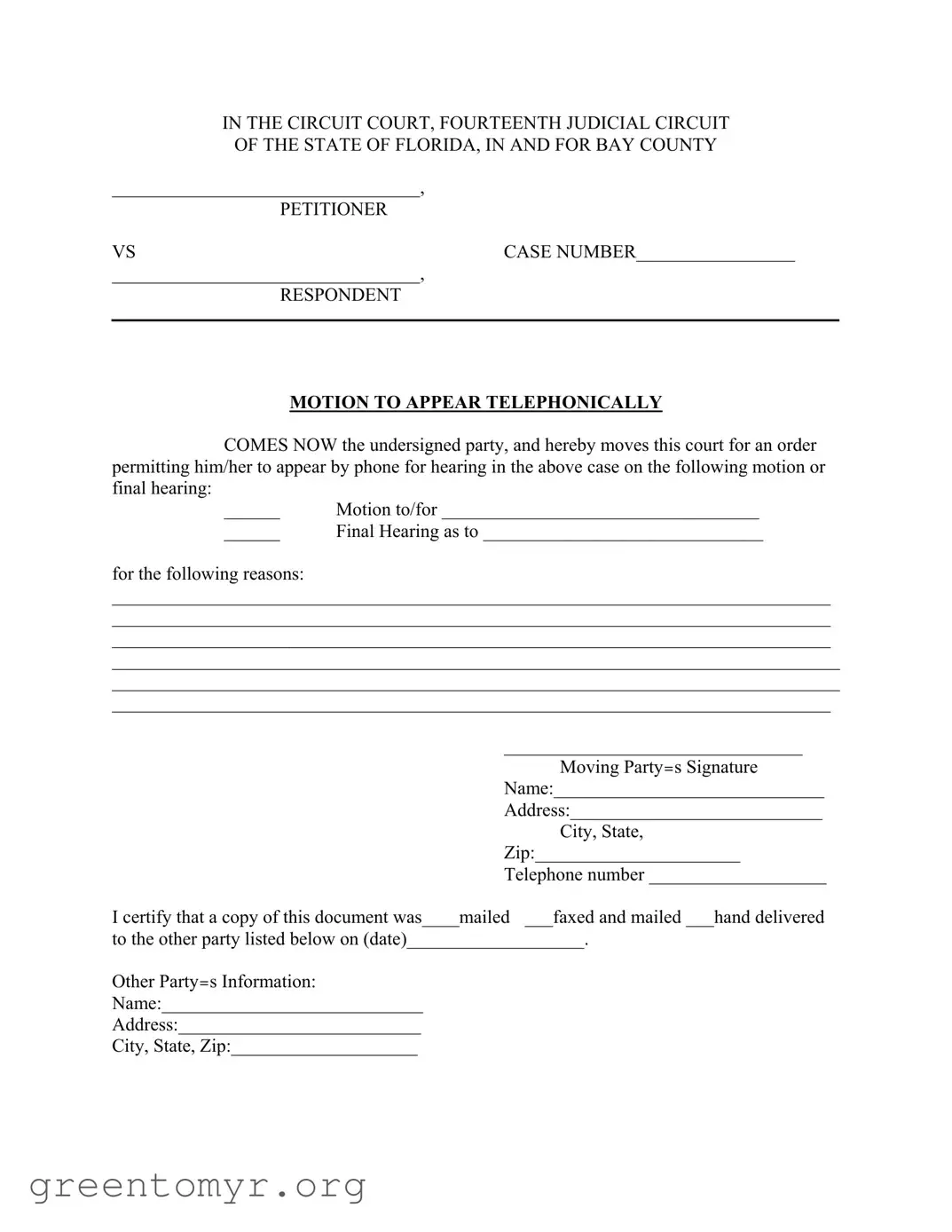
The Motion Telephonic form is an essential document used in the legal process within the Fourteenth Judicial Circuit of Florida, particularly in Bay County. This form allows a party involved in a case to request permission from the court to participate in a hearing via telephone. It is designed to streamline proceedings and accommodate individuals who may face challenges attending in person. The form requires the petitioner to provide specific details, including the case number and the nature of the hearing, whether it is a motion or a final hearing. Additionally, the moving party must articulate the reasons for the request, ensuring that the court understands the necessity of telephonic participation. The form also includes spaces for the moving party's signature, contact information, and a certification section that confirms the document has been properly served to the other party involved in the case. This procedural tool reflects the court's efforts to maintain accessibility and efficiency in the judicial process.
IN THE CIRCUIT COURT, FOURTEENTH JUDICIAL CIRCUIT
OF THE STATE OF FLORIDA, IN AND FOR BAY COUNTY
_________________________________,
PETITIONER |
|
VS |
CASE NUMBER_________________ |
_________________________________, |
|
RESPONDENT |
|
|
|
MOTION TO APPEAR TELEPHONICALLY
COMES NOW the undersigned party, and hereby moves this court for an order permitting him/her to appear by phone for hearing in the above case on the following motion or final hearing:
______ |
Motion to/for __________________________________ |
______ |
Final Hearing as to ______________________________ |
for the following reasons:
_____________________________________________________________________________
_____________________________________________________________________________
_____________________________________________________________________________
______________________________________________________________________________
______________________________________________________________________________
_____________________________________________________________________________
________________________________
Moving Party=s Signature
Name:_____________________________
Address:___________________________
City, State, Zip:______________________
Telephone number ___________________
I certify that a copy of this document was____mailed ___faxed and mailed ___hand delivered
to the other party listed below on (date)___________________.
Other Party=s Information:
Name:____________________________
Address:__________________________
City, State, Zip:____________________
| Fact Name | Description |
|---|---|
| Governing Law | The Motion Telephonic form is governed by the Florida Rules of Civil Procedure. |
| Court Jurisdiction | This form is specifically used in the Fourteenth Judicial Circuit of the State of Florida. |
| Purpose | The form allows a party to request permission to appear telephonically for a hearing. |
| Signature Requirement | The moving party must provide their signature on the form to validate the request. |
| Notification Requirement | The moving party must certify that a copy of the document was sent to the other party. |
| Information Needed | Contact information for both the moving party and the other party must be included on the form. |
Completing the Motion Telephonic form is a straightforward process that requires attention to detail. Once filled out correctly, this form allows a party to request permission to appear at a court hearing via telephone. Below are the steps to ensure all necessary information is included.
The Motion Telephonic form is a legal document used in the Fourteenth Judicial Circuit of Florida. It allows a party involved in a court case to request permission to appear at a hearing via telephone rather than in person. This can be particularly helpful for individuals who may have difficulty attending court due to distance, health issues, or other valid reasons.
Any party involved in a case in the Fourteenth Judicial Circuit of Florida can use this form. This includes petitioners and respondents who wish to participate in hearings without being physically present in the courtroom.
To complete the Motion Telephonic form, you will need to provide the following information:
You can submit the Motion Telephonic form to the court by mailing, faxing, or delivering it in person. Make sure to also send a copy of the document to the other party involved in the case. You must indicate how you provided this copy on the form.
The form allows you to outline your reasons for wanting to appear by phone. Common reasons include:
Be sure to provide a clear and concise explanation of your circumstances.
Typically, there is no specific fee for filing a motion to appear telephonically. However, standard court filing fees may apply depending on your case. It’s advisable to check with the court clerk for any potential fees related to your specific situation.
Once you submit the form, the court will review your request. If granted, you will receive instructions on how to participate in the hearing by phone. If the motion is denied, you may be required to appear in person. Always check your court's rules for specific procedures and timelines.
Filling out the Motion Telephonic form can be a straightforward process, but there are common mistakes that individuals often make. One frequent error is neglecting to include the case number. This number is crucial for the court to identify the specific case being referenced. Without it, the motion may be delayed or even dismissed due to lack of clarity.
Another mistake involves the section where the moving party indicates the type of motion or final hearing. Some individuals either leave this section blank or provide vague descriptions. It is essential to specify whether it is a motion to appear telephonically or a final hearing, along with a clear description of the subject matter. Incomplete information can lead to confusion and potential rejection of the request.
Additionally, many people forget to sign the form. The moving party’s signature is not just a formality; it confirms that the information provided is accurate and that the party is formally requesting the court’s permission. A missing signature can halt the process and require resubmission, causing unnecessary delays.
Providing incorrect or outdated contact information is another common error. The form requires the moving party's name, address, and telephone number. If any of this information is incorrect, the court may struggle to reach the individual if needed. It is vital to double-check all contact details before submitting the form.
Some individuals also overlook the certification of service section. This part confirms that the other party has been informed about the motion. Failing to complete this section can lead to complications, as the court needs to ensure that all parties are aware of the proceedings. It is important to indicate how the document was delivered and the date it was sent.
Moreover, the reasons for requesting a telephonic appearance should be articulated clearly. Many people either provide insufficient detail or fail to explain their reasoning altogether. A well-thought-out explanation not only supports the request but also helps the court understand the necessity of the motion.
Another mistake is not adhering to the formatting requirements. Courts often have specific guidelines regarding font size, margins, and spacing. Ignoring these requirements can result in the form being rejected or sent back for correction, which can be frustrating and time-consuming.
Lastly, some individuals may rush through the process and submit the form without reviewing it thoroughly. A careful review can catch errors or omissions that might otherwise lead to complications. Taking the time to proofread ensures that the motion is clear, complete, and ready for the court's consideration.
The Motion Telephonic form is an important document used in court proceedings when a party wishes to attend a hearing via phone. Several other forms and documents often accompany this motion to ensure proper procedure and communication. Below is a list of these documents, along with brief descriptions of each.
Understanding these documents can help parties navigate the legal process more effectively. Proper preparation and adherence to court procedures are essential for a smooth hearing experience.
The Motion Telephonic form is a specific document used in legal proceedings to request permission for a party to appear via telephone during a hearing. It shares similarities with several other legal documents, each serving a unique purpose while maintaining a common goal of facilitating communication and participation in legal processes. Here are five documents that are similar to the Motion Telephonic form:
When filling out the Motion Telephonic form, consider the following guidelines:
There are several misconceptions about the Motion Telephonic form that can lead to confusion. Understanding these can help individuals navigate the process more effectively.
By clarifying these misconceptions, individuals can approach the process with a better understanding and greater confidence.
When filling out and using the Motion Telephonic form, it is essential to follow specific guidelines to ensure a smooth process. Here are five key takeaways:
Following these guidelines will help ensure that your Motion Telephonic is processed efficiently. Always keep a copy for your records and be prepared for any follow-up communications from the court.