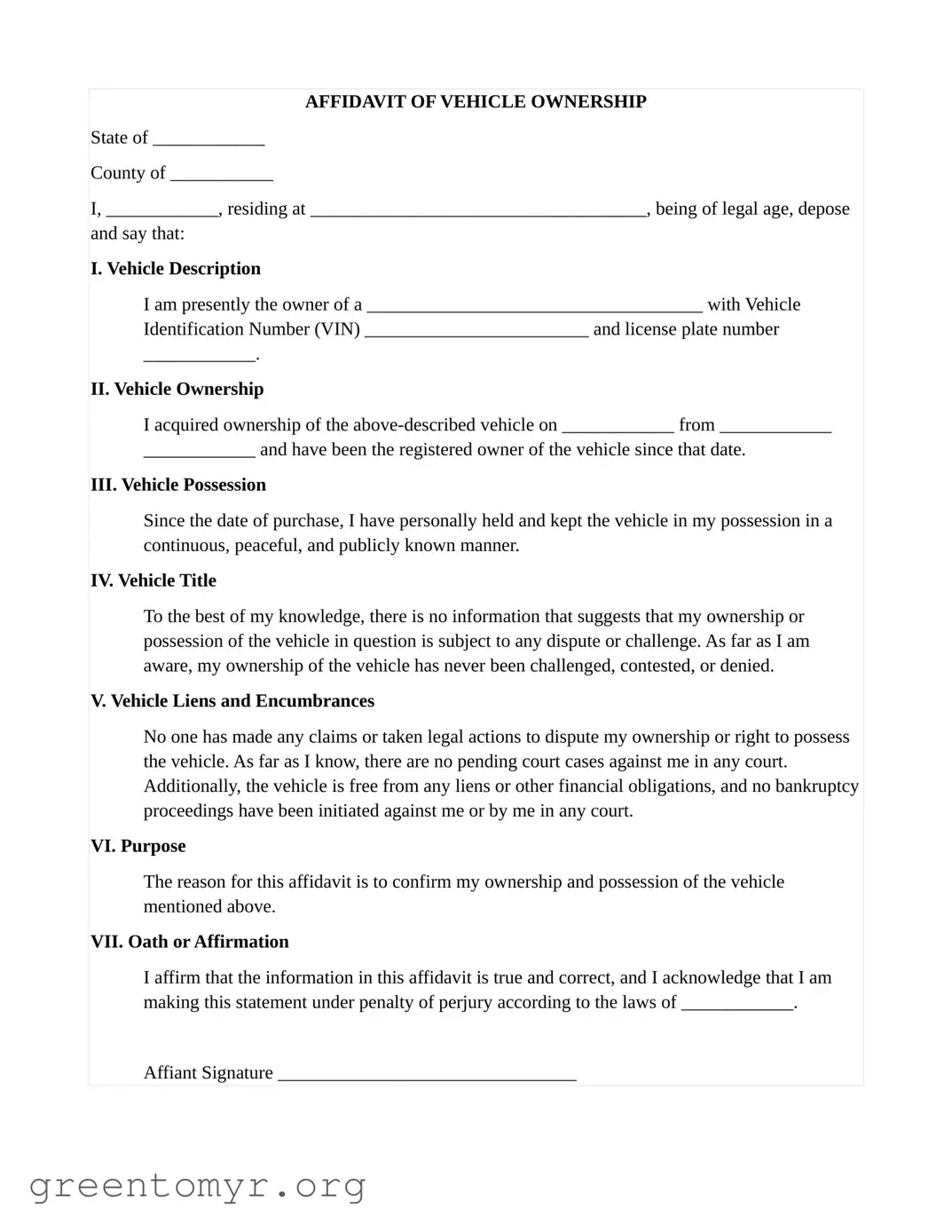
The Motor Vehicle Ownership Affidavit form serves as a crucial document for individuals asserting their ownership of a vehicle. This form requires the owner to provide specific details about the vehicle, including its description, Vehicle Identification Number (VIN), and license plate number. Additionally, the form outlines the history of ownership, stating when and from whom the vehicle was acquired. It confirms that the owner has maintained continuous and peaceful possession of the vehicle since the purchase date. The affidavit also addresses any potential disputes regarding ownership, affirming that the owner has not faced challenges to their claim and that there are no liens or encumbrances against the vehicle. The purpose of this affidavit is to provide a legal declaration of ownership, ensuring that the information presented is accurate and truthful under penalty of perjury. Finally, the document must be notarized, providing an official verification of the owner’s identity and the authenticity of the affidavit.

AFFIDAVIT OF VEHICLE OWNERSHIP
State of ____________
County of ___________
I, ____________, residing at ____________________________________, being of legal age, depose
and say that:
I. Vehicle Description
I am presently the owner of a ____________________________________ with Vehicle
Identification Number (VIN) ________________________ and license plate number
____________.
II. Vehicle Ownership
I acquired ownership of the
____________ and have been the registered owner of the vehicle since that date.
III. Vehicle Possession
Since the date of purchase, I have personally held and kept the vehicle in my possession in a continuous, peaceful, and publicly known manner.
IV. Vehicle Title
To the best of my knowledge, there is no information that suggests that my ownership or possession of the vehicle in question is subject to any dispute or challenge. As far as I am aware, my ownership of the vehicle has never been challenged, contested, or denied.
V. Vehicle Liens and Encumbrances
No one has made any claims or taken legal actions to dispute my ownership or right to possess the vehicle. As far as I know, there are no pending court cases against me in any court. Additionally, the vehicle is free from any liens or other financial obligations, and no bankruptcy proceedings have been initiated against me or by me in any court.
VI. Purpose
The reason for this affidavit is to confirm my ownership and possession of the vehicle mentioned above.
VII. Oath or Affirmation
I affirm that the information in this affidavit is true and correct, and I acknowledge that I am making this statement under penalty of perjury according to the laws of ____________.
Affiant Signature ________________________________

STATE OF ____________
COUNTY OF ____________
Subscribed and sworn to (or affirmed) before me on this ____________ by ____________, proved
to me on the basis of satisfactory evidence to be the person(s) who appeared before me.
____________ Notary Public for ____________
My Commission Expires: ____________
| Fact Name | Details |
|---|---|
| Purpose of Affidavit | This form is used to confirm ownership and possession of a vehicle. |
| State-Specific Requirement | The form must be completed according to the laws of the specific state where the vehicle is registered. |
| Vehicle Identification | It requires the Vehicle Identification Number (VIN) and license plate number for identification. |
| Ownership Confirmation | The affiant must state how they acquired the vehicle and confirm their ownership since that date. |
| Possession Details | The form asserts that the vehicle has been held in a continuous and publicly known manner. |
| Dispute Declaration | The affiant must declare that there are no disputes regarding their ownership of the vehicle. |
| Liens and Encumbrances | The affidavit confirms that the vehicle is free from liens or financial obligations. |
| Legal Penalty | Falsifying information in the affidavit can lead to penalties under the laws of the state. |
| Notarization Requirement | The affidavit must be notarized to be legally binding. |
| Affiant's Signature | The individual affirming ownership must sign the affidavit, confirming the truth of the information provided. |
Completing the Motor Vehicle Ownership Affidavit form is a straightforward process. Follow these steps carefully to ensure that all required information is accurately provided.
The Motor Vehicle Ownership Affidavit serves to confirm an individual's ownership and possession of a specific vehicle. It provides a legal declaration that the person signing the affidavit is the rightful owner and has maintained possession of the vehicle without dispute.
Anyone who claims ownership of a motor vehicle and needs to provide proof of that ownership may need to complete this form. This can include individuals who have purchased a vehicle without a title or those who need to clarify ownership in cases of disputes or legal requirements.
The form requires several key pieces of information, including:
The individual completing the affidavit must affirm that the information provided is true and correct. This affirmation is made under penalty of perjury, meaning that providing false information can lead to legal consequences.
Yes, notarization is typically required. After the affidavit is completed, it must be signed in the presence of a notary public, who will verify the identity of the signer and notarize the document. This adds an extra layer of authenticity to the affidavit.
If there are disputes regarding vehicle ownership, it is advisable to consult with a legal professional. The affidavit can help clarify ownership, but legal advice may be necessary to navigate any potential conflicts or claims made by others.
The Motor Vehicle Ownership Affidavit is a general form, but specific requirements may vary by state. It is essential to check state laws and regulations to ensure compliance and proper use of the affidavit in your jurisdiction.
If the information in the affidavit is found to be false, the individual may face legal repercussions, including penalties for perjury. Additionally, the ownership claim may be challenged, potentially resulting in the loss of ownership rights to the vehicle.
The Motor Vehicle Ownership Affidavit form can often be obtained from state motor vehicle departments, legal aid offices, or online legal resources. It is important to ensure that the correct version for your state is used.
Filling out the Motor Vehicle Ownership Affidavit form is a crucial step in confirming vehicle ownership. However, many individuals make common mistakes that can lead to complications. Understanding these errors can help ensure that the affidavit is completed correctly.
One frequent mistake is failing to provide complete and accurate vehicle information. The form requires specific details, including the Vehicle Identification Number (VIN) and license plate number. Omitting any of this information can lead to delays or even rejection of the affidavit. It is essential to double-check these details to ensure they match official documents.
Another common error involves the date of acquisition. Individuals often forget to include the exact date they acquired ownership of the vehicle. This information is vital as it establishes a timeline for ownership. Providing an incorrect or vague date can raise questions about the legitimacy of the claim.
Many people also overlook the importance of detailing the seller’s information. The affidavit requires the name of the individual or entity from whom the vehicle was purchased. Neglecting to include this information can create ambiguity regarding the chain of ownership, which may complicate future transactions.
Additionally, some individuals fail to affirm the accuracy of their statements. The affidavit includes a section where the affiant must acknowledge the truthfulness of the information provided. Skipping this step or not signing the affidavit can render it invalid. It is crucial to remember that this is a legal document, and all claims must be verified.
Lastly, individuals sometimes forget to have the affidavit notarized. The notarization process adds a layer of authenticity to the document. Without a notary’s signature, the affidavit may not be accepted by the relevant authorities. Ensuring that this step is completed can prevent unnecessary complications.
By being aware of these common mistakes, individuals can take the necessary steps to fill out the Motor Vehicle Ownership Affidavit form accurately. This diligence not only facilitates a smoother process but also reinforces the legitimacy of their vehicle ownership claims.
The Motor Vehicle Ownership Affidavit is an essential document for establishing ownership of a vehicle. However, several other forms and documents often accompany it to ensure a smooth transfer of ownership or to provide additional information. Below is a list of these commonly used documents, along with a brief description of each.
Understanding these documents can greatly assist individuals in navigating the vehicle ownership process. Having the right forms ready can simplify the transfer and ensure compliance with local regulations.
The Motor Vehicle Ownership Affidavit form serves a specific purpose in confirming vehicle ownership and possession. Several other documents share similarities in their function or structure. Below is a list of ten such documents, each accompanied by a brief explanation of how they relate to the Motor Vehicle Ownership Affidavit.
When filling out the Motor Vehicle Ownership Affidavit form, it's essential to follow certain guidelines to ensure your submission is accurate and valid. Here’s a helpful list of things you should and shouldn't do:
Misconceptions about the Motor Vehicle Ownership Affidavit form can lead to confusion and potential issues for vehicle owners. Below is a list of common misunderstandings regarding this important document.
Understanding these misconceptions can help individuals navigate the complexities of vehicle ownership and ensure that they are adequately prepared when dealing with their vehicles.
When filling out and using the Motor Vehicle Ownership Affidavit form, consider the following key takeaways: