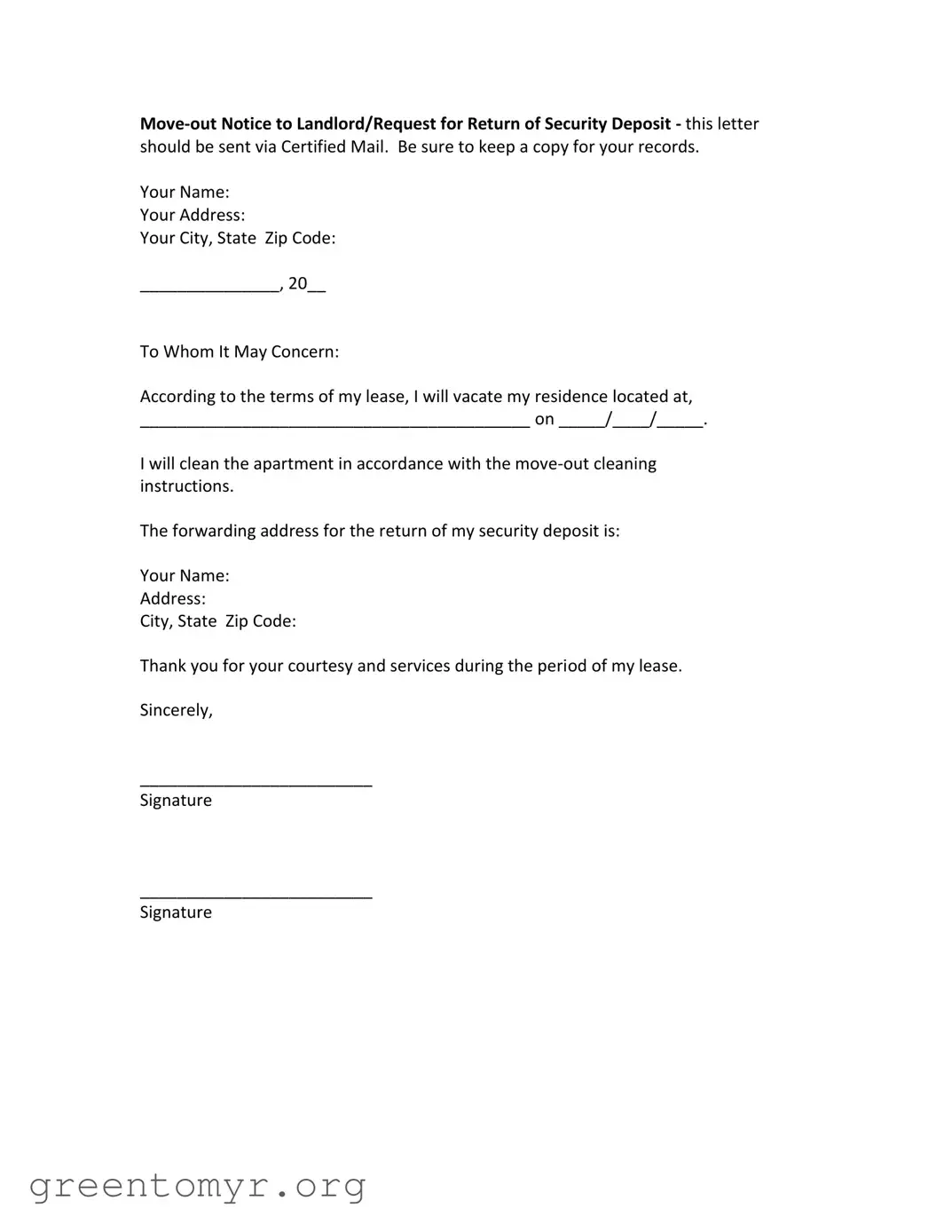
When preparing to move out of a rental property, a Move Out Notice Letter serves as an essential communication tool between a tenant and their landlord. This letter notifies the landlord of the tenant's intent to vacate the premises, ensuring compliance with the lease agreement. It includes important details such as the tenant's name, address, and the specific date of departure. Additionally, the letter should outline the tenant's commitment to cleaning the apartment according to established guidelines. A forwarding address for the return of the security deposit must also be provided. Sending the letter via Certified Mail is recommended to ensure delivery and create a record of correspondence. Keeping a copy for personal records is crucial for future reference. This straightforward form helps facilitate a smooth transition and reinforces the tenant's rights regarding their security deposit.
should be sent via Certified Mail. Be sure to keep a copy for your records.
Your Name:
Your Address:
Your City, State Zip Code:
_______________, 20__
To Whom It May Concern:
According to the terms of my lease, I will vacate my residence located at,
__________________________________________ on _____/____/_____.
I will clean the apartment in accordance with the
The forwarding address for the return of my security deposit is:
Your Name:
Address:
City, State Zip Code:
Thank you for your courtesy and services during the period of my lease.
Sincerely,
_________________________
Signature
_________________________
Signature
| Fact Name | Details |
|---|---|
| Purpose | The Move Out Notice Letter notifies the landlord of the tenant's intention to vacate the property. |
| Delivery Method | This letter should be sent via Certified Mail to ensure proof of delivery. |
| Record Keeping | It is important to keep a copy of the letter for personal records. |
| Lease Terms | The notice must comply with the terms outlined in the tenant's lease agreement. |
| Cleaning Requirements | The tenant agrees to clean the apartment according to the move-out cleaning instructions provided in the lease. |
| Forwarding Address | A forwarding address for the return of the security deposit must be included in the letter. |
| Signature Requirement | The letter must be signed by the tenant to validate the notice. |
| State-Specific Laws | In California, the governing law is California Civil Code § 1946.1 regarding move-out notices. |
| Timing | Most states require notice to be given 30 days prior to vacating the property. |
| Landlord's Response | The landlord is expected to acknowledge receipt of the notice and initiate the process for the return of the security deposit. |
Once the Move Out Notice Letter form is completed, it should be sent to the landlord via Certified Mail. Retaining a copy for personal records is advisable to ensure documentation of the notice.
A Move Out Notice Letter is a formal notification that a tenant sends to their landlord to inform them of their intention to vacate the rental property. This letter typically includes the tenant's name, address, and the date they plan to move out. It serves as a record of the tenant's intent and ensures that both parties are on the same page regarding the end of the lease agreement.
Sending your Move Out Notice Letter via Certified Mail provides proof that the landlord received your notice. This is crucial in case any disputes arise later regarding the return of your security deposit or the timing of your move-out. Certified Mail also allows you to track the delivery, ensuring that your notice is received in a timely manner.
Your Move Out Notice Letter should contain the following information:
Including these details ensures clarity and helps facilitate a smooth transition for both you and your landlord.
Forgetting to include your forwarding address can complicate the return of your security deposit. If you realize this after sending the letter, it's advisable to follow up with your landlord directly. You can do this via email or phone, providing your forwarding address and confirming your move-out date. Keeping open communication can help prevent any misunderstandings.
The timing for sending your Move Out Notice Letter typically depends on the terms outlined in your lease agreement. Most leases require at least 30 days' notice, but some may require more. Check your lease for specific requirements. Sending your notice well in advance not only fulfills your obligations but also allows your landlord ample time to find a new tenant.
Filling out a Move Out Notice Letter can seem straightforward, but many individuals make common mistakes that can lead to complications. One prevalent error is failing to provide a complete and accurate forwarding address. This address is crucial for the landlord to return the security deposit. If the address is incorrect or missing, the tenant may face delays or even lose their deposit altogether.
Another frequent mistake is neglecting to send the letter via certified mail. This step is important because it provides proof that the landlord received the notice. Without this documentation, tenants may struggle to prove that they properly notified their landlord of their intent to vacate. This could lead to disputes regarding the lease termination date or the return of the security deposit.
Some people also overlook the importance of including the specific date they intend to vacate the premises. Leaving this date blank can create confusion and may result in the landlord assuming the tenant will remain in the property longer than intended. It is essential to clearly state the move-out date to avoid any misunderstandings.
Additionally, many individuals fail to mention that they will clean the apartment according to the move-out cleaning instructions. This statement reassures the landlord that the tenant is aware of their responsibilities and intends to leave the property in good condition. Omitting this detail can raise concerns about the state in which the apartment will be left.
Lastly, some tenants forget to keep a copy of the letter for their records. This simple step can be invaluable if any disputes arise later regarding the move-out process or the security deposit. Having a copy ensures that the tenant has a reference point for what was communicated to the landlord, which can be critical in protecting their rights.
When preparing to move out of a rental property, several important documents can help ensure a smooth transition. Along with the Move Out Notice Letter, consider these additional forms and documents that may be necessary for your move.
Having these documents ready can make your move-out process easier and help you avoid potential disputes. Always keep copies for your records and ensure that all correspondence is sent through reliable methods.
When preparing to move out of a rental property, various documents may serve similar purposes to a Move Out Notice Letter. Each document plays a role in ensuring a smooth transition between tenants and landlords. Here are eight documents that share similarities with the Move Out Notice Letter:
Understanding these documents can facilitate a smoother moving process and help protect the rights and responsibilities of both tenants and landlords.
When filling out the Move Out Notice Letter form, there are several important considerations to keep in mind. Below is a list of things you should and shouldn't do.
Understanding the Move Out Notice Letter form is essential for both tenants and landlords. However, several misconceptions can lead to confusion. Here are eight common misunderstandings:
By addressing these misconceptions, tenants can navigate the move-out process more effectively and ensure their rights are protected.
When filling out and using the Move Out Notice Letter form, keep the following key takeaways in mind: