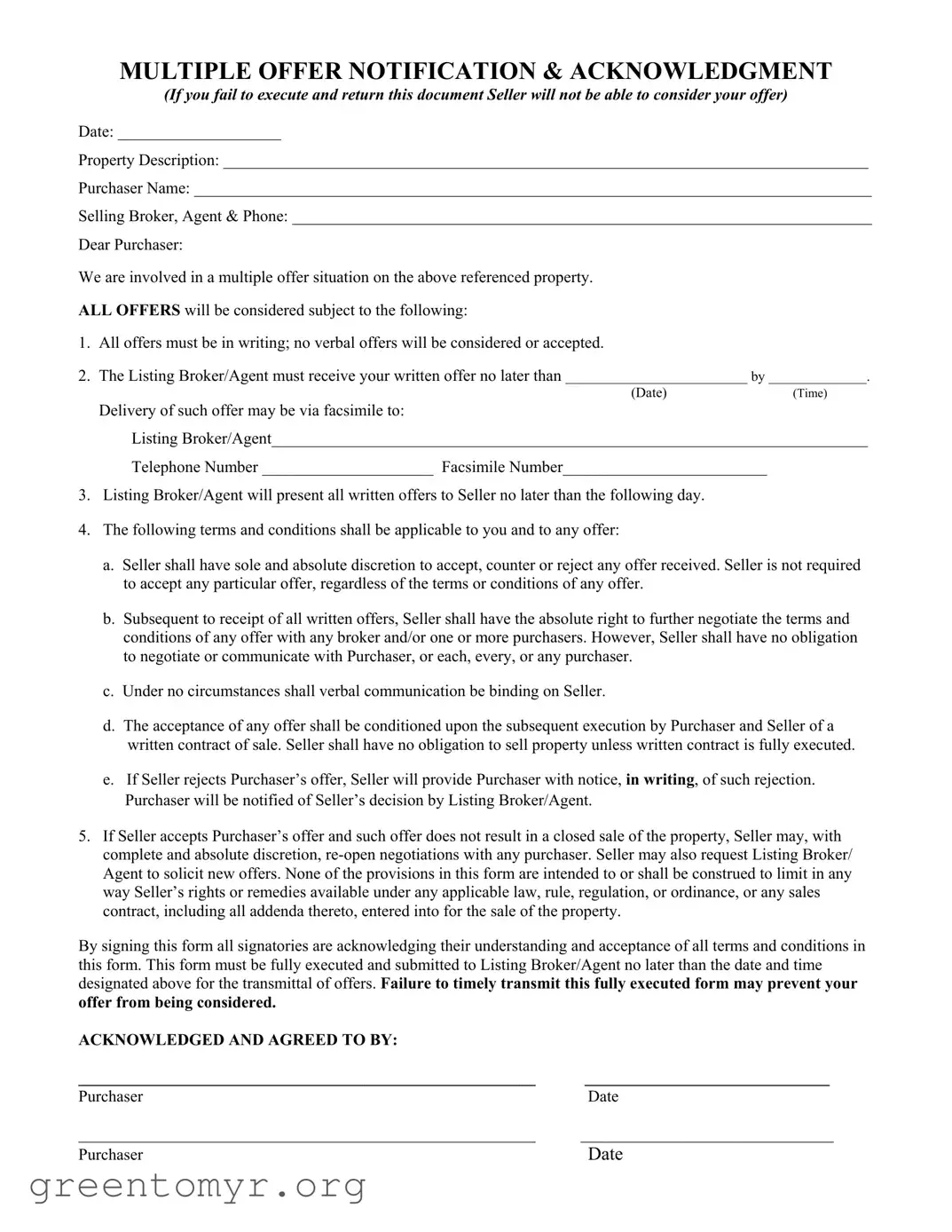
The Multiple Offer Notification form plays a crucial role in real estate transactions, particularly when a property receives multiple offers. This form serves as a formal communication tool between sellers and potential buyers, ensuring that all parties are aware of the competitive nature of the bidding process. It outlines essential terms and conditions that govern how offers will be handled, emphasizing the necessity for all offers to be submitted in writing. The seller retains the right to accept, counter, or reject any offer without obligation, which underscores the importance of understanding the form’s stipulations. Additionally, it sets clear deadlines for when offers must be submitted, providing transparency in the timeline of the negotiation process. Buyers are informed that verbal offers will not be considered, reinforcing the need for written documentation. The form also stipulates that any acceptance of an offer is contingent upon the execution of a formal contract, further clarifying the steps necessary to finalize a sale. By signing the Multiple Offer Notification, purchasers acknowledge their understanding of these terms, ensuring that they are fully informed of the seller's rights and the overall process. This document is not just a formality; it is an essential part of navigating the complexities of a competitive real estate market.
MULTIPLE OFFER NOTIFICATION & ACKNOWLEDGMENT
(If you fail to execute and return this document Seller will not be able to consider your offer)
Date: ____________________
Property Description: _______________________________________________________________________________
Purchaser Name: ___________________________________________________________________________________
Selling Broker, Agent & Phone: _______________________________________________________________________
Dear Purchaser:
We are involved in a multiple offer situation on the above referenced property.
ALL OFFERS will be considered subject to the following:
1.All offers must be in writing; no verbal offers will be considered or accepted.
2.The Listing Broker/Agent must receive your written offer no later than __________________________ by ______________.
(Date)(Time)
Delivery of such offer may be via facsimile to:
Listing Broker/Agent_________________________________________________________________________
Telephone Number _____________________ Facsimile Number_________________________
3.Listing Broker/Agent will present all written offers to Seller no later than the following day.
4.The following terms and conditions shall be applicable to you and to any offer:
a.Seller shall have sole and absolute discretion to accept, counter or reject any offer received. Seller is not required to accept any particular offer, regardless of the terms or conditions of any offer.
b.Subsequent to receipt of all written offers, Seller shall have the absolute right to further negotiate the terms and conditions of any offer with any broker and/or one or more purchasers. However, Seller shall have no obligation to negotiate or communicate with Purchaser, or each, every, or any purchaser.
c.Under no circumstances shall verbal communication be binding on Seller.
d.The acceptance of any offer shall be conditioned upon the subsequent execution by Purchaser and Seller of a written contract of sale. Seller shall have no obligation to sell property unless written contract is fully executed.
e.If Seller rejects Purchaser’s offer, Seller will provide Purchaser with notice, in writing, of such rejection. Purchaser will be notified of Seller’s decision by Listing Broker/Agent.
5.If Seller accepts Purchaser’s offer and such offer does not result in a closed sale of the property, Seller may, with complete and absolute discretion,
By signing this form all signatories are acknowledging their understanding and acceptance of all terms and conditions in this form. This form must be fully executed and submitted to Listing Broker/Agent no later than the date and time designated above for the transmittal of offers. Failure to timely transmit this fully executed form may prevent your offer from being considered.
ACKNOWLEDGED AND AGREED TO BY:
________________________________________________________
Purchaser
________________________________________________________
Purchaser
| Fact Name | Description | Governing Law |
|---|---|---|
| Written Offers Only | All offers must be submitted in writing. Verbal offers will not be accepted. | Real Estate Law, varies by state |
| Submission Deadline | Offers must be received by the Listing Broker/Agent by a specific date and time. | Real Estate Law, varies by state |
| Seller's Discretion | The Seller has the absolute right to accept, counter, or reject any offer received. | Real Estate Law, varies by state |
| Notification of Rejection | If an offer is rejected, the Seller must provide written notice to the Purchaser. | Real Estate Law, varies by state |
Once you have gathered the necessary information, you can proceed to fill out the Multiple Offer Notification form. Make sure to complete each section accurately to ensure your offer is considered.
The Multiple Offer Notification form informs potential buyers that there are multiple offers on a property. It outlines the process for submitting offers and ensures that all parties understand the terms and conditions involved in a competitive bidding situation.
Submitting the form is crucial because it acknowledges that you understand the competitive nature of the offers being considered. Without this form, your offer may not be taken into account, which could mean missing out on the property.
If you fail to submit the form by the specified date and time, your offer will not be considered. Timely submission is essential for participation in the bidding process.
No, verbal offers will not be accepted. All offers must be in writing to be considered. This ensures clarity and protects both the seller and the buyer.
Your written offer should include:
Make sure to submit this offer to the Listing Broker/Agent by the deadline provided in the form.
If your offer is rejected, the seller will notify you in writing. You will receive this notice through the Listing Broker/Agent. This ensures that you are informed of the seller's decision.
The seller has complete discretion to accept, counter, or reject any offer. They may consider various factors, such as the offer amount, terms, and conditions. Ultimately, the seller is not obligated to accept any specific offer.
When filling out the Multiple Offer Notification form, many people make common mistakes that can lead to confusion or even disqualification of their offer. One frequent error is leaving the date fields blank. This form requires specific dates for submission, and without them, the offer may not be considered valid.
Another mistake is failing to provide complete property descriptions. The property description section should be filled out clearly. If it's vague or incomplete, it can create misunderstandings about which property the offer pertains to.
Some individuals neglect to include the purchaser name. This information is essential for identifying who is making the offer. Without a name, the offer cannot be properly processed.
Additionally, people often forget to include the contact details for their selling broker or agent. This information is crucial for communication. If the listing broker or agent cannot reach the purchaser, it may delay the process or even lead to missed opportunities.
Many also overlook the importance of the submission deadline. The form specifies a date and time by which the written offer must be received. Missing this deadline can result in the offer not being considered at all.
Another common error involves misunderstanding the requirement for written offers. Some people mistakenly believe that verbal offers can be accepted. However, only written offers are valid in this situation, and failing to comply can disqualify the offer.
In addition, failing to sign the form is a critical mistake. All parties involved must sign to acknowledge their understanding of the terms. Without signatures, the form is incomplete and cannot be processed.
Another mistake is not reviewing the terms and conditions carefully. Some individuals may overlook specific clauses that outline the seller's rights. Understanding these terms is vital to ensure that the offer aligns with the seller's expectations.
Lastly, people sometimes forget to keep a copy of the submitted form. This can lead to confusion later if there are questions about the offer. Keeping a record ensures that all parties are on the same page.
By avoiding these mistakes, purchasers can improve their chances of having their offers considered in a competitive market.
When navigating a real estate transaction, especially in a multiple offer situation, several documents often accompany the Multiple Offer Notification form. Each of these documents serves a specific purpose and helps ensure that all parties are informed and protected throughout the process. Below is a list of commonly used forms and documents that may be relevant in this context.
Understanding these documents can significantly enhance your experience in a real estate transaction. Each plays a vital role in protecting your interests and ensuring a smooth process. If you have any questions about these forms or how they apply to your situation, seeking guidance from a qualified professional is always a wise step.
The Multiple Offer Notification form serves a specific purpose in real estate transactions, particularly when multiple offers are on the table for a property. Several other documents share similarities with this form, as they also aim to clarify terms and conditions in situations where multiple parties are involved. Here are seven documents that are similar to the Multiple Offer Notification form:
When filling out the Multiple Offer Notification form, it's crucial to follow specific guidelines to ensure your offer is considered. Here’s a list of what to do and what to avoid:
Adhering to these guidelines will help ensure your offer is properly considered in a competitive market.
Understanding the Multiple Offer Notification form is crucial for anyone involved in real estate transactions. However, several misconceptions can lead to confusion. Here’s a breakdown of eight common misunderstandings:
Being aware of these misconceptions can help purchasers navigate the multiple offer process more effectively and set realistic expectations.
Filling out and using the Multiple Offer Notification form is an important step for both sellers and buyers in a competitive real estate market. Here are some key takeaways to keep in mind:
Understanding these points can help you navigate the complexities of multiple offers and increase your chances of success in the real estate market.