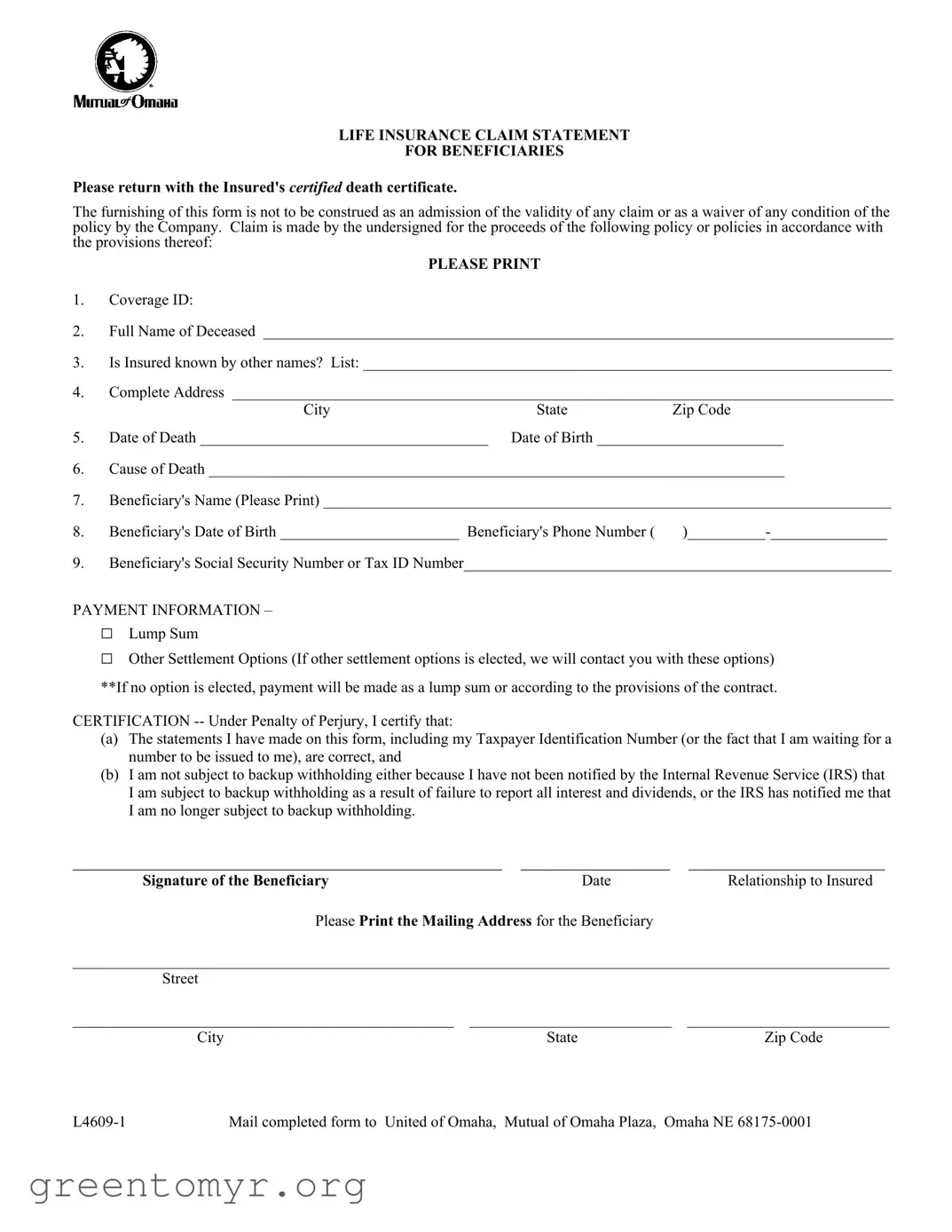
When dealing with the loss of a loved one, navigating the claims process can feel overwhelming. The Mutual of Omaha Accidental Death Claim form is a crucial document designed to facilitate the claims process for beneficiaries seeking benefits from a life insurance policy. This form requires key information, such as the deceased's full name, date of birth, and date of death, as well as the cause of death. Beneficiaries must also provide their own personal details, including their relationship to the insured and contact information. Additionally, the form emphasizes the importance of including a certified death certificate to validate the claim. Payment options are outlined, allowing beneficiaries to choose between a lump sum or other settlement methods, should they wish to explore alternatives. Furthermore, the form includes a certification section where the beneficiary affirms the accuracy of the information provided under penalty of perjury. It’s essential to read the attached fraud statements carefully, as they detail the legal implications of providing false information. Completing this form accurately and thoroughly is vital for ensuring a smooth claims process during a challenging time.

LIFE INSURANCE CLAIM STATEMENT
FOR BENEFICIARIES
Please return with the Insured's CERTIFIED death certificate.
The furnishing of this form is not to be construed as an admission of the validity of any claim or as a waiver of any condition of the policy by the Company. Claim is made by the undersigned for the proceeds of the following policy or policies in accordance with the provisions thereof:
PLEASE PRINT
1.Coverage ID:
2.Full Name of Deceased _________________________________________________________________________________
3.Is Insured known by other names? List: ____________________________________________________________________
4.Complete Address _____________________________________________________________________________________
|
City |
State |
Zip Code |
5. |
Date of Death _____________________________________ |
Date of Birth ________________________ |
|
6.Cause of Death __________________________________________________________________________
7.Beneficiary's Name (Please Print) _________________________________________________________________________
8. |
Beneficiary's Date of Birth _______________________ Beneficiary's Phone Number ( |
9.Beneficiary's Social Security Number or Tax ID Number_______________________________________________________
PAYMENT INFORMATION –
□
□
Lump Sum
Other Settlement Options (If other settlement options is elected, we will contact you with these options)
**If no option is elected, payment will be made as a lump sum or according to the provisions of the contract.
CERTIFICATION
(a)The statements I have made on this form, including my Taxpayer Identification Number (or the fact that I am waiting for a number to be issued to me), are correct, and
(b)I am not subject to backup withholding either because I have not been notified by the Internal Revenue Service (IRS) that I am subject to backup withholding as a result of failure to report all interest and dividends, or the IRS has notified me that I am no longer subject to backup withholding.
______________________________________________ |
________________ |
_____________________ |
Signature of the Beneficiary |
Date |
Relationship to Insured |
Please Print the Mailing Address for the Beneficiary
_________________________________________________________________________________________________________
Street |
|
|
_________________________________________________ |
__________________________ |
__________________________ |
City |
State |
Zip Code |
Mail completed form to United of Omaha, Mutual of Omaha Plaza, Omaha NE |
FRAUD STATEMENTS
The following fraud language is attached to, and made part of this claim form. Please read and do not remove these pages from this claim form.
**Alabama: Any person who knowingly presents a false or fraudulent claim for payment of a loss or benefit or who knowingly presents false information in an application for insurance is guilty of a crime and may be subject to restitution fines or confinement in prison, or any combination thereof.
**Alaska: A person who knowingly and with intent to injure, defraud or deceive an insurance company files a claim containing false, incomplete, or misleading information may be prosecuted under state law.
**Arizona: For your protection Arizona law requires the following statement to appear on this form.
Any person who knowingly presents a false or fraudulent claim for payment of a loss is subject to criminal and civil penalties.
**Arkansas: Any person who knowingly presents a false or fraudulent claim for payment of a loss or benefit or knowingly presents false information in an application for insurance is guilty of a crime and may be subject to fines and confinement in prison.
**California: For your protection California law requires the following to appear on this form. Any person who knowingly presents a false or fraudulent claim for the payment of a loss is guilty of a crime and may be subject to fines and confinement in state prison.
**Colorado: It is unlawful to knowingly provide false, incomplete, or misleading facts or information to an insurance company for the purpose of defrauding or attempting to defraud the company. Penalties may include imprisonment, fines, denial of insurance and civil damages. Any insurance company or agent of an insurance company who knowingly provides false, incomplete, or misleading facts or information to a policyholder or claimant for the purpose of defrauding or attempting to defraud the policyholder or claimant with regard to a settlement or award payable from insurance proceeds shall be reported to the Colorado Division of Insurance within the Department of Regulatory Agencies.
**Delaware: Any person who knowingly and with intent to injure, defraud or deceive any insurer, files a statement of claim containing any false, incomplete or misleading information is guilty of a felony.
**District of Columbia: WARNING: It is a crime to provide false or misleading information to an insurer or any other person. Penalties include imprisonment and/or fines. In addition, an insurer may deny insurance benefits if false information materially related to a claim was provided by the applicant.
**Florida: Any person who knowingly and with intent to injure, defraud, or deceive any insurer files a statement of claim or an application containing any false, incomplete, or misleading information is guilty of a felony of the third degree.
**Idaho: Any person who knowingly, and with intent to defraud or deceive any insurance company, files a statement containing any false, incomplete, or misleading information is guilty of a felony.
**Indiana: A person who knowingly and with intent to defraud an insurer files a statement of claim containing any false, incomplete, or misleading information commits a felony.
**Kentucky: Any person who knowingly and with intent to defraud any insurance company or other person files a statement of claim containing any materially false information or conceals, for the purpose of misleading, information concerning any fact material thereto commits a fraudulent insurance act, which is a crime.
**Louisiana: Any person who knowingly presents a false or fraudulent claim for payment of a loss or benefit or knowingly presents false information in an application for insurance is guilty of a crime and may be subject to fines and confinement in prison.
**Maine: It is a crime to knowingly provide false, incomplete or misleading information to an insurance company for the purpose of defrauding the company. Penalties include imprisonment, fines or a denial of insurance benefits.
**Maryland: Any person who knowingly or willfully presents a false or fraudulent claim for payment of a loss or benefit or who knowingly or willfully presents false information in an application for insurance is guilty of a crime and may be subject to fines and confinement in prison..
FS12222_0812
**Minnesota: A person who files a claim with intent to defraud or helps commit a fraud against an insurer is guilty of a crime.
**New Hampshire: Any person who, with a purpose to injure, defraud or deceive any insurance company, files a statement of claim containing any false, incomplete or misleading information is subject to prosecution and punishment for insurance fraud, as provided in RSA 638:20.
**New Jersey: Any person who knowingly files a statement of claim containing any false or misleading information is subject to criminal and civil penalties.
**New Mexico: ANY PERSON WHO KNOWINGLY PRESENTS A FALSE OR FRAUDULENT CLAIM FOR PAYMENT OF A LOSS OR BENEFIT OR KNOWINGLY PRESENTS FALSE INFORMATION IN AN APPLICATION FOR INSURANCE IS GUILTY OF A CRIME AND MAY BE SUBJECT TO CIVIL FINES AND CRIMINAL PENALTIES.
**New York: Any person who knowingly and with intent to defraud any insurance company or other person files an application for insurance or statement of claim containing any materially false information or conceals for the purpose of misleading, information concerning any fact material thereto, commits a fraudulent insurance act, which is a crime and shall also be subject to a civil penalty not to exceed five thousand dollars and the stated value of the claim for each such violation.
**Ohio: Any person who, with intent to defraud or knowing that he is facilitating a fraud against an insurer, submits an application or files a claim containing a false or deceptive statement is guilty of insurance fraud.
**Oklahoma: WARNING: Any person who knowingly, and with intent to injure, defraud or deceive any insurer, makes any claim for the proceeds of an insurance policy containing any false, incomplete or misleading information is guilty of a felony.
**Pennsylvania: Any person who knowingly and with intent to defraud any insurance company or other person files an application for insurance or statement of claim containing any materially false information or conceals for the purpose of misleading, information concerning any fact material thereto commits a fraudulent insurance act, which is a crime and subjects such person to criminal and civil penalties.
**Puerto Rico: Any person who knowingly and with the intention of defrauding presents false information in an insurance application, or presents, helps, or causes the presentation of a fraudulent claim for the payment of a loss or any other benefit, or presents more than one claim for the same damage or loss, shall incur a felony and, upon conviction, shall be sanctioned for each violation by a fine of not less than five thousand dollars ($5,000) and not more than ten thousand dollars ($10,000), or a fixed term of imprisonment for three (3) years, or both penalties. Should aggravating circumstances be present, the fixed penalty thus established may be increased to a maximum of five (5) years; if extenuating circumstances are present, it may be reduced to a minimum of two (2) years.
**Rhode Island: Any person who knowingly presents a false or fraudulent claim for payment of a loss or benefit or knowingly presents false information in an application for insurance is guilty of a crime and may be subject to fines and confinement in prison.
**Tennessee: It is a crime to knowingly provide false, incomplete or misleading information to an insurance company for the purpose of defrauding the company. Penalties include imprisonment, fines and denial of insurance benefits.
**Texas: Any person who knowingly presents a false or fraudulent claim for the payment of a loss is guilty of a crime and may be subject to fines and confinement in state prison.
**Virginia: It is a crime to knowingly provide false, incomplete or misleading information to an insurance company for the purpose of defrauding the company. Penalties include imprisonment, fines and denial of insurance benefits.
**Washington: It is a crime to knowingly provide false, incomplete, or misleading information to an insurance company for the purpose of defrauding the company. Penalties include imprisonment, fines and denial of insurance benefits.
**West Virginia: Any person who knowingly presents a false or fraudulent claim for payment of a loss or benefit or knowingly presents false information in an application for insurance is guilty of a crime and may be subject to fines and confinement in prison.
**If you live in a state other than mentioned above, the following statement applies to you: Any person who knowingly, and with intent to injure, defraud or deceive any insurer or insurance company, files a statement of claim containing any materially false, incomplete, or misleading information or conceals any fact material thereto, may be guilty of a fraudulent act, may be prosecuted under state law and may be subject to civil and criminal penalties. In addition, any insurer or insurance company may deny benefits if false information materially related to a claim is provided by the claimant.
| Fact Name | Description |
|---|---|
| Form Purpose | This form is used to file a claim for accidental death benefits under a life insurance policy. |
| Required Documentation | A certified death certificate must be submitted along with the claim form. |
| Fraud Warning | The form includes a fraud warning that outlines penalties for providing false information. |
| Beneficiary Information | Claimants must provide detailed information about the beneficiary, including name, date of birth, and Social Security number. |
| Payment Options | Claimants can choose between a lump sum payment or other settlement options, which will be communicated by the insurer. |
| State-Specific Laws | Each state has specific laws regarding fraudulent claims, affecting penalties and legal consequences. |
| Mailing Address | Completed forms should be mailed to United of Omaha, Mutual of Omaha Plaza, Omaha, NE 68175-0001. |
When you need to fill out the Mutual Of Omaha Accidental Death Claim form, it's important to provide accurate and complete information. This ensures that the claims process can proceed smoothly. Here are the steps to help you fill out the form correctly.
After you have completed these steps, ensure that all information is accurate and legible before sending your claim. This will help facilitate the processing of your claim by the insurance company.
The Mutual Of Omaha Accidental Death Claim PDF form is a document that beneficiaries must complete to claim the proceeds from a life insurance policy following the accidental death of the insured. This form requires specific information about the deceased, the beneficiary, and the circumstances of the death.
You will need to provide several key pieces of information, including:
Yes, a certified death certificate must be submitted along with the completed claim form. This document verifies the death of the insured and is crucial for processing the claim.
If you do not select a payment option, the proceeds will be paid out as a lump sum by default, according to the terms of the insurance policy.
The completed form should be mailed to the following address: United of Omaha, Mutual of Omaha Plaza, Omaha, NE 68175-0001. Ensure that all required information is filled out accurately to avoid delays.
If you have questions or need assistance, it is best to contact Mutual of Omaha directly. They can provide guidance specific to your situation and help clarify any uncertainties regarding the claim process.
Yes, providing false or misleading information on the claim form can lead to serious legal consequences. This includes criminal charges, fines, and potential denial of your claim. Always ensure that the information you provide is accurate and truthful.
The certification section is a declaration by the beneficiary, affirming that all information provided is correct and that they are not subject to backup withholding. This section helps protect both the beneficiary and the insurance company from fraudulent claims.
Once a claim has been submitted, changing the beneficiary may not be possible until the claim is processed. It is advisable to review your policy and contact Mutual of Omaha for guidance on beneficiary changes.
The processing time can vary based on the complexity of the claim and the completeness of the submitted information. Generally, it may take several weeks, so it’s important to submit the form promptly and accurately.
Filling out the Mutual Of Omaha Accidental Death Claim form can be a daunting task. Many people make common mistakes that can delay the process or even result in a denial of the claim. Here are ten mistakes to avoid.
First, failing to provide a certified death certificate is a frequent oversight. This document is essential for processing the claim. Without it, the claim may be rejected outright.
Another common error is not printing information clearly. Illegible handwriting can lead to misunderstandings. Ensure that all details, especially the deceased's full name and address, are easy to read.
Some individuals forget to include the Coverage ID. This number is critical for identifying the policy in question. Omitting it can cause unnecessary delays.
It’s also important to provide accurate dates. Mistakes in the date of death or date of birth can raise red flags. Double-check these dates to ensure they match official documents.
Many claimants overlook the section about other names the insured might have used. If applicable, list any aliases. This information can help clarify the identity of the deceased.
Another mistake involves the beneficiary's information. Ensure that the beneficiary's name, date of birth, and Social Security number are correct. Inaccuracies can complicate the payment process.
Choosing a payment option is another area where people stumble. If you do not select a payment method, the default will be a lump sum. Make sure to indicate your preference clearly.
Some individuals forget to sign and date the form. A missing signature can halt the processing of the claim entirely. Always check that you’ve completed this crucial step.
Another frequent error is not providing a complete mailing address for the beneficiary. Incomplete addresses can delay communications and payments.
Lastly, failing to read the fraud statements can lead to unintended consequences. Understanding the implications of providing false information is vital. Always ensure that all information is truthful and complete.
By avoiding these common mistakes, you can help ensure a smoother claims process with Mutual Of Omaha. Take your time and review the form thoroughly before submission.
When filing a claim for accidental death benefits with Mutual of Omaha, several other forms and documents may be required to support the claim. Each of these documents plays a crucial role in ensuring that the claim is processed smoothly and efficiently. Below is a list of commonly used forms and documents that accompany the Mutual of Omaha Accidental Death Claim form.
Gathering these documents can help streamline the claims process and provide the necessary evidence to support the claim. It is always best to check with Mutual of Omaha for any specific requirements related to your situation.
When filling out the Mutual Of Omaha Accidental Death Claim form, it’s important to be careful and thorough. Here are five essential do's and don'ts to keep in mind:
Following these guidelines can help ensure a smoother claims process. Take your time and ensure everything is filled out correctly.
Here are nine common misconceptions about the Mutual Of Omaha Accidental Death Claim PDF form:
When filling out the Mutual of Omaha Accidental Death Claim form, there are several important points to keep in mind: