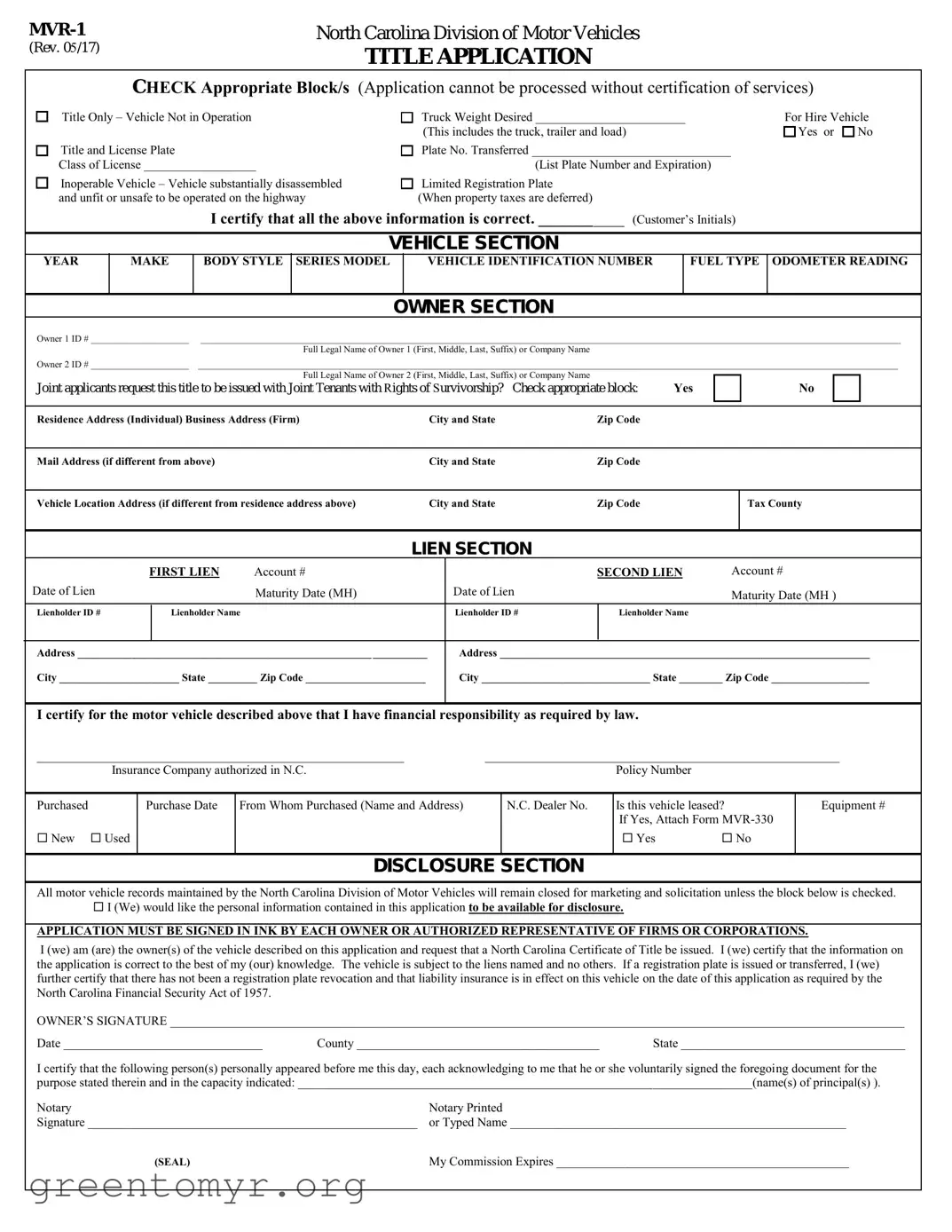
The MVR-1 form is an essential document for individuals and businesses in North Carolina seeking to apply for a vehicle title. This form serves multiple purposes, including the application for a title only, title with a license plate, or for vehicles that are inoperable or substantially disassembled. Applicants must check the appropriate boxes to indicate the specific services they require. The form requires detailed information about the vehicle, such as its year, make, model, and vehicle identification number (VIN), as well as the odometer reading at the time of application. Additionally, it collects owner information, including the full legal names and addresses of up to two owners, and allows for the designation of joint ownership with rights of survivorship. The MVR-1 also includes a lien section where any existing liens on the vehicle must be disclosed, ensuring transparency in ownership. Furthermore, applicants must certify their financial responsibility and provide insurance details, affirming compliance with North Carolina laws. Finally, the form includes a disclosure section regarding the availability of personal information, which can be opted into for marketing purposes. Proper completion and signature by all owners or authorized representatives are required to process the application effectively.
|
|
North Carolina Division of Motor Vehicles |
|
||
|
(Rev. 05/17) |
|
|
TITLE APPLICATION |
|
|
|
|
|
|
|
|
|
CHECK Appropriate Block/s (Application cannot be processed without certification of services) |
|||
|
Title Only – Vehicle Not in Operation |
|
Truck Weight Desired ________________________ |
For Hire Vehicle |
|
|
|
|
|
(This includes the truck, trailer and load) |
Yes or No |
|
Title and License Plate |
|
Plate No. Transferred ________________________________ |
|
|
|
Class of License __________________ |
|
(List Plate Number and Expiration) |
|
|
|
Inoperable Vehicle – Vehicle substantially disassembled |
Limited Registration Plate |
|
||
|
and unfit or unsafe to be operated on the highway |
|
(When property taxes are deferred) |
|
|
I certify that all the above information is correct. ___________ (Customer’s Initials)
VEHICLE SECTION
YEAR
MAKE
BODY STYLE SERIES MODEL
VEHICLE IDENTIFICATION NUMBER
FUEL TYPE ODOMETER READING
OWNER SECTION
Owner 1 ID # _____________________ |
______________________________________________________________________________________________________________________________________________________ |
||||
|
|
Full Legal Name of Owner 1 (First, Middle, Last, Suffix) or Company Name |
|
|
|
Owner 2 ID # _____________________ |
______________________________________________________________________________________________________________________________________________________ |
||||
|
|
Full Legal Name of Owner 2 (First, Middle, Last, Suffix) or Company Name |
Yes |
No |
|
Joint applicants request this title to be issued with Joint Tenants with Rights of Survivorship? |
Check appropriate block: |
||||
|
|
|
|
|
|
Residence Address (Individual) Business Address (Firm) |
City and State |
Zip Code |
|
|
|
|
|
|
|
|
|
Mail Address (if different from above) |
City and State |
Zip Code |
|
|
|
Vehicle Location Address (if different from residence address above) |
City and State |
Zip Code |
Tax County
LIEN SECTION
|
FIRST LIEN |
Account # |
|
SECOND LIEN |
Account # |
||
Date of Lien |
|
|
Maturity Date (MH) |
Date of Lien |
|
Maturity Date (MH ) |
|
Lienholder ID # |
|
Lienholder Name |
|
Lienholder ID # |
Lienholder Name |
|
|
|
|
|
|
|
|||
Address ______________________________________________________ __________ |
Address ____________________________________________________________________ |
||||||
City ______________________ State _________ Zip Code ______________________ |
City _______________________________ State ________ Zip Code __________________ |
||||||
|
|
|
|
|
|
|
|
I certify for the motor vehicle described above that I have financial responsibility as required by law.
___________________________________________________________ |
_________________________________________________________ |
Insurance Company authorized in N.C. |
Policy Number |
Purchased
New Used
Purchase Date
From Whom Purchased (Name and Address)
N.C. Dealer No.
Is this vehicle leased?
If Yes, Attach Form
Yes |
No |
Equipment #
DISCLOSURE SECTION
All motor vehicle records maintained by the North Carolina Division of Motor Vehicles will remain closed for marketing and solicitation unless the block below is checked.
I (We) would like the personal information contained in this application to be available for disclosure.
APPLICATION MUST BE SIGNED IN INK BY EACH OWNER OR AUTHORIZED REPRESENTATIVE OF FIRMS OR CORPORATIONS.
I (we) am (are) the owner(s) of the vehicle described on this application and request that a North Carolina Certificate of Title be issued. I (we) certify that the information on the application is correct to the best of my (our) knowledge. The vehicle is subject to the liens named and no others. If a registration plate is issued or transferred, I (we) further certify that there has not been a registration plate revocation and that liability insurance is in effect on this vehicle on the date of this application as required by the North Carolina Financial Security Act of 1957.
OWNER’S SIGNATURE ______________________________________________________________________________________________________________________
Date ________________________________County _______________________________________State ____________________________________
I certify that the following person(s) personally appeared before me this day, each acknowledging to me that he or she voluntarily signed the foregoing document for the purpose stated therein and in the capacity indicated: _________________________________________________________________________(name(s) of principal(s) ).
Notary |
Notary Printed |
Signature _____________________________________________________ |
or Typed Name ______________________________________________________ |
(SEAL) |
My Commission Expires _______________________________________________ |
| Fact Name | Details |
|---|---|
| Purpose of MVR-1 | The MVR-1 form is used to apply for a title for a vehicle in North Carolina, whether the vehicle is operational or not. |
| Governing Law | This form is governed by the North Carolina General Statutes, specifically under Title 20, Chapter 58, which pertains to motor vehicle titles and registration. |
| Owner Information | The form requires detailed information about the vehicle's owner, including full legal names and addresses for all owners. |
| Liens Disclosure | If there are any liens on the vehicle, the MVR-1 form must include information about the lienholders, including their names and addresses. |
| Insurance Certification | The applicant must certify that they have financial responsibility for the vehicle, as required by North Carolina law. |
| Application Signature | Each owner or authorized representative must sign the application in ink for it to be valid. |
| Notarization Requirement | The application must be notarized, confirming that the signatories have personally appeared and signed the document. |
Filling out the MVR-1 form is a straightforward process. Follow these steps carefully to ensure that all necessary information is provided accurately. Once completed, the form will need to be signed and submitted to the appropriate authority.
The MVR-1 form is an application for a vehicle title in North Carolina. It is primarily used to request a certificate of title for a vehicle, whether it is operational or not. This form is essential for registering a vehicle, transferring ownership, or obtaining a title for a vehicle that may have been previously unregistered.
Anyone who wishes to obtain a title for a vehicle in North Carolina must complete the MVR-1 form. This includes individuals buying or selling vehicles, those who have inherited a vehicle, or anyone who needs to replace a lost title. If there are multiple owners, each owner must provide their information on the form.
The MVR-1 form requires several pieces of information, including:
It is important to provide accurate information, as any discrepancies can delay the processing of the application.
Once you have completed the MVR-1 form, you can submit it to your local North Carolina Division of Motor Vehicles (DMV) office. It is advisable to check if you need to make an appointment or if you can walk in. Additionally, you may be required to pay a fee for processing the title application, so be prepared to provide payment as needed.
After submission, the DMV will review your application. If everything is in order, they will process your request and issue a title for your vehicle. This process may take several weeks, depending on the volume of applications being handled. You will receive a notification once your title is ready, or you may be able to check the status online through the DMV's website.
Filling out the MVR-1 form can be a straightforward process, but there are common mistakes that people often make. These errors can lead to delays in processing or even rejection of the application. Understanding these pitfalls is essential for a smooth experience.
One frequent mistake is failing to check the appropriate blocks at the beginning of the form. Each section, such as "Title Only" or "Title and License Plate," requires careful consideration. If the correct options are not selected, the application cannot be processed. This oversight can cause unnecessary delays.
Another common error involves incorrect or incomplete vehicle information. The section that requires details like the year, make, model, and vehicle identification number (VIN) must be filled out accurately. A simple typo in the VIN can lead to significant issues, including the inability to register the vehicle.
Omitting or misrepresenting ownership details is also a serious mistake. When listing the owners, it’s crucial to provide the full legal names, including any suffixes. If there are joint owners, both must be listed, and the correct designation for ownership rights should be checked. This ensures that all parties are recognized legally.
People often forget to include the residence and mailing addresses. These details are vital for the DMV to contact the applicant. If the addresses are missing or incorrect, it can result in important documents being sent to the wrong location.
Another mistake is neglecting to certify financial responsibility. The form requires a declaration of insurance coverage. If this section is left blank or filled out incorrectly, it may lead to the application being denied. Insurance information must be current and accurate.
In the lien section, errors can arise when listing lienholders. It’s essential to provide accurate account numbers and names. If there are multiple liens, all must be documented correctly. Missing or incorrect lien information can complicate the title issuance process.
Many applicants forget to sign the form. Each owner or authorized representative must sign in ink. Without a signature, the application is incomplete and cannot be processed. This is a simple yet crucial step that should not be overlooked.
Lastly, failing to notarize the application can lead to rejection. The form requires notarization to validate the signatures. If this step is missed, the application will not be accepted, causing further delays.
By being aware of these common mistakes, applicants can fill out the MVR-1 form more accurately and efficiently. Taking the time to double-check all information will help ensure a smoother process and avoid unnecessary complications.
The MVR-1 form is essential for applying for a vehicle title in North Carolina. However, several other documents often accompany it to ensure a smooth application process. Below is a list of these forms, each serving a specific purpose.
Each of these documents plays a vital role in the vehicle title application process, ensuring that all legal requirements are met and that ownership is properly established. Having these forms ready can significantly streamline the experience with the DMV.
When filling out the MVR-1 form for a vehicle title application in North Carolina, there are important guidelines to keep in mind. Here’s a list of things you should and shouldn’t do:
Following these guidelines can help make the process smoother and ensure that your application is processed without unnecessary issues.
Misconceptions about the MVR-1 form can lead to confusion for those trying to navigate the title application process in North Carolina. Here are six common misunderstandings:
Understanding these misconceptions can help ensure that your application process goes smoothly and that you comply with all necessary requirements.
When filling out the MVR-1 form for a title application in North Carolina, keep these key takeaways in mind: