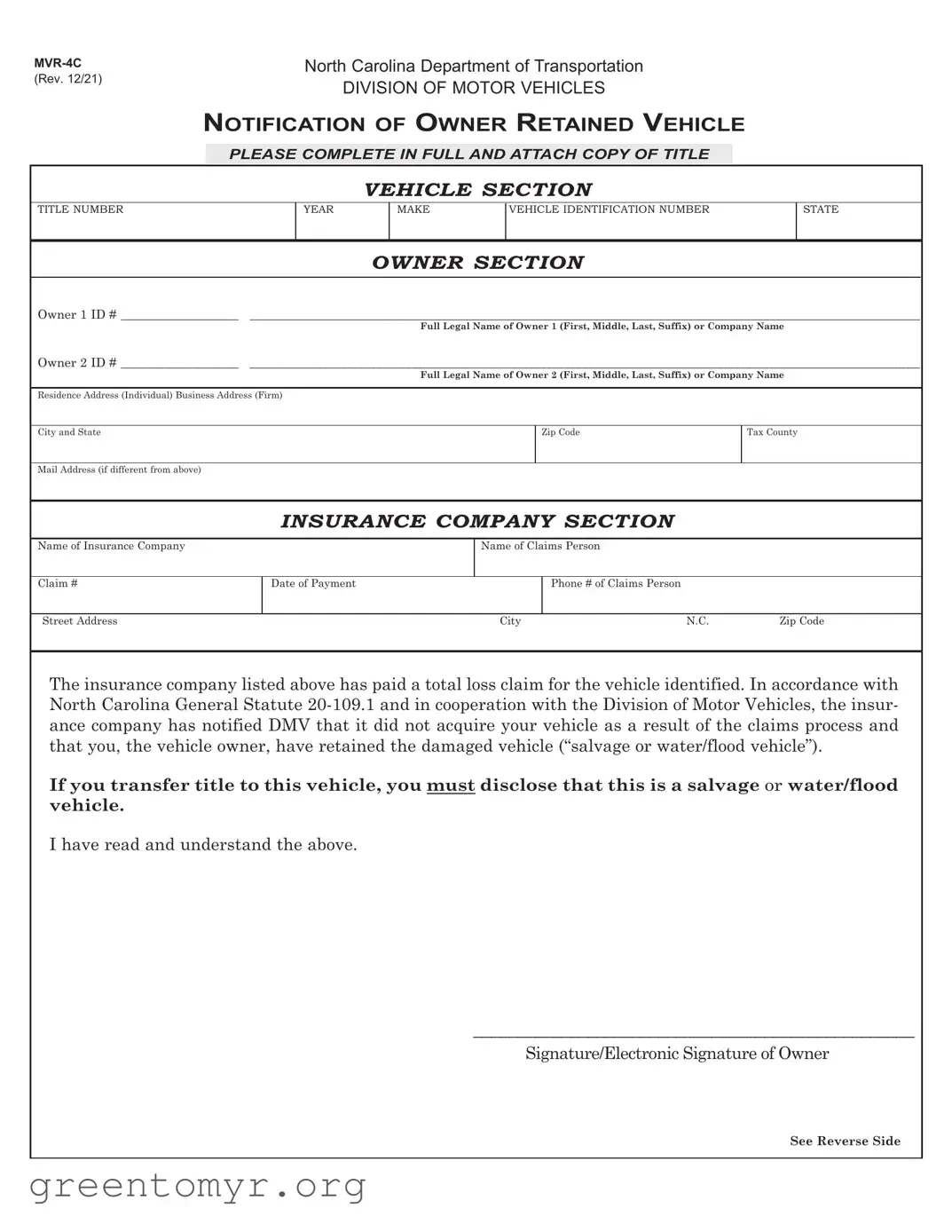
The MVR-4C form plays a crucial role in the management of vehicles that have been deemed salvage or water/flood vehicles in North Carolina. This form serves as a notification from the insurance company to the Division of Motor Vehicles (DMV) regarding a vehicle that the owner has chosen to retain after a total loss claim. It requires detailed information about the vehicle, including its title number, year, make, and vehicle identification number, as well as the full legal names and addresses of the vehicle owners. The insurance company must also provide contact information for the claims representative and details of the claim, ensuring transparency throughout the process. By completing the MVR-4C form, vehicle owners acknowledge their understanding of the implications of retaining a salvage vehicle, particularly the need to disclose its status if they later transfer the title. This form is not just a bureaucratic necessity; it is a safeguard for both the owner and future buyers, ensuring that everyone is aware of the vehicle's condition and history. Understanding the MVR-4C form is essential for anyone involved in the salvage vehicle process, as it delineates the responsibilities of both the vehicle owner and the insurance company, while also adhering to the legal requirements set forth by North Carolina General Statute 20-109.1.
(Rev. 12/21)
North Carolina Department of Transportation
DIVISION OF MOTOR VEHICLES
NOTIFICATION OF OWNER RETAINED VEHICLE
PLEASE COMPLETE IN FULL AND ATTACH COPY OF TITLE
VEHICLE SECTION
TITLE NUMBER
YEAR
MAKE
VEHICLE IDENTIFICATION NUMBER
STATE
OWNER SECTION
Owner 1 ID # ____________________ __________________________________________________________________________________________________________________
Full Legal Name of Owner 1 (First, Middle, Last, Suffix) or Company Name
Owner 2 ID # ____________________ __________________________________________________________________________________________________________________
Full Legal Name of Owner 2 (First, Middle, Last, Suffix) or Company Name
Residence Address (Individual) Business Address (Firm)
City and State
Zip Code
Tax County
Mail Address (if different from above)
INSURANCE COMPANY SECTION
Name of Insurance Company
Name of Claims Person
Claim #
Date of Payment
Phone # of Claims Person
Street Address
City
N.C. |
Zip Code |
The insurance company listed above has paid a total loss claim for the vehicle identified. In accordance with North Carolina General Statute
If you transfer title to this vehicle, you must disclose that this is a salvage or water/flood vehicle.
I have read and understand the above.
__________________________________________________
Signature/Electronic Signature of Owner
See Reverse Side
G.S.
(a)Option to Keep Title. — When a vehicle is damaged to the extent that it becomes a salvage vehicle and the owner submits a claim for the damages to the insurer of the vehicle, the insurer must determine whether the owner wants to keep the vehicle after payment of the claim, the procedures in subsection (b) of this section apply. If the owner wants to keep the vehicle after payment of the claim, the procedures in subsection (c) of this section apply.
(b)Transfer to Insurer. — If a salvage vehicle owner does not want to keep the vehicle, the owner must assign the vehicle’s certificate of title to the insurer when the insurer pays the claim. The insurer must send the assigned title to the Division within 10 days after receiving it from the vehicle owner. The Division must then send the insurer a form to use to transfer title to the vehicle from the insurer to a person who buys the vehicle from the insurer. If the insurer sells the vehicle, the insurer must complete the form and give it to the buyer. If the buyer rebuilds the vehicle, the buyer may apply for a new certificate of title to the vehicle.
(c)Owner Keeps Vehicle. — If a salvage vehicle owner wants to keep the vehicle, the insurer must give the owner an
(d)Theft Claim on Salvage Vehicle. — An insurer that pays a theft loss claim on a vehi- cle and, upon recovery of the vehicle, determines that the vehicle has been damaged to the extent that it is a salvage vehicle must send the vehicle's certificate of title to the Division within 10 days after making the determination. The Division and the insurer must then fol- low the procedures set in subsection (b) of this section.
(e)
(f)Sanctions. — Violation of this section is a Class 1 misdemeanor. In addition to this criminal sanction, a person who violates this section is subject to a civil penalty of up to one hundred dollars ($100.00), to be imposed in the discretion of the Commissioner.
G.S.
| Fact Name | Details |
|---|---|
| Form Purpose | The MVR-4C form is used in North Carolina to notify the DMV that the vehicle owner has retained a damaged vehicle after an insurance claim for total loss. |
| Governing Law | This form is governed by North Carolina General Statute 20-109.1, which outlines the procedures for salvage vehicles and owner retention. |
| Insurance Notification | The form requires insurance companies to notify the DMV if they have paid a total loss claim but the owner has chosen to keep the vehicle. |
| Owner's Responsibility | Vehicle owners must disclose that the vehicle is salvage or water/flood damaged if they transfer the title in the future. |
| Submission Timeline | Insurers must send the completed MVR-4C form to the DMV within 10 days of receiving it from the vehicle owner. |
| Consequences of Non-Compliance | Failing to comply with the requirements of this statute can result in a Class 1 misdemeanor and potential civil penalties up to $100. |
After filling out the MVR-4C form, the next step involves submitting it to the appropriate department. Ensure you attach a copy of the vehicle title as required. This form is essential for notifying the North Carolina Department of Transportation about your retained vehicle status. Follow the steps below to complete the form accurately.
The MVR-4C form is a notification document used in North Carolina. It is specifically for vehicle owners who have retained their vehicle after an insurance company has declared it a total loss. This form informs the Division of Motor Vehicles (DMV) that the owner has chosen to keep the damaged vehicle, which may be classified as salvage or water/flood vehicle.
Any vehicle owner in North Carolina who decides to keep their vehicle after receiving a total loss claim from their insurance company must complete the MVR-4C form. Both individual owners and businesses can fill out this form. If there are multiple owners, each must provide their information on the form.
The form requires several key pieces of information:
It’s important to fill out the form completely and accurately to avoid any delays in processing.
Once you submit the MVR-4C form to your insurance company, they will send it to the DMV within 10 days. The DMV will then update their records to indicate that your vehicle is classified as a salvage vehicle. This classification is important for any future transactions involving the vehicle, such as selling or transferring the title.
If you fail to file the MVR-4C form when required, you may face legal consequences. This can include penalties such as fines or civil penalties up to $100. Additionally, not properly notifying the DMV could complicate any future transactions involving the vehicle, such as selling or transferring ownership.
Yes, if you acquire a salvage vehicle that is registered in another state, you must still follow the procedures outlined in the MVR-4C form. You are required to send the vehicle's title to the North Carolina DMV within 10 days of bringing the vehicle into the state. This ensures that the vehicle is properly registered and classified according to North Carolina laws.
Filling out the MVR-4C form can be straightforward, but several common mistakes can lead to complications. One frequent error is failing to provide complete information in the vehicle section. Individuals must ensure that all fields, including the title number, year, make, and vehicle identification number (VIN), are accurately filled out. Omitting any of these details can delay the processing of the form.
Another mistake is neglecting to include a copy of the vehicle title. The form explicitly states that a copy of the title must be attached. Without this documentation, the form may be rejected, requiring the owner to resubmit the application with the necessary paperwork.
In the owner section, errors often arise from incorrect names. It is crucial that the full legal names of both owners are entered correctly. Any discrepancies, such as misspellings or using nicknames, can create confusion and may result in processing delays. Each owner’s ID number must also be accurately recorded.
Providing an incorrect or incomplete address is another common issue. The form requires both residence and business addresses if applicable. Failing to provide the correct mailing address can lead to important communications being missed, which may affect the status of the vehicle.
Additionally, some individuals overlook the insurance company section. They may either fail to list the name of the insurance company or omit crucial details such as the claims person’s name or claim number. This information is essential for the insurance company to validate the claim and process the form effectively.
Another common mistake is not signing the form. The signature or electronic signature of the owner is mandatory. Without this, the form cannot be processed, and it may be returned for completion. Owners should also ensure that they understand the statement regarding the retention of the vehicle and acknowledge it by signing.
Furthermore, many people forget to submit the form within the required timeframe. The insurance company must send the completed MVR-4C form to the Division of Motor Vehicles within ten days of receiving it from the vehicle owner. Delays in submission can lead to complications in vehicle registration.
Lastly, individuals often overlook the importance of understanding the implications of retaining a salvage vehicle. They must be aware that if they choose to keep the vehicle, it will be classified as a salvage or water/flood vehicle. This classification can affect future insurance and resale options, making it vital to understand the long-term consequences of their decision.
The MVR-4C form is a critical document for vehicle owners in North Carolina who have retained a vehicle after an insurance claim. Alongside this form, several other documents are often required to ensure compliance with state regulations regarding vehicle ownership and title transfer. Below is a list of these documents, each serving a specific purpose in the process.
Understanding these accompanying documents is essential for vehicle owners navigating the complexities of salvage vehicle ownership. Properly completing and submitting these forms ensures compliance with North Carolina laws and facilitates a smoother transition in vehicle ownership.
The MVR-4C form is an important document for vehicle owners in North Carolina who wish to retain a damaged vehicle after an insurance claim. Several other documents serve similar purposes in different contexts. Here’s a list of ten documents that are comparable to the MVR-4C form:
When filling out the MVR-4C form, it’s important to follow the guidelines carefully. Here’s a list of things you should and shouldn’t do:
The MVR-4C form is an important document in North Carolina for vehicle owners who have retained a damaged vehicle after an insurance claim. However, several misconceptions surround its purpose and requirements. Here are nine common misconceptions explained:
Understanding these misconceptions can help vehicle owners navigate the process more effectively and ensure compliance with North Carolina laws regarding salvage vehicles.
When dealing with the MVR-4C form in North Carolina, it is essential to understand its purpose and the steps required for proper completion. Here are some key takeaways:
Understanding these points will facilitate a smoother process when filling out and using the MVR-4C form, helping vehicle owners navigate their obligations effectively.