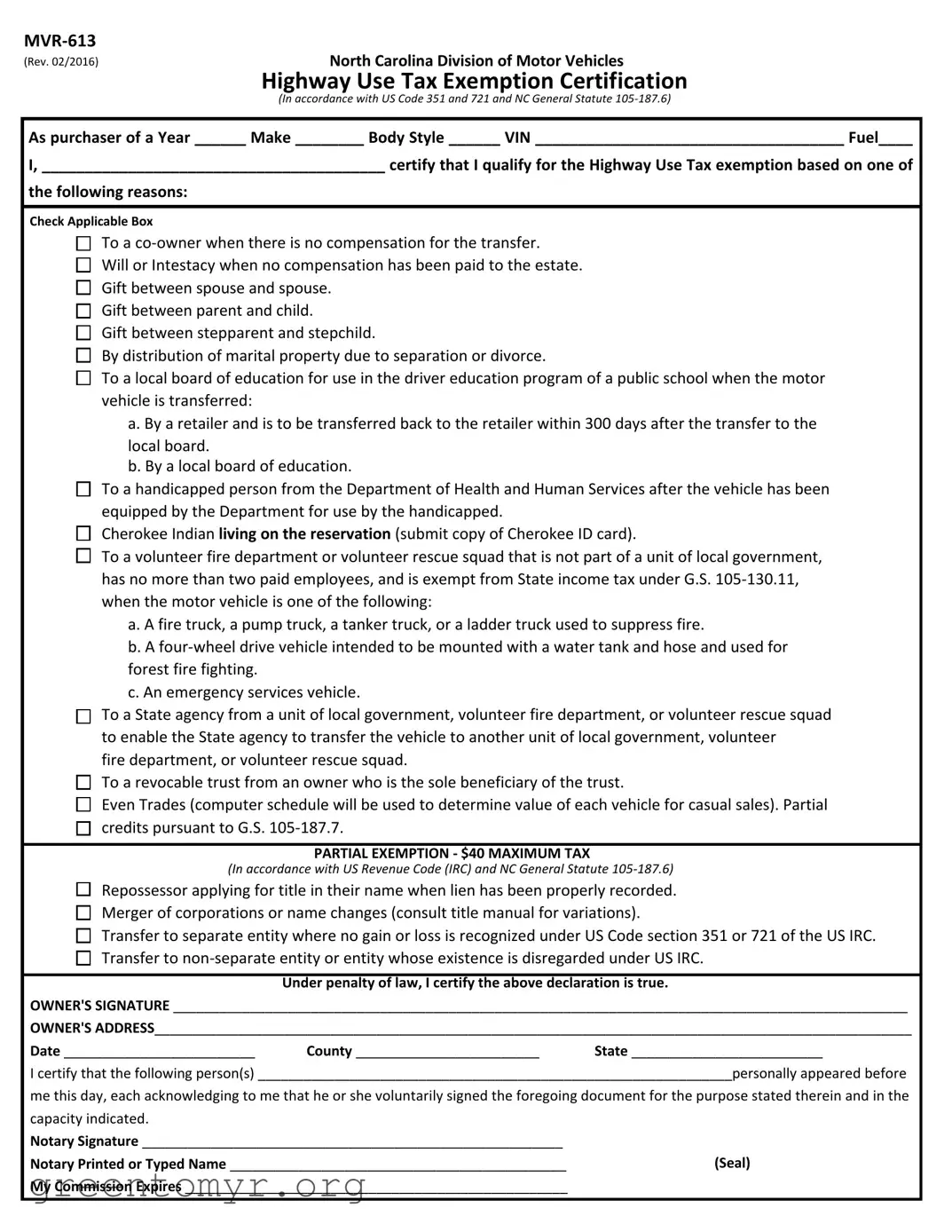
The MVR-613 form is a crucial document for individuals and entities seeking a Highway Use Tax exemption in North Carolina. This form is utilized by purchasers of motor vehicles, allowing them to certify their eligibility for tax relief under specific circumstances outlined by state and federal law. Various scenarios qualify for exemption, including transfers between co-owners without compensation, gifts between family members, and vehicles designated for public education programs. Additionally, the form accommodates unique situations such as transfers to volunteer fire departments and certain state agencies. Completing the MVR-613 requires the purchaser to provide detailed information about the vehicle, including its make, model, and VIN, along with their personal certification of eligibility. The form also includes provisions for partial exemptions and specific tax considerations for repossessors and corporate mergers. Properly filling out and submitting this form can significantly impact the tax obligations of vehicle purchasers, making it an essential part of the vehicle transfer process in North Carolina.

(Rev. 02/2016) |
North Carolina Division of Motor Vehicles |
|
Highway Use Tax Exemption Certification |
|
(In accordance with US Code 351 and 721 and NC General Statute |
As purchaser of a Year ______ Make ________ Body Style ______ VIN ____________________________________ Fuel____
I, ________________________________________ certify that I qualify for the Highway Use Tax exemption based on one of
the following reasons:
Check Applicable Box
To a
Will or Intestacy when no compensation has been paid to the estate. Gift between spouse and spouse.
Gift between parent and child.
Gift between stepparent and stepchild.
By distribution of marital property due to separation or divorce.
To a local board of education for use in the driver education program of a public school when the motor vehicle is transferred:
a. By a retailer and is to be transferred back to the retailer within 300 days after the transfer to the local board.
b. By a local board of education.
To a handicapped person from the Department of Health and Human Services after the vehicle has been equipped by the Department for use by the handicapped.
Cherokee Indian living on the reservation (submit copy of Cherokee ID card).
To a volunteer fire department or volunteer rescue squad that is not part of a unit of local government, has no more than two paid employees, and is exempt from State income tax under G.S.
a. A fire truck, a pump truck, a tanker truck, or a ladder truck used to suppress fire.
b. A
c. An emergency services vehicle.
To a State agency from a unit of local government, volunteer fire department, or volunteer rescue squad to enable the State agency to transfer the vehicle to another unit of local government, volunteer
fire department, or volunteer rescue squad.
To a revocable trust from an owner who is the sole beneficiary of the trust.
Even Trades (computer schedule will be used to determine value of each vehicle for casual sales). Partial credits pursuant to G.S.
PARTIAL EXEMPTION - $40 MAXIMUM TAX
(In accordance with US Revenue Code (IRC) and NC General Statute
Repossessor applying for title in their name when lien has been properly recorded. Merger of corporations or name changes (consult title manual for variations).
Transfer to separate entity where no gain or loss is recognized under US Code section 351 or 721 of the US IRC. Transfer to
Under penalty of law, I certify the above declaration is true.
OWNER'S SIGNATURE ________________________________________________________________________________________________
OWNER'S ADDRESS___________________________________________________________________________________________________
Date _________________________ County ________________________ State _________________________
I certify that the following person(s) ______________________________________________________________personally appeared before
me this day, each acknowledging to me that he or she voluntarily signed the foregoing document for the purpose stated therein and in the capacity indicated.
Notary Signature _______________________________________________________ |
|
Notary Printed or Typed Name ____________________________________________ |
(Seal) |
My Commission Expires __________________________________________________ |
|
| Fact Name | Details |
|---|---|
| Form Title | MVR-613 - Highway Use Tax Exemption Certification |
| Governing Laws | US Code 351, 721; NC General Statute 105-187.6 |
| Purpose | Certifies eligibility for Highway Use Tax exemption on vehicle transfers. |
| Eligible Transfers | Includes gifts, transfers to educational boards, and transfers to certain organizations. |
| Partial Exemption | Allows for a maximum tax of $40 under specific conditions. |
| Signature Requirement | Owner must sign to certify the truth of the declaration. |
| Notary Acknowledgment | Requires a notary signature to validate the form. |
Completing the MVR-613 form is essential for certifying your eligibility for a Highway Use Tax exemption in North Carolina. Follow these steps to ensure the form is filled out correctly.
The MVR-613 form is used in North Carolina to certify eligibility for a Highway Use Tax exemption when transferring ownership of a motor vehicle. This exemption can apply in various situations, such as gifts between family members, transfers due to divorce, or transfers to specific organizations like volunteer fire departments. The form ensures compliance with both federal and state laws regarding motor vehicle taxation.
Eligibility for the MVR-613 form includes a range of circumstances, such as:
Each scenario must meet the requirements outlined in the form to qualify for the exemption.
To complete the MVR-613 form, follow these steps:
Ensure all sections are accurately completed to avoid delays in processing.
If you do not qualify for the Highway Use Tax exemption, you will be required to pay the applicable tax when transferring the vehicle. It is essential to review the eligibility criteria carefully before submitting the MVR-613 form. Failing to provide accurate information may lead to penalties or delays in the registration process.
The completed MVR-613 form should be submitted to the North Carolina Division of Motor Vehicles (NCDMV) along with any other required documents for vehicle registration. This can typically be done at your local DMV office or through their online services, if available. It is advisable to check the NCDMV website for specific submission guidelines and requirements.
Providing false information on the MVR-613 form can lead to serious legal consequences. Under penalty of law, individuals who submit inaccurate or misleading information may face fines, penalties, or criminal charges. It is crucial to ensure that all statements made on the form are truthful and accurately reflect your situation.
Filling out the MVR-613 form can be straightforward, but many people make common mistakes that can delay processing. One frequent error is failing to provide complete information about the vehicle. The form requires details such as the year, make, body style, and VIN. Missing any of these can lead to complications.
Another mistake is not checking the correct box for the exemption reason. The form lists several options, and selecting the wrong one can result in the denial of the exemption. Take your time to read through each option carefully before making your choice.
Many people also overlook the importance of the owner's signature. Without a signature, the form is not valid. Ensure that you sign in the designated area. Additionally, it's crucial to provide a complete address. An incomplete or incorrect address can create issues in communication or processing.
Some individuals forget to date the form. The date is important for record-keeping and processing timelines. Always double-check that the date is filled in correctly. Similarly, failing to provide the county and state can lead to delays. These details are essential for the processing of the form.
Another common oversight is not including the notary section. The MVR-613 requires a notary signature for verification. Ensure that the notary public completes this section properly, or your form may be rejected. Remember to check that the notary's commission has not expired, as this can invalidate the notarization.
People sometimes neglect to review the entire form before submission. Taking a moment to double-check your entries can save you from potential errors. Lastly, be cautious of using abbreviations or shorthand. Clarity is key. Ensure that all information is written out clearly to avoid any confusion during processing.
The MVR-613 form is an essential document for individuals in North Carolina seeking a Highway Use Tax exemption. However, it is often accompanied by several other forms and documents that help facilitate various transactions related to vehicle transfers. Understanding these additional documents can streamline the process and ensure compliance with legal requirements.
In summary, the MVR-613 form works in conjunction with several other important documents that facilitate the legal transfer of vehicle ownership. Familiarity with these forms can help ensure that all necessary steps are taken, making the process smoother and more efficient for everyone involved.
The MVR-613 form serves a specific purpose related to tax exemptions for vehicle transfers in North Carolina. Several other documents share similarities with it, particularly in their function or requirements. Here are nine documents that are similar to the MVR-613 form:
When filling out the MVR-613 form, it’s important to follow specific guidelines to ensure your submission is accurate and complete. Here are some things you should and shouldn't do:
The MVR-613 form is an important document used in North Carolina for certifying eligibility for the Highway Use Tax exemption. However, several misconceptions exist regarding its purpose and use. Below are nine common misconceptions, along with explanations to clarify the facts.
Understanding these misconceptions can help individuals navigate the process of applying for a Highway Use Tax exemption more effectively. It is essential to read the form carefully and ensure all criteria are met to avoid potential issues.
When dealing with the MVR-613 form for Highway Use Tax Exemption in North Carolina, there are several important points to keep in mind. This form is crucial for ensuring that you qualify for exemptions and can avoid unnecessary tax burdens. Here are key takeaways to consider:
Completing the MVR-613 form accurately and understanding its requirements is essential for navigating the Highway Use Tax exemption process effectively. Ensure that you take the necessary steps to comply with all legal obligations.