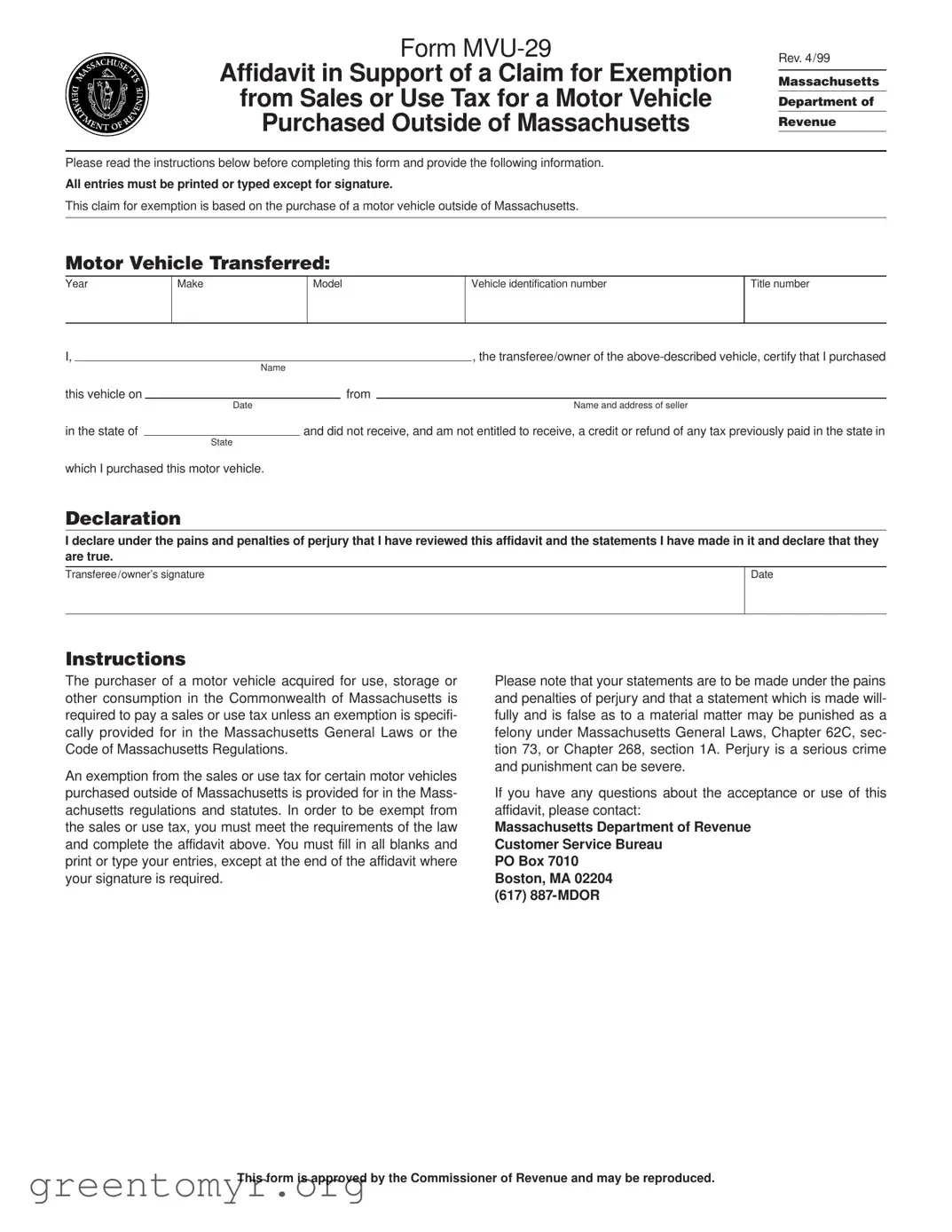
The MVU-29 form, officially known as the Affidavit in Support of a Claim for Exemption from Sales or Use Tax for a Motor Vehicle Purchased Outside of Massachusetts, serves a critical role for residents who buy vehicles outside the state. Designed by the Massachusetts Department of Revenue, this form allows purchasers to claim an exemption from the sales or use tax that would typically apply when a vehicle is brought into Massachusetts for use. To successfully complete the MVU-29, individuals must provide specific details about the vehicle, including its year, make, model, and vehicle identification number, along with information about the seller and the purchase date. A key component of the form is the declaration made by the purchaser, affirming that they have not received, nor are entitled to receive, any tax credits or refunds from the state where the vehicle was originally purchased. This declaration is made under the penalties of perjury, highlighting the importance of accuracy and honesty in the information provided. Completing the MVU-29 is essential for those looking to avoid unnecessary tax burdens while ensuring compliance with Massachusetts regulations. For any questions regarding the form or its requirements, the Massachusetts Department of Revenue provides resources and customer service support to assist residents.
Form
Affidavit in Support of a Claim for Exemption
from Sales or Use Tax for a Motor Vehicle
Purchased Outside of Massachusetts
Rev. 4/99
Massachusetts
Department of
Revenue
Please read the instructions below before completing this form and provide the following information.
All entries must be printed or typed except for signature.
This claim for exemption is based on the purchase of a motor vehicle outside of Massachusetts.
Motor Vehicle Transferred:
Year
Make
Model
Vehicle identification number
Title number
I, |
|
|
|
|
|
, the transferee/owner of the |
|
|
|
|
Name |
||||
this vehicle on |
|
|
|
from |
|
|
|
|
|
Date |
|
|
|
|
Name and address of seller |
in the state of |
|
|
and did not receive, and am not entitled to receive, a credit or refund of any tax previously paid in the state in |
||||
|
|
State |
|
|
|
|
|
which I purchased this motor vehicle.
Declaration
I declare under the pains and penalties of perjury that I have reviewed this affidavit and the statements I have made in it and declare that they
are true.
Transferee /owner’s signature
Date
Instructions
The purchaser of a motor vehicle acquired for use, storage or other consumption in the Commonwealth of Massachusetts is required to pay a sales or use tax unless an exemption is specifi- cally provided for in the Massachusetts General Laws or the Code of Massachusetts Regulations.
An exemption from the sales or use tax for certain motor vehicles purchased outside of Massachusetts is provided for in the Mass- achusetts regulations and statutes. In order to be exempt from the sales or use tax, you must meet the requirements of the law and complete the affidavit above. You must fill in all blanks and print or type your entries, except at the end of the affidavit where your signature is required.
Please note that your statements are to be made under the pains and penalties of perjury and that a statement which is made will- fully and is false as to a material matter may be punished as a felony under Massachusetts General Laws, Chapter 62C, sec- tion 73, or Chapter 268, section 1A. Perjury is a serious crime and punishment can be severe.
If you have any questions about the acceptance or use of this affidavit, please contact:
Massachusetts Department of Revenue
Customer Service Bureau
PO Box 7010
Boston, MA 02204
(617)
This form is approved by the Commissioner of Revenue and may be reproduced.
| Fact Name | Details |
|---|---|
| Form Title | Form MVU-29 Affidavit in Support of a Claim for Exemption from Sales or Use Tax for a Motor Vehicle Purchased Outside of Massachusetts |
| Governing Authority | Massachusetts Department of Revenue |
| Purpose | This form is used to claim an exemption from sales or use tax for motor vehicles purchased outside of Massachusetts. |
| Signature Requirement | The transferee/owner must sign the form to validate the claim. |
| Legal Basis | Exemptions are provided under Massachusetts General Laws and the Code of Massachusetts Regulations. |
| Perjury Warning | False statements made on this affidavit may result in felony charges under Massachusetts General Laws, Chapter 62C, section 73, or Chapter 268, section 1A. |
| Contact Information | For questions, contact the Massachusetts Department of Revenue Customer Service Bureau at (617) 887-MDOR. |
| Form Approval | This form is approved by the Commissioner of Revenue and can be reproduced. |
| Instructions | All entries must be printed or typed, except for the signature at the end of the affidavit. |
Completing the MVU-29 form is essential for those seeking an exemption from sales or use tax on a motor vehicle purchased outside of Massachusetts. By following these steps carefully, you can ensure that your affidavit is filled out correctly and submitted without issues.
The MVU-29 form, also known as the Affidavit in Support of a Claim for Exemption from Sales or Use Tax for a Motor Vehicle Purchased Outside of Massachusetts, is used to claim an exemption from sales or use tax for motor vehicles acquired outside of Massachusetts. This form must be completed accurately to validate the exemption claim.
Individuals who purchase a motor vehicle outside of Massachusetts and intend to use, store, or consume it within the state are required to complete the MVU-29 form if they wish to claim a sales or use tax exemption. This applies to both residents and non-residents of Massachusetts.
When completing the MVU-29 form, you must provide the following information:
Providing false information on the MVU-29 form can result in severe penalties. Under Massachusetts General Laws, making a false statement knowingly can lead to charges of perjury, which is a felony. Penalties may include fines and imprisonment, emphasizing the importance of honesty when filling out the form.
The completed MVU-29 form should be submitted to the Massachusetts Department of Revenue. You can send it via mail to the Customer Service Bureau at PO Box 7010, Boston, MA 02204. Ensure that all required fields are filled out correctly before submission.
While there is no specific deadline stated for the MVU-29 form, it is advisable to submit it as soon as possible after the vehicle purchase. This ensures that you can benefit from the tax exemption without delays or complications.
After submitting the MVU-29 form, the Massachusetts Department of Revenue will review your claim. If everything is in order and your exemption is approved, you will not be required to pay sales or use tax on the vehicle. Keep a copy of the submitted form for your records.
Yes, the MVU-29 form is approved for reproduction by the Commissioner of Revenue. You can make copies for your use, ensuring that all information is filled out correctly on each copy you submit.
If you have questions regarding the MVU-29 form or its submission, you can contact the Massachusetts Department of Revenue Customer Service Bureau at (617) 887-MDOR. They can provide guidance and clarification on any concerns you may have.
When filling out the MVU-29 form, individuals often make several common mistakes that can lead to delays or denials in their exemption claims. One frequent error is failing to provide complete information. All sections of the form must be filled out, including details about the vehicle, the seller, and the purchaser. Leaving any blank spaces can result in the form being rejected.
Another mistake is not printing or typing the entries as instructed. Handwritten forms can be difficult to read, which may cause confusion or misinterpretation of the information provided. It is essential to ensure that all entries are clear and legible to avoid any issues.
Some individuals neglect to include the vehicle identification number (VIN). This number is crucial for identifying the specific vehicle in question. Without it, the Massachusetts Department of Revenue may struggle to process the claim, leading to unnecessary complications.
Additionally, people often forget to indicate the correct date of purchase. This date is significant for establishing the timeline of the transaction and ensuring compliance with tax regulations. An incorrect date can raise questions about the validity of the claim.
Another common oversight is failing to provide the name and address of the seller. This information is necessary for verifying the transaction. Omitting it can hinder the review process and potentially result in a denial of the exemption.
Some claimants also mistakenly believe they are entitled to a tax credit or refund from the state where they purchased the vehicle. The MVU-29 form requires a declaration that no such credit or refund has been received or is expected. Misunderstanding this requirement can lead to serious legal consequences, including charges of perjury.
People sometimes overlook the importance of signing and dating the form. The signature certifies that the information provided is true and accurate. A missing signature can render the form invalid, causing further delays in processing.
Moreover, individuals may fail to read the instructions thoroughly. The form includes specific guidelines that must be followed to ensure compliance with Massachusetts tax laws. Ignoring these instructions can lead to errors that could have been easily avoided.
Finally, some individuals neglect to seek assistance if they have questions about the form. The Massachusetts Department of Revenue provides resources and customer service to help clarify any uncertainties. Failing to utilize these resources can result in unnecessary mistakes that complicate the exemption process.
When dealing with the MVU-29 form, there are several other documents and forms that may also be necessary to complete the process of claiming an exemption from sales or use tax for a motor vehicle purchased outside of Massachusetts. Each of these documents serves a specific purpose and helps to ensure that all legal requirements are met.
Gathering these documents along with the MVU-29 form is essential for a smooth process in claiming your tax exemption. Each piece of documentation plays a vital role in ensuring compliance with Massachusetts tax laws and regulations.
The MVU-29 form serves a specific purpose in Massachusetts, allowing individuals to claim an exemption from sales or use tax for motor vehicles purchased outside the state. However, there are several other documents that share similarities with the MVU-29 form, particularly in terms of their purpose and the information they require. Here’s a look at eight such documents:
Understanding these forms can be crucial for compliance and avoiding potential penalties. Each document plays a role in maintaining transparency and accountability in various transactions, much like the MVU-29 form does for motor vehicle purchases in Massachusetts.
When filling out the MVU-29 form, it's important to follow specific guidelines to ensure your submission is correct. Below are ten things to do and not to do.
Following these guidelines will help ensure that your MVU-29 form is completed correctly and efficiently.
Understanding the Mvu 29 form is crucial for those seeking an exemption from sales or use tax for a motor vehicle purchased outside of Massachusetts. However, several misconceptions can lead to confusion. Below are five common misconceptions:
This is incorrect. The Mvu 29 form can be used for both new and used vehicles purchased outside of Massachusetts.
Filling out the Mvu 29 form does not automatically grant an exemption. Applicants must meet specific requirements outlined in Massachusetts law.
Proof of purchase is essential. The form requires details about the seller and the transaction, which must be accurate and complete.
The form must be signed by the transferee or owner of the vehicle. This ensures that the person claiming the exemption is the actual purchaser.
This is a serious misconception. Making false statements on the Mvu 29 form can lead to severe penalties, including charges of perjury.
When filling out and using the MVU-29 form, it is essential to understand its purpose and the requirements involved. Here are some key takeaways:
Understanding these key points will help ensure a smoother process when claiming your exemption from sales or use tax for your motor vehicle.