Content Navigation

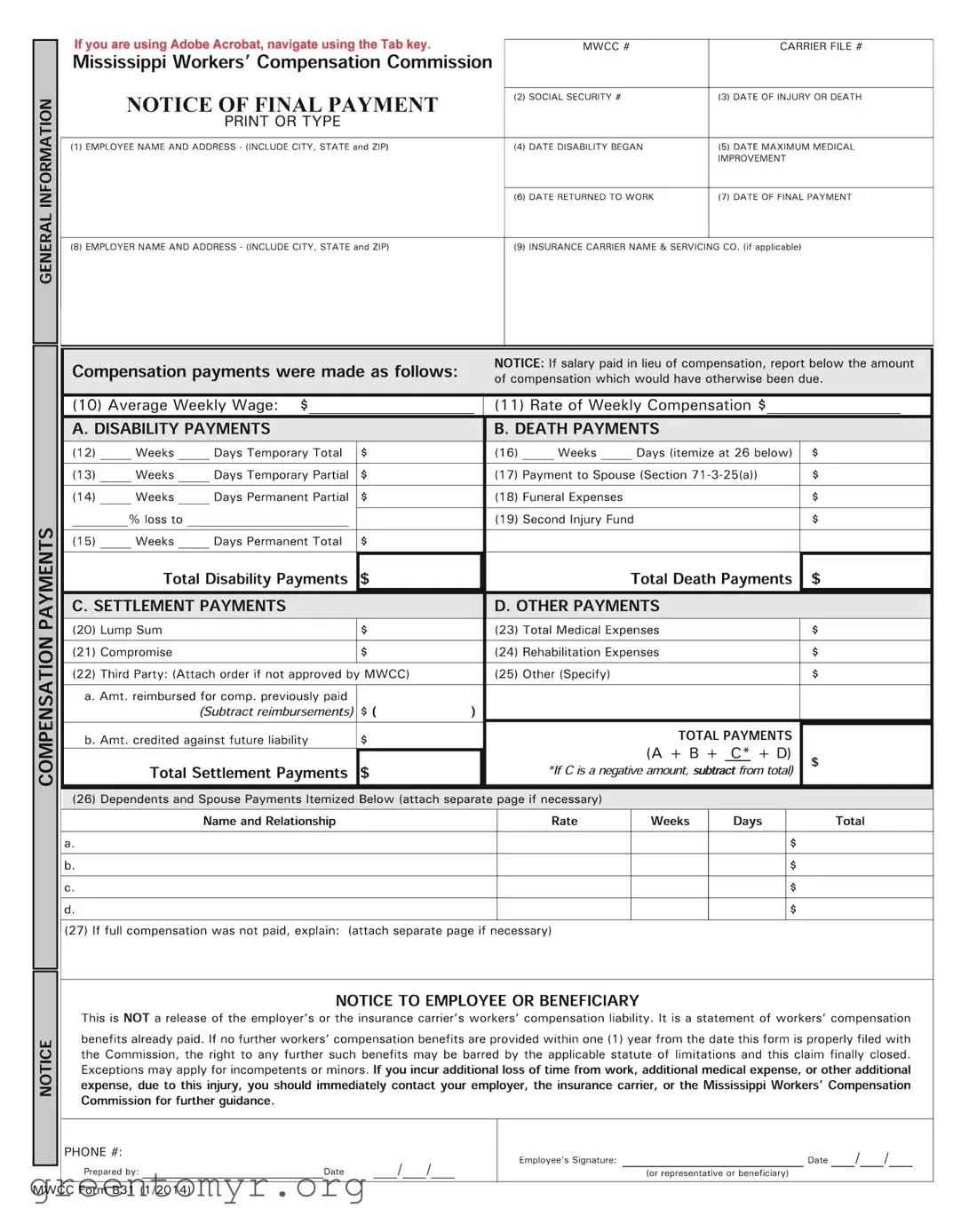
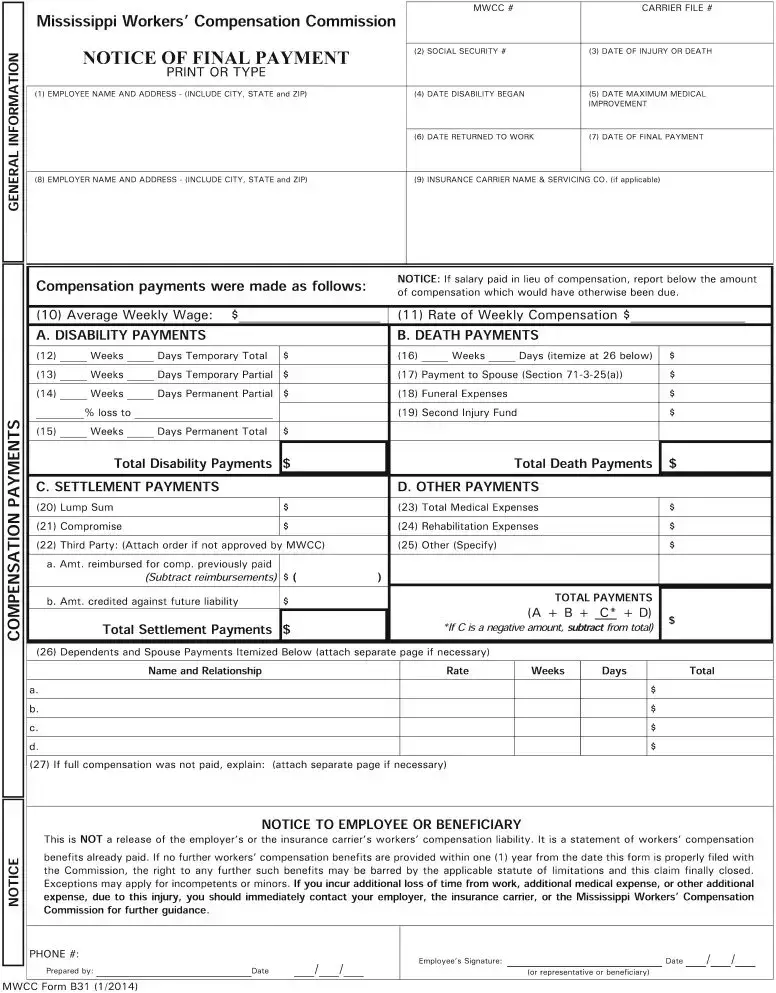
The Mwcc B31 form serves as a crucial document in the Mississippi workers' compensation system, providing essential information regarding compensation payments made to employees following a workplace injury or death. This form captures key details such as the employee's name, social security number, and the dates relevant to the injury, including when the disability began and when the employee returned to work. It also outlines the average weekly wage and breaks down various types of compensation payments, including temporary total, temporary partial, and permanent partial disability payments. Additionally, it addresses death benefits, including payments to spouses and funeral expenses. The Mwcc B31 form ensures transparency by itemizing total payments and specifying any outstanding liabilities. Importantly, it serves as a notice to employees or beneficiaries that the document does not release the employer or insurance carrier from their workers' compensation obligations. Instead, it summarizes benefits already paid, while also highlighting the importance of timely communication regarding any further claims or expenses related to the injury. Understanding this form is vital for both employees and employers to navigate the complexities of workers' compensation effectively.
Mwcc B31 Example

File Breakdown

Fact Name Details
Purpose of the Form The MWCC B31 form serves as a notice of final payment for workers' compensation benefits in Mississippi. It documents the compensation payments made to an employee following a workplace injury or death.
Filing Requirements This form must be filed with the Mississippi Workers' Compensation Commission. It is crucial to ensure that it is completed accurately to avoid delays in processing.
Governing Law The MWCC B31 form is governed by the Mississippi Workers' Compensation Law, specifically outlined in Mississippi Code Annotated § 71-3-1 et seq.
Important Notice Employees or beneficiaries should be aware that this form does not release the employer or insurance carrier from liability. It simply reflects benefits that have already been paid.

Guide to Using Mwcc B31

Completing the MWCC B31 form is an important step in documenting workers' compensation payments. This form requires specific information about the employee, the injury, and the payments made. Once you have filled out the form, it should be submitted to the Mississippi Workers' Compensation Commission for processing.

  1. Obtain the form: Download the MWCC B31 form from the Mississippi Workers' Compensation Commission website or request a physical copy.
  2. Fill in employee details: Provide the employee's name and address, including city, state, and ZIP code. Include the MWCC number and the carrier file number.
  3. Enter social security number: Input the employee's social security number accurately.
  4. Document injury details: Fill in the date of injury or death, the date disability began, and the date returned to work.
  5. Record medical improvement: Indicate the date of maximum medical improvement.
  6. Final payment date: Specify the date of final payment.
  7. Employer information: Provide the employer's name and address, including city, state, and ZIP code.
  8. Insurance carrier details: Enter the name of the insurance carrier and servicing company, if applicable.
  9. List compensation payments: Document the average weekly wage and detail all payments made, including temporary total, temporary partial, permanent partial, and permanent total disability payments.
  10. Settlement payments: If applicable, record lump sum and compromise payments, as well as any third-party reimbursements.
  11. Death payments: If applicable, itemize any death payments, including payments to a spouse and funeral expenses.
  12. Other payments: Include any total medical expenses, rehabilitation expenses, and other payments, specifying what those payments are.
  13. Total payments: Calculate the total of all payments made (A + B + C* + D), noting that if C is a negative amount, it should be subtracted from the total.
  14. Dependents and spouse payments: Itemize payments made to dependents or a spouse, including their names, relationships, rates, and total amounts.
  15. Explanatory notes: If full compensation was not paid, provide an explanation and attach a separate page if necessary.
  16. Sign and date: Ensure the employee or their representative signs and dates the form. Include the preparer's name and date as well.

Get Answers on Mwcc B31

What is the purpose of the MWCC B31 form?

The MWCC B31 form is used to report final compensation payments made to an employee under the Mississippi Workers' Compensation system. This form provides a detailed summary of all payments made, including disability payments, death benefits, and other related expenses. It ensures that both the employee and the employer have a clear record of what has been paid and what remains outstanding.

What information is required on the MWCC B31 form?

The MWCC B31 form requires several key pieces of information:

  • Employee's name and address
  • Social Security number
  • Details about the injury, including the date of injury and the date disability began
  • Employer's name and address
  • Insurance carrier information
  • Details of compensation payments, including types and amounts
  • Any other relevant payments, such as medical or rehabilitation expenses

Completing this form accurately is essential for proper processing of workers' compensation claims.

What happens if full compensation is not paid?

If full compensation has not been paid, the MWCC B31 form provides a section to explain why. It is important to detail any reasons for the shortfall, such as disputes over the claim or additional medical expenses incurred. This information is crucial for the Mississippi Workers' Compensation Commission to understand the status of the claim and any potential next steps.

What should an employee do if they incur additional expenses after filing the MWCC B31 form?

If an employee experiences additional loss of time from work or incurs extra medical expenses after submitting the MWCC B31 form, they should promptly contact their employer or the insurance carrier. The employee can also reach out to the Mississippi Workers' Compensation Commission for guidance on how to proceed. Timely communication is important to ensure that any new claims are handled appropriately.

Common mistakes

Filling out the MWCC B31 form can be straightforward, but mistakes can lead to delays or complications. One common error is failing to provide complete information in the employee name and address section. This section requires full details, including city, state, and ZIP code. Omitting any part can cause processing issues.

Another frequent mistake involves the social security number. It’s essential to enter the correct number without any typos. A wrong social security number can create confusion and may result in the claim being denied or delayed.

Many people also overlook the importance of accurately reporting the date of injury. This date is critical for determining the timeline of benefits. If the date is incorrect, it may affect the calculation of compensation and the overall validity of the claim.

In the section regarding compensation payments, individuals sometimes forget to itemize payments correctly. It’s important to clearly list all types of payments, including temporary and permanent benefits. Failure to do so can lead to misunderstandings about what has been paid and what is still owed.

Lastly, some individuals neglect to sign and date the form. The employee's signature is necessary to validate the information provided. Without it, the form may be considered incomplete, resulting in further delays in processing the claim.

Documents used along the form

The MWCC B31 form is a key document in the workers' compensation process in Mississippi. However, several other forms and documents often accompany it to ensure all aspects of a claim are properly addressed. Below is a list of these related documents, each serving a specific purpose in the workers' compensation process.

  • MWCC Form B3: This form is used to report an employee's injury to the Mississippi Workers' Compensation Commission. It provides essential details about the incident and initiates the claims process.
  • MWCC Form B4: This form is for the employer's first report of injury. It includes information about the injured employee, the nature of the injury, and the circumstances surrounding it.
  • MWCC Form B5: This form is used to notify the Commission of any changes in the employee's status, such as returning to work or changes in medical treatment. It helps keep the Commission updated on the claim's progress.
  • MWCC Form B6: This form is for medical reports and is submitted by healthcare providers. It details the employee's medical condition, treatment provided, and any recommendations for further care.
  • MWCC Form B7: This document is a request for a hearing before the Commission. If there are disputes regarding the claim, this form initiates the process to resolve those issues through a formal hearing.
  • MWCC Form B8: This form is used for the employee to request a change of physician. If the injured worker is not satisfied with their current medical provider, this form facilitates a transition to a new one.
  • MWCC Form B9: This is a settlement agreement form. It outlines the terms of a settlement between the injured worker and the employer or insurance carrier, detailing compensation amounts and any other agreements.
  • MWCC Form B10: This form is used for wage loss claims. It provides information about the employee's average weekly wage and any lost wages due to the injury.
  • MWCC Form B11: This document is for the application of vocational rehabilitation services. It helps injured workers access resources for retraining or job placement if they are unable to return to their previous employment.
  • MWCC Form B12: This is a form for reporting any disputes regarding compensation payments. It is used when there are disagreements about the amount or duration of benefits being paid.

Each of these forms plays a crucial role in the workers' compensation process, ensuring that all necessary information is collected and that the rights of both employees and employers are protected. Understanding these documents can help streamline the claims process and facilitate communication among all parties involved.

Similar forms

  • Form I-9: Similar to the Mwcc B31, the Form I-9 verifies the identity and employment authorization of individuals hired for employment in the United States. Both documents require detailed personal information and serve as official records for compliance purposes.
  • W-2 Form: The W-2 form reports an employee's annual wages and the taxes withheld from their paycheck. Like the Mwcc B31, it includes essential information about payments made, though it focuses more on tax implications rather than workers' compensation benefits.
  • Claim for Compensation (Form C): This document is used to initiate a workers' compensation claim. It shares similarities with the Mwcc B31 in that both require information about the employee, the injury, and the compensation sought, but the Form C is focused on the initial claim rather than final payments.
  • Notice of Injury (Form A): This form notifies the employer and the workers' compensation board of an employee's injury. Both the Mwcc B31 and Form A serve as official notifications, but the Mwcc B31 details payments made after the claim has been processed.
  • Release of Information Form: This document allows for the sharing of medical records related to a workers' compensation claim. Similar to the Mwcc B31, it involves the employee's consent and is integral to the claims process, focusing on the medical aspects of the case.
  • Settlement Agreement: This document outlines the terms of a settlement between the injured worker and the employer or insurance company. Both the Mwcc B31 and a Settlement Agreement summarize financial details, but the latter is focused on the resolution of the claim rather than the payment history.
  • Form 1099-MISC: This form is used to report various types of income, including payments made to independent contractors. Like the Mwcc B31, it provides a summary of payments, but it is generally used for tax reporting rather than workers' compensation purposes.

Dos and Don'ts

When filling out the MWCC B31 form, it is essential to follow certain guidelines to ensure accuracy and completeness. Here is a list of things you should and shouldn't do:

  • Do print or type your information clearly to avoid any misunderstandings.
  • Do include all required details, such as your name, address, and Social Security number.
  • Do double-check the dates you provide, including the date of injury and the date disability began.
  • Do specify the amounts for compensation payments and other expenses accurately.
  • Do attach any necessary documentation, such as orders for third-party settlements.
  • Don't leave any sections blank; incomplete forms may cause delays.
  • Don't use abbreviations or shorthand that could confuse the reader.
  • Don't forget to sign and date the form before submission.
  • Don't submit the form without reviewing it for errors or omissions.

By following these tips, you can help ensure that your MWCC B31 form is filled out correctly and processed smoothly.

Misconceptions

Misconceptions about the MWCC B31 form can lead to confusion and misunderstandings regarding workers' compensation claims in Mississippi. Here are nine common misconceptions, along with clarifications:

  1. The MWCC B31 form is a release of liability. Many believe that submitting this form releases the employer or insurance carrier from future liability. In reality, it only details benefits already paid and does not absolve any future claims.
  2. Filing the MWCC B31 form means the claim is closed. Some think that once the form is filed, their claim is permanently closed. However, if further benefits are not provided within one year, the right to additional benefits may be barred, but the claim itself is not automatically closed.
  3. All claims will receive full compensation. It is a common misconception that every claim filed will result in full compensation. Compensation depends on various factors, including the nature of the injury and the specifics of the case.
  4. The form only applies to temporary disabilities. Some individuals believe the MWCC B31 form is relevant only for temporary disabilities. In fact, it covers various types of compensation, including permanent partial and total disabilities.
  5. Once the form is submitted, no further action is needed. Many think that submitting the MWCC B31 form ends their responsibilities. It’s crucial to monitor any ongoing medical issues or loss of work time and report them to the employer or insurance carrier.
  6. Only employees can file the MWCC B31 form. There is a belief that only injured employees can submit this form. In reality, representatives or beneficiaries can also prepare and file it on behalf of the employee.
  7. The form does not require detailed information. Some may underestimate the importance of providing complete and accurate information. Incomplete forms can delay processing and lead to potential issues with claims.
  8. All medical expenses will be covered under the MWCC B31 form. There is a misconception that all medical expenses related to an injury will be reimbursed. Only medical expenses that are deemed necessary and reasonable for the treatment of the work-related injury are covered.
  9. Filing the form guarantees a prompt response. Many assume that submitting the MWCC B31 form will result in a quick response. However, processing times can vary, and it’s important to follow up if there are delays.

Understanding these misconceptions can help ensure that individuals navigate the workers' compensation process more effectively and avoid unnecessary pitfalls.

Key takeaways

Filling out the Mwcc B31 form is an important step in the workers' compensation process. Here are some key takeaways to keep in mind:

  • Complete Information: Make sure to provide all required details, including employee name, address, and dates related to the injury.
  • Accurate Dates: Clearly indicate the date of injury, date disability began, and date returned to work.
  • Social Security Number: Include the employee's Social Security number to ensure proper identification.
  • Average Weekly Wage: Report the average weekly wage accurately, as this will affect compensation calculations.
  • Compensation Types: Differentiate between temporary total, temporary partial, and permanent disability payments.
  • Settlement Payments: If applicable, itemize any settlement payments, including lump sums and compromises.
  • Death Payments: For cases involving death, list payments to dependents and funeral expenses separately.
  • Additional Expenses: Report any other payments, such as medical or rehabilitation expenses.
  • Signature Required: Ensure the employee or their representative signs the form before submission.
  • One-Year Limitation: Be aware that if no further benefits are claimed within one year, rights to additional compensation may be lost.

By following these guidelines, you can help ensure that the Mwcc B31 form is filled out correctly and efficiently. This can aid in the smooth processing of workers' compensation claims.