Content Navigation

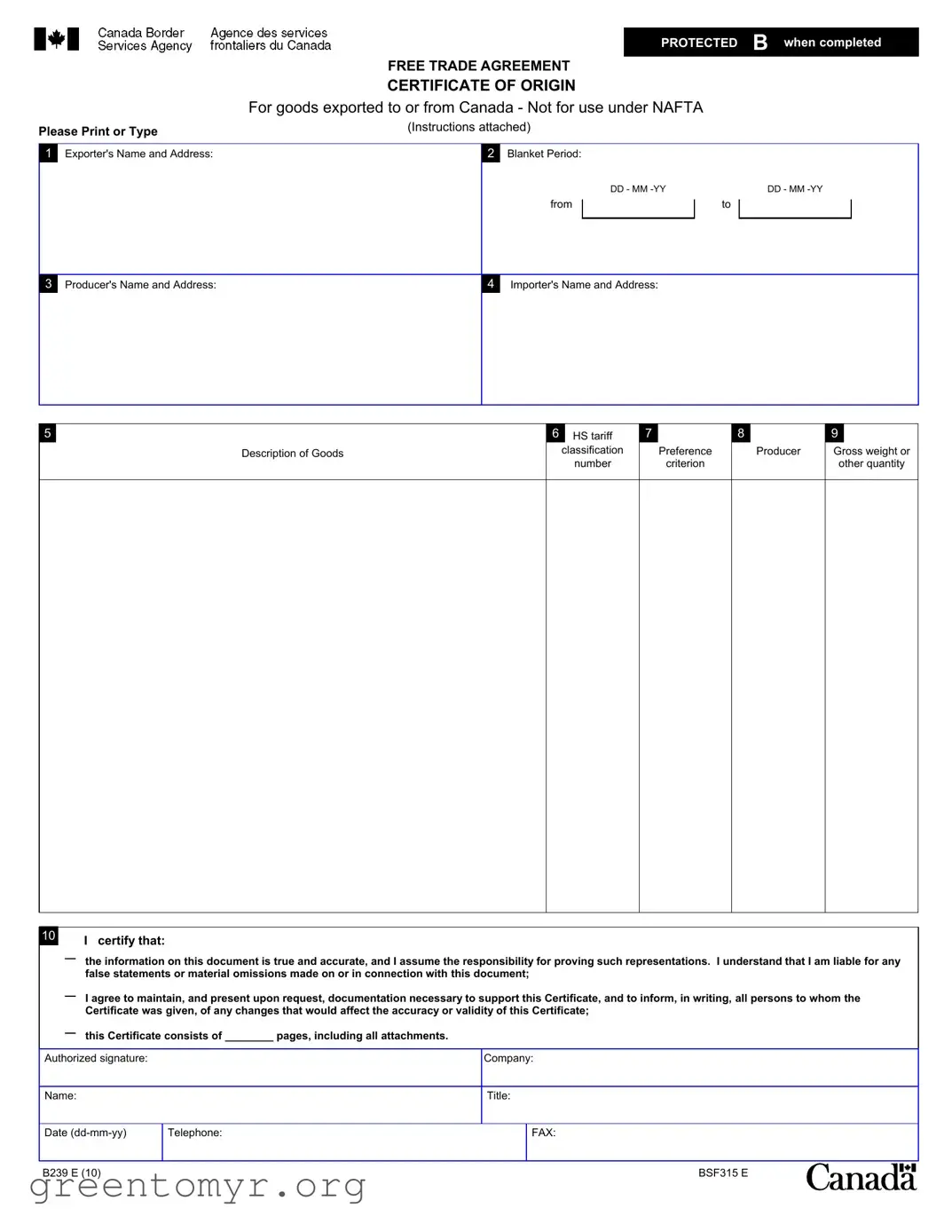
The NAFTA Certificate of Origin for Canada is a crucial document for businesses engaged in cross-border trade. It serves as proof that goods qualify for preferential tariff treatment under trade agreements. Completing this form accurately is essential for both exporters and importers. The form requires basic information such as the names and addresses of the exporter, producer, and importer. It also includes details about the goods being shipped, including a description, HS tariff classification number, and preference criteria. Each criterion outlines specific conditions under which the goods can be considered as originating from the free-trade area. Additionally, the exporter must certify the truthfulness of the information provided and agree to maintain supporting documentation. This form not only facilitates smoother trade but also helps businesses avoid potential penalties for inaccuracies. Understanding the importance of this certificate can significantly impact the efficiency of international transactions.

Nafta Certificate Of Origin Canada Example

Blanket Period:
For goods exported to or from Canada - Not for use under NAFTA
Date (dd-mm-yy)
Importer's Name and Address:
Telephone:
Exporter's Name and Address:
FAX:
Description of Goods
HS tariff
classification
number
Preference
criterion
Producer Gross weight or
other quantity
Producer's Name and Address:
3
B239 E (10)
Authorized signature:
Name: Title:
Please Print or Type
from
DD - MM -YY
to
1 2
4
5 6 7 8 9
10
Company:
(Instructions attached)
the information on this document is true and accurate, and I assume the responsibility for proving such representations. I understand that I am liable for any
false statements or material omissions made on or in connection with this document;
I agree to maintain, and present upon request, documentation necessary to support this Certificate, and to inform, in writing, all persons to whom the
Certificate was given, of any changes that would affect the accuracy or validity of this Certificate;
this Certificate consists of ________ pages, including all attachments.
I certify that:
FREE TRADE AGREEMENT
CERTIFICATE OF ORIGIN
BSF315 E
when completed
PROTECTED
B
DD - MM -YY
FREE TRADE AGREEMENT
CERTIFICATE OF ORIGIN INSTRUCTIONS FOR GOODS EXPORTED TO OR FROM CANADA -
NOT FOR USE UNDER NAFTA
For purposes of obtaining preferential tariff treatment, this document must be completed legibly and in full by the exporter and be in the possession of
the importer at the time the declaration is made. Please print or type.
Field 1:
Field 2:
Field 3:
Field 4:
Field 5:
Field 6:
Field 7:
State the full legal name and address of the exporter.
Complete this field if the certificate covers multiple shipments of identical goods, as described in Field 5, that are imported for a specified period of up
to one year (blanket period). "From" is the date upon which the certificate becomes applicable to the good covered by the blanket certificate (it may be
prior to the date of signing this certificate). "To" is the date upon which the blanket period expires. The importation of a good for which preferential tariff
treatment is claimed based on this certificate must occur between these dates.
State the full legal name and address of the producer. If more than one producer's good is included on the certificate, attach a list of the additional
producers, including the legal name and address cross referenced to the good described in field 5. If you wish this information to be confidential, it is
acceptable to state "Available to customs upon request." If the producer and the exporter are the same, complete field with "Same." If the producer is
unknown, it is acceptable to state "Unknown."
State the full legal name and address of the importer. If the importer is not known, state "Unknown"; if multiple importers, state "Various."
Provide a full description of each good. The description should be sufficient to relate it to the invoice description and to the Harmonized System (HS)
description of the good. If the certificate covers a single shipment of a good, i.e., it is not a blanket certificate, include the invoice number as shown on
the commercial invoice. If not known, indicate another unique reference number, such as the shipping order number.
For each good described in Field 5, identify the HS tariff classification to six digits. If the good is subject to a specific rule of origin that requires eight
digits, identify to eight digits, using the HS tariff classification of the Party into whose territory the good is imported.
For each good described in Field 5, state which criterion (A through E) is applicable. The rules of origin are set out in the regulations enacted and
published by the Parties.
Note: In order to be entitled to preferential tariff treatment, each good must meet at least one of the criteria below.
Preference
criteria
A
B
C
D
E
Field 8:
Field 9:
Field 10:
The good is "wholly obtained or produced entirely" in the free-trade area.
Note: The purchase of a good in the free-trade area does not necessarily render it "wholly obtained or produced."
The good is produced entirely in the free-trade area and satisfies the specific rule of origin that applies to its tariff classification. The good must also
satisfy all other applicable requirements.
The good satisfies, as a result of production occurring entirely within the free-trade area, the applicable requirements set out in the specific rule of origin
where no change in tariff classification is required in that rule.
The good is produced entirely in the free-trade area exclusively from originating materials. Under this criterion, not all materials need to fall within
criterion A. However, all materials used in the production of the good must qualify as "originating" by meeting the rules of one of the preference criteria.
Goods are produced in the free-trade area but do not meet the applicable specific rule of origin because certain non-originating materials do not
undergo the required change in tariff classification. This criterion is applicable only where the good incorporated one or more non-originating materials,
provided for as parts under the HS, which could not undergo a change in tariff classification because the heading provides for both the good and its
parts and was not further subdivided into subheadings, or the subheading provided for both the good and its parts. Furthermore, at least one category
of identical or similar materials provided for in that heading or subheading must be originating.
Note: This criterion does not apply to Chapters 61 through 63 of the HS
For each good described in Field 5, state "Yes" if you are the producer of the good. If you are not the producer of the good, state "No" followed by (1)
or (2), depending on whether this certificate was based upon: (1) your knowledge of whether the good qualifies as an originating good or (2) your
reliance on the producer's written representation that the good qualifies as an originating good.
Where the certificate is not a blanket certificate indicate the gross weight or number of pieces in the shipment.
This field must be completed, signed, and dated by the exporter. The date must be the date the certificate was completed and signed.

File Breakdown

Fact Name Description
Purpose The NAFTA Certificate of Origin is used to obtain preferential tariff treatment for goods exported to or from Canada.
Blanket Period This certificate can cover multiple shipments of identical goods over a specified period of up to one year, known as the blanket period.
Producer Information Exporters must provide the full legal name and address of the producer. If there are multiple producers, a list must be attached.
Preference Criteria Goods must meet at least one of the specified criteria (A through E) to qualify for preferential treatment under the agreement.
Certification Requirement The exporter must certify that the information provided is accurate and assumes responsibility for any false statements made on the certificate.

Guide to Using Nafta Certificate Of Origin Canada

Completing the NAFTA Certificate of Origin Canada form is essential for ensuring that goods qualify for preferential tariff treatment. Follow these steps carefully to fill out the form accurately.

  1. Exporter's Name and Address: Enter the full legal name and address of the exporter in the designated field.
  2. Blanket Period: If applicable, specify the blanket period by entering the start date and end date in the format DD-MM-YY.
  3. Producer's Name and Address: Provide the full legal name and address of the producer. If there are multiple producers, attach a list.
  4. Importer's Name and Address: Fill in the full legal name and address of the importer. If unknown, write "Unknown".
  5. Description of Goods: Describe each good clearly, ensuring it relates to the invoice description and the Harmonized System (HS) description.
  6. HS Tariff Classification Number: Identify the HS tariff classification for each good, using six or eight digits as required.
  7. Preference Criterion: Indicate the applicable preference criterion (A through E) for each good.
  8. Producer: State "Yes" if you are the producer of the good. If not, write "No" and indicate whether the certificate is based on your knowledge or the producer's representation.
  9. Gross Weight or Other Quantity: For non-blanket certificates, indicate the gross weight or the number of pieces in the shipment.
  10. Certification: Complete, sign, and date the certification section, ensuring the date matches when the certificate was signed.

Get Answers on Nafta Certificate Of Origin Canada

What is the NAFTA Certificate of Origin Canada form used for?

The NAFTA Certificate of Origin Canada form is used to certify that goods exported to or from Canada qualify for preferential tariff treatment under free trade agreements. This form is essential for importers to claim reduced tariffs on eligible goods, ensuring compliance with trade regulations.

Who is responsible for completing the form?

The exporter is responsible for completing the NAFTA Certificate of Origin. They must ensure that all fields are filled out accurately and legibly. It is crucial that the exporter maintains documentation to support the claims made in the certificate.

What information is required on the form?

The form requires the following information:

  1. Exporter’s name and address
  2. Blanket period (if applicable)
  3. Producer’s name and address
  4. Importer’s name and address
  5. Description of goods
  6. HS tariff classification number
  7. Preference criterion
  8. Producer status
  9. Gross weight or quantity

Each of these fields must be completed accurately to ensure the certificate's validity.

What is a blanket period?

A blanket period allows the certificate to cover multiple shipments of identical goods over a specified timeframe, which can be up to one year. The exporter must indicate the start and end dates of this period on the form.

How does one determine the HS tariff classification number?

The HS tariff classification number is a standardized code used to identify goods in international trade. Exporters should refer to the Harmonized System (HS) codes relevant to their products. Each good must be classified to six or eight digits, depending on the specific rules of origin.

What are the preference criteria listed on the form?

There are five preference criteria that determine if a good qualifies for preferential tariff treatment:

  • A: Wholly obtained or produced entirely in the free-trade area.
  • B: Produced entirely in the free-trade area and meets specific rules of origin.
  • C: Satisfies applicable requirements without a change in tariff classification.
  • D: Produced entirely from originating materials.
  • E: Incorporates non-originating materials but meets specific conditions.

Each good must meet at least one of these criteria to qualify for reduced tariffs.

What happens if the information on the certificate is incorrect?

If any information on the NAFTA Certificate of Origin is incorrect or misleading, the exporter may be liable for false statements or material omissions. This can lead to penalties or denial of preferential tariff treatment. It is essential to ensure all information is accurate and up-to-date.

Common mistakes

Filling out the NAFTA Certificate of Origin for Canada can be a straightforward process, yet many individuals and businesses encounter pitfalls that can lead to complications. One common mistake is failing to provide complete information in the exporter's name and address section. It is crucial to ensure that this field is filled out with the full legal name and accurate address. Incomplete or incorrect details can result in delays or even denial of preferential tariff treatment.

Another frequent error occurs in the blanket period section. This section should clearly indicate the start and end dates for certificates covering multiple shipments. Many individuals either leave this field blank or enter incorrect dates, which can invalidate the certificate. Precision is essential here, as the dates must align with the importation of goods.

In the producer's name and address field, mistakes often arise when exporters fail to include all relevant producers. If there are multiple producers involved, a comprehensive list must be attached. Omitting this information can lead to confusion and may jeopardize the certificate’s validity.

Providing a vague or incomplete description of goods is another common misstep. The description should be detailed enough to correlate with the invoice and the Harmonized System classification. If the description lacks clarity, it may not meet the requirements for preferential tariff treatment, which can result in unexpected duties or tariffs.

When it comes to the HS tariff classification number, many individuals mistakenly provide incorrect or incomplete codes. This classification is critical for determining eligibility for preferential treatment. Ensuring accuracy in this section can save time and money, as incorrect codes can lead to significant delays in processing.

Additionally, errors in stating the preference criterion can undermine the entire application. Each good must meet at least one of the specified criteria to qualify for preferential treatment. Misunderstanding these criteria can lead to incorrect selections, causing the certificate to be rejected.

Another area where mistakes frequently occur is in the producer section. If the exporter is not the producer, it is essential to indicate this accurately. Mislabeling can create complications, especially if the certificate is based on the producer’s representation regarding the origin of the goods.

Furthermore, the gross weight or other quantity field is often overlooked or filled out incorrectly. This information is necessary for customs purposes, and inaccuracies can lead to logistical challenges or penalties. It is advisable to double-check this information before submission.

Finally, the importance of a proper signature and date in the certification section cannot be overstated. Many individuals neglect to sign the document or provide an incorrect date. This oversight can render the certificate invalid, leading to significant complications during the importation process.

Documents used along the form

The NAFTA Certificate of Origin Canada form is a crucial document for businesses engaged in trade between Canada and its partners. However, several other forms and documents often accompany it to ensure compliance with trade regulations and facilitate smooth transactions. Here’s a list of these essential documents.

  • Commercial Invoice: This document outlines the transaction details between the seller and buyer, including the goods sold, their value, and payment terms. It serves as proof of sale and is vital for customs clearance.
  • Bill of Lading: This is a legal document issued by the carrier to the shipper. It serves as a receipt for the cargo and outlines the terms of transport. It is essential for the transfer of ownership of the goods during shipping.
  • Import/Export Declaration: This declaration is required by customs authorities. It provides information about the goods being imported or exported, including their value and classification. It is necessary for customs clearance and to assess duties and taxes.
  • Proof of Origin Document: This document verifies the origin of the goods. It is crucial for claiming preferential tariff treatment under trade agreements and may include additional certifications from the producer.
  • Customs Bond: A customs bond is a contract between the importer and the customs authority. It ensures that duties, taxes, and penalties will be paid. It protects the government from potential losses due to non-compliance.
  • Certificate of Free Sale: This certificate indicates that the goods are legally sold in the domestic market and comply with local regulations. It may be required for certain products, especially in the food and pharmaceutical sectors.
  • Insurance Certificate: This document provides proof of insurance coverage for the goods during transit. It protects against potential loss or damage and is often required by both exporters and importers.

Each of these documents plays a vital role in ensuring compliance with trade regulations and facilitating smooth international transactions. Understanding their importance can help businesses navigate the complexities of cross-border trade more effectively.

Similar forms

The NAFTA Certificate of Origin for Canada serves a specific purpose in international trade, particularly in facilitating preferential tariff treatment. Several other documents share similarities with this certificate, each playing a crucial role in trade compliance and customs procedures. Below is a list of documents that are comparable to the NAFTA Certificate of Origin, along with explanations of their similarities.

  • Certificate of Origin (CO): This document certifies that the goods being exported originate from a specific country. Like the NAFTA Certificate, it is used to determine eligibility for preferential tariffs based on the country of origin.
  • Commercial Invoice: This document provides details about the transaction, including the description of goods, quantity, and price. Both the commercial invoice and the NAFTA Certificate of Origin require accurate descriptions of the goods to ensure compliance with trade regulations.
  • Bill of Lading (BOL): A bill of lading serves as a receipt for goods and a contract for transportation. Similar to the NAFTA Certificate, it is essential for customs clearance and must accompany shipments.
  • Export Declaration: This document is required by customs authorities when exporting goods. It includes details about the shipment and, like the NAFTA Certificate, helps verify compliance with trade regulations.
  • Import Declaration: Required by customs upon the arrival of goods, this document provides information about the imported items. Both the import declaration and the NAFTA Certificate of Origin are used to assess duties and taxes based on the origin of the goods.
  • Preference Certificate: Similar to the NAFTA Certificate, this document is used to claim preferential tariff treatment under various trade agreements, ensuring that exporters can benefit from reduced duties.
  • Customs Bond: A customs bond guarantees that duties and taxes will be paid. Like the NAFTA Certificate, it is part of the overall compliance framework for international trade.
  • Proforma Invoice: Often used for customs purposes, a proforma invoice provides a preliminary bill of sale. It includes similar information to the commercial invoice and is important for establishing the value of goods for customs purposes.
  • Harmonized System (HS) Classification Document: This document details the classification of goods under the HS system, which is crucial for determining tariffs. Both the HS classification and the NAFTA Certificate include tariff classification numbers for the goods being exported.

Dos and Don'ts

Do's:

  • Print or type all information clearly to ensure legibility.
  • Provide accurate and complete details for each field, including names and addresses.
  • Indicate the appropriate preference criterion for each good listed.
  • Sign and date the certificate on the day of completion.

Don'ts:

  • Do not leave any fields blank; all sections must be filled out.
  • Avoid using vague descriptions for goods; be specific and detailed.
  • Do not submit the certificate without verifying the accuracy of all information.
  • Refrain from using abbreviations or informal language in any part of the form.

Misconceptions

Understanding the NAFTA Certificate of Origin for Canada can be challenging. Here are seven common misconceptions that often arise:

  • Misconception 1: The NAFTA Certificate of Origin is the same as the Free Trade Agreement Certificate of Origin.
  • This is incorrect. The NAFTA Certificate of Origin is specifically for goods traded under NAFTA, while the Free Trade Agreement Certificate of Origin is used for other agreements, such as the Canada-United States-Mexico Agreement (CUSMA).

  • Misconception 2: You don’t need to complete the form if your goods are produced entirely in Canada.
  • Even if your goods are entirely produced in Canada, you must still complete the form to claim preferential tariff treatment. The form provides necessary documentation to support your claims.

  • Misconception 3: The exporter and producer must always be different entities.
  • This is false. If the exporter and producer are the same, you can simply indicate "Same" in the appropriate field. This helps simplify the process.

  • Misconception 4: The certificate can be completed after the goods have been shipped.
  • The certificate must be completed and in the possession of the importer at the time of declaration. Completing it post-shipment can jeopardize your ability to claim preferential treatment.

  • Misconception 5: You can leave fields blank if you don’t have all the information.
  • All fields must be completed accurately. Leaving fields blank can lead to delays or denials of preferential tariff treatment.

  • Misconception 6: The certificate is not necessary for low-value shipments.
  • This is misleading. Regardless of the shipment's value, if you are claiming preferential tariff treatment, the certificate is still required.

  • Misconception 7: Once the certificate is issued, it never needs to be updated.
  • It is essential to inform all parties of any changes that may affect the accuracy or validity of the certificate. Keeping documentation current is crucial for compliance.

Key takeaways

Filling out the NAFTA Certificate of Origin for goods exported to or from Canada is an important step in ensuring compliance and securing preferential tariff treatment. Here are some key takeaways to keep in mind:

  • Accurate Information is Crucial: Ensure that all details provided on the certificate are true and accurate. Any false statements or omissions can lead to liability.
  • Exporter Details: Clearly state the full legal name and address of the exporter in Field 1. This information is essential for identification.
  • Blanket Period: If applicable, specify the blanket period in Field 2. This period can cover multiple shipments of identical goods for up to one year.
  • Producer Information: In Field 3, include the full name and address of the producer. If there are multiple producers, attach a list with their details.
  • Goods Description: Provide a detailed description of the goods in Field 5. This should relate to the invoice description and the Harmonized System (HS) classification.
  • HS Classification: Identify the HS tariff classification number in Field 6. This classification is vital for determining eligibility for preferential tariff treatment.
  • Preference Criteria: In Field 7, indicate which preference criterion applies to each good. Each item must meet at least one of the specified criteria to qualify.
  • Producer Status: Field 8 requires you to indicate whether you are the producer of the good. If not, specify your basis for knowledge regarding its origin.
  • Weight or Quantity: For non-blanket certificates, Field 9 should indicate the gross weight or number of pieces in the shipment.
  • Signature Requirement: Field 10 must be completed, signed, and dated by the exporter. The date should reflect when the certificate is completed.

By following these guidelines, you can ensure that the NAFTA Certificate of Origin is filled out correctly, facilitating smoother trade processes and compliance with regulations.