Content Navigation

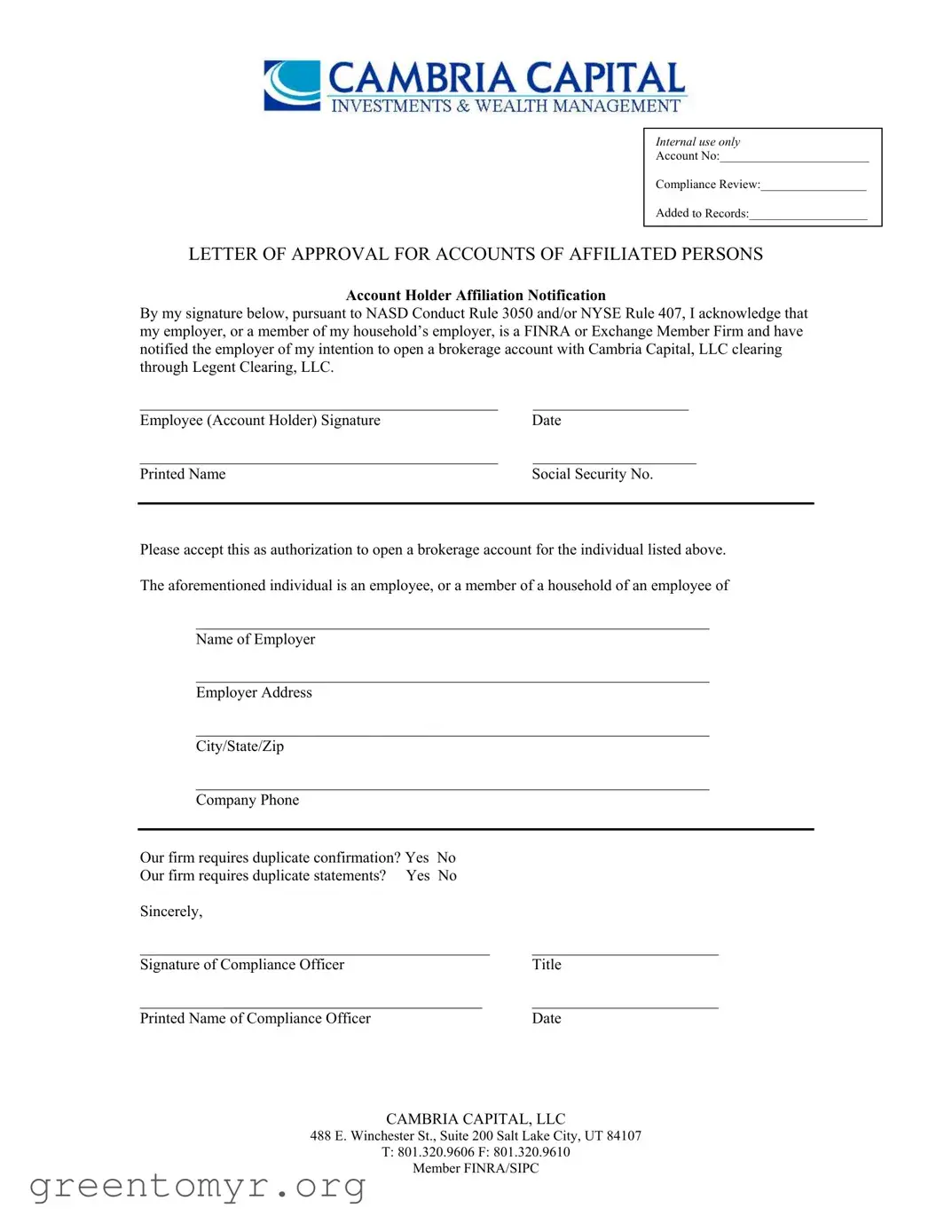
The NASD Rule 3050 form plays a crucial role in maintaining transparency and compliance within the financial industry, particularly for those affiliated with member firms. This form is primarily used to notify employers when employees or their household members wish to open brokerage accounts. It serves as a formal acknowledgment that the account holder is connected to a FINRA or Exchange Member Firm, ensuring that the employer is aware of any potential conflicts of interest. Key components of the form include the account holder's personal details, such as their name and Social Security number, along with the name and address of their employer. Additionally, the form requires the signature of both the account holder and a compliance officer, affirming the legitimacy of the account opening process. Options for duplicate confirmations and statements are also included, allowing firms to maintain oversight of account activities. By adhering to these guidelines, firms can better manage the financial dealings of their employees and uphold the integrity of the market.

Nasd Rule 3050 Example

CAMBRIA CAPITAL, LLC
488 E. Winchester St., Suite 200 Salt Lake City, UT 84107
T: 801.320.9606 F: 801.320.9610
Member FINRA/SIPC
Internal use only
Account No:________________________
Compliance Review:_________________
Added
t
o Records:___________________
LETTER OF APPROVAL FOR ACCOUNTS OF AFFILIATED PERSONS
Account Holder Affiliation Notification
By my signature below, pursuant to NASD Conduct Rule 3050 and/or NYSE Rule 407, I acknowledge that
my employer, or a member of my household’s employer, is a FINRA or Exchange Member Firm and have
notified the employer of my intention to open a brokerage account with Cambria Capital, LLC clearing
through Legent Clearing, LLC.
______________________________________________ ____________________
Employee (Account Holder) Signature Date
______________________________________________ _____________________
Printed Name Social Security No.
Please accept this as authorization to open a brokerage account for the individual listed above.
The aforementioned individual is an employee, or a member of a household of an employee of
__________________________________________________________________
Name of Employer
__________________________________________________________________
Employer Address
__________________________________________________________________
City/State/Zip
__________________________________________________________________
Company Phone
Our firm requires duplicate confirmation? Yes No
Our firm requires duplicate statements? Yes No
Sincerely,
_____________________________________________ ________________________
Signature of Compliance Officer Title
____________________________________________ ________________________
Printed Name of Compliance Officer Date

File Breakdown

Fact Name Details
Purpose The NASD Rule 3050 form is used to disclose the affiliation of an employee or household member with a FINRA or Exchange Member Firm when opening a brokerage account.
Compliance Requirement By signing the form, the account holder confirms that their employer has been notified of the intention to open the account, ensuring compliance with NASD Conduct Rule 3050 and NYSE Rule 407.
Employer Information The form requires the account holder to provide detailed information about their employer, including the name, address, and contact number.
State-Specific Law In New York, the governing law for this form includes both NASD Conduct Rule 3050 and NYSE Rule 407, ensuring adherence to state and federal regulations.

Guide to Using Nasd Rule 3050

Filling out the NASD Rule 3050 form is an important step in the process of opening a brokerage account. After completing the form, it will need to be submitted for review and approval by the compliance officer at your firm. Follow these steps to ensure the form is filled out correctly.

  1. Write your account number in the designated space at the top of the form.
  2. Leave the compliance review and added to records sections blank; these will be filled out by the compliance officer.
  3. Sign your name in the "Employee (Account Holder) Signature" section and write the date next to your signature.
  4. Print your name clearly in the "Printed Name" section.
  5. Provide your Social Security Number in the appropriate space.
  6. In the "Name of Employer" section, write the name of your employer or the employer of a household member.
  7. Fill in the "Employer Address" with the complete address of your employer.
  8. Provide the city, state, and zip code of your employer in the designated fields.
  9. Enter the company phone number in the space provided.
  10. Indicate whether your firm requires duplicate confirmation by selecting "Yes" or "No."
  11. Indicate whether your firm requires duplicate statements by selecting "Yes" or "No."
  12. Leave the "Signature of Compliance Officer" and other compliance officer sections blank; these will be completed by the compliance officer.

Get Answers on Nasd Rule 3050

What is the NASD Rule 3050 form?

The NASD Rule 3050 form is a document that facilitates the disclosure of certain relationships between employees of member firms and brokerage accounts. It ensures that firms are aware of any potential conflicts of interest that may arise when an employee opens a brokerage account. The rule mandates that employees notify their employers if they plan to open such accounts, allowing for transparency and compliance with regulatory standards.

Who needs to fill out the NASD Rule 3050 form?

Any employee of a FINRA member firm or a member of their household who intends to open a brokerage account must complete the NASD Rule 3050 form. This includes individuals who work for firms that are members of the Financial Industry Regulatory Authority (FINRA) or the New York Stock Exchange (NYSE). By doing so, they help ensure that their employer is informed about their financial activities.

What information is required on the form?

The form requires several key pieces of information:

  • Account holder's name and Social Security number
  • The name and address of the employer
  • Confirmation of the employee's relationship to the employer
  • Signature of the employee and the compliance officer
  • Indication of whether duplicate confirmations and statements are required

This information helps maintain compliance and allows for proper monitoring of accounts.

Why is it important to notify your employer?

Notifying your employer about the opening of a brokerage account is crucial for several reasons. First, it helps prevent potential conflicts of interest. Second, it ensures that the firm can monitor trading activities that may affect the integrity of the market. Lastly, it fulfills regulatory obligations, which can protect both the employee and the firm from potential legal issues.

What happens if an employee does not fill out the form?

If an employee fails to complete the NASD Rule 3050 form, they may face disciplinary actions from their employer or regulatory bodies. This could include fines, suspension, or even termination of employment. Moreover, the lack of disclosure may lead to conflicts of interest that could harm the firm’s reputation and operational integrity.

Can the form be submitted electronically?

Many firms have adopted electronic submission methods for the NASD Rule 3050 form. However, the specific process may vary by firm. It is essential to check with your compliance department to understand the acceptable submission methods. Regardless of the format, the information provided must remain accurate and complete.

How does the compliance review process work?

Once the NASD Rule 3050 form is submitted, the compliance officer will review the information to ensure that it meets regulatory standards. This review process may involve checking for any potential conflicts of interest and ensuring that all required disclosures have been made. After the review, the compliance officer will document their findings and maintain records for future reference.

What are duplicate confirmations and statements?

Duplicate confirmations and statements are copies of transaction confirmations and account statements sent to the employer as well as the employee. This practice is often required by firms to enhance oversight of employee trading activities. By receiving these duplicates, employers can monitor for any unusual or potentially problematic transactions, thereby maintaining compliance and protecting the firm's interests.

Common mistakes

Filling out the NASD Rule 3050 form can be straightforward, but many individuals make common mistakes that can delay the process or lead to compliance issues. Understanding these pitfalls is essential for ensuring a smooth application. Here are ten mistakes to watch out for when completing this important document.

First, failing to provide a complete account number is a frequent error. The account number is crucial for identifying the application and linking it to the correct records. Without it, the brokerage firm may struggle to process the request efficiently.

Second, many applicants overlook the compliance review section. This part must be filled out accurately to ensure that the application adheres to all regulatory requirements. Neglecting this section can result in unnecessary delays.

Another common mistake is not signing the form. A signature is necessary to authorize the opening of the brokerage account. Without it, the application is incomplete and cannot be processed.

Additionally, individuals often forget to include their Social Security number. This information is vital for identity verification and tax purposes. Omitting it can lead to complications down the line.

Some applicants mistakenly do not notify their employer of their intention to open an account. This notification is a requirement under NASD Conduct Rule 3050. Failure to do so could raise compliance issues and potentially lead to disciplinary action.

Another frequent oversight involves the employer's information. Applicants sometimes provide incomplete or incorrect details about their employer, such as the name or address. This information must be accurate to ensure proper communication between the brokerage and the employer.

Furthermore, individuals may forget to indicate whether their firm requires duplicate confirmations or statements. This choice is important for ensuring that all parties receive the necessary documentation. Not addressing this can lead to confusion or miscommunication.

Some applicants fail to date their signature, which is another common oversight. A date is essential for establishing a timeline for the application process and confirming that the request is current.

Lastly, individuals may neglect to provide the compliance officer's information. The signature and printed name of the compliance officer are necessary to validate the application. Without this, the form may not be accepted.

By being aware of these common mistakes, individuals can better prepare to fill out the NASD Rule 3050 form accurately. Taking the time to double-check the details can save time and ensure compliance with regulatory requirements.

Documents used along the form

The NASD Rule 3050 form is essential for employees or affiliated persons who wish to open a brokerage account. Alongside this form, several other documents may be required to ensure compliance and proper record-keeping. Here’s a list of additional forms and documents often used in conjunction with the NASD Rule 3050 form.

  • Brokerage Account Application: This form collects personal and financial information from the account holder to establish the brokerage account.
  • W-9 Form: Used for tax purposes, this form provides the broker with the account holder's taxpayer identification number (TIN).
  • Affidavit of Employment: This document verifies the employment status of the account holder, confirming their affiliation with a FINRA or Exchange Member Firm.
  • Compliance Officer Acknowledgment: A signed statement from the compliance officer confirming that the account holder's application complies with company policies and regulations.
  • Risk Disclosure Statement: This document outlines the risks associated with trading and investing, ensuring that the account holder is aware of potential losses.
  • Privacy Policy Notice: This notice informs account holders about how their personal information will be used and protected by the brokerage firm.
  • Account Transfer Form: If the account holder is transferring assets from another brokerage, this form facilitates the transfer process.
  • Duplicate Statement Request Form: This form allows the account holder to request duplicate copies of account statements for record-keeping purposes.
  • Investment Policy Statement: This document outlines the account holder's investment goals, risk tolerance, and strategies, guiding investment decisions.

These documents work together with the NASD Rule 3050 form to ensure that all necessary information is gathered and compliance is maintained. Understanding each document's purpose can help streamline the account opening process and ensure a smooth experience for all parties involved.

Similar forms

The NASD Rule 3050 form is an important document for individuals opening brokerage accounts, especially those affiliated with member firms. Several other documents share similarities with this form, primarily in their purpose of ensuring compliance and transparency in financial dealings. Here’s a list of six documents that are similar to the NASD Rule 3050 form:

  • Form U4: This is used for registering individuals with FINRA. Like the NASD Rule 3050, it requires disclosure of employment and affiliations, ensuring that all parties are aware of potential conflicts of interest.
  • Form U5: When an individual leaves a member firm, this form notifies FINRA and provides information about the termination. It shares the goal of transparency regarding an individual’s professional history.
  • Brokerage Account Application: This form is completed when opening a new brokerage account. It collects personal and financial information, similar to the NASD Rule 3050, ensuring compliance with regulations.
  • Compliance Disclosure Form: Often required by firms, this document discloses any potential conflicts of interest or affiliations. It serves a similar purpose in maintaining ethical standards in financial practices.
  • Investment Policy Statement: This outlines an investor's goals and strategies. Like the NASD Rule 3050, it helps ensure that investment decisions align with the investor’s affiliations and compliance requirements.
  • Conflict of Interest Disclosure Form: This form is used to disclose any potential conflicts that may arise from personal relationships or affiliations. It parallels the NASD Rule 3050 in its focus on transparency and ethical conduct.

Dos and Don'ts

When filling out the NASD Rule 3050 form, it's essential to follow some guidelines to ensure accuracy and compliance. Here’s a helpful list of things you should and shouldn't do:

  • Do provide accurate information in all required fields.
  • Do sign and date the form where indicated.
  • Do notify your employer about your intention to open a brokerage account.
  • Do double-check your Social Security number for accuracy.
  • Don't leave any fields blank; incomplete forms may delay processing.
  • Don't forget to include the name and address of your employer.
  • Don't use any abbreviations that could cause confusion.
  • Don't forget to confirm whether your firm requires duplicate confirmations or statements.

Following these tips will help ensure that your form is completed correctly and efficiently. Taking the time to review your submission can save you from potential issues down the line.

Misconceptions

Here are ten common misconceptions about the NASD Rule 3050 form:

  1. Only employees of broker-dealers need to fill it out. Many believe that only employees of broker-dealers are required to submit this form. In reality, it applies to anyone affiliated with a FINRA or Exchange Member Firm.
  2. It is optional to submit the form. Some think that submitting the NASD Rule 3050 form is optional. However, it is a requirement for opening a brokerage account if you have an affiliation with a member firm.
  3. The form is only for new accounts. Many assume that this form is only necessary for new accounts. Existing account holders must also submit the form if their affiliation status changes.
  4. All brokerage firms require the same information. Some believe that all brokerage firms have identical requirements for the form. Each firm may have specific processes or additional requirements beyond the standard form.
  5. Duplicate confirmations and statements are mandatory. There is a misconception that firms must always require duplicate confirmations and statements. This requirement is optional and depends on the firm’s policy.
  6. The form is only for individual accounts. Some think the form applies only to individual accounts. However, it can also apply to joint accounts or accounts held by family members of employees.
  7. Compliance officers have no role in the process. Many believe compliance officers are not involved in the submission of this form. In fact, they play a crucial role in reviewing and approving the account.
  8. Filling out the form is a quick process. Some individuals think that completing the form is straightforward and quick. Depending on the situation, gathering the necessary information can take time.
  9. Once submitted, the form does not need to be updated. There is a belief that the form remains valid indefinitely. Changes in employment or affiliation require an update to the information on the form.
  10. Only the account holder needs to sign the form. Some assume that only the account holder's signature is necessary. The compliance officer's signature is also required to validate the account opening.

Key takeaways

Filling out and using the NASD Rule 3050 form is essential for compliance when opening a brokerage account, especially for employees or their household members associated with a FINRA or Exchange Member Firm. Here are some key takeaways:

  • The form is required to disclose affiliations with member firms, ensuring transparency in account openings.
  • Account holders must provide their employer's details, including name and address, to verify their affiliation.
  • Both the account holder and a compliance officer must sign the form, indicating approval and acknowledgment of the account opening.
  • It is important to specify whether duplicate confirmations and statements are required for the account, as this can affect record-keeping.
  • Accurate completion of the form is crucial; any errors may lead to delays in account processing.
  • Employers must be notified of the account opening, reinforcing the need for communication between the employee and their firm.
  • The form serves as a record for compliance reviews, making it important to retain a copy for internal use.
  • Timeliness in submitting the form can expedite the account opening process, facilitating quicker access to trading and investment opportunities.