Content Navigation

The NASTF Secure Data Release Model (SDRM) plays a crucial role in ensuring the security and integrity of vehicle services related to key generation and anti-theft measures. This model establishes a Positive Identification Policy that vehicle security professionals (VSPs) must adhere to when servicing requests for keys or immobilizer resets. The process begins with the VSP informing the caller about the identification requirements and then completing an Authorization for Automotive Key Generation and/or Immobilizer System/Anti-Theft Services form, known as Form D-1. This form collects essential information such as the customer’s name, contact details, vehicle specifics, and a signature confirming the accuracy of the provided information. Verification of the customer’s identity is paramount; thus, a valid photo ID must be presented and matched with the details on the form. Additionally, proof of entitlement to the vehicle, such as a registration certificate or insurance ID, is required to ensure the requestor has the authority to obtain services. The completed Form D-1 must be retained for two years, subject to random audits by the NASTF Administrator to ensure compliance. This structured approach not only protects the interests of service providers but also upholds the rights of vehicle owners, fostering trust and accountability in the automotive service industry.

Nastf Example

Attachment D
NASTF SECURE DATA RELEASE MODEL
(SDRM)
Positive Identification
Policy
NASTF SDRM Registry Vehicle Security Professionals (VSPs) shall comply with the following Positive
Identification Policy when servicing orders for keys, immobilizer reset, or other anti-theft services for
vehicles:
1. Inform the Caller - At the time of initial request, ask the caller whether he or she has identification and
authority for the service. Inform them of the requirements of this Positive Identification Policy.
2. Complete the Form - Upon arrival at the job site or when the customer comes in, the VSP shall complete
an Authorization for Automotive Key Generation and/or Immobilizer System / Anti-Theft Services form
(aka Form D-1, attached) that asks for the name, address, phone number, drivers license, vehicle make,
model and year, vehicle license plate number, Vehicle Identification Number (VIN), odometer reading, and
disclaimer and signature. An invoice or work order that contains all identifying information, when stapled
to a duly signed Form D-1, is acceptable for collection of this customer information.
3. Verify I.D. - Verify the customers valid photo ID and compare to the information provided by the
customer on the authorization form. The customer must present a valid state issued driver’s license as
proof of identity to qualify for use of Registry services.
4. Verify Authority - Ask the customer to present proof of entitlement, which shall include at least one of the
following: a valid registration certificate, a valid insurance ID card, a valid insurance policy, vehicle title or
a certificate of ownership for the vehicle. The name and address on the proof of entitlement document
must match the information on the driver’s license to qualify for use of Registry services. In the event that
necessary documentation is locked within the vehicle, the vehicle may be entered to verify the authority of
the requestor. If upon entry to the vehicle, you are unable to verify the authority of the requestor, the
vehicle shall be shut and locked. Do not produce a replacement key, do not provide any key related
information to the requestor and destroy all information acquired from the automaker during the
transaction.
5. Ask for Signature - Require the customer to read and sign Form D-1(attached). The customer is
attesting to:
a. the information given by the customer being correct and truthful,
b. the customer having the authority to obtain keys or immobilizer services for the vehicle and,
c. the customer agreeing to indemnify and hold harmless the service provider and related parties
against liability.
6. File the Form - Keep the completed Form D-1 on file for two (2) years, or longer as required by law.
7. Compliance with Applicable Laws. The VSP will take all other actions required by applicable laws. In
the event of a conflict between the steps set forth herein and the applicable laws, the VSP should comply
with applicable laws.
8. Mobile VSPs - A mobile VSP doing work for a body shop, garage, or dealership may accept a legible
photocopy of the picture I.D. in order to match it to the registration/title documents. This cannot be a faxed
copy. The shop owner or manager must verify the customer's I.D. in person and attest they have done so
by signing the bottom of the Form D-1.
DCDB01 20874079. v1.2.1 27-Aug-08 13:00 Page 1 of 2
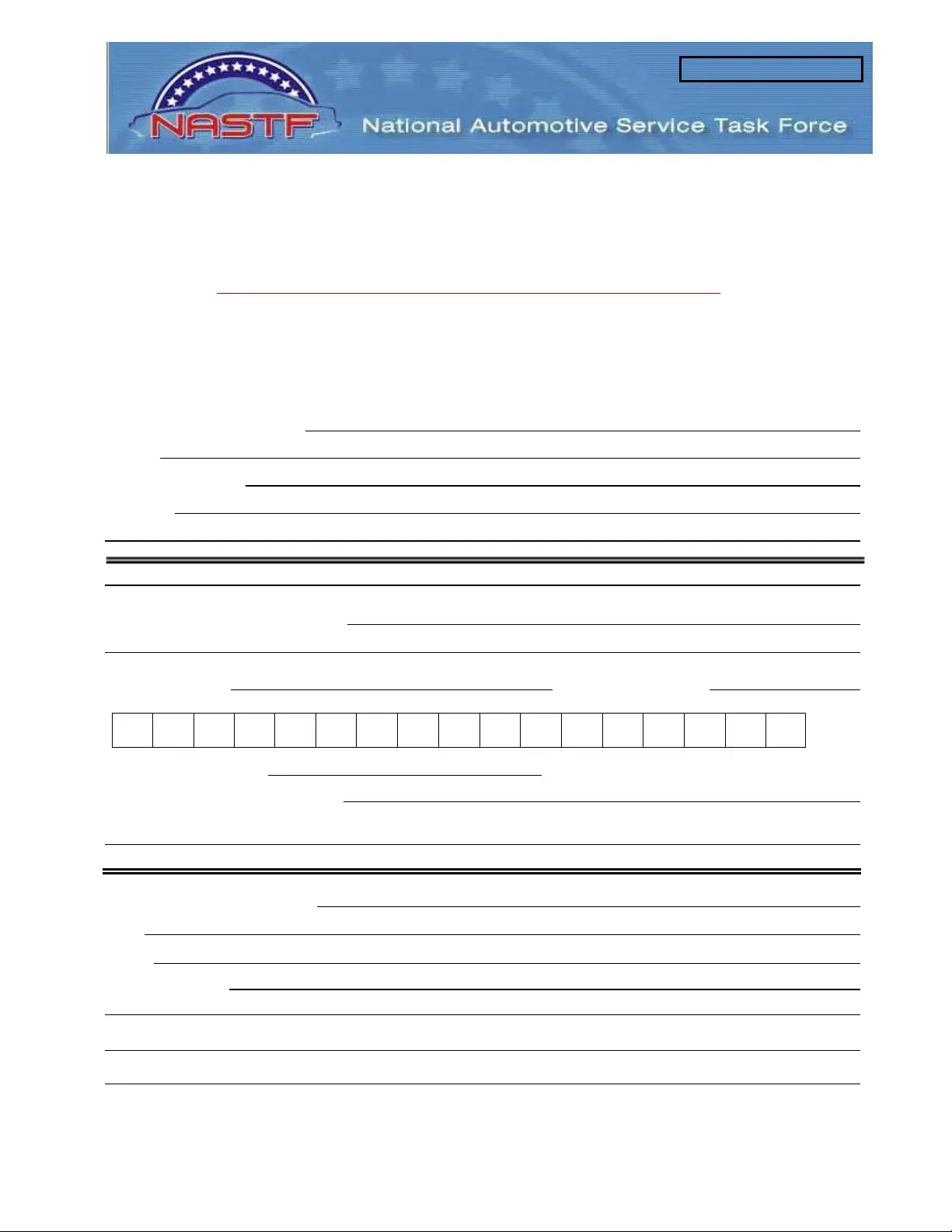
Form D-1
AUTHORIZATION FOR AUTOMOTIVE KEY GENERATION
and/or IMMOBILIZER SYSTEM/ANTI-THEFT
SERVICES
(The LSID Holder must fill out this form, after personally looking at the photo I.D., the registration and the VIN plate on the Vehicle.
These forms are to be kept for 2 years in a secured location as per the NASTF positive I.D. Policy. The NASTF Administrator will
randomly audit these forms to ensure compliance with positive I.D policy. Failure to produce D-1 Forms when requested will
result in LSID registry suspension and possible termination.)
I
hereby certify that I have the authority to order keys and immobilizer system reset services for the vehicle indicated below. I agree that the
information I am providing is true and correct. Further, to the maximum extent permitted by applicable law, I agree to indemnify and hold
harmless the service provider listed below and related parties providing security information from any and all liability or claims that may arise
from the performance of this service. I further agree to indemnify the automaker and their affiliates, successors, assignees, and nominees
from any and all claims, losses, or costs (including reasonable attorney's fees) arising from any acts or omissions of the service provider, the
service provider’s employees, subcontractors, or agents.
Vehicle Owner/Customer Name:
Address:
City / State / Zip Code:
Telephone:
|
Vehicle Owner/Customer Signature Date
Driver’s License Number
1
State Expiration Date
Other Form of ID (specify type and number):
| | |
Vehicle Year Make Model Color:
License Plate Number State of Vehicle Registration
Vehicle ID Number (VIN) (17 characters)
Odometer Reading (mileage): (or) Not Available:
For Dealership/Auctions: PO / Stock # /
Service Performed: Key cut from code Immobilizer reset Other (describe below) :
VSP/Service Provider Business Name:
Phone:
Address:
City / State / Zip Code:
|
VSP/Technician Name LSID:
| / /
VSP/Technician Signature
| / /
Contracting Shop Owner/Manager Signature Date
(Item 8 of the Positive ID Policy)
1
IMPORTANT: Mobile Service Providers - If the VSP is not present at the time vehicle is received for service by a contracting service facility, the contracting service facility must make a
photocopy of the vehicle owner’s drivers license and attach to this form. Additionally, a valid registration must be left with the vehicle so that the VSP can verify that the driver’s license
matches the ownership documentation.
DCDB01 20874833.4 v1.2 21-Nov 11
Page 2 of 2

File Breakdown

Fact Name Description Governing Law(s)
Positive Identification Policy Vehicle Security Professionals (VSPs) must verify the identity and authority of customers before providing key and anti-theft services. State-specific motor vehicle laws
Form D-1 Requirements The VSP must complete Form D-1, collecting detailed customer and vehicle information, including a valid photo ID. State-specific identification laws
Retention Period Completed Form D-1 must be retained for two years or longer, as required by applicable laws. State-specific record retention laws
Mobile VSP Protocol Mobile VSPs can accept a photocopy of the customer’s ID, but the shop owner must verify the ID in person. State-specific regulations on mobile services

Guide to Using Nastf

Filling out the NASTF form is a straightforward process that ensures compliance with identification policies when servicing vehicle security needs. Follow these steps carefully to complete the form accurately.

  1. Inform the Caller: Ask the caller if they have identification and authority for the service. Explain the requirements of the Positive Identification Policy.
  2. Complete the Form: When at the job site or when the customer arrives, fill out the Authorization for Automotive Key Generation and/or Immobilizer System/Anti-Theft Services form (Form D-1). Include the customer's name, address, phone number, driver’s license, vehicle make, model, year, license plate number, VIN, odometer reading, and have them sign the disclaimer.
  3. Verify I.D.: Check the customer’s valid photo ID against the information on the form. The ID must be a state-issued driver’s license.
  4. Verify Authority: Request proof of entitlement. Acceptable documents include a valid registration certificate, insurance ID card, insurance policy, vehicle title, or ownership certificate. Ensure the name and address match the driver’s license.
  5. Ask for Signature: Have the customer read and sign Form D-1, confirming the accuracy of their information and their authority to request the service.
  6. File the Form: Keep the completed Form D-1 on file for two years or longer if required by law.
  7. Compliance with Applicable Laws: Adhere to all applicable laws. If there’s a conflict between these steps and the law, follow the law.
  8. Mobile VSPs: If working for a body shop, accept a legible photocopy of the customer’s ID, but ensure the shop owner or manager verifies it in person and signs Form D-1.

Get Answers on Nastf

What is the NASTF form and why is it important?

The NASTF form, specifically Form D-1, is an Authorization for Automotive Key Generation and/or Immobilizer System/Anti-Theft Services. It is crucial for vehicle security professionals (VSPs) as it ensures that services related to key generation and immobilizer resets are performed only for authorized individuals. This helps prevent unauthorized access to vehicles and enhances overall vehicle security.

What information is required on the NASTF form?

The NASTF form requires several pieces of information to verify the identity and authority of the individual requesting the service. This includes:

  • Name and address of the customer
  • Phone number
  • Driver’s license number
  • Vehicle make, model, and year
  • Vehicle license plate number
  • Vehicle Identification Number (VIN)
  • Odometer reading

Additionally, the customer must provide a signature attesting to the truthfulness of the information and their authority to request the service.

How does a VSP verify a customer’s identity and authority?

A VSP must take several steps to verify the customer’s identity and authority. First, the VSP will check for a valid photo ID, specifically a state-issued driver’s license. The information on the ID must match the details provided on the NASTF form. Next, the VSP will request proof of entitlement, which can be a valid registration certificate, insurance ID card, vehicle title, or certificate of ownership. If the necessary documents are locked inside the vehicle, the VSP may enter the vehicle to verify the authority of the requestor. If the authority cannot be confirmed, the VSP must refrain from providing any services and secure all information obtained during the transaction.

How long should the NASTF form be kept on file?

The completed NASTF form must be kept on file for a minimum of two years. This retention period is essential for compliance with the Positive Identification Policy. In some cases, local laws may require a longer retention period, so VSPs should be aware of and adhere to applicable regulations.

What happens if a VSP fails to comply with the NASTF form requirements?

If a VSP fails to comply with the requirements of the NASTF form, they may face serious consequences. The NASTF Administrator conducts random audits to ensure compliance with the Positive Identification Policy. Failure to produce the completed forms when requested can result in suspension or even termination from the LSID registry. This emphasizes the importance of adhering to the established procedures to maintain the integrity of vehicle security services.

Common mistakes

Filling out the NASTF form can be a straightforward process, but many individuals make common mistakes that can lead to delays or complications. Understanding these pitfalls can help ensure that the form is completed correctly and efficiently.

One frequent mistake is failing to provide complete and accurate information. When filling out the form, it is essential to include all required details, such as the vehicle's make, model, year, and the Vehicle Identification Number (VIN). Missing even a single piece of information can result in the form being rejected or delayed.

Another common error is not verifying the customer’s identification properly. The form requires a valid state-issued driver’s license as proof of identity. If the customer presents an expired or invalid ID, the service cannot proceed. Always double-check that the ID matches the information provided on the form.

Many individuals overlook the importance of confirming the customer’s authority to request services. It’s crucial to ask for proof of entitlement, such as a registration certificate or insurance ID card. If this documentation does not match the name and address on the driver’s license, the request should not be fulfilled.

Additionally, some people forget to have the customer sign the form. The signature is vital as it attests to the accuracy of the information provided and confirms the customer's authority to obtain services. Without this signature, the form may be considered incomplete.

Filing errors can also occur. Some individuals neglect to keep the completed Form D-1 on file for the required two years. This oversight can lead to compliance issues if the NASTF Administrator requests to review the forms during an audit.

Another mistake is failing to follow the Positive Identification Policy. Each step outlined in the policy must be adhered to, as non-compliance can result in penalties, including suspension from the LSID registry. It’s important to stay updated on any changes to the policy.

Mobile service providers sometimes make the error of accepting faxed copies of identification. The policy clearly states that only legible photocopies are acceptable, and the shop owner or manager must verify the ID in person. Ignoring this requirement can jeopardize the legitimacy of the service provided.

Some individuals also neglect to provide a disclaimer or signature on the form. This section is crucial as it protects the service provider from liability. Failing to include this can expose the provider to unnecessary risks.

Lastly, individuals often misinterpret the requirements for the odometer reading. If the mileage is not available, it must be clearly indicated on the form. Leaving this section blank can lead to confusion and potential issues with the service request.

By being aware of these common mistakes, individuals can fill out the NASTF form more effectively. Attention to detail and adherence to the outlined policies are key to ensuring a smooth process.

Documents used along the form

The NASTF form is essential for vehicle security professionals when providing key and anti-theft services. However, several other forms and documents are often used alongside it to ensure compliance and protect all parties involved. Below is a list of these documents, each serving a specific purpose.

  • Authorization for Automotive Key Generation and/or Immobilizer System Services (Form D-1) - This form collects vital information from the customer, including identification details and vehicle specifics. It requires the customer to attest to their authority to request services and includes a signature for liability purposes.
  • Proof of Identity Document - A valid photo ID, such as a driver’s license, is necessary to verify the identity of the customer. This document ensures that the person requesting services is indeed authorized to do so.
  • Proof of Entitlement - This document can be a vehicle registration certificate, insurance ID card, or title. It must match the name and address on the customer’s ID, confirming their ownership and authority over the vehicle.
  • Work Order or Invoice - This document outlines the services provided and includes identifying information about the customer and vehicle. It is typically stapled to Form D-1 to ensure all necessary details are documented together.

Using these documents in conjunction with the NASTF form helps maintain a secure and compliant process for vehicle security services. It is critical to follow the outlined procedures to protect both the service provider and the customer.

Similar forms

  • Authorization for Automotive Key Generation Form (Form D-1): This document is integral to the NASTF process. It collects essential information such as the vehicle's make, model, and VIN, as well as customer identification details. Like the NASTF form, it requires the customer to confirm their identity and authority to request services, ensuring accountability and security.

  • Vehicle Title: The vehicle title serves as proof of ownership, similar to the proof of entitlement required by the NASTF form. Both documents must match the identification provided by the customer to verify their authority to request services related to the vehicle.

  • Insurance ID Card: An insurance ID card is another form of identification that can be used to verify ownership. Like the NASTF form, it requires the name and address on the card to match the driver's license, ensuring that the person requesting services is indeed authorized.

  • Work Order or Invoice: This document outlines the services performed and includes customer information. Similar to the NASTF form, it serves as a record that must be kept for a specified period. It is important for tracking services rendered and ensuring compliance with identification policies.

Dos and Don'ts

When filling out the NASTF form, it is essential to adhere to specific guidelines to ensure compliance and accuracy. Below is a list of dos and don'ts that will help streamline the process.

  • Do inform the caller about the identification requirements at the initial request.
  • Do complete the Authorization for Automotive Key Generation and/or Immobilizer System/Anti-Theft Services form accurately upon arrival at the job site.
  • Do verify the customer's valid photo ID against the information provided on the authorization form.
  • Do require proof of entitlement from the customer, ensuring that the name and address match the driver's license.
  • Do ask the customer to read and sign the form, confirming the accuracy of the information provided.
  • Do keep the completed form on file for at least two years, or longer if required by law.
  • Do comply with all applicable laws, even if they conflict with the outlined steps.
  • Don't provide any key-related information if you cannot verify the authority of the requestor.
  • Don't produce a replacement key without confirming the customer's identity and authority.
  • Don't accept a faxed copy of the customer's ID; only a legible photocopy is acceptable.
  • Don't neglect to file the completed form securely, as failure to do so may result in audits and penalties.
  • Don't allow the vehicle to be entered without proper verification of the requestor's authority.
  • Don't overlook the importance of accuracy when filling out the form; incorrect information can lead to liability issues.
  • Don't forget to have the shop owner or manager verify the customer's ID in person when applicable.

Misconceptions

Understanding the NASTF form can be crucial for vehicle security professionals. However, several misconceptions often cloud its purpose and usage. Here’s a breakdown of ten common misunderstandings:

  1. The NASTF form is optional. Many believe that using the NASTF form is a choice. In reality, it is a mandatory requirement for compliance with the Positive Identification Policy.
  2. Only large companies need to use the NASTF form. This is false. Whether you’re a small shop or a large dealership, all Vehicle Security Professionals must adhere to the same requirements.
  3. Any form of identification will suffice. Incorrect. A valid state-issued driver’s license is specifically required to verify the customer’s identity.
  4. Once the form is filled out, it can be discarded. This is a misconception. The completed form must be kept on file for a minimum of two years, or longer if required by law.
  5. The form only protects the customer. Not true. The form also protects the service provider by requiring the customer to indemnify them against any claims that may arise.
  6. Mobile service providers can ignore the identification requirements. This is misleading. Mobile VSPs must still verify identification and follow the same protocols as stationary providers.
  7. Photocopies of IDs are always acceptable. This is not accurate. Only a legible photocopy is acceptable under specific conditions, and it cannot be a faxed copy.
  8. All information on the form is optional. This is incorrect. Essential information, such as the Vehicle Identification Number (VIN) and the customer’s signature, is mandatory.
  9. The form does not require customer consent. This is a misconception. The customer must read and sign the form, affirming their authority and the truthfulness of the information provided.
  10. Compliance with the NASTF form is only necessary during audits. This is misleading. Compliance is an ongoing requirement, not just something to worry about during audits.

By clarifying these misconceptions, vehicle security professionals can better navigate the requirements of the NASTF form and ensure they are operating within legal guidelines. Understanding these points can lead to smoother transactions and enhanced security for all parties involved.

Key takeaways

Understanding the NASTF form is crucial for Vehicle Security Professionals (VSPs) who provide key and anti-theft services. Here are some key takeaways to keep in mind:

  • Initial Communication is Key: Always inform the caller about the identification requirements when they first request service. This sets clear expectations from the start.
  • Thorough Completion: When filling out the Authorization for Automotive Key Generation and/or Immobilizer System form, ensure all required information is collected. This includes the customer’s name, address, vehicle details, and signatures.
  • Verification of Identity: Always verify the customer’s valid photo ID against the information provided on the form. A state-issued driver’s license is essential for this process.
  • Proof of Authority: Customers must present documentation that proves their entitlement to the vehicle. This could be a registration certificate, insurance ID, or vehicle title, among others.
  • Signature Requirement: The customer must read and sign the form, confirming the truthfulness of the information and their authority to request services.
  • Record Keeping: Keep the completed form on file for at least two years. This is important for compliance and in case of audits.

Following these guidelines will help ensure a smooth process and maintain compliance with the NASTF Positive Identification Policy.