Content Navigation

The National Compliance Center (NCC) plays a crucial role in ensuring that law enforcement and legal entities can access the wireless customer records they need while maintaining the privacy of individuals. Located in North Palm Beach, Florida, the NCC operates around the clock, providing essential support to various legal contacts, including Public Safety Answering Points (PSAPs). The form associated with the NCC outlines the procedures for submitting requests related to subpoenas, search warrants, and court orders. It is designed to facilitate the flow of information while adhering to both state and federal laws. This form serves multiple purposes: it allows PSAPs to request subscriber information during emergencies, offers guidance on lawful requests, and ensures compliance with the Communications Assistance to Law Enforcement Act (CALEA). Additionally, the NCC is committed to providing education and support to law enforcement agencies regarding their policies and procedures. With dedicated contact numbers for different types of requests, the NCC ensures that help is always just a call away, especially in urgent situations where lives may be at stake.

National Compliance Center Example

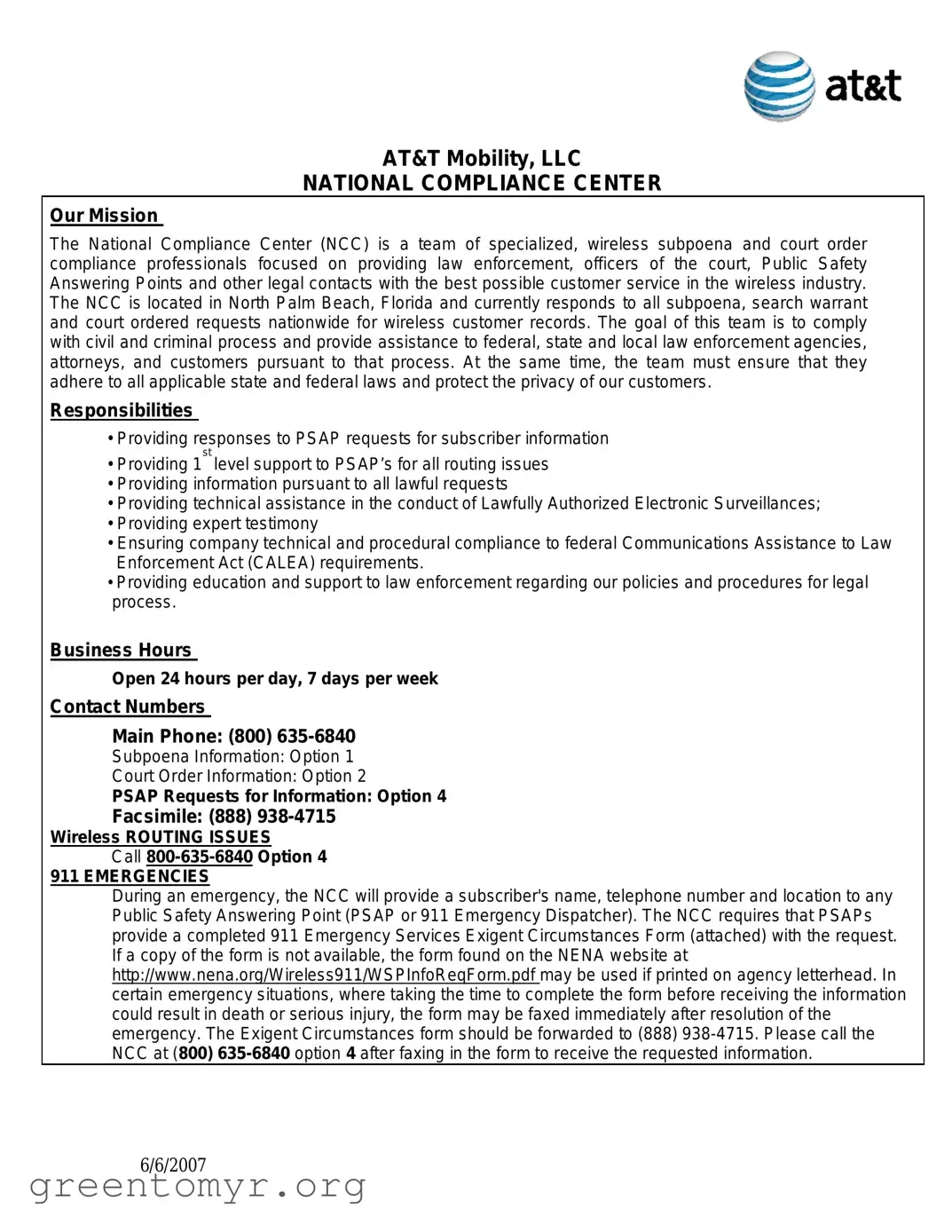
AT&T Mobility, LLC
NATIONAL COMPLIANCE CENTER
Our Mission
The National Compliance Center (NCC) is a team of specialized, wireless subpoena and court order
compliance professionals focused on providing law enforcement, officers of the court, Public Safety
Answering Points and other legal contacts with the best possible customer service in the wireless industry.
The NCC is located in North Palm Beach, Florida and currently responds to all subpoena, search warrant
and court ordered requests nationwide for wireless customer records. The goal of this team is to comply
with civil and criminal process and provide assistance to federal, state and local law enforcement agencies,
attorneys, and customers pursuant to that process. At the same time, the team must ensure that they
adhere to all applicable state and federal laws and protect the privacy of our customers.
Responsibilities
• Providing responses to PSAP requests for subscriber information
• Providing 1
st
level support to PSAP’s for all routing issues
• Providing information pursuant to all lawful requests
• Providing technical assistance in the conduct of Lawfully Authorized Electronic Surveillances;
• Providing expert testimony
• Ensuring company technical and procedural compliance to federal Communications Assistance to Law
Enforcement Act (CALEA) requirements.
Providing education and support to law enforcement regarding our policies and procedures for legal
process.
Business Hours
Open 24 hours per day, 7 days per week
Contact Numbers
Main Phone: (800) 635-6840
Subpoena Information: Option 1
Court Order Information: Option 2
PSAP Requests for Information: Option 4
Facsimile: (888) 938-4715
Wireless ROUTING ISSUES
Call
800-635-6840 Option 4
911 EMERGENCIES
During an emergency, the NCC will provide a subscriber's name, telephone number and location to any
Public Safety Answering Point (PSAP or 911 Emergency Dispatcher). The NCC requires that PSAPs
provide a completed 911 Emergency Services Exigent Circumstances Form (attached) with the request.
If a copy of the form is not available, the form found on the NENA website at
http://www.nena.org/Wireless911/WSPInfoReqForm.pdf may be used if printed on agency letterhead. In
certain emergency situations, where taking the time to complete the form before receiving the information
could result in death or serious injury, the form may be faxed immediately after resolution of the
emergency. The Exigent Circumstances form should be forwarded to (888) 938-4715. Please call the
NCC at (800) 635-6840 option 4 after faxing in the form to receive the requested information.
6/6/2007
911 EXIGENT CIRCUMSTANCES FORM
To: National Compliance Center Tel. (800) 635-6840, Fax: (888) 938-4715)
From: ____________________________________________
(Name of Agency/PSAP) (DATE)
Re: Emergency Request for Records for Wireless Number: _________________________
This office received a 911distress call for assistance from the above wireless telephone number on
_________________200___ at __________a.m./p.m. Based upon that phone call, we believe that one
or more people face immediate danger of death or serious physical injury. As such, we request that you
promptly provide us with the following information so that we may render assistance to that individual
(or individuals). Check needed information below:
_____ current subscriber name and billing address information for the above-referenced telephone;
_____ cell site or location information for the call placed by the above-referenced telephone to 911.
Signature: _________________________________________________________
Printed Name: ______________________________________________________
Title: _____________________________________________________________
Address 1 _________________________________________________________
Address 2 _________________________________________________________
City, State, Zip_____________________________________________________
Contact Number:
____________________________________________________
Contact Facsimile: ___________________________________________________
THIS FORM MUST BE FILLED OUT IN ITS ENTIRETY
PLEASE CALL (800) 635-6840 OPTION 4 AFTER FAXING THIS FORM
6/6/2007

File Breakdown

Fact Name Details
Organization The National Compliance Center (NCC) operates under AT&T Mobility, LLC.
Location The NCC is based in North Palm Beach, Florida.
Service Hours The NCC is available 24/7, providing continuous support.
Emergency Protocol During emergencies, the NCC can provide subscriber information to Public Safety Answering Points (PSAPs).
Exigent Circumstances Form PSAPs must submit a completed 911 Emergency Services Exigent Circumstances Form to request information.
Compliance Focus The NCC ensures adherence to federal and state laws, including the Communications Assistance to Law Enforcement Act (CALEA).
Contact Information Main Phone: (800) 635-6840; Fax: (888) 938-4715.

Guide to Using National Compliance Center

Filling out the National Compliance Center form is a straightforward process. Follow the steps carefully to ensure that all required information is provided accurately. Once completed, you will need to submit the form to the appropriate contact at the NCC.

  1. Obtain the form: Download the 911 Exigent Circumstances Form from the NENA website or use the attached form.
  2. Fill in the agency information: Write the name of your agency or Public Safety Answering Point (PSAP) at the top of the form.
  3. Date the request: Enter the current date in the designated space.
  4. Provide the wireless number: Fill in the wireless number associated with the emergency request.
  5. Document the call details: Indicate the date and time of the distress call in the specified format.
  6. Select needed information: Check the boxes for the information you are requesting: subscriber name and billing address, or cell site/location information.
  7. Sign the form: Ensure that the form is signed by an authorized individual.
  8. Print your name and title: Below the signature, print your name and title clearly.
  9. Fill in the contact information: Provide your agency’s address, contact number, and facsimile number.
  10. Submit the form: Fax the completed form to (888) 938-4715 and call (800) 635-6840, option 4, to confirm receipt and request the needed information.

Get Answers on National Compliance Center

What is the purpose of the National Compliance Center (NCC)?

The National Compliance Center (NCC) serves as a dedicated team focused on ensuring compliance with subpoenas, search warrants, and court orders related to wireless customer records. Their mission is to provide exceptional service to law enforcement, attorneys, and Public Safety Answering Points (PSAPs) while adhering to applicable laws and protecting customer privacy. The NCC operates from North Palm Beach, Florida, and is available 24/7 to respond to requests nationwide.

How can law enforcement contact the NCC for information?

Law enforcement agencies can reach the NCC through several contact methods. The main phone number is (800) 635-6840. For specific inquiries:

  • Subpoena Information: Option 1
  • Court Order Information: Option 2
  • PSAP Requests for Information: Option 4

Additionally, the NCC can be contacted via fax at (888) 938-4715. It's important to use the appropriate option to ensure that requests are directed to the right team.

What should PSAPs do in emergency situations to obtain subscriber information?

In emergency situations, PSAPs can obtain a subscriber's name, telephone number, and location by submitting a completed 911 Emergency Services Exigent Circumstances Form. This form must be faxed to (888) 938-4715. If the situation is critical and time-sensitive, the form can be sent after the emergency is resolved. However, it is crucial to call the NCC at (800) 635-6840, option 4, after faxing the form to receive the requested information promptly.

What information is required on the Exigent Circumstances Form?

The Exigent Circumstances Form must include specific details to ensure a swift response. Required information includes:

  1. Name of the agency or PSAP making the request.
  2. Date of the request.
  3. Wireless number associated with the emergency call.
  4. A statement indicating the immediate danger of death or serious injury.
  5. Requested information, such as the current subscriber name and billing address or cell site/location information.

Completing the form in its entirety is essential for processing the request efficiently.

What are the NCC's hours of operation?

The National Compliance Center operates 24 hours a day, 7 days a week. This round-the-clock availability ensures that law enforcement and legal contacts can receive assistance and information whenever it is needed, regardless of the time or day.

Common mistakes

When filling out the National Compliance Center (NCC) form, it's crucial to avoid common mistakes that can delay your request or lead to complications. One frequent error is incomplete information. Many individuals forget to fill out all required fields, such as the agency name, date, or contact information. Omitting any of these details can result in the form being rejected or delayed.

Another common issue is incorrect formatting. For instance, dates should be clearly written in a consistent format. If the date is not clearly indicated, it can create confusion and slow down the processing of your request. Additionally, ensure that you follow the correct format for phone numbers and addresses, as discrepancies can lead to miscommunication.

Some people also fail to sign the form. A signature is essential for validating the request. Without it, the NCC cannot process your request, as they need to verify that the request is legitimate and authorized. Always double-check that you have signed and printed your name clearly.

Another mistake involves not providing enough context in the emergency request. It’s important to include a detailed explanation of the situation that necessitates the request. Simply stating that it’s an emergency without elaborating can lead to misunderstandings and may result in a delay in receiving the necessary information.

Some individuals neglect to use agency letterhead when required. For certain requests, especially during emergencies, using official letterhead is crucial. If the form is not printed on the agency's letterhead, it may be viewed as unofficial and could be disregarded.

Additionally, people often forget to follow up after submitting the form. It’s recommended to call the NCC after faxing the form to confirm receipt and to ensure that everything is in order. A simple follow-up can save time and prevent any potential issues.

Another mistake is failing to check the urgency of the request. If you are dealing with a true emergency, make sure to clearly indicate this on the form. Mislabeling the urgency can lead to delays in response time, which could have serious consequences.

Lastly, many overlook the importance of reviewing the entire form before submission. Take a moment to read through all the information you provided. Errors can be easily missed, and a quick review can help catch mistakes that might otherwise hinder your request.

Documents used along the form

When working with the National Compliance Center form, several other documents are commonly needed to ensure smooth communication and compliance. These forms help law enforcement and legal entities gather necessary information efficiently and effectively.

  • Subpoena Form: This document is used to request specific records or information from a company or individual. It is a formal legal order that compels the recipient to provide the requested data, often necessary in investigations or court cases.
  • Court Order: A court order is a directive issued by a judge that requires a party to do or refrain from doing something. In the context of compliance, this document may mandate the release of specific information or records from a company.
  • Exigent Circumstances Form: This form is used during emergencies when immediate access to information is crucial. It allows law enforcement to request subscriber information quickly, ensuring that help can be provided without delay.
  • Law Enforcement Request for Information: This document is typically used by law enforcement agencies to formally request data from a telecommunications provider. It outlines the specific information needed and the legal basis for the request.

Each of these documents plays a vital role in facilitating communication between law enforcement and service providers. Understanding their purpose and proper use can greatly enhance the efficiency of legal processes and ensure compliance with applicable laws.

Similar forms

The National Compliance Center (NCC) form shares similarities with several other legal documents used in law enforcement and compliance. Here’s a list of nine documents that have comparable functions or structures:

  • Subpoena Duces Tecum: This document requires an individual or organization to produce documents or records for a legal proceeding. Like the NCC form, it is a formal request for information necessary for investigations.
  • Search Warrant: Issued by a judge, this document allows law enforcement to search a specific location for evidence. Both the search warrant and the NCC form involve the collection of information under legal authority.
  • Affidavit: A written statement confirmed by oath, used as evidence in court. The NCC form, similar to an affidavit, often requires a declaration of urgency and justification for the request.
  • Emergency Protective Order: This legal order provides immediate protection for individuals in danger. The NCC form facilitates urgent requests for information, paralleling the swift action required in protective orders.
  • Law Enforcement Information Request Form: Used by agencies to request information from telecommunications providers, this form functions similarly to the NCC form in seeking subscriber data for investigations.
  • Incident Report: A document created by law enforcement to detail an event or crime. Both the incident report and the NCC form require detailed information about specific situations to aid investigations.
  • Consent to Release Information Form: This document allows individuals to permit the release of their personal information. The NCC form also involves obtaining necessary information, albeit under legal compulsion.
  • 911 Call Log: Records of emergency calls made to 911. The NCC form may request details about these calls, showing a direct connection in the context of emergency response.
  • Public Records Request: A request for access to documents held by government agencies. Similar to the NCC form, this request seeks information that is legally available to the public or law enforcement.

Dos and Don'ts

When filling out the National Compliance Center form, it's important to follow specific guidelines to ensure a smooth process. Here are six things you should and shouldn't do:

  • Do provide accurate and complete information in all fields.
  • Do use agency letterhead when submitting the Exigent Circumstances Form.
  • Do call the NCC at (800) 635-6840, option 4, after faxing your form.
  • Don't leave any sections of the form blank; it must be filled out in its entirety.
  • Don't forget to include your agency's contact information for follow-up.
  • Don't use unofficial forms; only the provided or NENA forms are acceptable.

Misconceptions

Understanding the National Compliance Center (NCC) form can be challenging due to various misconceptions. Here are six common misunderstandings about this important document:

  • The NCC form is only for law enforcement agencies. Many believe that only police or government entities can use the NCC form. In reality, it is also accessible to attorneys and public safety answering points (PSAPs) who require information for legal processes.
  • All requests are processed immediately. While the NCC strives to provide timely responses, not every request can be fulfilled instantly. The complexity of the request and the need for verification can affect processing times.
  • The NCC does not protect customer privacy. Some individuals think that the NCC disregards customer privacy. On the contrary, the NCC is committed to adhering to all applicable laws to ensure that customer information is handled with care and confidentiality.
  • Emergency requests do not require any documentation. There is a misconception that emergency requests can be made without any forms. However, even in exigent circumstances, a completed 911 Emergency Services Exigent Circumstances Form is necessary for the NCC to process the request.
  • The NCC only deals with subpoenas. Many assume that the NCC's responsibilities are limited to subpoenas. In fact, the NCC also handles court orders, search warrants, and various lawful requests for customer records.
  • All NCC services are available during business hours only. Some people think that they can only reach the NCC during traditional business hours. The NCC operates 24/7, ensuring that assistance is available at any time of day or night.

By clarifying these misconceptions, users can better understand how to effectively utilize the NCC form and the services it provides.

Key takeaways

When filling out and using the National Compliance Center form, consider the following key takeaways:

  • Understand the Purpose: The National Compliance Center (NCC) aims to assist law enforcement and legal professionals in obtaining wireless customer records.
  • 24/7 Availability: The NCC operates around the clock, providing services every day of the week.
  • Emergency Protocols: In emergencies, the NCC can quickly provide subscriber information to Public Safety Answering Points (PSAPs).
  • Required Forms: For emergency requests, the Exigent Circumstances Form must be completed and submitted.
  • Submission Methods: Forms can be faxed to (888) 938-4715, and a follow-up call to (800) 635-6840 option 4 is necessary.
  • Accuracy is Key: Ensure that all sections of the form are filled out completely to avoid delays in processing requests.
  • Technical Support: The NCC provides technical assistance related to lawful electronic surveillances and routing issues.
  • Compliance with Laws: The NCC adheres to federal and state laws, including the Communications Assistance to Law Enforcement Act (CALEA).
  • Education and Training: The NCC offers support and training to law enforcement on their policies and procedures for legal processes.
  • Contact Information: Familiarize yourself with the NCC's contact numbers for different types of inquiries to streamline communication.