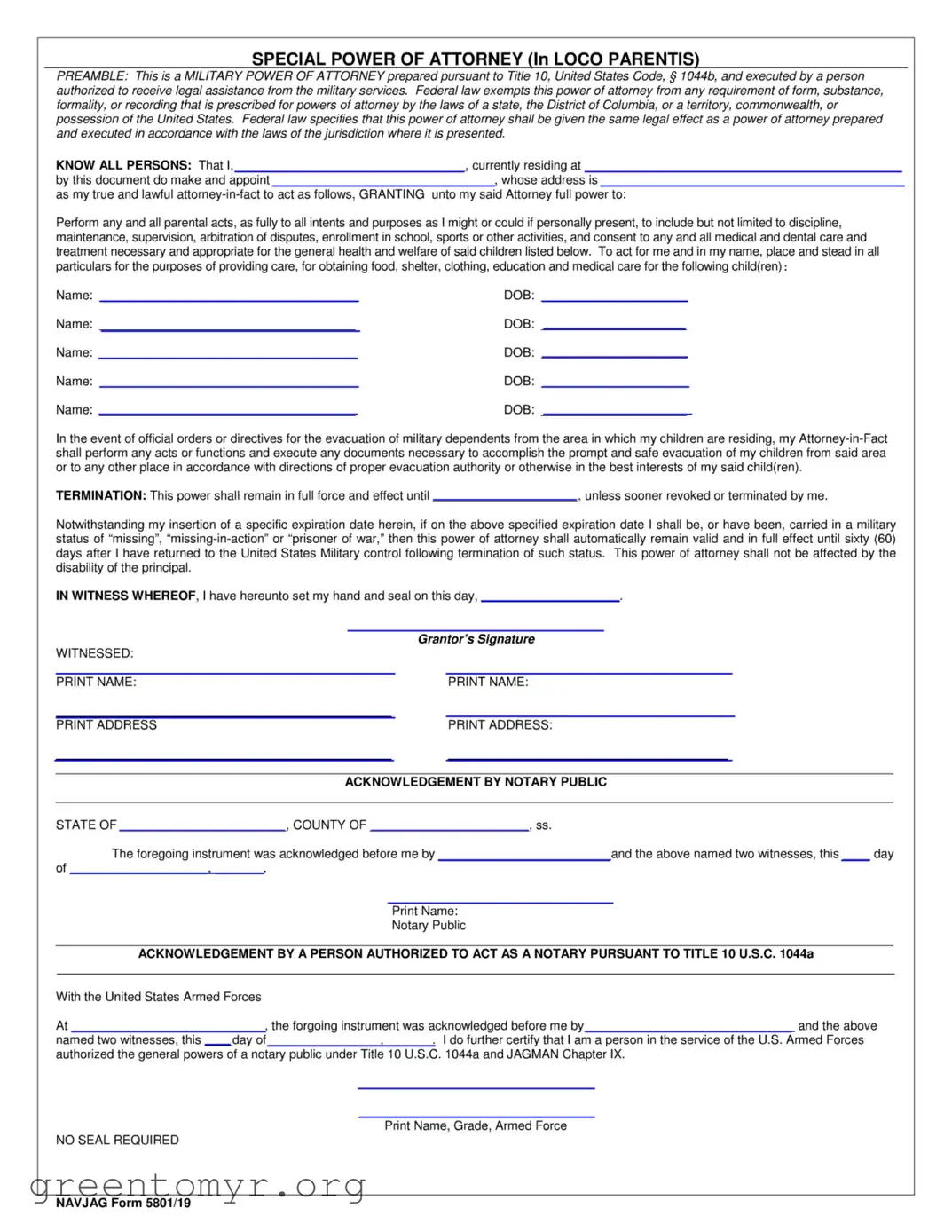
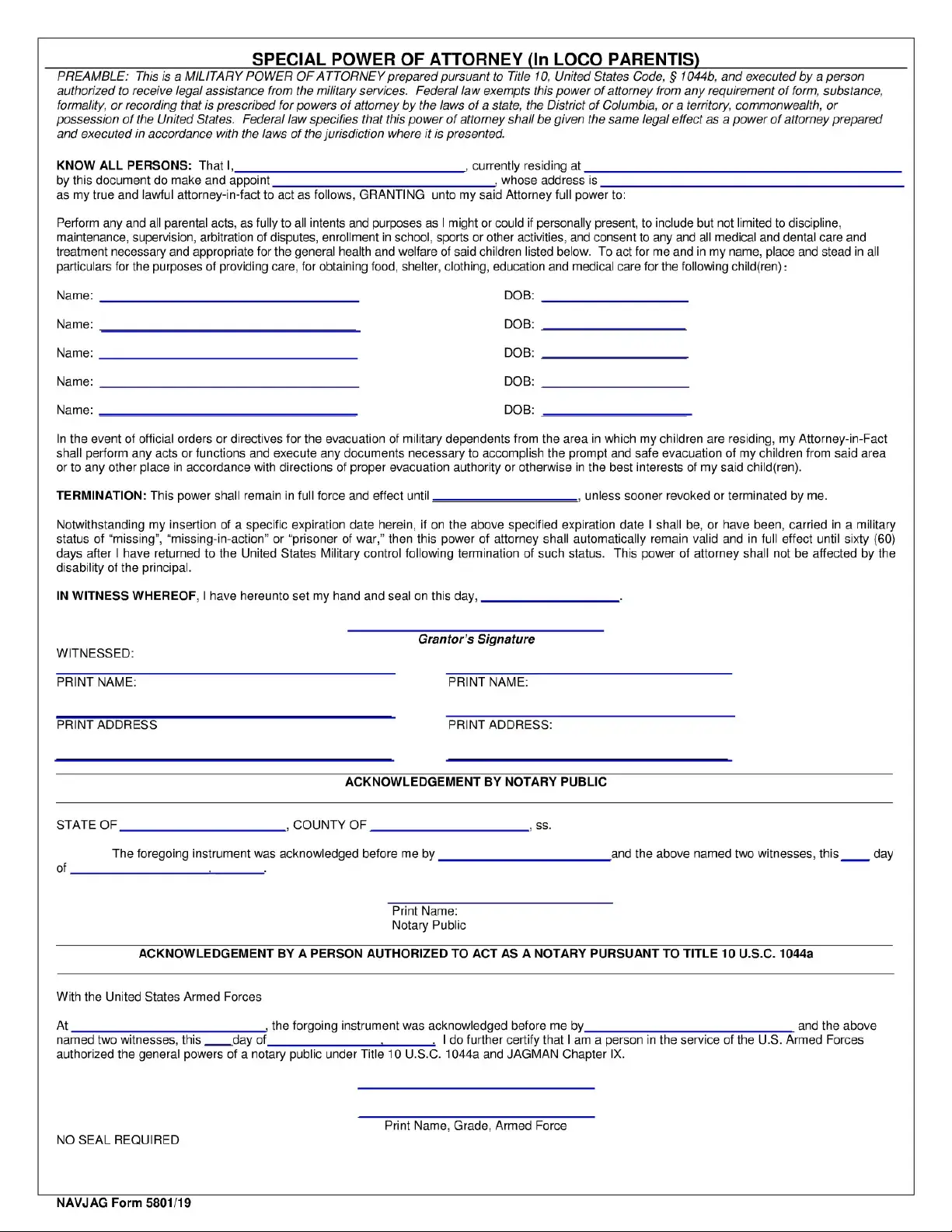
The Navjag 5801 form, also known as the Special Power of Attorney (In Loco Parentis), serves a critical function for military families. This document allows a designated individual to act on behalf of a service member, particularly in matters concerning their children. It is prepared under federal law, specifically Title 10, United States Code, § 1044b, which provides certain protections and exemptions from state laws regarding powers of attorney. The form grants the appointed attorney-in-fact the authority to make decisions related to the child's education, medical care, and general welfare. This includes everything from enrollment in schools and sports activities to consenting to medical treatment. The form also includes provisions for the evacuation of children in case of emergencies, ensuring their safety during military operations. Importantly, the power of attorney remains effective even if the service member is declared missing or a prisoner of war, extending its validity until they are safely returned. Proper execution of this form is essential, as it must be signed, witnessed, and acknowledged by a notary public or an authorized military notary to be legally binding.
| Fact Name | Fact Description |
|---|---|
| Purpose | The Navjag 5801 form serves as a Special Power of Attorney for military personnel, allowing them to designate someone to act in loco parentis for their children. |
| Governing Law | This form is governed by Title 10, United States Code, § 1044b, which provides specific provisions for military powers of attorney. |
| Federal Exemption | Federal law exempts this power of attorney from state-specific requirements regarding formality and recording. |
| Legal Effect | The power of attorney has the same legal effect as one executed according to the laws of the jurisdiction where it is presented. |
| Parental Authority | The attorney-in-fact is granted full parental authority, including discipline, education, and medical care for the children listed. |
| Evacuation Powers | In case of evacuation orders, the attorney-in-fact can perform necessary actions to ensure the safe evacuation of the children. |
| Duration | This power of attorney remains in effect until revoked or until a specified expiration date, with special provisions for military status. |
| Missing Status | If the principal is missing or a prisoner of war, the power remains valid for 60 days after their return to military control. |
| Disability Clause | The power of attorney is not affected by the disability of the principal, ensuring continued authority. |
| Witness and Notary | The form requires signatures from witnesses and acknowledgment by a notary public or a person authorized to act as a notary under military law. |
Filling out the Navjag 5801 form is a straightforward process that requires careful attention to detail. This form is essential for granting a special power of attorney in loco parentis, allowing an appointed individual to make decisions on behalf of a child or children. Following the steps below will help ensure that the form is completed accurately and effectively.
The Navjag 5801 form is a Special Power of Attorney designed specifically for military personnel. It allows a designated individual, known as the attorney-in-fact, to act on behalf of a service member in matters related to their children. This includes making decisions about education, medical care, and general welfare. The form is recognized under federal law, meaning it does not need to adhere to state-specific requirements for powers of attorney.
This form can be utilized by active duty military members who need to appoint someone to take care of their children while they are away. It is particularly useful for service members who may be deployed or stationed far from home, ensuring that their children's needs are met in their absence.
The attorney-in-fact is granted comprehensive powers to perform parental acts, which include:
This wide range of authority ensures that the designated individual can effectively care for the children in the absence of the service member.
The power of attorney remains in effect until a specified expiration date, unless it is revoked earlier by the service member. Notably, if the service member is declared "missing," "missing-in-action," or "prisoner of war," the power of attorney automatically remains valid for up to sixty days after they return to military control. This provision is crucial for ensuring that the attorney-in-fact can continue to act in the best interests of the children during uncertain times.
The Navjag 5801 form explicitly states that the power of attorney will not be affected by the disability of the principal. This means that even if the service member is unable to act due to a disability, the authority granted to the attorney-in-fact remains intact. This provision provides peace of mind, ensuring that the designated individual can continue to make decisions for the children without interruption.
Yes, the form must be acknowledged before a notary public or a person authorized to act as a notary under military law. This step is crucial as it validates the power of attorney and ensures that it is legally recognized. The notary will confirm the identity of the service member and the witnesses, adding an additional layer of security to the document.
Yes, the service member has the right to revoke the power of attorney at any time. This can be done by providing written notice to the attorney-in-fact and any relevant parties. It is advisable to formally document the revocation to avoid any confusion regarding the authority of the attorney-in-fact.
When filling out the Navjag 5801 form, individuals often make several common mistakes that can lead to complications. One frequent error is leaving sections blank. It is crucial to fill in all required fields, including names and addresses, to ensure the form is complete. Missing information can delay processing and create legal challenges.
Another common mistake is incorrect or incomplete names. Providing the full legal name of the attorney-in-fact and the children is essential. Abbreviations or nicknames can cause confusion and may invalidate the document. Similarly, failing to include dates of birth for the children listed can lead to issues, as this information is necessary for identification purposes.
People sometimes overlook the importance of signatures. The form must be signed by the grantor, and it should be done in the presence of witnesses. Not having the required signatures can render the power of attorney ineffective. Additionally, witnesses should print their names and addresses clearly. Illegible handwriting can create problems during verification.
Another mistake involves misunderstanding the termination clause. It is vital to specify an expiration date or understand that the power of attorney remains valid under certain conditions. Failing to address this can lead to unintended consequences, especially in emergency situations.
Individuals may also neglect to acknowledge the notary public section. This part is crucial for legal validation. Not having a notarized signature can result in the document being challenged or deemed invalid. It is important to ensure that the notary public's information is complete and accurate.
Some people forget to review the document for errors before submission. Typos or incorrect information can lead to delays or legal issues. A thorough review can catch these mistakes early. Additionally, not understanding the implications of the power of attorney can lead to misuse or misinterpretation of authority granted.
Lastly, individuals may not keep a copy of the completed form for their records. Having a copy is important for reference and can assist in resolving any future disputes. Proper documentation is key to ensuring that the power of attorney is executed as intended.
The Navjag 5801 form is a Special Power of Attorney designed for military personnel to appoint someone to act on their behalf in caring for their children. Along with this form, there are several other documents that are often used to ensure a smooth process. Below is a list of these related forms and documents.
These documents work together to support military families in managing their affairs, especially when service members are away. Each form plays a crucial role in ensuring that children receive the care and support they need during such times.
The Navjag 5801 form, which serves as a special power of attorney in loco parentis, shares similarities with several other legal documents. Each of these documents allows individuals to grant authority to another person to act on their behalf, particularly in matters related to care and decision-making. Below are five documents that are similar to the Navjag 5801 form:
When filling out the NAVJAG 5801 form, it's essential to be careful and thorough. Here’s a helpful list of things you should and shouldn’t do to ensure the process goes smoothly.
Here are some common misconceptions about the Navjag 5801 form:
When navigating the process of filling out and utilizing the NAVJAG 5801 form, several key points should be kept in mind to ensure clarity and effectiveness. Below are essential takeaways that can guide individuals through this important legal document.
By keeping these key points in mind, individuals can navigate the process of completing the NAVJAG 5801 form with greater confidence and clarity, ensuring that their children’s needs are met in their absence.