Content Navigation

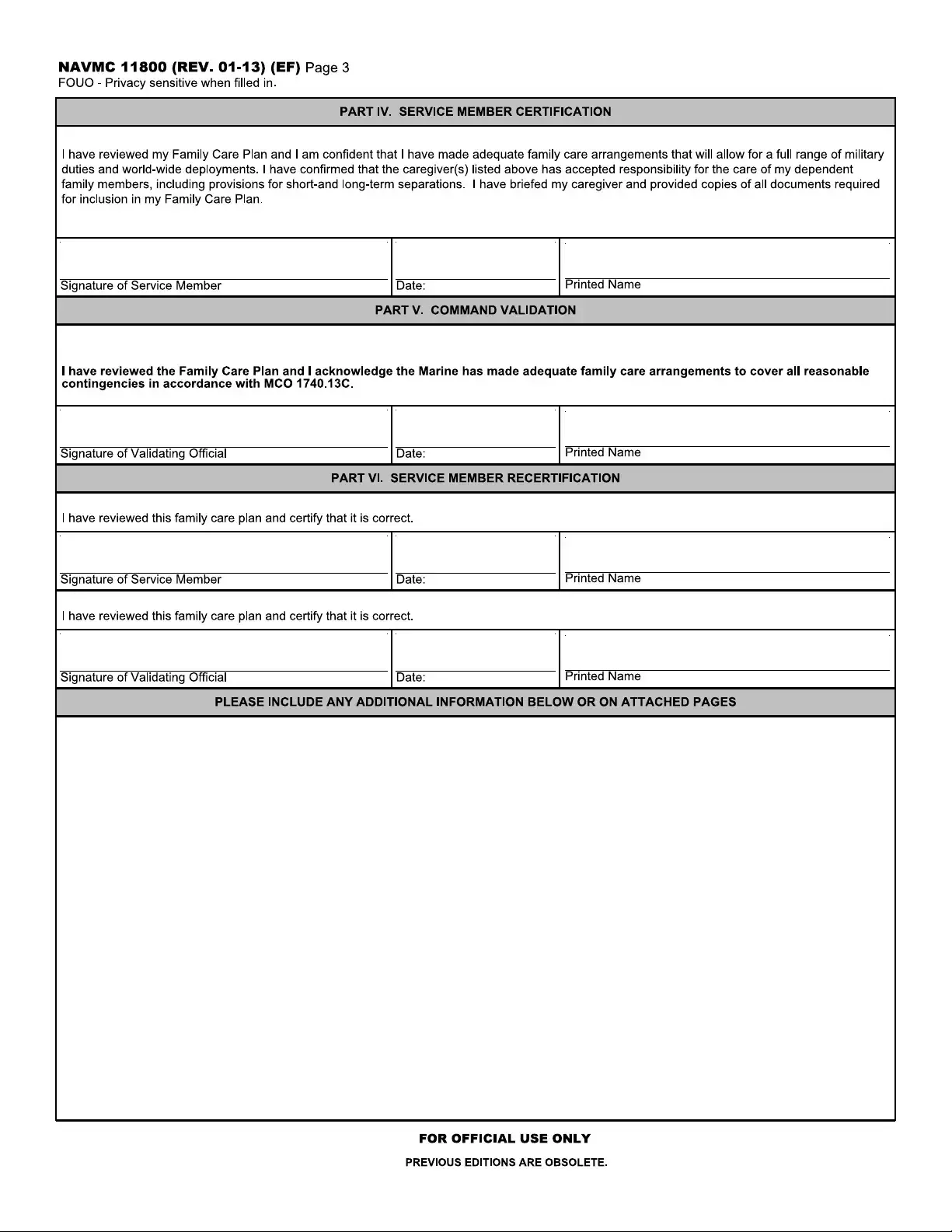
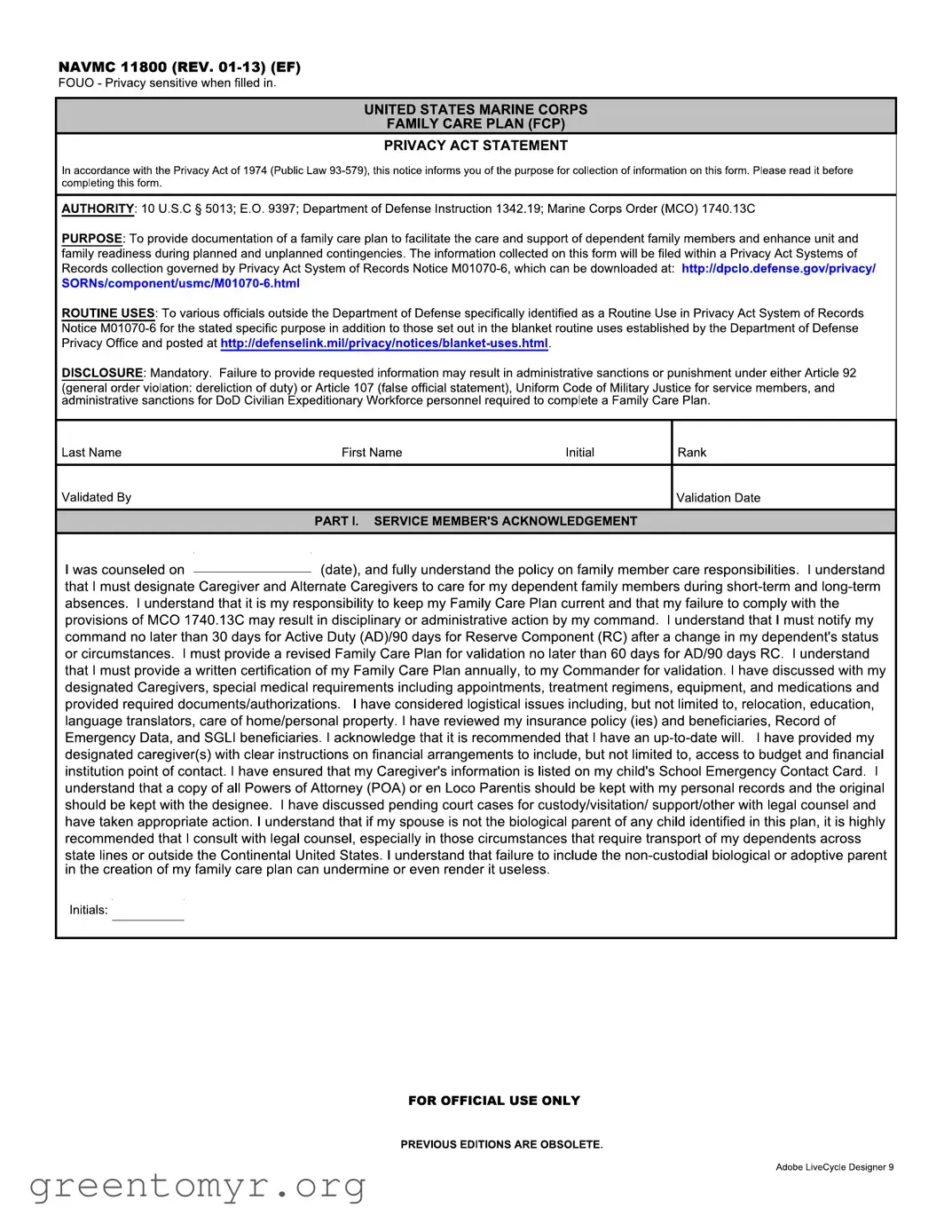
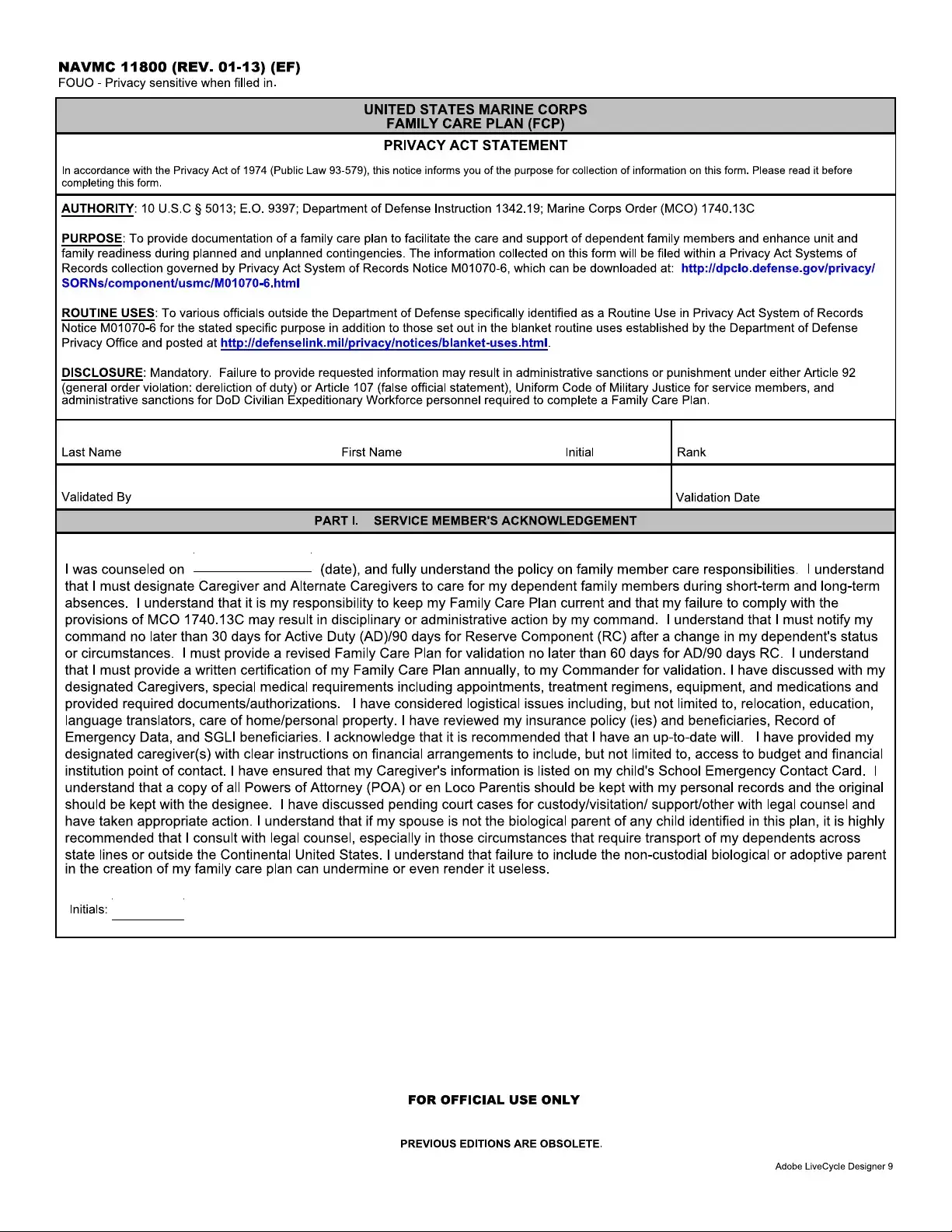
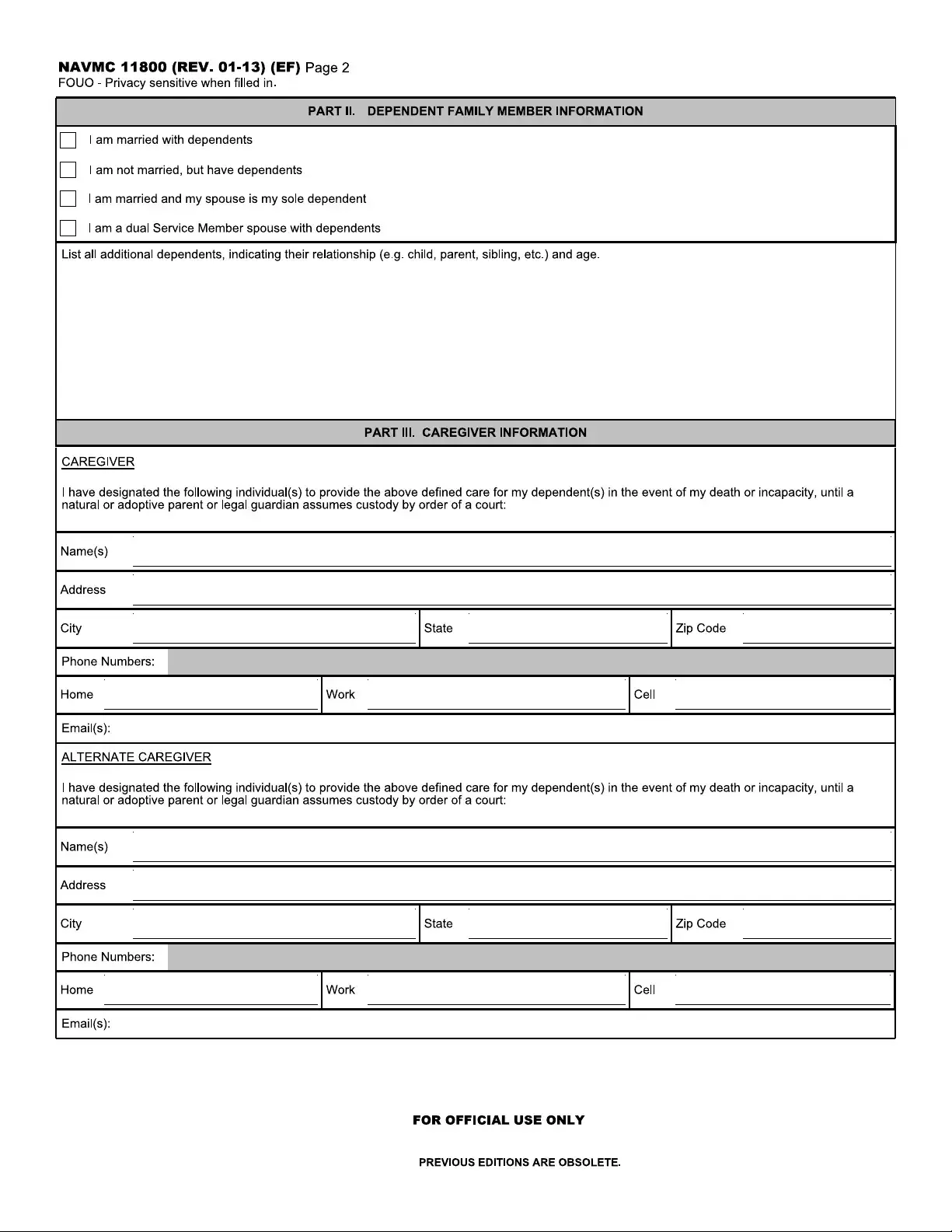
The NAVMC 11800 form is an essential document for service members of the United States Marine Corps, designed to ensure that family care plans are in place for dependents. This form addresses various aspects of family care, emphasizing the importance of proper planning in both expected and unexpected situations. It requires service members to designate caregivers who will be responsible for their dependents in case of their absence due to military duties. The form includes sections for detailing dependent family member information, caregiver details, and a certification process to confirm that arrangements are adequate. It also highlights the mandatory nature of the information provided, emphasizing compliance with established military regulations. Service members must keep their family care plans current and notify their command of any changes in dependent status within specified timeframes. The form serves not only as a record of care arrangements but also as a tool to enhance overall readiness for both the service member and their family.
01234556778927558
!""#
$
%&'()*+(,()+-,.'&)/0.1+
2,-'34/,.)13,&52/16
1.'7,/4,/(+(,()-)&(
89# :9!;<=>?@A"B<CD=<EF 9!9G9@9! H@H9!99""99!!9G99 !9G$"#A!9
9GH"I !9G$
,%(J0.'(4K;L$M$NODL;CPQ$$<C<=PRHG9!R!8@9;C>S$;<PTN9H#?TNE;=>L$;CN
1%.10+)KU9H9##9@G99!!G"H"9!" #@HH99!#H#!G"GGA# @#
!G"##@IH"##@H"#9I$U !9G99""#9 !9G""A!"# :MG9!
V9#9""9I9#A:MG9!V9#W9TL;L=LXF A#9"9##KYZZ[\]]^[_`ab^cdcefcbgah][ijhk_l]
+0.&f]_am[aeceZ]nfm_]-opoqorsbYZm`
.0%('&)%+)+KU99@9!!"9@# RHG9!R!H!""#!#V9@:MG9!V9#
W9TL;L=LX!9 #H!H@H9##99 99@ A"t9@@A" #A RHG9!R!
!!#H9#YZZ[\]]^cdcefc`jeubmj`][ijhk_l]eaZj_cf]v`keucZrnfcfbYZm`$
*'+/30+%.)KT#9$"@9H9#w@#!9G9G@"#G99H@ G@# :"<S
?I"9#9"9K#"99!#@E9:";L=?!"9!!"GEF!9GN9#9!T"x@!9GGAF#
#G9!9R9RN"QyH#9z9t!9H9"w@#99GH"G"N"$
BWG
WG
8"
Vt
{"##|
1,.('b+).7'/)-)-}).~+,/&03)*)-)&(
89@"#9?#EF#!@""@## H9"9!G"GGAH9A"$8@##
8G@#INI#:"NI9!9G#H#!G"GGA#@I 9G#"9IG
A$8@## GH9A"9tHGG"N"@# G!"@99GH"
H999!TN;=>L$;CNG@"#H"9#G9AG9GG#$8@## 8G@9!G
9GG#9" CL#!9:R@?:RE<L#!9VN9GH9?VNE! IG#H#@
9@G$8G@H9##G"N"!9"#99" XL#!9:R<L#VN$8@##
8G@H9#!99!GG"N"@""F9GN9GG#!9"#9$8 #@# G
#I#NIFH"G
#"w@G"@#IHH9GFGIGFw@HG
F#G#9#
H9##w@##9@G
@ 99$8 9##"9I"@"@#IFA@9"G#
9F"99F#@9F
"I@I"9F
9! 9GH9"H9H$8 #G@H9"?E#
A!FV9#9!
QGIRF#MB8A!$8t9"#I
9GG## 8 @H9#""$
8 H9##G
#I#I?E
"@99!"IG9"@#FA@9"G#9F9
A@#I#!"
@9H99!9$8
@# GNI!9G9"#9G "#M 99"QG
IN9N#$8
@## 9H9!""99!:9?:E9
B99 9@"#AtH G
H9"9## 9I"
9@"#AtH #I$8 #@#H#I9@!9@9#9@HH99 "I"9@"#
tHH9H9$8@## !GH9@9 A9"9I"H9! "##!# H"F I "
9GG## 89@" "I"9@"FH"" 9@G w@H99!G#H#9
"99@# N9"#M$8@## !"@9"@# 9@9#"A9"9I"9#9HH
99!G!G"H"@#G9#@"$
8"K
9410
:#9ABN"RI<
1.)7'0%+)*'('0&+,.)0}+03)()b
01234556778927558
!"#$$%
&
'()*++,-.'./-./*0(1+231.14.)+/05)1(*+5/
6 $$%% 7$%8% 9% "$ 7"8:&&"$%98 9;$9 &<%&
=9=>4>1?@A=0?B
CDD%! "%8%
CD7 D%9;E "%8%
CDD%%D87ED7$%8%
CD%E$FGD;87E! "%8%
'()*+++,H().I+J.)+/05)1(*+5/
KLMNOCPNM
C"% % "#7$$7!%%E$:< 787% ";7%#%#7D%8% :< " 7#D% "78 9E $
E$7%78 8 7$$E%EDE 7%;7%7#7E Q
RD:<
L%%
K
F
S8K7%
T7D
U7V
K$$
"7RED;Q
ND$:<Q
L6WNMRLWNKLMNOCPNM
C"% % "#7$$7!%%E$:< 787% ";7%#%#7D%8% :< " 7#D% "78 9E $
E$7%78 8 7$$E%EDE 7%;7%7#7E Q
RD:<
L%%
K
F
S8K7%
T7D
U7V
K$$
"7RED;Q
ND$:<Q
').J+5XY.-+*+5/Y().54Y52.*.,
01234556778927558
!"#$$%
&
'()*+,-./),+0/1/12/)0/)*+3+0(*+45
696747189:608;
<"!%==$>$%<=?#% " <"=%%@A #=$= " !$$$$?!#?#A$$?#=$
%A %!?$%!%%B$?= &<"?#=% " "CD$ %E?"B %B?E$ #? "?#=%B%
#=$==EF$A%B??#?"? %$? =B ?&<"E#%=%B?%%?B?#$$%?A= @A%
#?$A?==$>$&
%G=
H A?#HI=E
J K
'()*,-0411(5L,(M+L(*+45
+NOPQRQPSQTQUVNQ3OWSXY0ORQ'XOZOZU+O[\Z]TXQU^QVNQ1ORSZQNO_WOUQOUQ`aOVQbOWSXY[ORQORROZ^QWQZV_V][]PQROXXRQO_]ZOcXQ
[]ZVSZ^QZ[SQ_SZO[[]RUOZ[QTSVN104defg-dh0-
%G=
H A?#i$% ##$
J K
'()*,+-./),+0/1/12/))/0/)*+3+0(*+45
<"!% "#=$B$% # " ? &
%G=
H A?#HI=E
J K
<"!% "#=$B$% # " ? &
%G=
H A?#i$% ##$
J K
'M/(./+50MjL/(5k(LL+*+45(M+534)1(*+452/M4l4)45(**(0m/L'(n/.
')/,+4j./L+*+45.()/42.4M/*/-

File Breakdown

Fact Name Description
Form Purpose The NAVMC 11800 form is designed to document a family care plan for service members, ensuring the care and support of dependent family members during military duties.
Governing Laws This form is governed by 10 U.S.C § 5013, E.O. 9397, Department of Defense Instruction 1342.19, and Marine Corps Order (MCO) 1740.13C.
Privacy Act Compliance In accordance with the Privacy Act of 1974, the form collects personal information that is considered privacy sensitive when filled out.
Mandatory Disclosure Providing the requested information on the form is mandatory. Failure to do so may result in administrative sanctions or disciplinary action.
Routine Uses The information collected may be shared with various officials outside the Department of Defense for specific purposes as outlined in the Privacy Act System of Records Notice M01070-6.
Validation Requirement Service members must validate their Family Care Plan annually and notify their command of any changes in dependent status within specified timeframes.
Caregiver Designation Service members are required to designate caregivers and alternate caregivers responsible for their dependents in case of absence due to military duties.

Guide to Using Navmc 11800

Completing the NAVMC 11800 form is an essential step in ensuring that your family care plan is documented and validated. This process involves providing accurate information about your dependents and the caregivers you designate. Follow the steps below to fill out the form correctly.

  1. Obtain the NAVMC 11800 form from the appropriate source.
  2. Fill in your last name, first name, and middle initial at the top of the form.
  3. Indicate your rank and the validation date.
  4. In the acknowledgment section, confirm that you have been counseled on family member care responsibilities. Include the date of acknowledgment.
  5. Designate your primary caregiver and any alternate caregivers. Provide their names, addresses, phone numbers, and email addresses in the designated sections.
  6. In Part II, indicate your marital status and provide information about your dependents, including their relationships to you and their ages.
  7. In Part III, ensure that the caregiver(s) you listed have accepted their responsibilities for your dependents in the event of your death or incapacity.
  8. In Part IV, certify that you have made adequate family care arrangements. Sign and date the form where indicated.
  9. Have your commanding officer or validating official review the plan in Part V. They will need to sign and date the form as well.
  10. In Part VI, recertify your family care plan by signing and dating the section again. Ensure that the validating official also reviews and signs this part.
  11. If necessary, provide any additional information in the space provided or on attached pages.

Get Answers on Navmc 11800

  1. What is the purpose of the NAVMC 11800 form?

    The NAVMC 11800 form serves to document a family care plan. This plan is essential for ensuring the care and support of dependent family members during both planned and unplanned situations. It aims to enhance the readiness of both the unit and the family.

  2. Who is required to complete the NAVMC 11800 form?

    Service members of the United States Marine Corps are required to complete this form. It is mandatory for those who have dependent family members and must provide a family care plan to their command.

  3. What information is collected on the NAVMC 11800 form?

    The form collects information regarding the service member's dependents, designated caregivers, and alternate caregivers. Additionally, it includes details about the care arrangements made for dependents in the event of the service member's absence.

  4. What happens if a service member fails to provide the required information?

    Failure to provide the requested information may lead to administrative sanctions or punishment under the Uniform Code of Military Justice. This can include violations such as dereliction of duty or making a false official statement.

  5. How often must the NAVMC 11800 form be updated?

    The family care plan must be kept current. Service members are required to notify their command within 30 days for Active Duty or 90 days for Reserve Component after any change in their dependent's status. A revised family care plan must be provided for validation within 60 days for Active Duty or 90 days for Reserve Component.

  6. What should a service member consider when creating their family care plan?

    When creating a family care plan, service members should consider:

    • Logistical issues such as relocation and education.
    • Medical requirements and necessary documentation for caregivers.
    • Financial arrangements and access to financial resources.
    • Legal considerations regarding custody and visitation.
  7. What is the significance of caregiver designation on the NAVMC 11800 form?

    Designating caregivers is crucial for ensuring that dependents receive proper care in the event of the service member's incapacity or absence. The designated caregivers must be informed and agree to take on this responsibility.

  8. How does the Privacy Act of 1974 relate to the NAVMC 11800 form?

    The Privacy Act of 1974 governs the collection and handling of personal information on the NAVMC 11800 form. It ensures that the information collected is used solely for the purposes stated and that individuals' privacy is protected.

  9. What should be done if a service member's spouse is not the biological parent of a dependent?

    In such cases, it is highly recommended that the service member consult with legal counsel. This is particularly important for arrangements involving transport of dependents across state lines or outside the Continental United States.

Common mistakes

Filling out the NAVMC 11800 form can be a straightforward process, but many people make mistakes that can lead to complications. One common error is failing to provide complete and accurate information about dependents. It is essential to list all dependents, including their relationships and ages. Missing even one dependent can create issues when trying to validate the Family Care Plan.

Another mistake is neglecting to update the form after a change in circumstances. If a service member experiences a change in their dependent's status, such as a new child or a change in custody, they must notify their command within the specified timeframe. Failing to do so can result in administrative sanctions.

Some individuals overlook the importance of designating both primary and alternate caregivers. It is crucial to have backup plans in place. If the primary caregiver is unavailable, the alternate caregiver should be ready to step in. Not including an alternate can leave dependents without necessary support during critical times.

Additionally, many people forget to discuss specific medical needs with their caregivers. This includes any special requirements, medications, or treatment regimens. Without this information, caregivers may struggle to provide adequate care, especially during emergencies.

Another frequent error is not reviewing and updating the Family Care Plan annually. The form requires annual certification to ensure that the information remains current. Ignoring this requirement can lead to complications during deployments or other military obligations.

Some service members fail to consult legal counsel when necessary. If a spouse is not the biological parent of a dependent, it is advisable to seek legal guidance, especially for matters involving custody or travel. Not doing so can create legal challenges that complicate caregiving arrangements.

Lastly, individuals often forget to include necessary documentation, such as Powers of Attorney or emergency contact information. Keeping these documents organized and accessible is vital. Without them, caregivers may face difficulties in making decisions or accessing resources for dependents.

Documents used along the form

The NAVMC 11800 form is essential for documenting a Family Care Plan within the United States Marine Corps. Alongside this form, several other documents play a crucial role in ensuring the proper care and support of dependent family members. Below is a list of these documents, each serving a specific purpose in the context of family care planning.

  • Power of Attorney (POA): This legal document allows a designated person to make decisions on behalf of the service member regarding financial, medical, or legal matters when the service member is unavailable.
  • Record of Emergency Data (RED): This form provides essential information about the service member’s dependents and emergency contacts, ensuring that the right people can be reached in a crisis.
  • School Emergency Contact Card: This card lists emergency contacts for a child attending school, ensuring that caregivers are recognized and can be reached in case of an emergency.
  • Will: A legal document that outlines how a service member's assets will be distributed upon their death. It is advisable for service members to have an up-to-date will.
  • Dependent Care Agreements: These documents detail arrangements made for the care of dependents, specifying responsibilities and expectations of caregivers.
  • Medical Authorization Forms: These forms grant caregivers the authority to make medical decisions for dependents, ensuring timely care in emergencies.
  • Custody Agreements: In cases of divorce or separation, these legal documents outline custody arrangements for children, providing clarity on care responsibilities.
  • Financial Power of Attorney: Similar to a general POA, this document specifically authorizes someone to manage financial matters, ensuring dependents are supported financially when the service member is unavailable.
  • Service Member's Certification of Family Care Plan: This document confirms that the service member has reviewed and validated their Family Care Plan, ensuring all arrangements are current and adequate.

Each of these documents complements the NAVMC 11800 form, ensuring that family care plans are comprehensive and effective. Maintaining updated records and clear communication with caregivers is essential for the well-being of dependents, especially during the service member's absences.

Similar forms

The NAVMC 11800 form serves a specific purpose within the United States Marine Corps, focusing on family care plans. Several other documents share similar functions or objectives. Below is a list of six such documents, highlighting their similarities to the NAVMC 11800 form.

  • DD Form 1172 - This form is used to apply for a Uniformed Services Identification Card and to enroll eligible family members in the Defense Enrollment Eligibility Reporting System (DEERS). Like the NAVMC 11800, it ensures that family members are accounted for and have access to necessary services.
  • DA Form 5003 - This Army form documents a soldier's family care plan. It outlines the arrangements made for dependent care during the soldier's absence, similar to the NAVMC 11800's purpose of documenting family care responsibilities.
  • AF Form 357 - The Air Force uses this form to create a family care plan. It serves to ensure that service members have made provisions for their dependents, akin to the objectives of the NAVMC 11800 form.
  • Form I-130 - This form is used to petition for an alien relative to become a lawful permanent resident. While its primary focus is immigration, it also involves ensuring that family connections are maintained, similar to the family care focus of the NAVMC 11800.
  • Form SF-1179 - This form is for requesting a family care plan for civilian employees of the Department of Defense. It parallels the NAVMC 11800 by addressing the need for care arrangements for dependents in the absence of the employee.
  • Form DD 2656 - This form is used to provide information for the payment of retired pay and to designate beneficiaries. It emphasizes the importance of ensuring family members are supported, a theme also present in the NAVMC 11800.

Dos and Don'ts

When filling out the NAVMC 11800 form, it’s important to follow some key guidelines to ensure accuracy and compliance. Here’s a list of things to do and avoid:

  • Do read the Privacy Act Statement carefully before starting the form.
  • Do provide complete and accurate information about your dependents and caregivers.
  • Do keep your Family Care Plan updated, especially after any changes in your dependents’ status.
  • Do ensure that your designated caregivers are aware of their responsibilities and have the necessary information.
  • Do sign and date the form to acknowledge your understanding of the family care policy.
  • Don't leave any sections blank; incomplete forms may lead to delays or issues.
  • Don't forget to notify your command about changes in your family situation within the required timeframes.
  • Don't overlook the importance of discussing medical needs and logistical arrangements with your caregivers.
  • Don't assume that verbal agreements with caregivers are sufficient; provide written instructions.
  • Don't ignore the requirement for annual recertification of your Family Care Plan.

Misconceptions

  • Misconception 1: The NAVMC 11800 form is optional for all service members.
  • This form is mandatory for service members with dependents. It ensures that there is a clear plan for the care of family members during absences due to military duties.

  • Misconception 2: Only married service members need to fill out the NAVMC 11800.
  • Both married and single service members with dependents are required to complete this form. It applies to anyone responsible for the care of family members.

  • Misconception 3: Once the form is filled out, it does not need to be updated.
  • The Family Care Plan must be kept current. Service members are required to notify their command of any changes in dependent status or circumstances within specific time frames.

  • Misconception 4: The information on the NAVMC 11800 is not confidential.
  • This form contains sensitive personal information and is protected under the Privacy Act of 1974. It is crucial to handle it with care to maintain privacy.

  • Misconception 5: Designating caregivers is a simple process that can be done at any time.
  • Designating caregivers involves careful consideration and discussion. It is important to ensure that the designated individuals are willing and able to take on this responsibility.

  • Misconception 6: The form only needs to be submitted once during a service member's career.
  • Service members must recertify their Family Care Plan annually and whenever there are significant changes to their family situation.

  • Misconception 7: The NAVMC 11800 is solely for emergency situations.
  • While it is designed to prepare for emergencies, the Family Care Plan also facilitates support during routine military duties and deployments.

  • Misconception 8: The form does not require any legal considerations.
  • Service members are encouraged to consult legal counsel, especially regarding custody issues and the involvement of non-custodial parents in the care plan.

  • Misconception 9: The NAVMC 11800 can be filled out without any guidance.
  • It is advisable for service members to seek guidance from their command or legal resources to ensure that they fully understand their responsibilities and the requirements of the form.

Key takeaways

Filling out the NAVMC 11800 form, also known as the Family Care Plan, is essential for service members who have dependents. Here are some key takeaways to keep in mind:

  • Understand the Purpose: This form is designed to document care arrangements for dependents during both planned and unplanned absences.
  • Privacy Matters: Information collected on this form is sensitive and is protected under the Privacy Act of 1974.
  • Mandatory Disclosure: Providing the requested information is mandatory. Failure to do so may result in disciplinary action.
  • Designate Caregivers: Service members must designate primary and alternate caregivers responsible for their dependents.
  • Keep it Current: It’s the service member's responsibility to keep the Family Care Plan updated, especially after any changes in dependent status.
  • Annual Certification: Service members must provide a written certification of their Family Care Plan annually to their commanding officer.
  • Discuss Medical Needs: Caregivers should be informed about any special medical requirements, including treatment plans and medications.
  • Consider Logistics: Think about logistical issues such as education, relocation, and care of personal property when creating the plan.
  • Legal Considerations: Discuss any custody or visitation issues with legal counsel to ensure compliance and proper arrangements.
  • Emergency Contacts: Ensure that caregiver information is included in emergency contact lists, such as those at schools.

Completing the NAVMC 11800 form accurately and thoughtfully can help ensure that dependents receive the care they need in the service member's absence. It is not just a formality; it is a critical part of military family readiness.