Content Navigation

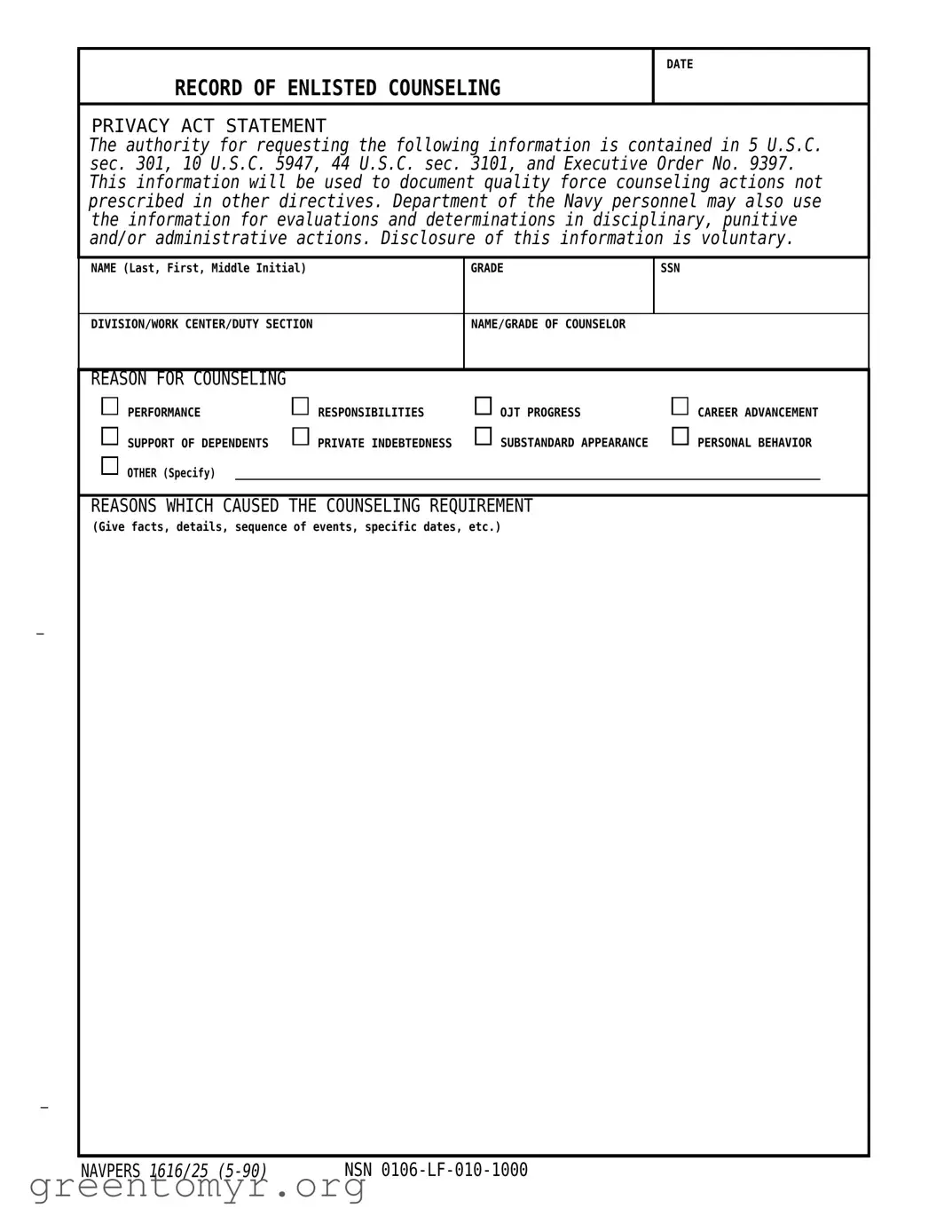
The NAVPERS 1616/25 form plays a crucial role in the counseling process for enlisted personnel within the Department of the Navy. This document serves as a structured means to record counseling sessions, ensuring that both the counselor and the member have a clear understanding of the issues at hand and the actions required for improvement. The form includes essential details such as the member's name, grade, Social Security number, and the division or work center in which they serve. It also captures the name and grade of the counselor, along with the specific reasons for counseling, which may range from performance responsibilities and on-the-job training progress to personal behavior and substandard appearance. Additionally, it requires a comprehensive account of the events leading to the counseling requirement, providing context and clarity. The NAVPERS 1616/25 emphasizes the importance of a collaborative plan developed by both the member and the counselor, aimed at fostering superior performance or addressing identified problems. This plan outlines the resolutions discussed and the actions the member has chosen to pursue, promoting accountability and personal growth. Importantly, the form includes a privacy statement, affirming that the disclosure of information is voluntary and governed by relevant legal statutes, thereby protecting the rights of the individuals involved.
DATE
RECORD OF ENLISTED COUNSELING
PRIVACY ACT STATEMENT
The authority for requesting the following information is contained in 5 U.S.C.
sec. 301, 10 U.S.C. 5947, 44 U.S.C. sec. 3101, and Executive Order No. 9397.
This information will be used to document quality force counseling actions not
prescribed in other directives. Department of the Navy personnel may also use
the information for evaluations and determinations in disciplinary, punitive
and/or administrative actions. Disclosure of this information is voluntary.
GRADE
SSN
NAME (Last, First, Middle Initial)
NAME/GRADE OF COUNSELOR
DIVISION/WORK CENTER/DUTY SECTION
REASON FOR COUNSELING
PERFORMANCE RESPONSIBILITIES
OJT PROGRESS CAREER ADVANCEMENT
SUBSTANDARD APPEARANCE PERSONAL BEHAVIOR
SUPPORT OF DEPENDENTS PRIVATE INDEBTEDNESS
OTHER (Specify)
REASONS WHICH CAUSED THE COUNSELING REQUIREMENT
(Give facts, details, sequence of events, specific dates, etc.)
-
-
NSN 0106-LF-010-1000
NAVPERS 1616/25 (5-90)
PLAN (DEVELOPED BY THE MEMBER AND COUNSELOR) TO CONTINUE SUPERIOR PERFORMANCE OR
TO OVERCOME PROBLEM(S) AND PRECLUDE FUTURE INVOLVEMENT
(Outline all resolutions discussed and indicate which actions the member has personally elected to pursue.)
-
Signature of Member/Date
Signature of Counselor/Date
I do/do not desire to make a statement.
Signature of Member/Date
NAVPERS 1616/25 (5-90)
• U.S. GPO: 19W-704-119/20152

File Breakdown

Fact Name Description
Purpose The NAVPERS 1616/25 form is used to document quality force counseling actions for Department of the Navy personnel. It serves as a record for evaluations and determinations in various administrative actions.
Legal Authority This form is governed by several legal authorities, including 5 U.S.C. sec. 301, 10 U.S.C. 5947, 44 U.S.C. sec. 3101, and Executive Order No. 9397.
Voluntary Disclosure Disclosure of the information requested on this form is voluntary. However, it is crucial for the documentation process.
Content Details The form requires personal information such as name, grade, SSN, and division. It also includes sections for the reason for counseling and a plan for improvement.

Guide to Using Navpers 1616 25

Filling out the NAVPERS 1616/25 form is a straightforward process. This form is used for documenting counseling sessions within the Department of the Navy. Accurate completion is essential for ensuring that all necessary information is captured effectively.

  1. Obtain the Form: Access the NAVPERS 1616/25 form from your unit's administrative office or download it from the official Navy website.
  2. Fill in the Date: Start by entering the date of the counseling session at the top of the form.
  3. Enter Personal Information: Provide your full name (Last, First, Middle Initial), grade, and Social Security Number (SSN). Include your division, work center, or duty section.
  4. Input Counselor Information: Write the name and grade of the counselor conducting the session.
  5. Select the Reason for Counseling: Check the appropriate box for the reason for counseling. Options include performance responsibilities, OJT progress, career advancement, support of dependents, private indebtedness, substandard appearance, personal behavior, or other (specify).
  6. Detail the Reasons for Counseling: Provide a clear and concise account of the facts, details, sequence of events, and specific dates that led to the counseling requirement.
  7. Develop a Plan: Outline the plan created by you and the counselor to continue superior performance or to address problems. Specify actions you have chosen to pursue.
  8. Sign the Form: Ensure both the counselor and the member sign and date the form. If desired, indicate whether you wish to make a statement.

Get Answers on Navpers 1616 25

What is the purpose of the NAVPERS 1616/25 form?

The NAVPERS 1616/25 form is designed to document quality force counseling actions for enlisted personnel in the Navy. It serves as a record for various counseling situations, including performance issues, personal behavior, and career advancement. This documentation can be used for evaluations and determinations in disciplinary or administrative actions. It helps ensure that counseling is structured and formalized, allowing both the counselor and the member to track progress and address issues effectively.

Who is required to fill out the NAVPERS 1616/25 form?

Both the member being counseled and the counselor must complete the NAVPERS 1616/25 form. The member's information, including their name, grade, and division, is necessary. The counselor's name and grade must also be included. This collaborative effort ensures that both parties are on the same page regarding the counseling process and any subsequent plans for improvement or resolution.

What types of issues can be addressed using the NAVPERS 1616/25 form?

The form can address a variety of issues, including but not limited to:

  • Performance responsibilities
  • On-the-job training progress
  • Career advancement opportunities
  • Support for dependents
  • Private indebtedness
  • Substandard appearance
  • Personal behavior
  • Other specified issues

Each of these areas can significantly impact a member's career and overall well-being, making it essential to address them through formal counseling.

Is disclosure of information on the NAVPERS 1616/25 form mandatory?

No, disclosure of information on the NAVPERS 1616/25 form is voluntary. However, providing accurate and complete information can facilitate more effective counseling and support. The form is structured to help both the member and the counselor identify issues and develop plans for improvement. Choosing not to disclose certain information may limit the effectiveness of the counseling process.

Common mistakes

Filling out the NAVPERS 1616/25 form can be a straightforward process, but mistakes can lead to delays or complications. One common error is not providing complete information in the NAME section. It's important to include your last name, first name, and middle initial accurately. Missing even a single character can cause confusion and may affect the processing of your counseling record.

Another frequent mistake involves the REASON FOR COUNSELING section. Some individuals may fail to specify the exact reason for their counseling. Instead of simply writing "performance issues," provide detailed explanations. This includes mentioning specific incidents, dates, and the context surrounding the counseling. Clarity helps ensure that the counselor understands the situation fully.

People often overlook the PLAN section of the form. This part requires collaboration between the member and the counselor. It's essential to outline actionable steps that will lead to improvement. Not taking the time to develop a clear plan can result in a lack of direction for future performance. This section is crucial for demonstrating commitment to change.

Additionally, some members forget to sign the form. Signatures are vital as they confirm that both the counselor and the member have agreed to the contents of the counseling record. Without these signatures, the document may be considered incomplete. Always double-check to ensure that all required signatures are present before submission.

Lastly, individuals sometimes neglect to review the entire form before turning it in. Errors can be easily missed, so taking a moment to read through the completed form can prevent misunderstandings. Ensure that all sections are filled out correctly and that the information is accurate. A careful review can save time and stress later on.

Documents used along the form

The NAVPERS 1616/25 form is an important document used in the Navy to record counseling sessions for enlisted personnel. It serves as a formal way to address performance issues, provide guidance, and support career advancement. Alongside this form, several other documents are commonly used to ensure a comprehensive approach to personnel management. Here’s a list of those documents and a brief description of each.

  • NAVPERS 1616/26: This form is used for the enlisted performance evaluation. It provides a structured way to assess a service member’s performance over a specific period, highlighting strengths and areas for improvement.
  • NAVPERS 1070/613: Known as the Administrative Remarks form, it documents significant events or changes in a member's record, such as disciplinary actions or commendations, and serves as a permanent part of their service record.
  • OPNAV 5211/9: This document is used for a Privacy Act Statement. It informs personnel about how their information will be used and protected, ensuring compliance with privacy regulations.
  • NAVPERS 1070/880: This is the Enlisted Evaluation Report. It is a formal assessment of an enlisted member’s performance and potential for advancement, which is crucial for career progression.
  • NAVPERS 1616/27: This form is utilized for documenting a member’s career counseling session. It outlines goals, aspirations, and plans for professional development, promoting proactive career management.
  • NAVPERS 1616/24: This is the Chief Petty Officer Evaluation Report. It assesses the performance of Chief Petty Officers, focusing on leadership qualities and overall effectiveness in their roles.
  • NAVPERS 1070/881: This form is used for documenting awards and commendations. It ensures that all recognitions are formally recorded in a service member’s file, which can impact future evaluations.
  • NAVPERS 1616/28: This document is the Command Evaluation Report. It provides an overview of a member’s performance from the command perspective, often used in conjunction with other evaluations.
  • NAVPERS 1070/845: This is the Record of Emergency Data form. It captures essential information about a service member's emergency contacts and medical preferences, ensuring that appropriate actions can be taken in emergencies.

These documents, when used alongside the NAVPERS 1616/25 form, create a well-rounded framework for managing enlisted personnel. They help ensure that service members receive the necessary support and guidance throughout their careers, while also maintaining accurate and comprehensive records.

Similar forms

  • NAVPERS 1616/26 - This form is used for documenting performance evaluations. Like the NAVPERS 1616/25, it focuses on assessing a service member's performance and potential for advancement.
  • NAVPERS 1070/613 - This is a record of administrative remarks. Similar to the NAVPERS 1616/25, it captures important counseling and disciplinary actions affecting a service member's career.
  • NAVPERS 1616/27 - This form is for documenting commendations and awards. It shares the purpose of recognizing performance and achievements, just as the NAVPERS 1616/25 addresses counseling for improvement.
  • NAVPERS 1070/601 - This document records a service member's service record. It is similar in that it contains essential information about the member's career, including counseling outcomes.
  • OPNAV 5211/9 - This is a privacy act statement. Like the NAVPERS 1616/25, it outlines the authority for collecting personal information and emphasizes the voluntary nature of disclosure.
  • DD Form 214 - This form is used for discharge from active duty. It includes performance information that can relate to counseling outcomes documented in the NAVPERS 1616/25.
  • NAVPERS 1616/22 - This form is for documenting fitness reports. It serves a similar purpose by evaluating a member's performance, much like the counseling documented in NAVPERS 1616/25.
  • NAVPERS 1070/880 - This is a record of non-judicial punishment. It parallels the NAVPERS 1616/25 by addressing disciplinary actions and their impact on a service member's career.
  • OPNAVINST 5350.4 - This instruction outlines the Navy's policy on substance abuse. It relates to counseling efforts aimed at addressing personal behavior issues, similar to those documented in the NAVPERS 1616/25.

Dos and Don'ts

When filling out the NAVPERS 1616/25 form, it is important to follow certain guidelines to ensure accuracy and completeness. Here are four things you should and shouldn’t do:

  • Do provide accurate personal information, including your name, grade, and social security number.
  • Do clearly outline the reasons for counseling, including specific details and dates.
  • Don’t leave any sections blank. Each part of the form is important for documenting the counseling process.
  • Don’t use vague language. Be specific about performance responsibilities and issues that led to counseling.

By adhering to these guidelines, you can help ensure that the form is filled out correctly and serves its intended purpose.

Misconceptions

Understanding the Navpers 1616 25 form is crucial for both service members and their counselors. However, several misconceptions exist regarding its purpose and use. Here are ten common misunderstandings:

  1. The form is mandatory for all counseling sessions. Many believe that every counseling session requires this form. In reality, its use is determined by specific circumstances and is not always necessary.
  2. Only negative counseling requires this form. This form is often associated with disciplinary actions, but it can also document positive counseling and career advancement discussions.
  3. Disclosure of information is mandatory. Some think that providing information on this form is compulsory. However, disclosing information is voluntary, and service members can choose not to provide certain details.
  4. The form is only for performance issues. While performance is a key focus, the form can address various topics, including personal behavior and support of dependents.
  5. It is solely for the counselor’s use. This form is a collaborative tool. Both the counselor and the member contribute to its content, ensuring mutual understanding.
  6. Once signed, the form cannot be changed. After the initial completion, members can still discuss and revise the plan for improvement or performance enhancement.
  7. The form is confidential and cannot be shared. While it contains sensitive information, it may be used in evaluations or administrative actions, meaning it can be shared under certain conditions.
  8. All counseling sessions are documented on this form. Not every counseling session requires documentation on this specific form. Counselors may choose other methods for less formal discussions.
  9. It only applies to enlisted personnel. Although primarily used for enlisted members, the principles of counseling and documentation can apply to officers as well.
  10. Filling out the form guarantees no future issues. While the form aims to address concerns, it does not ensure that problems will not arise again. Continuous effort and commitment are essential.

By clarifying these misconceptions, service members can better understand the purpose of the Navpers 1616 25 form and its role in their professional development.

Key takeaways

When filling out and using the NAVPERS 1616/25 form, several key points should be kept in mind to ensure proper documentation and compliance with Navy procedures.

  • Purpose of the Form: The NAVPERS 1616/25 is primarily used to document quality force counseling actions. It serves as a record for performance evaluations and can influence disciplinary or administrative actions.
  • Voluntary Disclosure: Providing information on the form is voluntary. However, it is important to understand that the details may impact future evaluations and decisions.
  • Detailed Information Required: When outlining the reasons for counseling, include specific facts, details, and a sequence of events. This clarity is crucial for accurate documentation.
  • Action Plan Development: Both the member and the counselor should collaboratively develop a plan to either continue superior performance or address issues. This plan must be clearly outlined on the form.
  • Signatures Are Essential: Ensure that both the counselor and the member sign and date the form. This step confirms that both parties acknowledge the counseling session and its outcomes.