Content Navigation

The Navy Mobilizing Voluntary Waiver Acknowledgement (VWA) form, designated as NAVPERS 1300/25, is a crucial document for service members who wish to volunteer for mobilization under specific conditions. This form is particularly relevant for those who may be called to active duty with less than 60 days' notice or who are still within their dwell time following a previous involuntary mobilization. It requires service members to provide essential personal information, including their name, rank, and contact details, as well as details regarding their planned assignment and reporting dates. The form consists of several sections, each addressing different scenarios for volunteering, such as waiving the 60-day notification period or the dwell time requirement. Additionally, it outlines the implications of such waivers, emphasizing the service member's understanding that they will serve based on the Navy's needs and cannot revoke their decision once submitted. The form also includes a statement of understanding regarding the associated benefits and entitlements under various U.S. Codes, which may differ based on the mobilization order authority. Proper completion of this form is necessary for it to be accepted, and service members are encouraged to reach out to their Navy Reserve Activity or Navy Operational Support Center for assistance if needed.
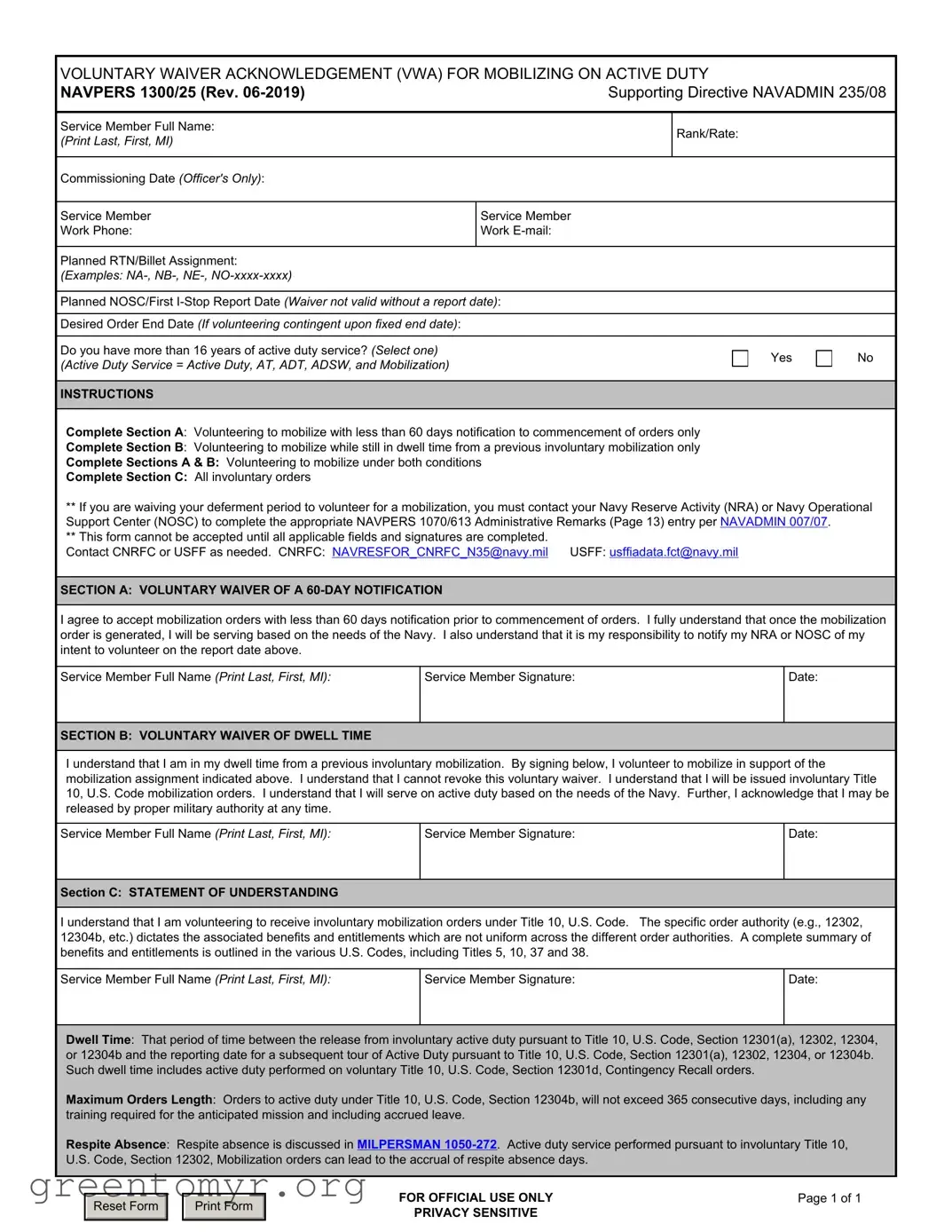
VOLUNTARY WAIVER ACKNOWLEDGEMENT (VWA) FOR MOBILIZING ON ACTIVE DUTY
NAVPERS 1300/25 (Rev. 06-2019) Supporting Directive NAVADMIN 235/08
FOR OFFICIAL USE ONLY
PRIVACY SENSITIVE
Page 1 of 1
Service Member Full Name:
(Print Last, First, MI)
Rank/Rate:
Commissioning Date (Officer's Only):
Service Member
Work Phone:
Service Member
Work E-mail:
Planned RTN/Billet Assignment:
(Examples: NA-, NB-, NE-, NO-xxxx-xxxx)
Planned NOSC/First I-Stop Report Date (Waiver not valid without a report date):
Desired Order End Date (If volunteering contingent upon fixed end date):
Do you have more than 16 years of active duty service? (Select one)
(Active Duty Service = Active Duty, AT, ADT, ADSW, and Mobilization)
Yes No
INSTRUCTIONS
Complete Section A: Volunteering to mobilize with less than 60 days notification to commencement of orders only
Complete Section B: Volunteering to mobilize while still in dwell time from a previous involuntary mobilization only
Complete Sections A & B: Volunteering to mobilize under both conditions
Complete Section C: All involuntary orders
** If you are waiving your deferment period to volunteer for a mobilization, you must contact your Navy Reserve Activity (NRA) or Navy Operational
Support Center (NOSC) to complete the appropriate NAVPERS 1070/613 Administrative Remarks (Page 13) entry per NAVADMIN 007/07.
** This form cannot be accepted until all applicable fields and signatures are completed.
Contact CNRFC or USFF as needed. CNRFC: [email protected] USFF: [email protected]
SECTION A: VOLUNTARY WAIVER OF A 60-DAY NOTIFICATION
I agree to accept mobilization orders with less than 60 days notification prior to commencement of orders. I fully understand that once the mobilization
order is generated, I will be serving based on the needs of the Navy. I also understand that it is my responsibility to notify my NRA or NOSC of my
intent to volunteer on the report date above.
Service Member Full Name (Print Last, First, MI):
Service Member Signature: Date:
SECTION B: VOLUNTARY WAIVER OF DWELL TIME
I understand that I am in my dwell time from a previous involuntary mobilization. By signing below, I volunteer to mobilize in support of the
mobilization assignment indicated above. I understand that I cannot revoke this voluntary waiver. I understand that I will be issued involuntary Title
10, U.S. Code mobilization orders. I understand that I will serve on active duty based on the needs of the Navy. Further, I acknowledge that I may be
released by proper military authority at any time.
Service Member Full Name (Print Last, First, MI):
Service Member Signature: Date:
Section C: STATEMENT OF UNDERSTANDING
I understand that I am volunteering to receive involuntary mobilization orders under Title 10, U.S. Code. The specific order authority (e.g., 12302,
12304b, etc.) dictates the associated benefits and entitlements which are not uniform across the different order authorities. A complete summary of
benefits and entitlements is outlined in the various U.S. Codes, including Titles 5, 10, 37 and 38.
Service Member Full Name (Print Last, First, MI):
Service Member Signature: Date:
Dwell Time: That period of time between the release from involuntary active duty pursuant to Title 10, U.S. Code, Section 12301(a), 12302, 12304,
or 12304b and the reporting date for a subsequent tour of Active Duty pursuant to Title 10, U.S. Code, Section 12301(a), 12302, 12304, or 12304b.
Such dwell time includes active duty performed on voluntary Title 10, U.S. Code, Section 12301d, Contingency Recall orders.
Maximum Orders Length: Orders to active duty under Title 10, U.S. Code, Section 12304b, will not exceed 365 consecutive days, including any
training required for the anticipated mission and including accrued leave.
Respite Absence: Respite absence is discussed in MILPERSMAN 1050-272. Active duty service performed pursuant to involuntary Title 10,
U.S. Code, Section 12302, Mobilization orders can lead to the accrual of respite absence days.
Reset Form
Print Form

File Breakdown

Fact Name Description
Form Title The form is officially titled "Voluntary Waiver Acknowledgement (VWA) for Mobilizing on Active Duty NAVPERS 1300/25".
Revision Date This version of the form was revised in June 2019.
Governing Directive The supporting directive for this form is NAVADMIN 235/08, which outlines the procedures for mobilization.
Notification Requirement Service members can volunteer to mobilize with less than 60 days' notification, but they must understand the implications of this choice.
Involuntary Orders By signing, service members acknowledge they may receive involuntary mobilization orders under Title 10, U.S. Code.
Dwell Time Definition Dwell time refers to the period between release from involuntary active duty and the reporting date for a subsequent tour.

Guide to Using Navy Mobilizing Vwa

Filling out the Navy Mobilizing Vwa form requires attention to detail. Ensure that all necessary information is provided accurately to avoid delays in processing. Follow these steps to complete the form correctly.

  1. Service Member Full Name: Print your last name, first name, and middle initial in the designated space.
  2. Rank/Rate: Enter your current rank or rate.
  3. Commissioning Date: If you are an officer, provide your commissioning date.
  4. Service Member Work Phone: Write your work phone number.
  5. Work E-mail: Fill in your work email address.
  6. Planned RTN/Billet Assignment: Indicate your planned assignment using the specified format (e.g., NA-, NB-, NE-, NO-xxxx-xxxx).
  7. Planned NOSC/First I-Stop Report Date: Enter the report date, noting that the waiver is invalid without this date.
  8. Desired Order End Date: If applicable, state your desired end date for the orders.
  9. Active Duty Service Question: Select "Yes" or "No" to indicate if you have more than 16 years of active duty service.
  10. Complete Sections: Depending on your situation, fill out the relevant sections (A, B, or C) as instructed on the form.
  11. Signatures: Ensure you sign and date the form in all required sections.

After completing the form, review all entries for accuracy. Once verified, submit the form to your Navy Reserve Activity or Navy Operational Support Center as instructed. If you have questions, reach out to the provided contacts for assistance.

Get Answers on Navy Mobilizing Vwa

What is the purpose of the Navy Mobilizing Vwa form?

The Navy Mobilizing Voluntary Waiver Acknowledgement (VWA) form is designed for service members who wish to volunteer for mobilization orders under specific conditions. This form allows members to waive their rights to a 60-day notification period or their dwell time following a previous involuntary mobilization. By completing this form, service members acknowledge their understanding of the implications of their decision and the responsibilities that come with it.

What information is required to complete the VWA form?

To successfully complete the VWA form, service members must provide several key pieces of information:

  • Full name (last, first, middle initial)
  • Rank or rate
  • Commissioning date (for officers)
  • Work phone number
  • Work email address
  • Planned return or billet assignment
  • First I-Stop report date
  • Desired order end date, if applicable
  • Confirmation of whether they have more than 16 years of active duty service

All fields must be completed accurately, and signatures are required to validate the form.

What are the implications of waiving the 60-day notification period?

By waiving the 60-day notification period, service members agree to accept mobilization orders with less than 60 days' notice. This means that once the mobilization order is issued, they will serve according to the Navy's needs. It is crucial for service members to understand that they cannot revoke this waiver once it is signed. They must also notify their Navy Reserve Activity (NRA) or Navy Operational Support Center (NOSC) of their intent to volunteer on the specified report date.

How does the dwell time affect my mobilization?

Dwell time refers to the period between being released from involuntary active duty and the reporting date for a new active duty assignment. If a service member is still within their dwell time from a previous involuntary mobilization, they must acknowledge this when completing the VWA form. By volunteering during this time, they accept the possibility of receiving involuntary mobilization orders under Title 10, U.S. Code. It is important to recognize that this decision cannot be revoked, and service members may be released by military authority at any time.

Common mistakes

Filling out the Navy Mobilizing VWA form can be a straightforward process, but many people make common mistakes that can lead to delays or complications. One frequent error is not providing complete contact information. It's crucial to include your full name, rank, work phone, and email address. Missing this information can hinder communication and cause unnecessary setbacks.

Another mistake involves misunderstanding the notification requirements. Some individuals may not realize that they need to agree to mobilization orders with less than 60 days' notice. This agreement is essential, as it confirms that you understand the implications of your decision. If this section is left unchecked or misunderstood, it could result in complications later on.

People often overlook the importance of the report date. This date is critical for the waiver to be valid. If you fail to fill it out or provide an inaccurate date, your application may be rejected. Always double-check this detail to ensure that everything aligns correctly.

Lastly, signatures are sometimes forgotten. Each section of the form requires your signature and the date. Skipping this step can render the entire form incomplete. Make sure to review the form thoroughly before submission to avoid this common pitfall.

Documents used along the form

The Navy Mobilizing Voluntary Waiver Acknowledgement (VWA) form is a crucial document for service members who wish to volunteer for mobilization on active duty. Alongside this form, several other documents are often required to ensure that the process is handled smoothly and that all necessary information is collected. Below is a list of related forms and documents that may be needed.

  • NAVPERS 1070/613 Administrative Remarks: This form is used to document any administrative actions or remarks regarding a service member’s record. It is particularly important for noting waivers and other significant decisions made by the service member.
  • NAVPERS 1300/21 Report of Medical History: This document provides a comprehensive overview of the service member's medical history. It is essential for assessing fitness for duty and ensuring that any medical concerns are addressed prior to mobilization.
  • NAVPERS 1300/22 Physical Fitness Assessment: This form records the results of the service member’s physical fitness assessment. It is crucial for determining readiness for active duty and may influence mobilization decisions.
  • NAVPERS 1300/3 Request for Orders: This document is used to formally request mobilization orders. It outlines the service member's qualifications and readiness for the specific assignment.
  • NAVPERS 1300/4 Application for Active Duty for Training: This form is utilized when a service member seeks to apply for active duty training. It helps to ensure that training needs are met in preparation for mobilization.
  • NAVPERS 1300/5 Certificate of Release or Discharge from Active Duty: This certificate is issued upon completion of active duty service. It is important for documenting the end of service and for transitioning back to civilian life.
  • NAVPERS 1300/6 Deployment Health Assessment: This assessment evaluates the health of service members before and after deployment. It is vital for monitoring any health issues that may arise during active duty.
  • NAVPERS 1300/7 Family Care Plan: This document outlines the arrangements made for the care of dependents during the service member’s absence. It is essential for ensuring that family responsibilities are managed while the member is on active duty.
  • NAVPERS 1300/8 Leave Request: This form is used to request leave during active duty. It is important for managing time off and ensuring that the service member's needs are met while serving.

Each of these documents plays a significant role in the mobilization process, helping to ensure that service members are prepared and that all administrative requirements are met. Understanding the purpose of each document can aid in navigating the complexities of military mobilization with greater ease and confidence.

Similar forms

The Navy Mobilizing Voluntary Waiver Acknowledgement (VWA) form shares similarities with several other documents used in military and personnel management. Below are six documents that are comparable, along with a brief explanation of how they are similar to the VWA form:

  • NAVPERS 1070/613 Administrative Remarks: This form is used to document administrative actions and changes in a service member's record. Like the VWA, it requires signatures and is crucial for processing mobilization-related actions.
  • NAVADMIN Messages: These are official communications from the Navy that provide updates and directives. Similar to the VWA, NAVADMIN messages often outline procedures and requirements for mobilization and service member responsibilities.
  • DD Form 214, Certificate of Release or Discharge from Active Duty: This document summarizes a service member's active duty service. It shares the purpose of documenting service details, much like the VWA captures specific mobilization agreements.
  • NAVPERS 1300/21, Application for Active Duty for Training: This form is used for requesting active duty training. Both forms involve voluntary participation and require the service member to acknowledge their understanding of the implications of their choices.
  • Request for Orders (RFO): This document is submitted to initiate the process of receiving orders. Similar to the VWA, it outlines the service member's intent and understanding of their mobilization status.
  • NAVPERS 1300/16, Officer Candidate School Application: This form is used for applying to officer training programs. Like the VWA, it involves a commitment from the service member and requires acknowledgment of responsibilities and potential consequences.

Dos and Don'ts

When filling out the Navy Mobilizing VWA form, there are several important considerations to keep in mind. Below is a list of things you should and shouldn't do:

  • Do ensure all fields are completed accurately before submission.
  • Do sign and date the form in the designated areas.
  • Do contact your Navy Reserve Activity (NRA) or Navy Operational Support Center (NOSC) for guidance if needed.
  • Do read all instructions carefully to understand your commitments.
  • Don't leave any required fields blank, as this will delay processing.
  • Don't submit the form without confirming your eligibility for mobilization.
  • Don't assume that verbal agreements are sufficient; written confirmation is necessary.
  • Don't ignore the importance of understanding the implications of waiving your deferment period.

Misconceptions

Understanding the Navy Mobilizing Vwa form is crucial for service members considering volunteering for active duty. However, several misconceptions often arise. Here are five common misunderstandings about the form:

  • Misconception 1: The VWA form is optional.
  • Many believe that submitting the VWA form is not necessary when volunteering for mobilization. In reality, completing this form is a mandatory step to officially acknowledge your intent to mobilize.

  • Misconception 2: Signing the form guarantees a specific assignment.
  • Some service members think that by signing the VWA form, they can secure a specific billet or assignment. However, the Navy retains the right to assign personnel based on its operational needs, regardless of the preferences indicated on the form.

  • Misconception 3: You can withdraw your waiver after signing.
  • There is a belief that once the VWA form is signed, a service member can change their mind later. Unfortunately, this is not the case. The waiver is irrevocable, meaning that once you volunteer, you cannot back out.

  • Misconception 4: The form is only for those with extensive active duty experience.
  • Some individuals think that only service members with more than 16 years of active duty can use the VWA form. In fact, it is available to all service members who meet the eligibility criteria, regardless of their years of service.

  • Misconception 5: The form is only relevant for mobilization under Title 10.
  • There is a common belief that the VWA form applies solely to Title 10 mobilizations. However, it is important to note that the form addresses various types of mobilization orders, and understanding these distinctions is vital for service members.

Key takeaways

Here are some important points to keep in mind when filling out and using the Navy Mobilizing Voluntary Waiver Acknowledgement (VWA) form:

  • Complete All Sections: Ensure that every relevant section of the form is filled out completely. Missing information can delay the process.
  • Understand Your Commitment: By signing the form, you agree to mobilization orders based on the Navy's needs, which may come with less than 60 days' notice.
  • Contact Your Navy Reserve Activity: If you are waiving your deferment period, reach out to your Navy Reserve Activity or Navy Operational Support Center to complete necessary administrative entries.
  • Be Aware of Dwell Time: Know that dwell time refers to the period between involuntary active duty and your next reporting date. This is crucial for understanding your mobilization timeline.
  • Review Benefits and Entitlements: Different mobilization orders come with varying benefits. Familiarize yourself with the specific order authority and associated entitlements.
  • Signature and Date Required: Your signature and the date are mandatory for the form to be valid. Double-check that these are included before submission.

By keeping these takeaways in mind, you can navigate the process more smoothly and ensure that you are fully informed about your mobilization options and responsibilities.