Content Navigation

The NC-120 form is a crucial document for anyone seeking to change their name in California. This form is filed with the Superior Court and initiates the legal process for a name change. It requires the petitioner to provide their current name and the proposed new name, along with necessary contact information. The form also sets a hearing date where interested parties can voice any objections to the name change. If no objections are filed in advance, the court may grant the petition without a hearing. Additionally, a notice of the hearing must be published in a local newspaper for four consecutive weeks. This ensures that the community is informed and has the opportunity to respond if they have concerns. It is important to follow the specific guidelines outlined in the form, especially when the name change involves a child, as additional notification requirements apply. Understanding the NC-120 form is essential for a smooth name change process.
Nc 120 Example

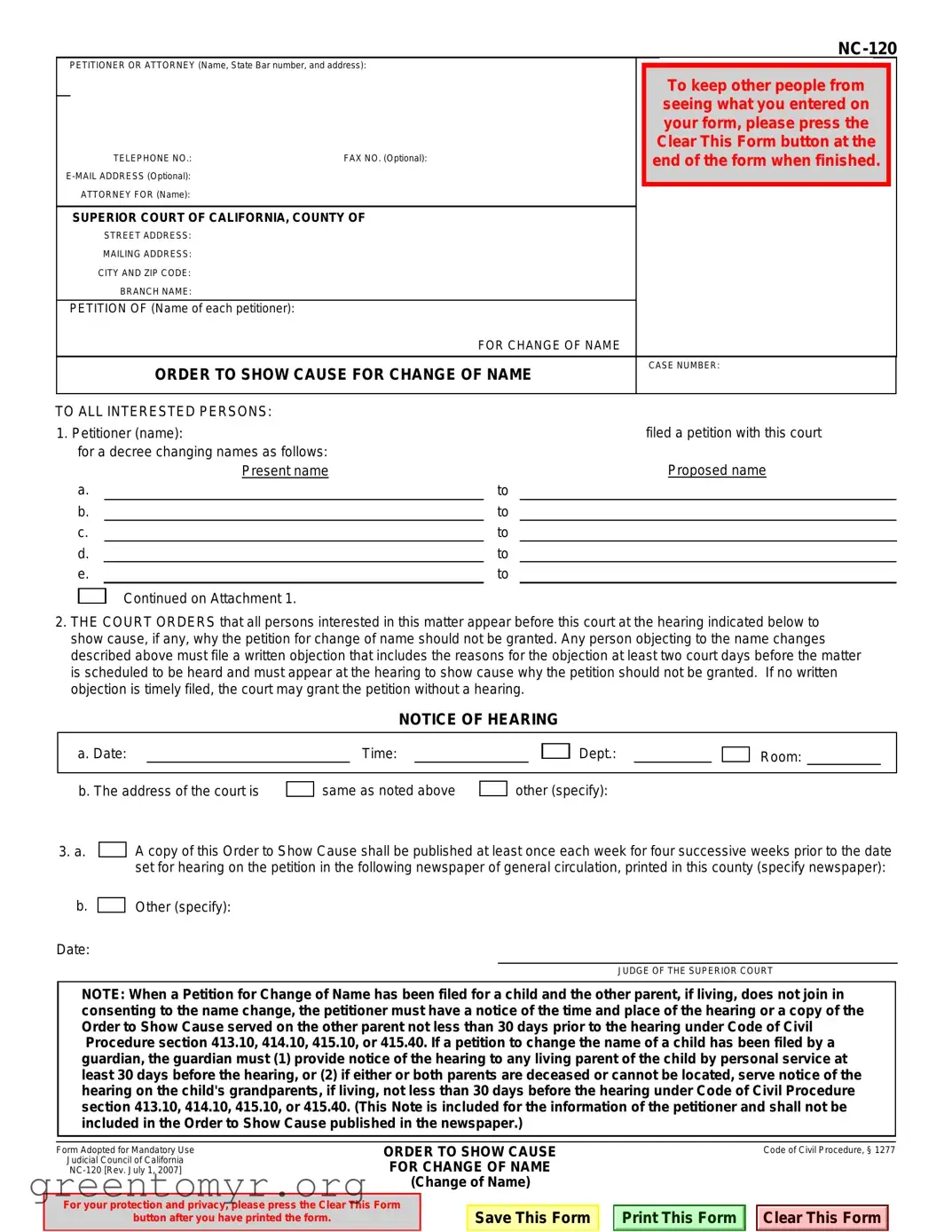
NC-120
PETITIONER OR ATTORNEY (Name, State Bar number, and address):
FOR COURT USE ONLY
TELEPHONE NO.: FAX NO. (Optional):
E-MAIL ADDRESS (Optional):
ATTORNEY FOR (Name):
SUPERIOR COURT OF CALIFORNIA, COUNTY OF
STREET ADDRESS:
MAILING ADDRESS:
CITY AND ZIP CODE:
BRANCH NAME:
PETITION OF (Name of each petitioner):
FOR CHANGE OF NAME
CASE NUMBER:
ORDER TO SHOW CAUSE FOR CHANGE OF NAME
TO ALL INTERESTED PERSONS:
filed a petition with this court
1. Petitioner (name):
for a decree changing names as follows:
Proposed name
Present name
a.
to
b. to
to
c.
tod.
e. to
Continued on Attachment 1.
2. THE COURT ORDERS that all persons interested in this matter appear before this court at the hearing indicated below to
show cause, if any, why the petition for change of name should not be granted. Any person objecting to the name changes
described above must file a written objection that includes the reasons for the objection at least two court days before the matter
is scheduled to be heard and must appear at the hearing to show cause why the petition should not be granted. If no written
objection is timely filed, the court may grant the petition without a hearing.
NOTICE OF HEARING
Room:
Time:a. Date: Dept.:
other (specify):
same as noted above
b. The address of the court is
A copy of this Order to Show Cause shall be published at least once each week for four successive weeks prior to the date
set for hearing on the petition in the following newspaper of general circulation, printed in this county (specify newspaper):
3. a.
Other (specify):
b.
Date:
JUDGE OF THE SUPERIOR COURT
NOTE: When a Petition for Change of Name has been filed for a child and the other parent, if living, does not join in
consenting to the name change, the petitioner must have a notice of the time and place of the hearing or a copy of the
Order to Show Cause served on the other parent not less than 30 days prior to the hearing under Code of Civil
Procedure section 413.10, 414.10, 415.10, or 415.40. If a petition to change the name of a child has been filed by a
guardian, the guardian must (1) provide notice of the hearing to any living parent of the child by personal service at
least 30 days before the hearing, or (2) if either or both parents are deceased or cannot be located, serve notice of the
hearing on the child's grandparents, if living, not less than 30 days before the hearing under Code of Civil Procedure
section 413.10, 414.10, 415.10, or 415.40. (This Note is included for the information of the petitioner and shall not be
included in the Order to Show Cause published in the newspaper.)
Form Adopted for Mandatory Use
Judicial Council of California
NC-120 [Rev. July 1, 2007]
ORDER TO SHOW CAUSE
FOR CHANGE OF NAME
(Change of Name)
Code of Civil Procedure, § 1277
To keep other people from
seeing what you entered on
your form, please press the
Clear This Form button at the
end of the form when finished.
For your protection and privacy, please press the Clear This Form
button after you have printed the form.
Save This Form
Print This Form
Clear This Form

File Breakdown

Fact Name Description
Form Purpose The NC-120 form is used to petition the court for a change of name in California.
Governing Law The form is governed by California Code of Civil Procedure, § 1277.
Petition Requirements Petitioners must provide their current name and the proposed new name(s).
Hearing Notice A notice of the hearing must be published in a local newspaper for four consecutive weeks.
Objections Interested persons can file objections at least two court days before the hearing.
Child Name Changes If changing a child's name, notice must be given to the other parent if they are living.
Service Requirements Notices must be served at least 30 days prior to the hearing if the other parent does not consent.
Confidentiality Petitioners are advised to clear their form data for privacy after completion.
Form Adoption This form has been adopted for mandatory use by the Judicial Council of California.

Guide to Using Nc 120

After filling out the NC-120 form, you will need to submit it to the appropriate court. This form is essential for initiating the process of changing a name. Be sure to follow the instructions carefully to avoid any delays.

  1. Begin by entering the name of the petitioner or attorney at the top of the form. Include the State Bar number and address.
  2. Provide a telephone number and, if applicable, a fax number and email address.
  3. Identify the attorney for the petitioner, if there is one.
  4. Fill in the street address, mailing address, city, and ZIP code of the Superior Court of California, County of.
  5. Specify the branch name of the court.
  6. List the name of each petitioner in the section labeled "Petition of."
  7. In the section for the present name and proposed name, fill in each name as needed. If there are more than two names, continue on Attachment 1.
  8. Complete the notice of hearing section by providing the date, time, department, and room number of the hearing.
  9. Indicate the newspaper where the Order to Show Cause will be published, as well as any other specifications required.
  10. Sign and date the form at the bottom.

Get Answers on Nc 120

  1. What is the NC-120 form?

    The NC-120 form is a legal document used in California to petition the court for a change of name. It allows individuals to formally request a decree that alters their current name to a proposed new name. This form is essential for anyone seeking to legally change their name through the Superior Court of California.

  2. Who can file the NC-120 form?

    Any individual, including adults and minors, can file the NC-120 form. However, if a minor is involved, the petition must be filed by a parent or guardian. If the other parent does not consent to the name change, specific notice requirements must be followed.

  3. What information is required on the NC-120 form?

    The NC-120 form requires several key pieces of information, including:

    • The current name and the proposed new name(s) of the petitioner.
    • The petitioner's contact information, including address, telephone number, and email (optional).
    • The court's address where the petition is being filed.
    • The date and time of the hearing regarding the name change.
  4. What happens after filing the NC-120 form?

    After filing the NC-120 form, the court will schedule a hearing date. A notice of this hearing must be published in a local newspaper for four consecutive weeks. Additionally, interested parties may file objections to the name change, which must be submitted at least two court days before the hearing.

  5. How do I serve notice to interested parties?

    If the name change involves a child and the other parent does not consent, the petitioner must serve notice of the hearing to the other parent. This can be done by personal service at least 30 days before the hearing. If the other parent is deceased or cannot be located, notice must be served to the child's grandparents, if they are living.

  6. What if no one objects to the name change?

    If no written objections are filed by interested parties before the hearing, the court may grant the name change without holding a hearing. This streamlines the process for those who do not face opposition.

  7. What should I do if I want to change my child's name?

    To change a child's name, a guardian or parent must file the NC-120 form. They must also ensure proper notice is given to the other parent, as outlined in the previous questions. It's important to follow the legal requirements to avoid delays or complications in the process.

  8. Is there a fee associated with filing the NC-120 form?

    Yes, there is typically a filing fee associated with submitting the NC-120 form to the court. The fee amount can vary by county, so it is advisable to check with the local court for the exact fee and payment methods accepted.

  9. How can I obtain the NC-120 form?

    The NC-120 form can be obtained online through the California Judicial Council's website or directly from your local Superior Court. It is important to use the most current version of the form to ensure compliance with legal requirements.

  10. What should I do if I need assistance with the NC-120 form?

    If you need help filling out the NC-120 form, consider seeking assistance from a legal professional or a self-help center at your local court. They can provide guidance and ensure that you understand the process and requirements for changing your name.

Common mistakes

Filling out the NC-120 form can be a straightforward process, but many individuals make common mistakes that can lead to delays or complications. One frequent error is failing to provide complete information. Each section of the form requires specific details, including names, addresses, and contact information. Omitting even a small piece of information can result in the court rejecting the petition or requiring additional documentation.

Another common mistake involves not following the proper format for names. When listing the current and proposed names, it is essential to ensure that they are written clearly and correctly. Mistakes in spelling or punctuation can cause confusion and may lead to the petition being dismissed. Double-checking the names before submission can help avoid this issue.

Timing is also critical. Many people overlook the requirement to publish the Order to Show Cause in a local newspaper for four consecutive weeks before the hearing. Missing this step can lead to the court not being able to proceed with the case. It’s important to plan ahead and account for the time needed for publication when scheduling the hearing.

Lastly, individuals often underestimate the importance of notifying interested parties. If the name change involves a child and the other parent does not consent, proper notice must be served. Failing to do so can complicate the process and may result in the court denying the petition. Understanding and adhering to these notification requirements is crucial for a smooth application process.

Documents used along the form

The NC-120 form, known as the Order to Show Cause for Change of Name, is a crucial document in the process of legally changing one’s name in California. Alongside this form, several other documents may be required to ensure that the name change process is conducted smoothly and legally. Below is a list of related forms and documents commonly used in conjunction with the NC-120.

  • NC-121: Declaration of Publication - This document serves as proof that the Order to Show Cause has been published in a newspaper of general circulation, as required by law. It includes details about the publication dates and the newspaper used.
  • NC-122: Consent to Change of Name - When a name change petition involves a child, this form must be completed by the non-petitioning parent to show their consent to the name change. It helps to prevent disputes and ensures that both parents are in agreement.
  • NC-123: Notice of Hearing - This document provides notice to all interested parties about the hearing date and time regarding the name change petition. It ensures that all relevant individuals are informed and can participate in the process.
  • NC-124: Proof of Service - This form is used to demonstrate that the required notices have been properly served to interested parties, including parents in the case of a child's name change. It is an essential part of the legal process to confirm that all parties have been notified.
  • NC-125: Objection to Name Change - If someone wishes to contest the name change, they must file this form. It outlines the reasons for the objection and must be submitted before the hearing date to be considered.
  • NC-126: Final Decree Changing Name - Once the court approves the name change, this document serves as the official decree reflecting the new name. It is important for updating personal records and identification documents.

Understanding these additional forms and documents is essential for a successful name change process. Each plays a significant role in ensuring that all legal requirements are met and that the rights of all interested parties are respected. Proper preparation and attention to detail can facilitate a smoother transition during this important personal change.

Similar forms

The NC-120 form, used for petitioning a change of name in California, shares similarities with several other legal documents. Each of these documents serves a specific purpose in legal proceedings, often relating to name changes or identity verification. Here’s a list of eight documents that are similar to the NC-120 form:

  • NC-110 Petition for Change of Name: This form is also used to request a change of name but is typically for individuals without the need for a court hearing, streamlining the process for straightforward cases.
  • NC-130 Order to Show Cause for Change of Name: Like the NC-120, this document notifies interested parties of the petition for a name change and requires them to show cause if they oppose the change.
  • NC-140 Decree Changing Name: After a successful petition, this form is issued by the court to formally change the name, providing legal recognition of the new name.
  • NC-150 Application for Waiver of Court Fees: Individuals seeking a name change may also need this form if they cannot afford the court fees associated with filing the NC-120.
  • NC-160 Notice of Hearing: This document is used to inform interested parties about the hearing date for the name change petition, similar to the notice included in the NC-120.
  • NC-170 Proof of Publication: After the Order to Show Cause is published, this form serves as evidence that the required public notice was completed, as mandated by law.
  • NC-180 Consent to Change of Name: In cases involving minors, this form is used to obtain consent from parents or guardians, ensuring that all parties are in agreement with the name change.
  • NC-190 Response to Petition for Change of Name: This document allows interested parties to formally respond to the petition, similar to the objections outlined in the NC-120.

Understanding these documents can help individuals navigate the name change process more effectively. Each form plays a crucial role in ensuring that the legal requirements are met and that all interested parties are properly informed.

Dos and Don'ts

When filling out the NC-120 form, attention to detail is crucial. Here’s a list of things to do and avoid:

  • Do ensure all names are spelled correctly to avoid delays.
  • Do provide accurate contact information, including telephone number and email address.
  • Do clearly state the present name and the proposed name for each petitioner.
  • Do check that the court address is complete and correct.
  • Do submit any written objections at least two court days before the hearing.
  • Don't leave any sections blank; incomplete forms may be rejected.
  • Don't forget to press the "Clear This Form" button after printing.
  • Don't neglect to publish the Order to Show Cause in the specified newspaper.
  • Don't assume the court will grant the petition without objections; be prepared to present your case.

Misconceptions

Misconceptions about the NC-120 form can lead to confusion and delays in the name change process. Here are four common misunderstandings:

  • The NC-120 form is only for adults. Many believe that this form can only be used by adults seeking a name change. In reality, it can also be used for children, but additional steps are required, such as notifying the other parent if they do not consent.
  • A hearing is always required. Some people think that a hearing is mandatory for every name change petition. However, if no objections are filed within the specified time frame, the court may grant the petition without a hearing.
  • Publication is optional. There is a misconception that publishing the Order to Show Cause is optional. In fact, the law requires that it be published at least once a week for four consecutive weeks before the hearing date.
  • Filing the form is the only step needed. Many assume that simply filing the NC-120 form is sufficient. However, it is crucial to follow all procedures, including notifying interested parties and adhering to deadlines, to ensure the petition is successful.

Key takeaways

The NC-120 form is used for filing a petition for a change of name in California. Here are some key takeaways to consider when filling out and using this form:

  • Petitioner Information: Clearly provide the name, address, and contact details of the petitioner or attorney at the top of the form.
  • Present and Proposed Names: List the current name and the desired name(s) accurately. Ensure that all proposed names are included in the designated sections.
  • Hearing Notification: Be aware that the court requires all interested parties to be notified of the hearing. This includes filing any objections at least two court days prior to the hearing.
  • Publication Requirement: A copy of the Order to Show Cause must be published in a local newspaper for four consecutive weeks before the hearing date.
  • Parental Consent for Minors: If the petition involves changing the name of a child, ensure that notice is served to the other parent, if applicable, at least 30 days before the hearing.

Following these guidelines can help streamline the process and ensure compliance with the legal requirements surrounding name changes in California.