Content Navigation

The North Carolina Certificate of Resale, known as FORM E-590, serves a critical function for both resident and nonresident retail and wholesale merchants. This form allows businesses to purchase tangible personal property without paying sales tax, provided the items are intended for resale. However, it is important to note that this certificate cannot be used by contractors, as they are considered the end users of the materials they purchase. To complete the form, merchants must provide essential information such as their business name, type of merchandise sold, and their North Carolina Sales and Use Tax Registration Number. The certificate must be signed by an authorized individual, ensuring accountability for any tax liabilities that may arise from the resale of the purchased goods. Additionally, merchants are responsible for maintaining accurate records of the certificate and understanding the limitations on its use, particularly regarding items that may be consumed rather than resold. Misuse of the certificate can lead to significant penalties, including fines and potential criminal charges. Understanding the nuances of the Certificate of Resale is vital for merchants to navigate their tax responsibilities effectively.

Nc Certificate Resale Example

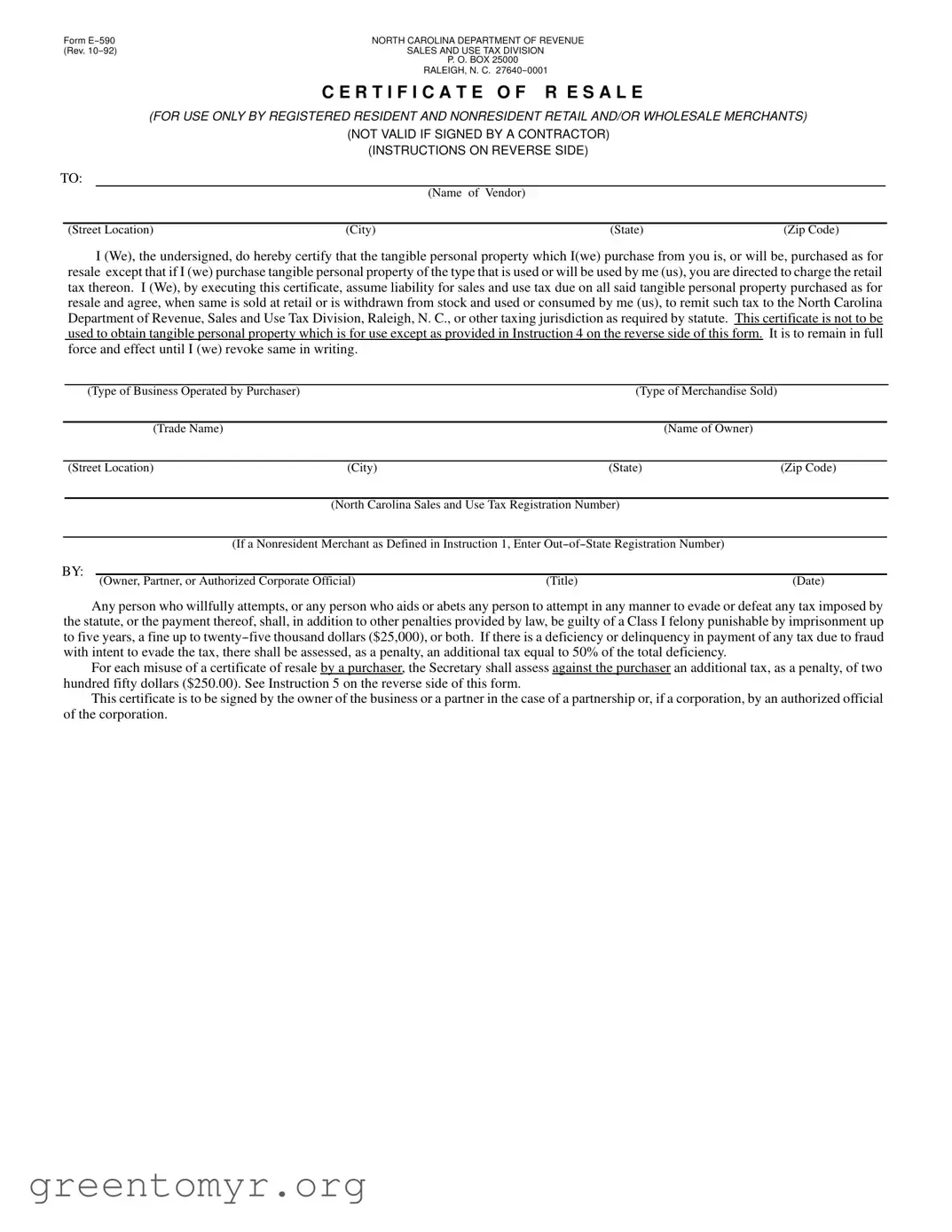
Form E--590
(Rev. 10--92)
NORTH CAROLINA DEPARTMENT OF REVENUE
SALES AND USE TAX DIVISION
P. O. BOX 25000
RALEIGH, N. C. 27640--0001
C E R T I F I C A T E O F R E S A L E
(FOR USE ONLY BY REGISTERED RESIDENT AND NONRESIDENT RETAIL AND/OR WHOLESALE MERCHANTS)
(NOT VALID IF SIGNED BY A CONTRACTOR)
(INSTRUCTIONS ON REVERSE SIDE)
TO:
(Name of Vendor)
(Street Location) (City) (State) (Zip Code)
I (We), the undersigned, do hereby certify that the tangible personal property which I(we) purchase from you is, or will be, purchased as for
resale except that if I (we) purchase tangible personal property of the type that is used or will be used by me (us), you are directed to charge the retail
tax thereon. I (We), by executing this certificate, assume liability for sales and use tax due on all said tangible personal property purchased as for
resale and agree, when same is sold at retail or is withdrawn from stock and used or consumed by me (us), to remit such tax to the North Carolina
Department of Revenue, Sales and Use Tax Division, Raleigh, N. C., or other taxing jurisdiction as required by statute. This certificate is not to be
used to obtain tangible personal property which is for use except as provided in Instruction 4 on the reverse side of this form. It is to remain in full
force and effect until I (we) revoke same in writing.
(Type of Business Operated by Purchaser) (Type of Merchandise Sold)
(Trade Name) (Name of Owner)
(Street Location) (City) (State) (Zip Code)
(North Carolina Sales and Use Tax Registration Number)
(If a Nonresident Merchant as Defined in Instruction 1, Enter Out--of--State Registration Number)
BY:
(Owner, Partner, or Authorized Corporate Official) (Title) (Date)
Any person who willfully attempts, or any person who aids or abets any person to attempt in any manner to evade or defeat any tax imposed by
the statute, or the payment thereof, shall, in addition to other penalties provided by law, be guilty of a Class I felony punishable by imprisonment up
to five years, a fine up to twenty--five thousand dollars ($25,000), or both. If there is a deficiency or delinquency in payment of any tax due to fraud
with intent to evade the tax, there shall be assessed, as a penalty, an additional tax equal to 50% of the total deficiency.
For each misuse of a certificate of resale by a purchaser, the Secretary shall assess against the purchaser an additional tax, as a penalty, of two
hundred fifty dollars ($250.00). See Instruction 5 on the reverse side of this form.
This certificate is to be signed by the owner of the business or a partner in the case of a partnership or, if a corporation, by an authorized official
of the corporation.
Form E--590 (Reverse)
(Rev. 10--92)
INSTRUCTIONS
1. This certificate is for use only by registered resident and nonresident retail and/or wholesale merchants. Nonresident retail or wholesale merchant
means a person who does not have a place of business in this State, is engaged in the business of acquiring, by purchase, consignment, or otherwise,
tangible personal property and selling the property outside this State, and is registered for sales and use tax purposes in a taxing jurisdiction outside
this State. Merchants issuing this certificate must keep a copy of the executed certificate in their records
.
2. This certificate is not to be used to obtain tangible personal property for use except as provided in Instruction 4 below
. See Sales and Use Tax
Administrative Rules 7B .0106 and 7B .2301 for additional information in regard to the proper use of this certificate.
3. Retailers and wholesalers making occasional or infrequent purchases of tangible personal property for resale should furnish their suppliers with
a copy of this certificate with each purchase order for such tangible personal property. Only one certificate is necessary where frequent purchases
are made.
4. Any registered merchant selling tangible personal property at retail and, in addition to such sales, makes purchases of such tangible personal
property for use in the general conduct of business and who cannot determine at the time of purchase whether the property will be resold or used may
purchase the property from his suppliers without payment of tax by issuing a certificate to such suppliers as their authority for not charging the tax.
Such merchant assumes responsibility for payment of the applicable sales and/or use taxes either (1) directly to the North Carolina Department of
Revenue, if the transaction is taxable in this State or (2) to the appropriate taxing jurisdiction in another state, if the transaction is taxable in that state.
An example of such a merchant is a retailer--contractor. A retailer--contractor is any person who engages in the business of selling building materials,
supplies, equipment and fixtures at retail and, in addition to such business, enters into contracts for constructing, building, erecting, altering or
repair-- ing buildings or other structures and for installing equipment and fixtures to buildings and, in the performance of such contracts, consumes
or uses such materials and merchandise.
5. A seller who accepts a certificate of resale from a purchaser of tangible personal property has the burden of proving that the sale was not a retail
sale unless all of the following conditions are met:
(a) The seller acted in good faith in accepting the certificate of resale.
(b) The certificate is in the form required by the Secretary.
(c) The certificate is signed by the purchaser, states the purchaser’s name, address, and registration number, and describes the type of tangible
personal property generally sold by the purchaser in the regular course of business.
(d) The purchaser is licensed under the North Carolina Sales and Use Tax Law or under the law of another taxing jurisdiction.
(e) The purchaser is engaged in the business of selling tangible personal property of the type sold.
A purchaser who does not resell property purchased under a certificate of resale is liable for any tax subsequently determined to be due on the sale.
A seller of property sold under a certificate of resale is jointly liable with the purchaser of the property for any tax subsequently determined to be
due on the sale only if the Secretary proves that the sale was a retail sale.
6. This certificate is not valid if signed by a contractor. A contractor is the user or consumer of tangible personal property and sales to contractors
are taxable at the retail rate of tax.
7. The vendor must obtain a corrected certificate in the event of change of ownership of a business for which a certificate of resale is on file. Such
changes in ownership of North Carolina businesses may be verified with the Sales and Use Tax Taxpayer Assistance Section, North Carolina
Department of Revenue, Post Office Box 25000, Raleigh, N. C. 27640--0001, or telephone No. (919) 733--3661.

File Breakdown

Fact Name Description Governing Law
Eligibility This form is for registered resident and nonresident retail and wholesale merchants only. North Carolina Sales and Use Tax Law
Liability The purchaser assumes liability for sales and use tax on all tangible personal property purchased for resale. North Carolina General Statutes § 105-164.4
Validity The certificate is invalid if signed by a contractor, as they are considered users of the property. North Carolina Sales and Use Tax Administrative Rules
Record Keeping Merchants must keep a copy of the executed certificate in their records for verification purposes. North Carolina Sales and Use Tax Administrative Rules

Guide to Using Nc Certificate Resale

Filling out the North Carolina Certificate of Resale form is an important step for registered merchants who wish to purchase tangible personal property for resale. Once you have completed the form, it will serve as a declaration that the items you buy are intended for resale, and it will help you avoid paying sales tax at the time of purchase. Make sure all information is accurate and complete to ensure compliance with state regulations.

  1. Begin by entering the name of the vendor from whom you are purchasing the items in the space provided.
  2. Fill in the vendor's street address, city, state, and zip code.
  3. In the next section, write your name or the name of your business as the purchaser.
  4. Specify the type of business you operate.
  5. Indicate the type of merchandise you sell.
  6. Provide your trade name, if applicable.
  7. Fill in your street address, city, state, and zip code.
  8. Enter your North Carolina Sales and Use Tax Registration Number.
  9. If you are a nonresident merchant, include your out-of-state registration number.
  10. Sign the form as the owner, partner, or an authorized corporate official.
  11. Include your title and the date of signing.

After completing the form, make sure to keep a copy for your records. This will help you maintain compliance and provide documentation if needed in the future. If there are any changes in your business ownership or if you need to revoke the certificate, be sure to follow the proper procedures as outlined in the instructions.

Get Answers on Nc Certificate Resale

What is the North Carolina Certificate of Resale?

The North Carolina Certificate of Resale is a document that allows registered retail and wholesale merchants to purchase tangible personal property without paying sales tax, as long as the property is intended for resale. This certificate is specifically designed for merchants who are either residents or nonresidents of North Carolina and must be filled out correctly to be valid.

Who can use the Certificate of Resale?

This certificate can only be used by registered resident and nonresident retail and wholesale merchants. Nonresident merchants are those who do not have a physical business location in North Carolina but are registered for sales tax purposes in another state. It is important to note that this certificate is not valid if signed by a contractor, as contractors are considered users or consumers of the property they purchase.

How should the Certificate of Resale be completed?

To complete the certificate, the merchant must provide specific information, including:

  1. Name and address of the vendor from whom the property is being purchased.
  2. Name of the purchaser, type of business, and type of merchandise sold.
  3. North Carolina Sales and Use Tax Registration Number or out-of-state registration number for nonresident merchants.
  4. The signature of the owner, partner, or authorized corporate official.

Each of these details is essential for the certificate to be valid and effective.

What are the responsibilities of the purchaser?

By using the Certificate of Resale, the purchaser assumes liability for any sales and use tax due on the property purchased. This means that if the property is not resold and is instead used or consumed, the purchaser must remit the appropriate tax to the North Carolina Department of Revenue. Failure to do so may result in penalties.

How often should the Certificate of Resale be presented?

Merchants making frequent purchases for resale can present one certificate to their suppliers, which will cover multiple transactions. However, for occasional or infrequent purchases, it is advisable to provide a copy of the certificate with each purchase order. This practice ensures that suppliers have the necessary documentation for tax exemption.

What happens if the Certificate of Resale is misused?

If a purchaser misuses the Certificate of Resale, they may face significant penalties. Each misuse can result in an additional tax penalty of $250. Moreover, if the misuse is deemed fraudulent, the purchaser could be subject to more severe penalties, including fines and potential imprisonment.

What should a vendor do if there is a change in ownership?

If there is a change in ownership of a business for which a Certificate of Resale is on file, the vendor must obtain a corrected certificate. This ensures that the new ownership is properly documented and compliant with sales tax regulations. Vendors can verify changes in ownership with the North Carolina Department of Revenue.

Common mistakes

Filling out the North Carolina Certificate of Resale form can be straightforward, but several common mistakes can lead to issues. One frequent error is neglecting to include the North Carolina Sales and Use Tax Registration Number. This number is essential for validating the purchaser's registration status. Without it, the certificate may be considered invalid.

Another common mistake involves the signature. The form must be signed by the owner, a partner, or an authorized corporate official. If the signature is missing or does not match the name of the person listed as the purchaser, the certificate may be rejected. Ensuring that the correct individual signs the document is crucial.

Many people also fail to specify the type of business operated and the type of merchandise sold. This information is necessary to demonstrate the nature of the business and the items being purchased for resale. Omitting these details can lead to confusion and potential penalties.

Another mistake is using the certificate for items that are not intended for resale. The form is strictly for tangible personal property purchased for resale. If a purchaser uses the certificate to buy items for personal use, they may face tax liabilities. It is important to understand the limitations of the certificate.

Some individuals may not keep a copy of the executed certificate in their records, which is required by law. This oversight can create problems if the North Carolina Department of Revenue requests proof of the certificate's validity. Maintaining accurate records is a vital part of compliance.

Additionally, failing to update the certificate after a change in ownership can lead to issues. If the business changes ownership, a corrected certificate must be obtained. Not doing so can result in penalties and complications regarding tax responsibilities.

Lastly, individuals sometimes misunderstand the rules regarding nonresident merchants. Nonresident merchants must provide their out-of-state registration number on the form. Failure to include this information can lead to the rejection of the certificate. Understanding the requirements for nonresident status is essential for compliance.

Documents used along the form

The North Carolina Certificate of Resale form is an important document for merchants who purchase tangible personal property for resale. However, several other forms and documents are often used in conjunction with this certificate to ensure compliance with state tax laws. Below is a list of these related documents, each serving a specific purpose in the resale process.

  • Sales and Use Tax Registration Application: This form is used by businesses to register for sales and use tax with the North Carolina Department of Revenue. It establishes the business as a tax collector and provides a unique registration number that is essential for issuing resale certificates.
  • North Carolina Sales and Use Tax Return: Businesses must file this return periodically to report sales and remit collected sales tax to the state. It details taxable and exempt sales, ensuring that the business complies with tax obligations.
  • Exempt Use Certificate: This document is utilized when a purchaser claims that a specific purchase is exempt from sales tax. It is necessary for certain types of purchases, such as those made by non-profit organizations or government entities.
  • Form E-595E (Streamlined Sales and Use Tax Agreement Certificate of Exemption): This form is used for purchases made by entities that are exempt from sales tax under specific circumstances. It helps simplify transactions for qualifying purchasers.
  • Vendor's Certificate of Exemption: This certificate allows vendors to sell goods to exempt organizations without charging sales tax. It is essential for maintaining accurate tax records and ensuring compliance with exemption rules.
  • Record Keeping Guidelines: While not a form, these guidelines outline the necessary documentation and records that businesses must maintain to support their resale activities and tax filings. Proper record-keeping is crucial for audits and compliance checks.
  • Change of Ownership Notification: If a business changes ownership, this notification must be submitted to update the sales tax registration and resale certificate records. It ensures that the new owner is recognized for tax purposes.

Understanding these documents and their purposes can help businesses navigate the complexities of sales tax compliance in North Carolina. Proper use of the Certificate of Resale and related forms is essential for maintaining good standing with the state tax authorities.

Similar forms

The North Carolina Certificate of Resale form is similar to several other documents used in business transactions, particularly in the context of sales tax and resale. Here are six documents that share similarities with the NC Certificate of Resale form:

  • Sales Tax Exemption Certificate: This document allows buyers to purchase goods without paying sales tax, similar to the resale certificate. It certifies that the buyer is exempt from sales tax due to specific qualifications, such as being a non-profit organization or a government entity.
  • Wholesale Purchase Agreement: This agreement outlines the terms under which a retailer can purchase goods from a wholesaler for resale. It serves as a legal acknowledgment of the buyer's intent to resell the products, akin to the resale certificate's purpose.
  • Vendor Registration Form: This form is typically required for businesses to register as vendors with state or local authorities. It often includes information about the business's sales tax registration, similar to the information required on the resale certificate.
  • Tax Exempt Certificate: Issued to businesses that qualify for tax exemption status, this certificate allows them to purchase goods tax-free. Like the resale certificate, it requires the buyer to confirm their eligibility for tax exemption.
  • Purchase Order: A purchase order is a document that confirms a buyer's intention to purchase goods or services. It can reference a resale certificate to indicate that the buyer will not pay sales tax on the items being ordered for resale.
  • Contractor's Exemption Certificate: While the resale certificate is not valid if signed by a contractor, this exemption certificate allows contractors to purchase materials without paying sales tax when those materials will be used in a tax-exempt project. It shares the theme of tax exemption with the resale certificate.

Dos and Don'ts

When filling out the North Carolina Certificate of Resale form, it’s important to follow specific guidelines to ensure compliance with state regulations. Here are some key dos and don’ts to consider:

  • Do ensure that you are a registered resident or nonresident merchant before using the form.
  • Do provide accurate information about your business, including the type of merchandise sold.
  • Do sign the certificate yourself or have an authorized official sign if your business is a corporation.
  • Do keep a copy of the completed certificate for your records.
  • Don't use the certificate to purchase items for personal use or consumption.
  • Don't sign the certificate if you are a contractor, as it is not valid for contractors.
  • Don't forget to update the certificate if there is a change in ownership of your business.
  • Don't use the certificate for transactions that do not meet the criteria outlined in the instructions.

Following these guidelines will help ensure that your use of the Certificate of Resale is valid and compliant with North Carolina tax laws.

Misconceptions

Understanding the North Carolina Certificate of Resale can be challenging. Here are ten common misconceptions about this form, along with clarifications to help you navigate its requirements.

  1. Only North Carolina residents can use the form. This is false. Both registered resident and nonresident merchants can utilize the Certificate of Resale.
  2. Contractors can use the Certificate of Resale. This is incorrect. The certificate is not valid if signed by a contractor, as they are considered users of the property.
  3. One certificate is enough for all purchases. Not true. Retailers making occasional purchases should provide a copy with each order, while frequent purchasers can use one certificate.
  4. Merchants can use the certificate for any type of purchase. This is misleading. The certificate is only valid for tangible personal property intended for resale.
  5. The seller is responsible for verifying the certificate. While the seller must act in good faith, the purchaser holds the responsibility for any tax due if they do not resell the property.
  6. All tangible personal property purchases are tax-exempt with this certificate. This is false. If the property is used rather than resold, tax must be paid.
  7. Nonresident merchants don’t need a state registration number. This is incorrect. Nonresident merchants must provide their out-of-state registration number on the form.
  8. The certificate is valid indefinitely. This is misleading. It remains valid until revoked in writing by the purchaser.
  9. Changes in business ownership do not affect the certificate. This is not true. A corrected certificate is required if there is a change in ownership.
  10. Misuse of the certificate has no penalties. This is false. There are significant penalties for misuse, including fines and potential criminal charges.

It is crucial to understand these points to ensure compliance with North Carolina tax laws. If you have further questions or need assistance, consider reaching out to a tax professional.

Key takeaways

Filling out and using the North Carolina Certificate of Resale form is an important process for businesses engaged in retail and wholesale activities. Here are key takeaways to consider:

  • Eligibility: This certificate is exclusively for registered resident and nonresident retail and wholesale merchants. Contractors cannot use this certificate.
  • Liability for Tax: By signing the certificate, the purchaser assumes liability for any sales and use tax on tangible personal property purchased for resale.
  • Record Keeping: Merchants must keep a copy of the executed certificate in their records for verification purposes.
  • Use Restrictions: The certificate cannot be used to obtain tangible personal property for personal use; it is strictly for resale purposes.
  • Occasional Purchases: Retailers and wholesalers making infrequent purchases should provide a copy of the certificate with each purchase order.
  • Tax Responsibility: Merchants who cannot determine if property will be resold or used may purchase it without tax by issuing a certificate, but they must pay the applicable sales tax later.
  • Good Faith Requirement: Sellers accepting the certificate must act in good faith and ensure it meets all required conditions to avoid liability for retail sales tax.
  • Change of Ownership: If there is a change in ownership of the business, the vendor must obtain a corrected certificate to reflect this change.

Understanding these key points will help ensure compliance with North Carolina's sales and use tax regulations when using the Certificate of Resale form.