Content Navigation

The North Carolina Deed of Trust is a crucial legal document that serves as a security instrument in real estate transactions, particularly for loans facilitated through the North Carolina Housing Finance Agency's Home Advantage Mortgage Program. This form outlines the relationship between three primary parties: the Grantor, who is the borrower; the Trustee, who holds the legal title to the property; and the Beneficiary, typically the lender, who is entitled to the repayment of the loan. The Deed of Trust specifies the terms under which the loan is secured, including the amount borrowed, the repayment schedule, and the conditions that must be met to avoid default. In the event of a default, the document grants the Trustee the authority to sell the property at public auction to recover the owed amount. Furthermore, it includes various covenants that the Grantor must adhere to, such as maintaining insurance on the property, paying taxes, and not committing waste. The Deed of Trust is designed to protect the interests of the Beneficiary while providing a clear framework for the rights and responsibilities of all parties involved. Understanding its components is essential for anyone participating in real estate financing in North Carolina.


Nc Deed Trust Example

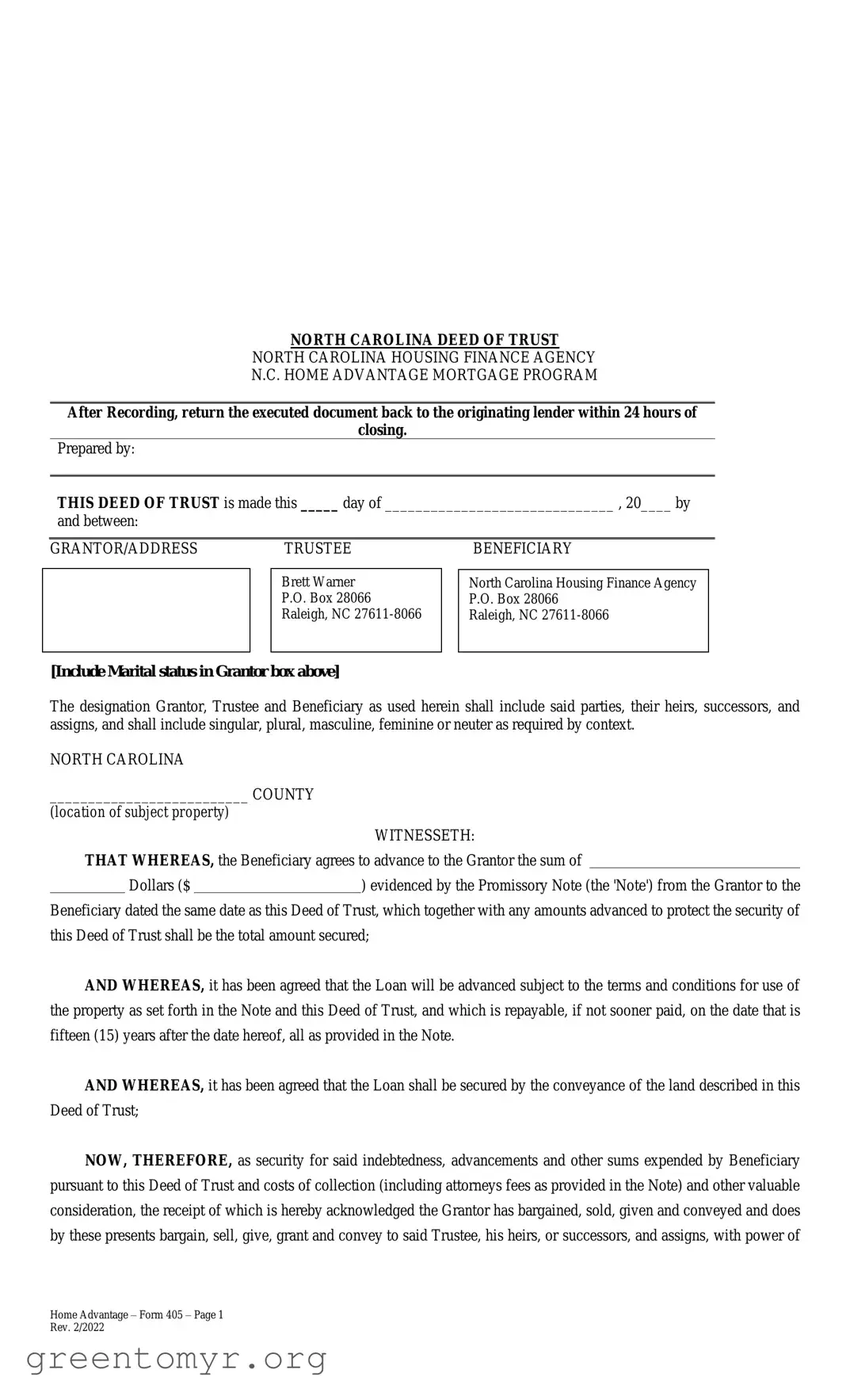
Home Advantage Form 405 Page 1
Rev. 2/2022
NORTH CAROLINA DEED OF TRUST
NORTH CAROLINA HOUSING FINANCE AGENCY
N.C. HOME ADVANTAGE MORTGAGE PROGRAM
After Recording, return the executed document back to the originating lender within 24 hours of
closing.
Prepared by:
THIS DEED OF TRUST is made this _____ day of ______________________________ , 20____ by
and between:
GRANTOR/ADDRESS TRUSTEE BENEFICIARY
[Include Marital status in Grantor box above]
The designation Grantor, Trustee and Beneficiary as used herein shall include said parties, their heirs, successors, and
assigns, and shall include singular, plural, masculine, feminine or neuter as required by context.
NORTH CAROLINA
__________________________ COUNTY
(location of subject property)
WITNESSETH:
THAT WHEREAS, the Beneficiary agrees to advance to the Grantor the sum of
Dollars ($ ) evidenced by the Promissory Note (the 'Note') from the Grantor to the
Beneficiary dated the same date as this Deed of Trust, which together with any amounts advanced to protect the security of
this Deed of Trust shall be the total amount secured;
AND WHEREAS, it has been agreed that the Loan will be advanced subject to the terms and conditions for use of
the property as set forth in the Note and this Deed of Trust, and which is repayable, if not sooner paid, on the date that is
fifteen (15) years after the date hereof, all as provided in the Note.
AND WHEREAS, it has been agreed that the Loan shall be secured by the conveyance of the land described in this
Deed of Trust;
NOW, THEREFORE, as security for said indebtedness, advancements and other sums expended by Beneficiary
pursuant to this Deed of Trust and costs of collection (including attorneys fees as provided in the Note) and other valuable
consideration, the receipt of which is hereby acknowledged the Grantor has bargained, sold, given and conveyed and does
by these presents bargain, sell, give, grant and convey to said Trustee, his heirs, or successors, and assigns, with power of
North Carolina Housing Finance Agency
P.O. Box 28066
Raleigh, NC 27611-8066
Brett Warner
P.O. Box 28066
Raleigh, NC 27611-8066
Home Advantage Form 405 Page 2
Rev. 2/2022
sale, the parcel(s) of land situated in the City of __________________, ___________________ County, North Carolina,
(the "Premises") and more particularly described as follows:
together with all heating, plumbing and lighting fixtures and equipment now or hereafter attached to or used in connection
with the premises (the “Property”).
TO HAVE AND TO HOLD the Property, with all privileges and appurtenances thereunto belonging, to the Trustee,
the Trustee's heirs, and assigns forever, upon the trust terms and conditions and for the uses set forth in this Deed of Trust.
If the Grantor shall pay the Note secured hereby in accordance with its terms, together with interest thereon, and any
renewals or extensions thereof in whole or in part, all other sums secured hereby and shall comply with all of the covenants,
terms and conditions of this Deed of Trust, then this conveyance shall be null and void and may be canceled of record at the
request and the expense of the Grantor. If, however, there shall be any default (a) in the payment of any sums due under the
Note, this Deed of Trust or any other instrument securing the Note and such default is not cured within thirty (30) days from
the due date, or (b) if there shall be default in any of the other covenants, terms or conditions of the Note secured hereby, or
any failure or neglect to comply with the covenants, terms or conditions contained in this Deed of Trust or any other
instrument securing the Note and such default is not cured within thirty (30) days after written notice, then and in any of
such events, without further notice, it shall be lawful for and the duty of the Trustee, upon request of the Beneficiary, to sell
the land herein conveyed at public auction for cash, after having first giving such notice of hearing as to commencement of
foreclosure proceedings and obtained such findings or leave of court as may then be required by law and giving such notice
and advertising the time and place of such sale in such manner as may then be provided by law, and upon such and any
resales and upon compliance with the law then relating to foreclosure proceedings under power of sale to convey title to the
purchaser in as full and ample manner as the Trustee is empowered. The Trustee shall be authorized to retain an attorney to
represent him in such proceedings. The proceeds of the Sale shall after the Trustee retains his commission, together with
reasonable attorneys fees incurred by the Trustee in such proceedings, be applied to the costs of sale, including, but not
limited to, costs of collection, taxes, assessments, costs of recording, service fees and incidental expenditures, the amount
due on the Note hereby secured and advancements and other sums expended by the Beneficiary according to the provisions
hereof and otherwise as required by the then existing law relating to foreclosures. The Trustee's commission shall be five
percent (5%) of the gross proceeds of the sale for a completed foreclosure.
The said Grantor does hereby covenant and agree with the Trustee and Beneficiary as follows:
1. PAYMENT AND PERFORMANCE. Grantor shall pay the Note and perform all other requirements at the time and
in the manner provided in the Note and herein.
2. INSURANCE. Grantor shall keep the property and all improvements, now or hereafter erected, constantly insured
for the benefit of the Beneficiary against loss by fire, windstorm and such other casualties and contingencies, in the
manner and with companies as may be satisfactory to the Beneficiary. The amount of the insurance required by this
provision shall be the lesser of either the amount of the Note secured by this Deed of Trust or 100% of the insurable
value of the improvements on the Property. Grantor shall purchase such insurance and pay all premiums in a timely
manner. In the event that Grantor fails to pay any premium when it is due, then the Beneficiary, at its option, may
purchase such insurance. Such amounts paid by the Beneficiary shall be added to the Note secured by this Deed of
Trust and shall be due and payable by Grantor upon demand of the Beneficiary.
3. TAXES, ASSESSMENTS, CHARGES. Grantor shall pay all taxes, assessments and charges as may be lawfully
levied against the Property before the same shall become past due. In the event that the Grantor fails to pay all taxes,
assessments and charges as required, then the Beneficiary at its option may pay them and the amount paid shall be
added to the Note secured by this Deed of Trust and shall be due and payable by Grantor upon demand of the
Beneficiary.
Home Advantage Form 405 Page 3
Rev. 2/2022
Grantor shall promptly discharge any lien which has priority over this Deed of Trust unless Grantor: (a) agrees in
writing to the payment of the obligation secured by the lien in a manner acceptable to Beneficiary, but only so long
as Grantor is performing such agreement; (b) contests to the lien in good faith by, or defends against enforcement of
the lien in, legal proceedings which in Beneficiary’s opinion operate to prevent the enforcement of the lien while
those proceedings are pending, but only until such proceedings are concluded; or (c) secures from the holder of the
lien an agreement satisfactory to Beneficiary subordinating the lien to this Deed of Trust. If Beneficiary determines
that any part of the Property is subject to a lien which can attain priority over this Deed of Trust, Beneficiary may
give Grantor a notice identifying the lien. Within 10 days of the date on which that notice is given, Grantor shall
satisfy the lien or take one or more of the actions set forth above in this Deed of Trust.
4. WASTE. The Grantor covenants that the Grantor will keep the Property in good order, repair and condition,
reasonable wear and tear excepted, and that Grantor will not commit or permit any waste on the Property.
5. WARRANTIES. Grantor covenants with Trustee and Beneficiary that Grantor is seized of the Property in fee simple,
has the right to convey the same in fee simple, that the title is marketable and free and clear of all encumbrances, and
that the Grantor will warrant and defend the title against the lawful claims of all persons whomsoever, except that the
title to the Property is subject to the following exceptions:
(See Exhibit “B” attached hereto and incorporated herein by references, if applicable)
6. OCCUPANCY. Grantor shall occupy, establish, and use the Premises as Grantor’s principal residence.
7. SUBSTITUTION OF TRUSTEE. Grantor and Trustee covenant and agree that in case the Trustee, or any trustee,
shall die, become incapable of acting, renounce this trust, or for other similar or dissimilar reason become
unacceptable to the Beneficiary or if the Beneficiary desires to replace the Trustee, then the Beneficiary may appoint,
in writing, a trustee to take the place of the Trustee; and upon the probate and registration of the writing, the trustee
thus appointed shall succeed to all the rights, powers and duties of the Trustee.
8. CIVIL ACTIONS. In the event that the Trustee is named as a party in any civil action as trustee in this Deed of
Trust, the Trustee shall be entitled to employ an attorney at law, including himself if he is a licensed attorney, to
represent him in said action and the reasonable attorney's fees of the Trustee in such action may be Paid by the
Beneficiary and added to the Note secured by this Deed of Trust, and shall be due and payable by Grantor upon
demand of the Beneficiary.
9. PRIOR LIENS. Default under the terms of any instrument secured by a lien to which this Deed of Trust is
subordinated shall constitute default under this Deed of Trust.
10. SUBORDINATION. Any subordination of this lien to additional liens or encumbrances shall be only upon the prior
written consent of the Beneficiary.
11. LOAN APPLICATION. Grantor shall be in default if, during the Loan application process, Grantor or any persons
or entities acting at the direction of Grantor or with Grantor’s knowledge or consent gave materially false, misleading,
or inaccurate information or statements to (or failed to provide Lender with material information) in connection with
the Loan. Material representations include, but are not limited to, representations concerning Grantor’s occupancy of
the Property as Grantor’s principal residence and Grantor’s income level.
12. RIGHT TO INSPECT. To assure and protect its right in this Deed of Trust and the Property, the Beneficiary shall
have right of access and inspection of the Property at reasonable times and with ample notice to the Grantor.
13. INDEMNITY. If any suit or proceeding be brought against the Trustee or Beneficiary or if any suit or proceeding be
brought which may affect the value or title of the Property, Grantor shall defend, indemnify and hold harmless and
on demand reimburse Trustee or Beneficiary from any loss, cost, damage or expense and any sums expended by
Trustee or Beneficiary shall bear interest as provided in the Note secured hereby for sums due after default and shall
be due and payable on demand.
14. SALE OF PROPERTY. Grantor agrees that if the Property or any part thereof or interest therein is sold, assigned,
transferred, conveyed or otherwise alienated by Grantor, whether voluntarily or involuntarily or by operation of law
other than: (i) the creation of a lien or other encumbrance subordinate to this Deed of Trust which does not relate to a
transfer of rights of occupancy in the Property; (ii) a transfer by devise, descent, or operation of law on the death of a
Home Advantage Form 405 Page 4
Rev. 2/2022
joint tenant or tenant by the entirety; (iii) a transfer to a relative resulting from the death of a Grantor; (iv) a transfer
resulting from a decree of a dissolution of marriage, legal separation agreement, or from an incidental property
settlement agreement, by which the spouse of the Grantor becomes an owner of the Property; (v) any other transfer
permitted under federal law, without the prior written consent of Beneficiary, Beneficiary, at its own option, may
declare the Note secured hereby and all other obligations hereunder to be forthwith due and payable. Any change in
the legal or equitable title of the Property or in the beneficial ownership of the Property shall be deemed to be the
transfer of an interest in the Property.
15. TERMINATION OF RESTRICTIONS. Any restrictions contained in the Note or this Deed of Trust will
automatically terminate if title to the Property is transferred by foreclosure or deed-in-lieu of foreclosure, or if the
mortgage is assigned to the Secretary of the United States Department of Housing and Urban Development.
16. PROTECTION OF BENEFICIARY’S INTEREST IN THE PROPERTY AND RIGHTS UNDER THIS DEED
OF TRUST. If (a) Grantor fails to perform the covenants and agreements contained in this Deed of Trust, (b) there
is a legal proceeding that might significantly affect Beneficiary’s interest in the Property and/or rights under this Deed
of Trust (such as a proceeding in bankruptcy, probate, for condemnation or forfeiture, for enforcement of a lien which
may attain priority over this Deed of Trust or to enforce laws or regulations), or (c) Grantor has abandoned the
Property, then Beneficiary may do and pay for whatever is reasonable or appropriate to protect Beneficiary’s interest
in the Property and rights under this Deed of Trust, including protecting and/or assessing the value of the Property,
and securing and/or repairing the Property. Beneficiary’s actions can include, but are not limited to: (a) paying any
sums secured by a lien which has priority over this Deed of Trust; (b) appearing in court; and (c) paying reasonable
attorneys’ fees to protect its interest in the Property and/or rights under this Deed of Trust, including its secured
position in a bankruptcy proceeding. Securing the Property includes, but is not limited to, entering the Property to
make repairs, change locks, replace or board up doors and windows, drain water from pipes, eliminate building or
other code violations or dangerous conditions, and have utilities turned on or off. Although Beneficiary may take
action under this Section 15, Beneficiary does not have to do so and is not under any duty or obligation to do so. It is
agreed that Beneficiary incurs no liability for not taking any or all actions authorized under this Section 15.
Any amounts disbursed by Beneficiary under this Section 15 shall become additional debt of Grantor secured by this
Deed of Trust. These amounts shall bear interest at the Note rate, if any, from the date of disbursement and shall be
payable, with such interest, upon notice from Beneficiary to Grantor requesting payment.
17. CONDEMNATION. If the Property, or any part of the Property, is condemned under any power of eminent domain,
or acquired for public use, the damages, proceeds, and the consideration for such acquisition, to the extent of the full
amount of indebtedness upon this Deed of Trust and if the Note remains unpaid, are hereby assigned by the Grantor
to the Beneficiary and shall be paid to the Beneficiary to be applied by the Beneficiary on account of the indebtedness.
18. WAIVER OF DEFAULT. No sale of the Property and no forbearance on the part of the Beneficiary and no extension
of the time for the repayment of the debt secured hereby given by the Beneficiary shall operate to release, discharge,
modify, change, or affect the original liability of the Grantor either in whole or in part. The Beneficiary can, in its
complete discretion, waive any default, and can waive by written instrument, in advance, any individual actions which
might constitute a default.
19. GOVERNING LAW. This Deed of Trust is to be governed and construed in accordance with the laws of the State
of North Carolina.
20. SUCCESSORS AND ASSIGNS. The covenants herein contained shall bind, and the benefits and advantages shall
inure to the legal representatives, successors and assigns of the parties hereto.
Home Advantage Form 405 Page 5
Rev. 2/2022
IN TESTIMONY WHEREOF, Grantor(s) has executed this instrument under seal on the date first above written.
GRANTOR(S):
(SEAL)
(Print Name)
(SEAL)
(Print Name)
STATE OF COUNTY OF
I, ___________________________, a Notary Public of ______________ County (enter county matching your notary
stamp), State of , certify that the following person(s):
personally appeared before me this day
and presented this Deed of Trust and he or she signed the Deed of Trust while in my physical presence and while being
personally observed signing the Deed of Trust by me for the purposes stated therein.
Witness my hand and official stamp or seal, this the day of , 20 .
(Apply Notary Seal) Signature of Notary Public
My Commission expires
Mortgage Loan Originator Name and NMLS #: , # (must match 1003)
Company Name and NMLS #: , # (must match 1003)

File Breakdown

Fact Name Details
Governing Law This Deed of Trust is governed by the laws of the State of North Carolina.
Parties Involved The Grantor, Trustee, and Beneficiary are the primary parties in this agreement, including their heirs and assigns.
Loan Duration The loan is typically repayable in 15 years, as specified in the Deed of Trust.
Insurance Requirement The Grantor must maintain insurance on the property for the benefit of the Beneficiary, covering specific risks.
Default Conditions Defaults can occur due to non-payment or failure to comply with the terms outlined in the Deed of Trust.
Foreclosure Process In case of default, the Trustee may sell the property at public auction after appropriate notice and legal proceedings.
Trustee's Commission The Trustee is entitled to a commission of 5% of the gross proceeds from a completed foreclosure sale.
Property Transfer Restrictions The Grantor cannot sell or transfer the property without the Beneficiary's prior written consent.

Guide to Using Nc Deed Trust

After gathering all necessary information, the next step involves accurately filling out the North Carolina Deed of Trust form. This document is crucial for securing a loan with the property as collateral. Ensure that all details are correct and complete to avoid any potential issues during the closing process.

  1. Enter the date in the format: _____ day of ______________________________ , 20____.
  2. Fill in the Grantor's name and address. Include marital status in the designated box.
  3. Specify the name of the Trustee.
  4. Identify the Beneficiary as the North Carolina Housing Finance Agency and provide its address.
  5. Indicate the county where the property is located by filling in ____________________________ COUNTY.
  6. State the amount of the loan in dollars ($) in the designated space.
  7. Provide the city where the property is situated by filling in the City of __________________.
  8. Describe the property in detail, including any fixtures and equipment attached to it.
  9. Sign the document as the Grantor(s) and ensure to print names clearly next to the signature lines.
  10. Complete the Notary section by having a Notary Public witness the signing. Fill in the date and ensure the notary applies their seal.
  11. Include the Mortgage Loan Originator's name, NMLS number, and the Company Name with its NMLS number at the bottom of the form.

Get Answers on Nc Deed Trust

What is a North Carolina Deed of Trust?

A North Carolina Deed of Trust is a legal document used in real estate transactions. It secures a loan by transferring the title of the property to a trustee, who holds it on behalf of the lender (beneficiary) until the borrower (grantor) repays the loan. This arrangement protects the lender's interest while allowing the borrower to retain use of the property.

Who are the parties involved in a Deed of Trust?

There are three main parties involved:

  1. Grantor: The borrower who takes out the loan and conveys the property to the trustee.
  2. Trustee: An impartial third party who holds the title to the property until the loan is repaid.
  3. Beneficiary: The lender who provides the loan and benefits from the security of the property.

What happens if the borrower defaults on the loan?

If the borrower fails to make payments or violates the terms of the Deed of Trust, the trustee can initiate foreclosure proceedings. This process involves selling the property at public auction to recover the loan amount. The trustee must follow legal procedures, including providing notice and advertising the sale.

How long does the borrower have to repay the loan?

The typical repayment period for a loan secured by a Deed of Trust in North Carolina is 15 years. However, this period can vary based on the terms outlined in the Promissory Note associated with the Deed of Trust.

What are the borrower's obligations under the Deed of Trust?

The borrower has several key responsibilities, including:

  • Making timely payments on the loan.
  • Maintaining insurance on the property.
  • Paying property taxes and assessments.
  • Keeping the property in good condition and not committing waste.

Can the borrower sell the property while the Deed of Trust is in effect?

The borrower may sell the property, but they must obtain the lender's consent first. If the property is sold without permission, the lender may declare the entire loan amount due immediately. This restriction helps protect the lender's interest in the property.

What is the role of the trustee in the Deed of Trust?

The trustee acts as a neutral party who holds the title to the property on behalf of the lender. If the borrower defaults, the trustee is responsible for managing the foreclosure process, ensuring compliance with legal requirements, and distributing the proceeds from the sale of the property to the lender.

How does the Deed of Trust affect the borrower's credit?

A Deed of Trust can impact the borrower's credit score. Timely payments can improve the borrower's credit, while defaults or foreclosures can significantly harm it. Maintaining good financial habits and adhering to the terms of the Deed of Trust is crucial for protecting one's credit standing.

Common mistakes

Filling out the North Carolina Deed of Trust form requires careful attention to detail. One common mistake is failing to include the marital status of the Grantor in the designated box. This information is crucial as it can affect the legal standing of the document and the rights of the parties involved.

Another frequent error is leaving the amount of the loan blank. The form must specify the sum of money being advanced by the Beneficiary to the Grantor. Omitting this detail can lead to confusion and complications later in the process.

Many individuals neglect to provide the correct property description. The Deed of Trust must include a clear and accurate description of the property being secured. An incomplete or incorrect description can create legal issues and hinder the enforcement of the trust.

Inaccurate dates are also a common mistake. The date on which the Deed of Trust is executed should be filled in accurately. This date is essential for determining timelines related to payments and potential defaults.

Some people forget to sign the document in the presence of a notary public. A notary’s signature and seal are necessary to validate the document. Without this, the Deed of Trust may not be legally enforceable.

Another mistake involves failing to provide the trustee's information. The form requires the name and address of the trustee, who will manage the trust. Omitting this information can delay the process or render the document invalid.

Additionally, individuals often overlook the need to include exhibits or attachments if applicable. If there are exceptions to the title or other relevant documents, they should be referenced and attached to the Deed of Trust.

Lastly, some individuals do not keep a copy of the completed form for their records. It is important to retain a copy of the signed and notarized Deed of Trust for future reference, as it serves as a legal record of the agreement between the parties.

Documents used along the form

The North Carolina Deed of Trust is a crucial document in real estate transactions, particularly when it comes to securing a loan. However, it often accompanies several other forms and documents that play significant roles in the overall process. Understanding these additional documents can provide clarity and ensure that all parties are well-informed. Below is a list of commonly used forms and documents that often accompany the North Carolina Deed of Trust.

  • Promissory Note: This document outlines the borrower's promise to repay the loan. It specifies the loan amount, interest rate, repayment schedule, and any penalties for late payments. The Promissory Note serves as a legal contract between the borrower and lender.
  • Mortgage Application: Also known as the 1003 form, this application gathers essential information about the borrower, including income, employment history, and debts. It is the starting point for the mortgage approval process.
  • Title Insurance Policy: This policy protects the lender and sometimes the borrower against any claims or legal issues related to the property’s title. It ensures that the title is clear of any liens or disputes that could affect ownership.
  • Property Survey: A survey provides a detailed map of the property, showing boundaries, easements, and any structures. This document is vital for confirming that the property description in the Deed of Trust is accurate.
  • Homeowners Insurance Policy: Lenders typically require borrowers to maintain homeowners insurance to protect the property against potential risks such as fire, theft, or natural disasters. This policy provides peace of mind for both parties.
  • Closing Disclosure: This document outlines the final terms of the mortgage, including loan costs, interest rates, and closing costs. It must be provided to the borrower at least three days before closing to ensure transparency.
  • Deed of Conveyance: This document transfers ownership of the property from the seller to the buyer. It is recorded in the county where the property is located and serves as proof of ownership.

Each of these documents plays a vital role in the real estate transaction process, ensuring that both the lender's interests and the borrower's rights are protected. By understanding these forms, all parties involved can navigate the complexities of real estate transactions with greater confidence and clarity.

Similar forms

The North Carolina Deed of Trust form serves as a crucial document in real estate transactions, particularly in securing loans. It shares similarities with several other legal documents, each serving a unique purpose while maintaining fundamental characteristics of property and loan agreements. Below are seven documents that are similar to the Deed of Trust, along with explanations of how they relate to it.

  • Mortgage: Like a Deed of Trust, a mortgage is a legal agreement that secures a loan with real property. Both documents outline the borrower's obligation to repay the loan and the lender's rights in case of default. However, a mortgage typically involves only two parties: the borrower and the lender, whereas a Deed of Trust involves three parties: the borrower, the lender, and a trustee.
  • Promissory Note: This document is often associated with the Deed of Trust, as it represents the borrower's promise to repay the loan. While the Deed of Trust secures the loan with the property, the Promissory Note details the terms of repayment, including interest rates and payment schedules.
  • Real Estate Purchase Agreement: This document outlines the terms and conditions under which a property is bought or sold. Similar to the Deed of Trust, it involves the transfer of property rights. However, the Purchase Agreement focuses on the sale transaction itself, while the Deed of Trust serves to secure financing for that purchase.
  • Loan Agreement: A Loan Agreement specifies the terms of a loan between a borrower and a lender, similar to the Promissory Note. Both documents detail repayment terms, but a Loan Agreement may cover broader terms, including covenants and representations, akin to those found in a Deed of Trust.
  • Lease Agreement: While primarily used for rental arrangements, a Lease Agreement can include clauses that resemble those in a Deed of Trust, such as maintenance obligations and insurance requirements. Both documents establish rights and responsibilities related to property use and care.
  • Security Agreement: This document grants a lender a security interest in personal property as collateral for a loan. Like a Deed of Trust, it protects the lender's interest in the event of default, but it typically pertains to personal property rather than real estate.
  • Title Insurance Policy: Although not a security instrument, this policy protects against losses related to defects in title. It is similar to a Deed of Trust in that both are concerned with property ownership and the rights associated with it. Title insurance can provide assurance to the lender that their interest in the property is secure.

Dos and Don'ts

  • Do include your marital status in the Grantor box to ensure accurate representation of your legal standing.
  • Do double-check all property descriptions to confirm they are complete and correct, as inaccuracies can lead to issues later.
  • Do ensure signatures are notarized to validate the document and prevent any legal complications.
  • Do return the executed document to the originating lender within 24 hours of closing to comply with requirements.
  • Do keep copies of all submitted documents for your records and future reference.
  • Don't leave any sections blank, as incomplete forms may be rejected or delayed.
  • Don't use vague language when describing the property, as clarity is crucial for legal documents.
  • Don't forget to review the terms outlined in the Deed of Trust to understand your obligations.
  • Don't rush the process; take your time to ensure all information is accurate and complete.
  • Don't ignore deadlines, as failing to meet them could result in penalties or complications with your loan.

Misconceptions

  • Misconception 1: A Deed of Trust is the same as a mortgage.

    While both serve as security for a loan, a Deed of Trust involves three parties: the borrower (Grantor), the lender (Beneficiary), and a third party (Trustee). In contrast, a mortgage only involves two parties: the borrower and the lender.

  • Misconception 2: The Grantor loses all rights to the property.

    This is not true. The Grantor retains ownership of the property and can live in it as long as they meet the terms of the Deed of Trust. Only if they default on the loan can the Trustee sell the property.

  • Misconception 3: A Deed of Trust is only used for residential properties.

    A Deed of Trust can be used for both residential and commercial properties. Its flexibility makes it a common choice for various types of real estate transactions.

  • Misconception 4: Once signed, a Deed of Trust cannot be changed.

    In fact, modifications can be made if all parties agree. Changes must be documented and may require additional legal steps, but they are possible.

  • Misconception 5: The Trustee has no responsibilities.

    This is incorrect. The Trustee has specific duties, including managing the Deed of Trust and overseeing the foreclosure process if necessary. They act in the best interest of the Beneficiary while ensuring the Grantor's rights are respected.

Key takeaways

Filling out and using the North Carolina Deed of Trust form requires careful attention to detail. Below are key takeaways to consider:

  • Timeliness is crucial. After recording, return the executed document to the originating lender within 24 hours of closing.
  • Identify all parties. Clearly list the Grantor, Trustee, and Beneficiary, including their addresses and marital status, if applicable.
  • Understand the loan terms. The Deed of Trust secures a loan evidenced by a Promissory Note, which specifies repayment terms.
  • Property description is essential. Accurately describe the property being secured, including its location and any fixtures attached to it.
  • Insurance obligations exist. The Grantor must maintain insurance on the property for the benefit of the Beneficiary.
  • Tax responsibilities fall on the Grantor. All taxes, assessments, and charges must be paid on time to avoid default.
  • Occupancy requirements apply. The Grantor must use the property as their principal residence.
  • Default consequences are serious. Failure to meet payment or other obligations can lead to foreclosure proceedings initiated by the Trustee.
  • Legal compliance is necessary. The Deed of Trust must adhere to North Carolina laws, and any changes or transfers require written consent from the Beneficiary.

These points highlight the importance of understanding the responsibilities and implications of the Deed of Trust. Proper execution ensures the protection of all parties involved.