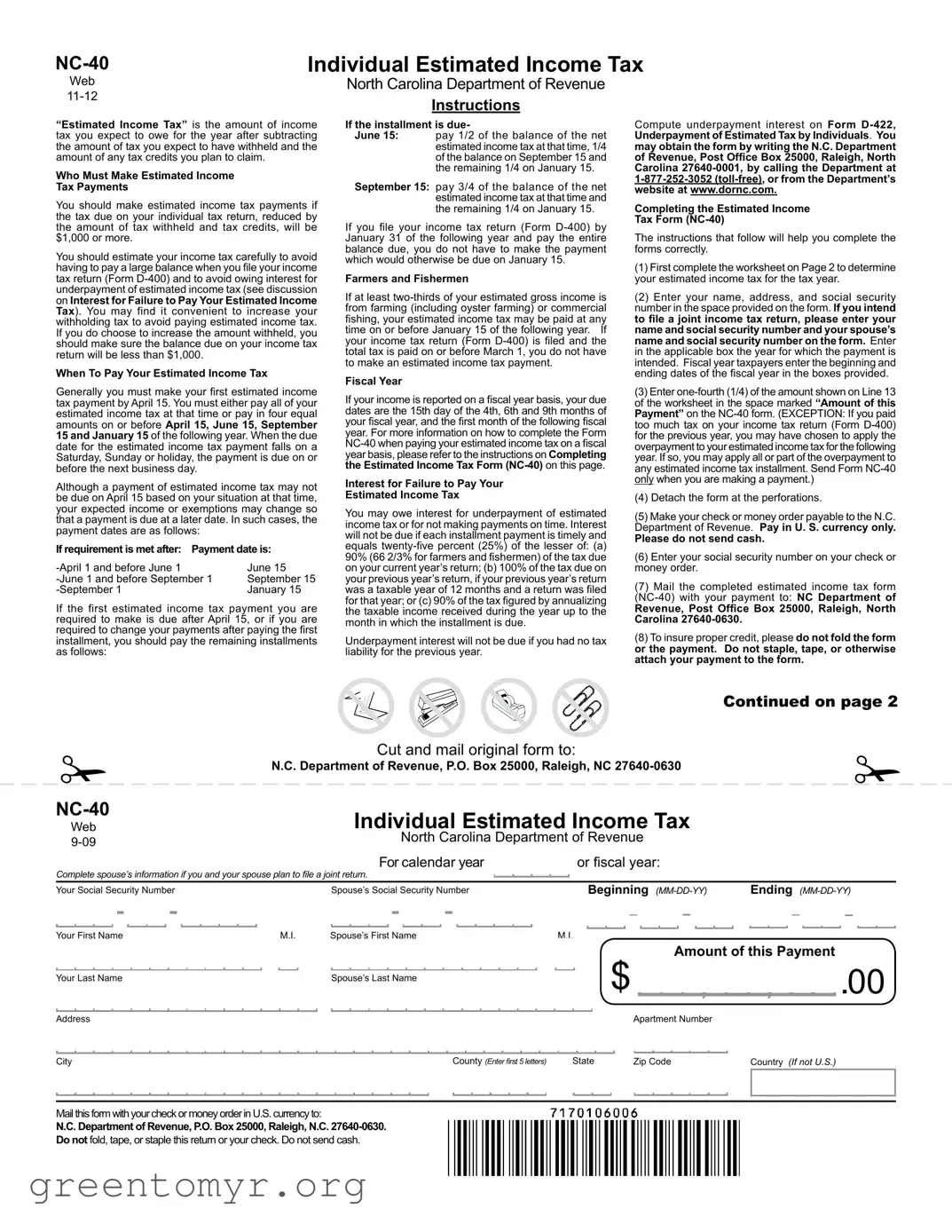
Understanding the NC Estimated Tax Payment form, also known as Form NC-40, is essential for North Carolina residents who expect to owe taxes on their income. This form is designed for individuals who anticipate a tax liability of $1,000 or more after accounting for any tax withheld and applicable credits. It helps taxpayers avoid the burden of a large tax bill when filing their annual income tax return. The form outlines specific payment deadlines, typically starting with the first payment due by April 15, and allows for payments to be made in four equal installments throughout the year. In addition, it offers flexibility for farmers and fishermen, who can make their payments by January 15 of the following year if they meet certain income criteria. Completing the NC-40 involves calculating your estimated income tax, providing personal information, and submitting your payment correctly to ensure timely processing. By following the instructions carefully, taxpayers can manage their estimated tax obligations efficiently and avoid penalties for underpayment.
Individual Estimated Income Tax |
|
Web |
North Carolina Department of Revenue |
Instructions |
|
|
“Estimated Income Tax” is the amount of income tax you expect to owe for the year after subtracting the amount of tax you expect to have withheld and the amount of any tax credits you plan to claim.
Who Must Make Estimated Income
Tax Payments
You should make estimated income tax payments if the tax due on your individual tax return, reduced by the amount of tax withheld and tax credits, will be $1,000 or more.
You should estimate your income tax carefully to avoid having to pay a large balance when you ile your income tax return (Form
underpayment of estimated income tax (see discussion on Interest for Failure to Pay Your Estimated Income Tax). You may find it convenient to increase your withholding tax to avoid paying estimated income tax. If you do choose to increase the amount withheld, you should make sure the balance due on your income tax return will be less than $1,000.
When To Pay Your Estimated Income Tax
Generally you must make your irst estimated income tax payment by April 15. You must either pay all of your estimated income tax at that time or pay in four equal amounts on or before April 15, June 15, September 15 and January 15 of the following year. When the due date for the estimated income tax payment falls on a Saturday, Sunday or holiday, the payment is due on or before the next business day.
Although a payment of estimated income tax may not be due on April 15 based on your situation at that time, your expected income or exemptions may change so that a payment is due at a later date. In such cases, the payment dates are as follows:
If requirement is met after: Payment date is:
June 15 |
|
September 15 |
|
January 15 |
If the first estimated income tax payment you are
required to make is due after April 15, or if you are required to change your payments after paying the irst installment, you should pay the remaining installments
as follows:
If the installment is due-
June 15: pay 1/2 of the balance of the net estimated income tax at that time, 1/4 of the balance on September 15 and the remaining 1/4 on January 15.
September 15: pay 3/4 of the balance of the net estimated income tax at that time and the remaining 1/4 on January 15.
If you ile your income tax return (Form
Farmers and Fishermen
If at least
from farming (including oyster farming) or commercial ishing, your estimated income tax may be paid at any time on or before January 15 of the following year. If your income tax return (Form
to make an estimated income tax payment.
Fiscal Year
If your income is reported on a iscal year basis, your due dates are the 15th day of the 4th, 6th and 9th months of your iscal year, and the irst month of the following iscal year. For more information on how to complete the Form
Interest for Failure to Pay Your
Estimated Income Tax
You may owe interest for underpayment of estimated income tax or for not making payments on time. Interest
will not be due if each installment payment is timely and equals
month in which the installment is due.
Underpayment interest will not be due if you had no tax liability for the previous year.
Compute underpayment interest on Form
may obtain the form by writing the N.C. Department of Revenue, Post Ofice Box 25000, Raleigh, North Carolina
Completing the Estimated Income
Tax Form
The instructions that follow will help you complete the forms correctly.
(1)First complete the worksheet on Page 2 to determine your estimated income tax for the tax year.
(2)Enter your name, address, and social security
number in the space provided on the form. If you intend to ile a joint income tax return, please enter your name and social security number and your spouse’s
name and social security number on the form. Enter in the applicable box the year for which the payment is
intended. Fiscal year taxpayers enter the beginning and ending dates of the iscal year in the boxes provided.
(3)Enter
(4)Detach the form at the perforations.
(5)Make your check or money order payable to the N.C. Department of Revenue. Pay in U. S. currency only.
Please do not send cash.
(6)Enter your social security number on your check or money order.
(7)Mail the completed estimated income tax form
Revenue, Post Ofice Box 25000, Raleigh, North
Carolina
(8)To insure proper credit, please do not fold the form or the payment. Do not staple, tape, or otherwise attach your payment to the form.
|
|
|
Continued on page 2 |
|
|
Cut and mail original form to: |
|
|
|
N.C. Department of Revenue, P.O. Box 25000, Raleigh, NC |
||||
|
|
|||
Individual Estimated Income Tax |
|
|||
Web |
|
|||
North Carolina Department of Revenue |
|
|||
|
|
|
||
|
For calendar year |
or iscal year: |
|
|
Complete spouse’s information if you and your spouse plan to ile a joint return. |
|
|
||
Your Social Security Number |
Spouse’s Social Security Number |
Beginning |
Ending |
|
|
Your First Name |
|
M.I. |
Spouse’s First Name |
|
M.I. |
|
|
|
|
|
|
|
|
|
|
|
|
|
|
|
|
|
|
|
|
|
Your Last Name |
|
|
|
Spouse’s Last Name |
|
|
|
$
Amount of this Payment
, ,.00
Address |
Apartment Number |
City |
County (Enter irst 5 letters) |
State |
Zip Code |
Country (If not U.S.)
Mail this form with your check or money order in U.S. currency to:
N.C. Department of Revenue, P.O. Box 25000, Raleigh, N.C.
Page 2
Web
Worksheet for Computation of Estimated N.C. Income Tax
1. Estimated Federal Adjusted Gross Income |
1. |
2.Estimated Additions to Federal Adjusted Gross Income
(See Individual Income Tax Instructions for Form |
2. |
3. Add Lines 1 and 2 and enter the total |
3. |
4.Estimated Deductions from Federal Adjusted Gross Income
(See Individual Income Tax Instructions for Form |
4. |
5. Subtract Line 4 from Line 3 and enter the total |
5. |
6.• If you plan to itemize deductions, enter the estimated total of your itemized deductions.
• If you do not plan to itemize, enter your standard deduction.
|
IMPORTANT: Do not enter the amount from your federal return. |
|
|
|
|
(You must refer to the Individual Income Tax Instructions for Form |
|
6. |
|
7. |
Subtract Line 6 from Line 5 and enter the total |
|
7. |
|
8. |
N.C. personal exemption (Multiply $2,500 or $2,000 by the number of exemptions) |
|
|
|
|
(You must refer to the Individual Income Tax Instructions for Form |
8. |
||
9. |
Estimated North Carolina Taxable Income (Subtract Line 8 from Line 7) |
|
9. |
|
10. |
Amount of Tax - Use the Tax Rates shown below |
|
10. |
|
11. |
A. Estimated N. C. Tax to be withheld |
A. |
|
|
|
B. Estimated Tax Credits |
B. |
|
|
12. |
Add Lines 11A and 11B |
|
12. |
|
13.Estimated Income Tax (Subtract Line 12 from Line 10) If $1,000 or more, ill out and mail the estimated income tax form along with your payment; if less than $1,000, no payment is
required at this time |
.......................................................................................................................................................................13. |
14.If the irst payment you are required to make is due April 15, enter 1/4 of Line 13 here and in the space marked “Amount of this Payment” on Form
whole dollar |
...................................................................................................................................................................................14. |
Tax Rates
Single |
|
|
|
Head of Household |
|
|
|||
$ |
0 |
$ 12,750 |
6% |
$ |
0 |
$ 17,000 |
6% |
|
|
|
12,750 |
60,000 |
$ |
765 + 7% of the amount over $12,750 |
|
17,000 |
80,000 |
$ 1,020 |
+ 7% of the amount over $17,000 |
|
60,000 |
$ |
4,072.50 + 7.75% of the amount over $60,000 |
|
80,000 |
$ 5,430 |
+ 7.75% of the amount over $80,000 |
||
Married Filing Jointly / Qualifying Widow(er) |
Married Filing Separately |
||||||
$ |
0 |
$ 21,250 |
6% |
$ |
0 |
$ 10,625 |
6% |
|
21,250 |
100,000 |
$ 1,275 + 7% of the amount over $21,250 |
|
10,625 |
50,000 |
$ 637.50 + 7% of the amount over $10,625 |
100,000 |
$ 6,787.50 + 7.75% of the amount over $100,000 |
|
50,000 |
$ 3,393.75 + 7.75% of the amount over $50,000 |
|||
| Fact Name | Fact Description |
|---|---|
| Form Title | The form is officially titled NC-40 Individual Estimated Income Tax. |
| Governing Body | The form is issued by the North Carolina Department of Revenue. |
| Payment Requirement | Taxpayers must make estimated payments if they expect to owe $1,000 or more. |
| Payment Schedule | Payments are generally due on April 15, June 15, September 15, and January 15. |
| Fiscal Year Reporting | Taxpayers using a fiscal year have different due dates based on their fiscal year end. |
| Farmers and Fishermen | Special rules apply, allowing these individuals to pay estimated taxes by January 15 of the following year. |
| Interest for Underpayment | Interest may be owed for underpayment or late payments of estimated taxes. |
| Completing the Form | Taxpayers should complete a worksheet to determine their estimated income tax before filling out the NC-40. |
| Payment Method | Payments must be made by check or money order, payable to the N.C. Department of Revenue. |
| Applicable Law | North Carolina General Statutes § 105-163.1 governs estimated income tax payments. |
Filling out the North Carolina Estimated Tax Payment form (NC-40) is an important step for individuals who expect to owe a significant amount of tax for the year. This guide provides clear instructions to ensure the form is completed accurately and submitted on time.
The NC Estimated Tax Payment form, known as NC-40, is used by individuals in North Carolina to report and pay their estimated income tax. This form helps taxpayers calculate the amount of income tax they expect to owe for the year after accounting for any tax withheld and tax credits. Submitting this form helps avoid a large tax bill at the end of the year.
If you expect to owe $1,000 or more in tax after subtracting your withheld taxes and any credits, you must make estimated tax payments. It is important to estimate your tax liability accurately to prevent a large balance due when filing your income tax return. Some individuals may choose to increase their tax withholding to avoid the need for estimated payments, ensuring that their balance due remains under $1,000.
Generally, the first estimated tax payment is due by April 15. Taxpayers can either pay the full estimated amount at that time or divide it into four equal payments due on:
If a due date falls on a weekend or holiday, the payment is due on the next business day. If your income situation changes, you may need to adjust your payment schedule accordingly.
If you do not make your estimated tax payments on time, you may incur interest charges for underpayment. However, you can avoid these charges if each installment is paid on time and meets certain criteria. For instance, if your payments equal 90% of your current year's tax or 100% of your previous year's tax, you will not owe interest. If you had no tax liability last year, no interest will be due.
To complete the NC-40 form, follow these steps:
Ensure that you do not fold or staple the form or payment to avoid processing issues.
Filling out the NC Estimated Tax Payment form can be a straightforward process, but mistakes can lead to complications. One common error is failing to accurately calculate the estimated income tax. Individuals may overlook certain income sources or deductions, resulting in an incorrect estimate. It's essential to review all income and possible deductions thoroughly to ensure the calculations reflect the true financial situation.
Another frequent mistake involves incorrect personal information. Entering the wrong social security number or misspelling names can delay processing and create issues with tax records. It is crucial to double-check that all personal details are accurate before submitting the form. This simple step can save time and prevent potential problems with the North Carolina Department of Revenue.
Many people also neglect to follow the payment instructions correctly. The form requires specific payment methods, such as checks or money orders in U.S. currency. Sending cash or using incorrect payment methods can lead to the form being rejected. Always adhere to the guidelines provided on the form to ensure the payment is accepted without issues.
Some filers mistakenly forget to include their estimated tax payment with the form. The NC-40 requires that the payment be sent along with the completed form. If the payment is missing, it may result in penalties or interest charges for underpayment. Ensure that both the form and payment are submitted together to avoid these consequences.
Lastly, individuals often overlook the importance of timely submission. The due dates for estimated payments are clearly outlined, and missing these deadlines can lead to additional fees. It is advisable to mark the calendar with payment dates and ensure that forms are mailed well in advance to avoid any last-minute issues. Adhering to these deadlines is crucial for maintaining compliance with tax obligations.
When filing your estimated tax payments in North Carolina, several other forms and documents may be required to ensure compliance and accuracy. Understanding these documents can help you navigate your tax responsibilities more effectively.
Being aware of these forms can streamline your tax filing process. Proper documentation and timely payments will help you avoid penalties and interest, keeping your financial situation in good standing.
When filling out the NC Estimated Tax Payment form, it's important to be thorough and accurate. Here’s a list of things you should and shouldn't do to ensure your submission goes smoothly.
By following these guidelines, you can avoid common pitfalls and ensure that your estimated tax payment is processed efficiently.
Understanding the NC Estimated Tax Payment form can be challenging due to various misconceptions. Here are nine common misunderstandings along with clarifications:
When filling out and using the NC Estimated Tax Payment form, it is essential to understand the process to avoid penalties and ensure compliance. Here are five key takeaways: