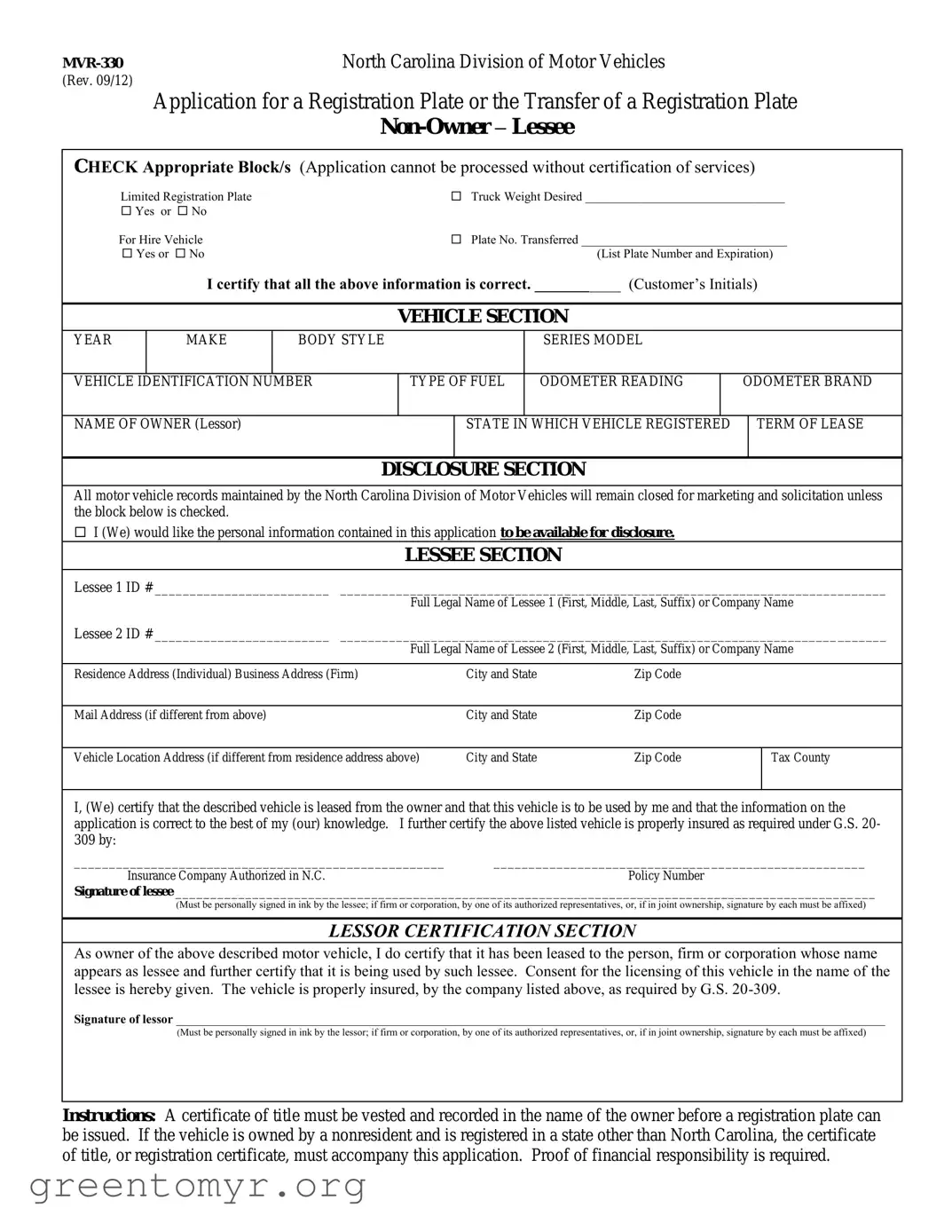
The NC MVR 330 form is a crucial document for individuals and businesses involved in leasing vehicles in North Carolina. This application serves multiple purposes, including the request for a registration plate or the transfer of an existing plate for non-owner lessees. It requires specific information about the vehicle, such as the year, make, model, and vehicle identification number (VIN), ensuring that all details are accurately captured. Additionally, the form includes sections that demand certification from both the lessee and the lessor, confirming the lease agreement and the vehicle's insurance status. Notably, applicants must check appropriate boxes to indicate their choices, such as whether they want limited registration plates or if they are transferring a plate number. The form also addresses privacy concerns by allowing individuals to choose whether their personal information can be disclosed. By ensuring that all required fields are completed and signatures are provided, the NC MVR 330 form facilitates the proper registration of leased vehicles, adhering to state regulations and promoting responsible vehicle use.
(Rev. 09/12)
North Carolina Division of Motor Vehicles
Application for a Registration Plate or the Transfer of a Registration Plate
CHECK Appropriate Block/s (Application cannot be processed without certification of services)
Limited Registration Plate |
Truck Weight Desired ________________________________ |
Yes or No |
|
For Hire Vehicle |
Plate No. Transferred _________________________________ |
Yes or No |
(List Plate Number and Expiration) |
I certify that all the above information is correct. ___________ (Customer’s Initials)
VEHICLE SECTION
YEAR |
MAKE |
BODY STYLE |
|
|
SERIES MODEL |
|
|
|
|
|
|
|
|
|
|
|
|
VEHICLE IDENTIFICATION NUMBER |
TYPE OF FUEL |
ODOMETER READING |
|
ODOMETER BRAND |
||||
|
|
|
|
|
|
|
|
|
NAME OF OWNER (Lessor) |
|
|
STATE IN WHICH VEHICLE REGISTERED |
|
TERM OF LEASE |
|||
|
|
|
|
|
|
|
|
|
DISCLOSURE SECTION
All motor vehicle records maintained by the North Carolina Division of Motor Vehicles will remain closed for marketing and solicitation unless the block below is checked.
I (We) would like the personal information contained in this application to be available for disclosure.
LESSEE SECTION
Lessee 1 ID # _________________________ |
______________________________________________________________________________ |
||
|
|
Full Legal Name of Lessee 1 (First, Middle, Last, Suffix) or Company Name |
|
Lessee 2 ID # _________________________ |
______________________________________________________________________________ |
||
|
|
Full Legal Name of Lessee 2 (First, Middle, Last, Suffix) or Company Name |
|
|
|
|
|
Residence Address (Individual) Business Address (Firm) |
City and State |
Zip Code |
|
|
|
|
|
Mail Address (if different from above) |
|
City and State |
Zip Code |
Vehicle Location Address (if different from residence address above) |
City and State |
Zip Code |
Tax County
I, (We) certify that the described vehicle is leased from the owner and that this vehicle is to be used by me and that the information on the application is correct to the best of my (our) knowledge. I further certify the above listed vehicle is properly insured as required under G.S. 20-
309 by:
_____________________________________________________ |
_____________________________________________________ |
Insurance Company Authorized in N.C. |
Policy Number |
Signature of lessee ____________________________________________________________________________________________________
(Must be personally signed in ink by the lessee; if firm or corporation, by one of its authorized representatives, or, if in joint ownership, signature by each must be affixed)
LESSOR CERTIFICATION SECTION
As owner of the above described motor vehicle, I do certify that it has been leased to the person, firm or corporation whose name appears as lessee and further certify that it is being used by such lessee. Consent for the licensing of this vehicle in the name of the lessee is hereby given. The vehicle is properly insured, by the company listed above, as required by G.S.
Signature of lessor __________________________________________________________________________________________________________________
(Must be personally signed in ink by the lessor; if firm or corporation, by one of its authorized representatives, or, if in joint ownership, signature by each must be affixed)
Instructions: A certificate of title must be vested and recorded in the name of the owner before a registration plate can be issued. If the vehicle is owned by a nonresident and is registered in a state other than North Carolina, the certificate of title, or registration certificate, must accompany this application. Proof of financial responsibility is required.
| Fact Name | Details |
|---|---|
| Form Purpose | The MVR-330 form is used to apply for a registration plate or transfer a registration plate for leased vehicles in North Carolina. |
| Governing Law | This form is governed by North Carolina General Statutes, specifically G.S. 20-309. |
| Certification Requirement | Applicants must certify that all information provided is correct. This includes the lessee's signature and initials. |
| Disclosure Option | Applicants can choose whether their personal information will be available for disclosure. This option must be indicated on the form. |
| Insurance Verification | The lessee must provide proof of insurance, including the insurance company's name and policy number, as required by state law. |
| Vehicle Information | Essential details about the vehicle must be included, such as year, make, model, and vehicle identification number (VIN). |
| Submission Instructions | A certificate of title must be recorded in the owner's name before submitting this application for a registration plate. |
Completing the NC MVR 330 form is essential for obtaining or transferring a registration plate for a leased vehicle. Follow these steps to ensure accurate submission.
Once completed, submit the form along with any required documents, including proof of title and financial responsibility, to the appropriate North Carolina Division of Motor Vehicles office.
The MVR-330 form is an application used in North Carolina for registering a vehicle or transferring a registration plate. It is specifically designed for non-owners or lessees of vehicles. This form must be completed accurately to ensure the registration process goes smoothly.
Individuals or businesses that lease a vehicle and need to register it in North Carolina must fill out this form. If you are the lessee of a vehicle, this form is essential for obtaining a registration plate.
The form requires various details, including:
Accurate completion of these sections is crucial for processing your application.
Yes, you must provide proof of insurance as required under North Carolina law. The form includes a section where you need to list the insurance company and policy number, ensuring that the vehicle is properly insured before registration.
Absolutely. The MVR-330 form allows for the transfer of a registration plate from one vehicle to another. You’ll need to indicate the plate number being transferred and ensure that all necessary signatures are included.
If the MVR-330 form is not filled out correctly, your application may be delayed or rejected. It’s essential to double-check all information for accuracy, especially the lessee and lessor details, vehicle information, and insurance proof.
Yes, there may be fees associated with registering a vehicle or transferring a registration plate. These fees can vary based on factors such as the type of vehicle and the specific registration requirements. It’s advisable to check with the North Carolina Division of Motor Vehicles for the most current fee schedule.
You can submit the MVR-330 form at your local North Carolina Division of Motor Vehicles office. Alternatively, you may also be able to submit it by mail, but be sure to check the specific submission guidelines provided by the DMV.
Filling out the NC MVR 330 form can be straightforward, but many people make common mistakes that can delay the processing of their application. One frequent error is failing to check the appropriate block. The application cannot be processed without this certification. Ensure that you select all relevant options before submitting the form.
Another mistake involves incorrect vehicle information. People often miswrite the vehicle identification number (VIN) or omit details about the vehicle's make, model, and year. Double-check this information to avoid complications. An accurate VIN is crucial, as it uniquely identifies the vehicle.
Many applicants neglect to provide the correct odometer reading. This figure must reflect the actual mileage of the vehicle at the time of leasing. An inaccurate reading can lead to issues with the registration process, so it’s important to be precise.
Another common oversight is the failure to include the lessee's full legal name. The form requires the first, middle, last names, and suffix if applicable. Omitting any part of this name can lead to confusion and may result in the application being returned.
Providing incomplete addresses is also a frequent error. Applicants sometimes forget to include the city and state or fail to differentiate between residence and business addresses. Ensure that all address fields are filled out completely to avoid any delays in processing.
Some people overlook the insurance certification section. It is essential to provide the name of the insurance company and policy number. Without this information, the application may not be accepted. Confirm that your vehicle is properly insured as required by law.
Signature mistakes can also cause problems. The lessee's signature must be in ink, and if the vehicle is owned by a firm or corporation, an authorized representative must sign. Missing or incorrect signatures can lead to rejection of the application.
Finally, applicants sometimes forget to include any necessary documentation, such as proof of financial responsibility. This proof is required before a registration plate can be issued. Make sure to attach all necessary documents to avoid any delays.
The MVR-330 form is essential for individuals and companies leasing vehicles in North Carolina. However, several other documents often accompany it to ensure compliance with state regulations and to facilitate the registration process. Below is a list of forms that are frequently used alongside the MVR-330.
In summary, the MVR-330 form is just one piece of the puzzle when it comes to vehicle registration in North Carolina. By understanding the additional documents required, lessees can better navigate the registration process and ensure compliance with state laws.
The NC MVR 330 form is an application for a registration plate or the transfer of a registration plate for non-owner lessees. Several other documents serve similar purposes in vehicle registration and leasing. Below is a list of eight documents that are comparable to the NC MVR 330 form:
When filling out the North Carolina MVR-330 form, there are several important dos and don'ts to keep in mind. Following these guidelines can help ensure that your application is processed smoothly.
Understanding the MVR-330 form in North Carolina can be a bit confusing. Here are ten common misconceptions that people often have about this important document.
By clearing up these misconceptions, you can navigate the MVR-330 form process more effectively and ensure you meet all necessary requirements.
When filling out the North Carolina MVR-330 form, there are several important points to keep in mind: