Navigating the waters of divorce can be a daunting experience, especially for those choosing to represent themselves in court. The North Carolina Pro Se Absolute Divorce Packet is designed specifically for individuals who are not working with an attorney, providing essential guidance and resources to help them file for an absolute divorce. This packet contains crucial information and sample forms that streamline the process, making it easier to understand the necessary steps involved. Among the forms included are the Complaint for Absolute Divorce, Civil Summons, and Judgment of Divorce, all of which are vital to successfully initiating and concluding the divorce proceedings. It’s important to note that individuals must have been separated from their spouse for at least one year and one day before filing for divorce. Furthermore, the packet emphasizes the need for pro se litigants to be aware of their legal rights, especially regarding spousal support and the division of marital property, as failing to address these issues prior to obtaining a divorce could result in losing those rights. While the pro se packet offers a helpful framework, it is strongly recommended that individuals conduct their own research and, if needed, seek legal advice to ensure they fully understand their situation and the applicable laws. This resource aims to empower individuals to take control of their divorce proceedings while highlighting the importance of being informed and prepared throughout the process.

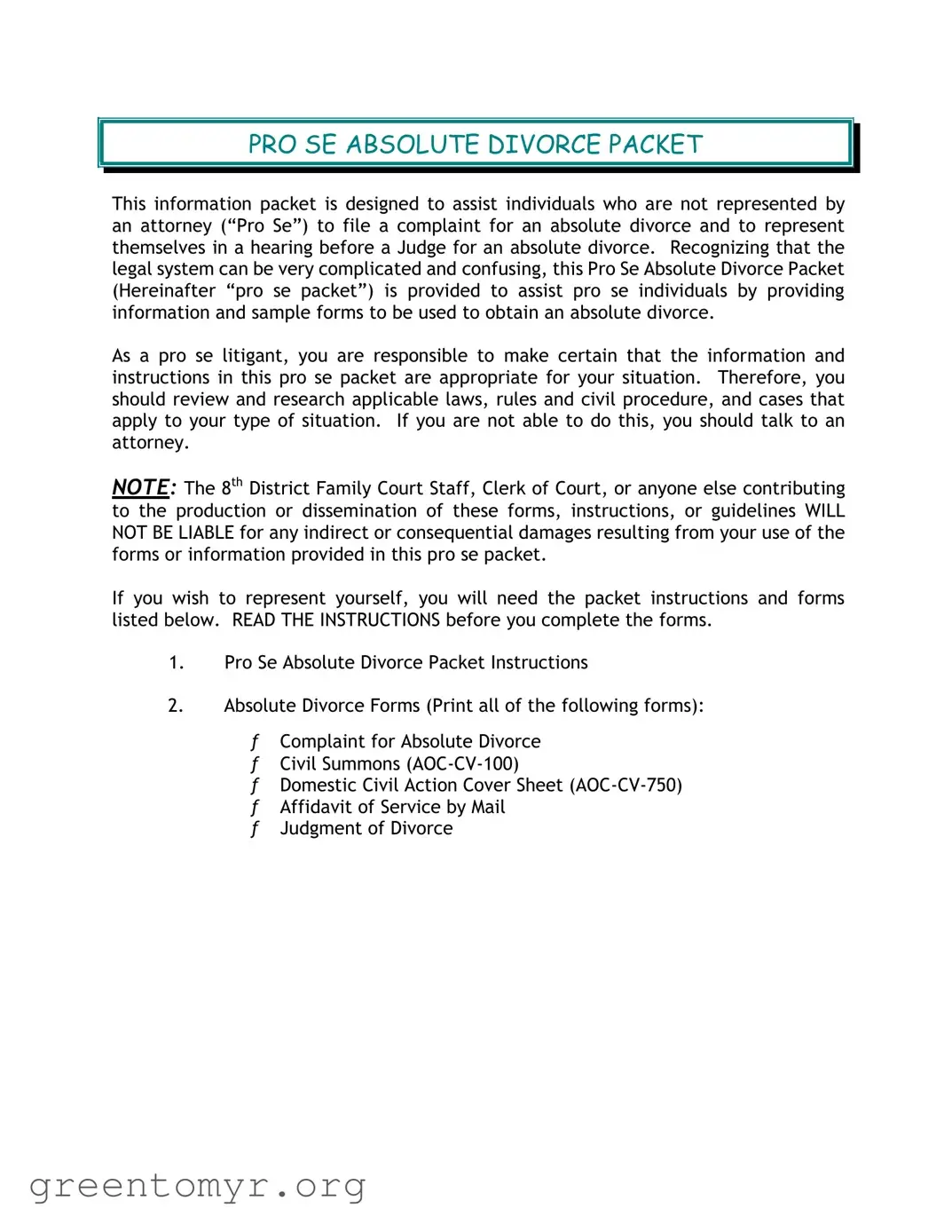
PRO SE ABSOLUTE DIVORCE PACKET
This information packet is designed to assist individuals who are not represented by an attorney (“Pro Se”) to file a complaint for an absolute divorce and to represent themselves in a hearing before a Judge for an absolute divorce. Recognizing that the legal system can be very complicated and confusing, this Pro Se Absolute Divorce Packet (Hereinafter “pro se packet”) is provided to assist pro se individuals by providing information and sample forms to be used to obtain an absolute divorce.
As a pro se litigant, you are responsible to make certain that the information and instructions in this pro se packet are appropriate for your situation. Therefore, you should review and research applicable laws, rules and civil procedure, and cases that apply to your type of situation. If you are not able to do this, you should talk to an attorney.
NOTE: The 8th District Family Court Staff, Clerk of Court, or anyone else contributing to the production or dissemination of these forms, instructions, or guidelines WILL NOT BE LIABLE for any indirect or consequential damages resulting from your use of the forms or information provided in this pro se packet.
If you wish to represent yourself, you will need the packet instructions and forms listed below. READ THE INSTRUCTIONS before you complete the forms.
1.Pro Se Absolute Divorce Packet Instructions
2.Absolute Divorce Forms (Print all of the following forms):
ƒComplaint for Absolute Divorce
ƒCivil Summons
ƒDomestic Civil Action Cover Sheet
ƒAffidavit of Service by Mail
ƒJudgment of Divorce

8TH DISTRICT FAMILY COURT
PRO SE ABSOLUTE DIVORCE PACKET
IMPORTANT
This information packet is designed to assist individuals who are not represented by an attorney (“Pro Se”) to file a complaint for an absolute divorce and to represent themselves in a hearing before a Judge for an absolute divorce. (You cannot start the process to get an absolute divorce until you and your spouse have been separated for at least one year and one day.)
BEWARE: If you obtain an absolute divorce without first properly filing for, or obtaining any legal rights you may have for spousal support (lawsuits known as post- separation support and alimony), or for the division of marital property, including marital debt (a lawsuit known as equitable distribution), YOU WILL LOSE THESE RIGHTS. Therefore, it is very important that if you have any questions about whether you are entitled to property (or division of marital debt) from the marriage and/or spousal support, YOU MUST TALK TO AN ATTORNEY.
NO ONE EXCEPT AN ATTORNEY
CAN ADVISE YOU ABOUT YOUR LEGAL RIGHTS
Because it is the nature of laws that they can change at any time, the forms and information in the pro se packet may become outdated. If you choose to represent yourself, you are responsible for knowing and following all
The 8th District Family Court Staff, Clerk of Court, or anyone else contributing to the production or dissemination of these forms, instructions, or guidelines WILL NOT BE LIABLE for any indirect or consequential damages resulting from your use of the forms or information provided to you in this pro se packet.
All persons using this pro se packet are doing so voluntarily, knowingly, and independent of any legal information from the Family Court.
USE OF THESE FORMS IS AT YOUR OWN RISK. THESE FORMS MAY OR MAY NOT BE APPROPRIATE IN YOUR PARTICULAR CASE. ANY DESIRED OUTCOME FROM THE USE OF THESE FORMS CANNOT BE PREDICTED OR GUARANTEED. IT IS

STRONGLY RECOMMENDED THAT YOU SEEK LEGAL ADVICE FROM AN ATTORNEY PRIOR TO USING THIS PRO SE PACKET.
This pro se packet is provided for individuals who wish to file for and obtain a court order for an absolute divorce. “Pro Se” is another way of saying that a person is representing himself/herself and is not represented by a lawyer. Recognizing that the legal system can be very complicated and confusing, this pro se packet is provided to assist pro se individuals by providing information and sample forms to be used to obtain an absolute divorce.
As a pro se litigant (one who represents himself/herself in litigation), you are responsible to make certain that the information and instructions in this pro se packet
are appropriate for your situation. Therefore, you should review and research applicable laws, rules of civil procedure, and cases that apply to your situation. If you are not able to do this, you should talk to an attorney.
IMPORTANT
Some of the legal terms in this packet are written in italics followed by the definitions in parentheses. The definitions and explanations given in this packet are intended to help you understand legal terminology sometimes used in court. It is not, however, intended as legal advice for your situation.
GETTING STARTED
An absolute divorce (also called dissolution of marriage) is a proceeding to end a legally valid marriage. After you get an absolute divorce, you will be single and you can marry again. (The process to obtain your absolute divorce as described in this pro se packet will usually take at least 45 days to complete – it could take even longer as there are many factors that could delay the process.) If you are sure that you want to represent yourself in obtaining an absolute divorce, you can use this packet and follow the steps outlined below. If you have trouble filling out your forms, you should contact an attorney for help.
STEP 1 Understand Your Obligations and Goals as a Pro Se Litigant
A.You are responsible for knowing the law and following all state and local rules of the court. You can find this information in a law library or on the Internet.
B.The court is a very traditional and polite place, it is important that you conduct yourself accordingly. In court, please:
a.dress professionally;
b.be respectful or everyone in court including the other party, the Judge, and court staff;
c.be on time for court;
d.be prepared with all documents that you may need for court;
e.do not ask for legal advice from court staff or the Judge;
f.know that a Judge is not allowed to talk to you about your case outside of a court hearing, so please, do not ask to speak to the Judge outside of court.
C.Make certain that all court documents are complete and accurate.
D.Your goal as the Plaintiff (the one who files the complaint) is to draft and file a complaint (another word for a lawsuit) for an absolute divorce, serve (making certain that the court documents are made available to the other party) the Defendant (the other party who receives the complaint) with the civil summons (a document that says that a lawsuit has been filed against them) and the complaint, and then go to court yourself, give testimony (telling the Judge the appropriate facts) to the Judge, and the Judge will decide whether or not to grant the absolute divorce.
STEP 2 Make Certain You Have All of the Court Documents That You Need
A.Complaint for Absolute Divorce
B.Civil Summons
C.Domestic Civil Action Cover Sheet
D.Affidavit of Service by Mail (optional)
E.Judgment of Divorce
F.Certificate of Absolute Divorce (DHHS 2089/Vital Records) (You will get this form from the courtroom clerk on the day you come to court for your divorce hearing.)
STEP 3 Drafting Your Complaint for Absolute Divorce
A.You may complete the blanks in the Complaint for Absolute Divorce, but it is preferred that you TYPE the appropriate information directly into the complaint.
B.Moving from the top of the COMPLAINT FORM to the bottom, complete as follows:
a.Leave a space (or leave the spaces blank) for the file number because you will not have a file number until the clerk gives your case a file number after you file the complaint.
b.Type in (or print clearly and neatly) your full name on the line above the word Plaintiff.
c.Type in (or print neatly) your spouse’s full name (your husband or wife) in the line above the word Defendant.
d.Question 1: In order to file a divorce complaint in North Carolina, either you, or the Defendant, must be a resident
of North Carolina for at least 6 months prior to the date you file the divorce complaint with the court. (If you, or your spouse, are not a citizen of the United States, you need to seek legal advice from an attorney about whether you may obtain a valid absolute divorce in North Carolina.) Type in the county in North Carolina where you reside.
e.Question 2: Type the county and state where the Defendant resides.
f.Question 3: Type in the date of marriage and the date of separation (the date the two parties began living separate and apart).
g.Question 4: Make certain that this statement is true for you or for your spouse so that you can testify that at the time of the separation, you or your spouse intended for the separation to be permanent.
h.Question 5: Make certain that you can testify that this statement is true.
i.Question 6: You must state whether there was a child or any children born while you and your spouse were married, or a child born to you and your spouse prior to the date you got married, and if so, then you must type the child(ren)’s full name(s) and give the dates of birth for each child.
j.Question 7: Make certain that you understand the meaning
of this paragraph. PLEASE
k.Question 8: If, after the date of the divorce, you wish to start using your maiden name (name prior to marriage), you may check this box and type the name you want to start using after the divorce. (You MAY NOT ask the Court for the other party to resume the use of former name.)
l.Type in the day, month, and year, and sign your full name. You also must give your complete address. Also provide your telephone number if you have one.
m.The Verification is a statement that you sign before a Notary Public. Make certain that you can testify that the statement you are signing is true. Do not sign the verification until you are with a Notary Public. If you do not know the Notary Public, you will need to take appropriate identification with you when you have your signature notarized.
n.You will need THREE TOTAL COPIES OF THE COMPLAINT. It is suggested that you leave your signature off of all copies and sign ALL THREE in front of the notary.
STEP 4 Completing the Civil Summons
A.You will need FOUR TOTAL COPIES of the Civil Summons (three should be yellow and the other one needs to be white).
B.From top to bottom, complete as follows:
a.Write in the County;
b.Put an “x” in the box beside District;
c.Print clearly and neatly your full name and address;
d.Print the Defendant’s full name in the box entitled “Name of the Defendant(s);
e.Print the Defendant’s full name and address in the box entitled “Name and Address of Defendant 1”.
C.The clerk will complete the remainder of the form.
D.You may find this form at www.nccourts.gov by searching forms and using the form number.
STEP 5 Completing the Domestic Civil Action Cover Sheet
A.Type your full name and address on the line under “Name &
Address of Plaintiff 1”.
B.Type the Defendant’s full name on the line under “Name of Defendant 1”.
C.Place an “x” in the box for Summons Submitted (because you will be giving the clerk a civil summons for the Defendant).
D.Type your name and address in the box on the right side of the document that says “Name and address of Attorney or Party, if not represented”.
E.Place an “x” in the box “No” since you are not requesting a jury hearing.
F.Place an “x” in the box beside “Complaint (COMP) and on the right side of the document place an “x” in the box beside
“Divorce (DIVR)”.
G.Date the cover sheet and sign it on the date that you file it with the clerk.
H.You may find this form at www.nccourts.gov by searching forms and using the form number.
STEP 6 Filing Your Absolute Divorce Complaint
A.You cannot sign the verification on your complaint for absolute divorce (and, therefore, cannot file it) until the DAY AFTER a year
has passed from the date of the separation. (You must be separated for one year plus one day.)
B.You need to bring the following documents to the Clerk of Court’s office:
a.The completed Domestic Civil Action Cover Sheet (one copy);
b.The completed Complaint for Absolute Divorce (1 original and two copies);
c.The completed Civil Summons (3 yellow and 1 white); a copy of the summons signed by the Clerk of Court must be filed in your court file.
d.$225.00 for the filing fee (Clerk does not accept personal checks. You must have cash, money order, or certified check).
e.$30.00 to pay to the Sheriff if you are using the Sheriff to serve the Complaint and Civil Summons on the Defendant.
f$10.00 for the resumption of former name(within or subsequent to absolute divorce).
STEP 7 Serving the Complaint and Civil Summons on the Defendant
A.Remember “serving” the defendant is a legal term. You must serve the defendant in an appropriate manner and have proof that the complaint and civil summons were delivered to the defendant.
B.The easiest method is to have the Sheriff in the county where the defendant lives or works serve the defendant for you. To do this, pay a $30.00 fee to the Sheriff in the county where the defendant lives or works and they will deliver the papers for you.
C.To serve the defendant by mail, you need to mail a copy of the Complaint and a copy of the Summons filled out by the Clerk’s office to the defendant’s mailing address by Certified Mail, Return Receipt Requested. Once the green receipt is returned
to you, you must complete the attached Affidavit of Proof of Service by Mail and file it with the Clerk of Court.
D.The defendant may also sign a sworn statement before a Notary Public that he/she received the complaint and civil summons. This type of statement is not included in the pro se packet and it is up to the defendant to properly complete and file with the court. (Plaintiff cannot prepare these types of statements for the defendant.)
STEP 8 Completing Your Affidavit of Proof of Service by Mail (optional)
A.If you served the defendant by Certified Mail, Return Receipt Requested, the green return receipt card will be mailed back to you.
B.Once you get the receipt back, you need to complete the Affidavit of Proof of Service by Mail form and take both the form and the green card to the Clerk of Court’s office.
a.Complete file number, names of plaintiff and defendant;
b.Print your full name in the first blank after the word “I”;
c.Print defendant’s complete address in Question #2;
d.Print the date the certified documents were served in Question #3;
e.Date and sign this Affidavit only in the presence of a Notary Public;
f.Staple the green return receipt to the Affidavit; and
g.Take the Affidavit to the Clerk of Court’s office.
STEP 9 Getting a Court Date
A.Once you have proof that the defendant has been served with the complaint and civil summons, you will get a court date from the Family Court Case Manager.
B.The case manager will give you a court date for the hearing on your divorce. The court date must be at least
COMPLETING THE APPROPRIATE FORMS AND GOING TO COURT
Step 10 Completing Your Judgment for Absolute Divorce
A.Type or print the file number, full name of plaintiff, and full name of defendant.
B.Paragraphs 1 and 2 should be the same as the first two paragraphs of the Divorce Complaint stating the residency and citizenship of the two parties.
C.Question #3 needs to state the date that the defendant was served and you need to mark the appropriate box as to how the defendant was served.
D.Question #4, print your date of marriage and date of separation.
E.Make certain that Questions #5 and #6 are true statements.
F.Question #7 needs to indicate whether or not you and your spouse had children during the marriage or had children together prior to the marriage, and if so, the child(ren)’s full names need to be printed along with their date(s) of birth and each child’s social security number.
G.Question #8 needs to be marked if you have asked in your complaint (or the defendant has asked in an Answer) to start using a maiden/former name after the divorce.
H.The Certificate of Service (signed statement that you served the Defendant with the document – note it does not have to be served by certified mail, it can be mailed by regular mail), is what you
provided a copy of the divorce judgment to the opposing party. (This certifies that you have served the defendant with a copy of this judgment after the Judge signs it and it has been file stamped by the clerk.) We suggest that you bring a stamped envelope to court with the defendant’s address on it so that you can mail a copy of the Divorce Judgment on the same day the divorce judgment is granted and therefore you can date your certificate of service the same day as the hearing. (If you mail the judgment on a later date, you are responsible for completing a certificate of service and filing it with the court stating the date that you mailed the judgment for absolute divorce.)
STEP 11 Completing Your Certificate of Absolute Divorce or Annulment (Form DHHS2089)
A.On the day of your divorce hearing, you will receive this form from the clerk in the courtroom.
B.Complete the following blanks:
a.Print the file Type or print the file number, full name of plaintiff, and full name of defendant.
b.Line one, put an “x” in the box as to whether you, as the plaintiff, are the husband or the wife. Then print (in black ink) your first name, middle, name, and last name. On line 2a, print the state where you live and the county that you live in.
c.Line three, put an “x” in the box as to whether the defendant is the husband or wife. Print the defendant’s first, middle and last name. On line 4a, print the defendant’s state and county where he/she lives.
d.Under “Marriage”, print the date of the marriage, the place of marriage (county and state), number of minor children (children age 17 and younger) and the date of separation.
e.The clerk will complete the remainder of the form.
STEP 12 On the Day of the Hearing for Your Absolute Divorce
A.Plan to arrive at least 15 minutes prior to the time you are to appear for your hearing.
B.You will need to bring THREE COMPLETED COPIES of the Divorce Judgment.
C.Sit on a bench and wait for your case to be called. (The Judge will call the case by the plaintiff’s last name versus the defendant’s last name. An example is “Smith versus Smith”).
swear that the testimony you are about to give is the truth) and you will go up and sit in the witness box.
E.Be prepared to testify to the information you wrote in your divorce complaint. (Take a copy of your divorce complaint with you so that you can refer to it.)
F.The Judge will determine whether you are entitled to an absolute divorce.
G.If the divorce is granted, go back to your seat and wait for the Clerk to process your paperwork and give you a copy of the Divorce Judgment for your records and a copy of the Judgment to mail to the defendant.
H.Make certain that you have completed the Certificate of Service on the Divorce Judgment and that you do, indeed, serve the defendant with a copy of the Divorce Judgment.
I.Keep a copy of the Divorce Judgment in a safe place.
| Fact Name | Fact Description |
|---|---|
| Purpose | The NC Pro Se Divorce Packet assists individuals without an attorney in filing for an absolute divorce. |
| Eligibility | At least one party must have been a resident of North Carolina for a minimum of six months prior to filing. |
| Separation Requirement | Parties must be separated for at least one year and one day before filing for an absolute divorce. |
| Legal Advice | It is strongly recommended to seek legal advice before using the forms, as they may not be suitable for every situation. |
| Forms Included | The packet includes forms such as the Complaint for Absolute Divorce and Civil Summons (AOC-CV-100). |
| Filing Process | The process typically takes at least 45 days to complete, depending on various factors. |
| Judgment of Divorce | A Judgment of Divorce must be obtained from the court to finalize the divorce process. |
| Obligations of Pro Se Litigants | Pro se litigants are responsible for knowing and following all relevant laws and court procedures. |
| Liability Disclaimer | The 8th District Family Court and its staff are not liable for any damages resulting from the use of the pro se packet. |
Filling out the NC Pro Divorce form is a crucial step in the process of obtaining an absolute divorce. This form requires careful attention to detail and accuracy. It is essential to follow the steps outlined below to ensure that your application is complete and meets the necessary legal requirements.
The NC Pro Divorce form is a set of documents designed for individuals who wish to represent themselves in filing for an absolute divorce in North Carolina. This packet includes instructions and sample forms that guide you through the process of filing a complaint for divorce and preparing for a court hearing.
This form is intended for individuals who are not represented by an attorney, also known as "Pro Se" litigants. If you are considering filing for an absolute divorce and meet the residency requirements, you can use this packet. However, if you have questions regarding spousal support or property division, it is advisable to consult an attorney.
The packet includes the following forms:
To file for an absolute divorce in North Carolina, either you or your spouse must have been a resident of the state for at least six months before filing the complaint. If neither party is a U.S. citizen, it's crucial to seek legal advice to determine eligibility for divorce in North Carolina.
The process to obtain an absolute divorce typically takes a minimum of 45 days. However, various factors can cause delays, so it is essential to be prepared for the possibility of a longer timeline.
If you encounter difficulties while completing the forms, it is recommended that you seek assistance from an attorney. The court staff cannot provide legal advice, and having guidance can help ensure that your forms are filled out correctly.
If you obtain an absolute divorce without addressing any rights to spousal support or the division of marital property, you may lose those rights. It is crucial to consider these issues carefully and consult an attorney if you have any questions or concerns.
The 8th District Family Court Staff, Clerk of Court, and others involved in creating this packet will not be liable for any damages resulting from its use. Individuals using this packet do so at their own risk and should ensure that they understand the forms and procedures relevant to their situation.
Filling out the NC Pro Divorce form can be a daunting task, and many individuals make common mistakes that can lead to delays or complications in their divorce proceedings. One frequent error is failing to read the instructions thoroughly before starting. The instructions provide essential guidance on how to complete each section of the form. Skipping this step often results in incomplete or incorrect submissions, which can hinder the process.
Another common mistake involves not providing accurate information regarding residency. In North Carolina, either you or your spouse must have been a resident for at least six months before filing. If this requirement is not met, the court may dismiss the case. It is crucial to double-check that all residency details are correct to avoid unnecessary complications.
People often overlook the importance of completing all sections of the complaint. Each question on the form is designed to gather specific information necessary for the court to process your divorce. Omitting even a single detail can lead to delays. Ensure that every question is answered fully and accurately.
In addition, individuals frequently make errors when documenting dates, such as the date of marriage and the date of separation. These dates must be precise, as they establish the timeline of the marriage and separation. Errors in these dates can result in confusion and may require additional court appearances to clarify.
Another mistake is neglecting to provide the correct names of any children involved. If there are children from the marriage, their full names and dates of birth must be included. Failure to do so can complicate custody arrangements and other related matters.
Some people also forget to sign the verification statement in front of a Notary Public. This step is crucial, as it certifies that the information provided is true. Not having this notarization can render the form invalid, leading to further delays in the divorce process.
Additionally, individuals sometimes misinterpret the section regarding marital property and debt. It is vital to understand what constitutes marital property and ensure that all relevant assets and debts are disclosed. Not addressing these issues can affect your rights to property division in the divorce.
Another oversight is not including a contact number on the form. Providing a phone number ensures that the court can reach you for any necessary follow-up or clarification regarding your case. This small detail can significantly impact communication with the court.
Finally, many individuals fail to seek legal advice when uncertain about any aspect of the process. While the pro se packet offers guidance, it cannot replace the expertise of an attorney. Consulting with a legal professional can provide clarity and help avoid mistakes that could affect the outcome of the divorce.
When navigating the process of obtaining an absolute divorce in North Carolina, several forms and documents are often required in addition to the NC Pro Divorce form. Each of these documents serves a specific purpose in the legal proceedings. Below is a list of these important forms.
Each of these forms plays a crucial role in the divorce process. It is important to ensure that they are completed accurately and filed in accordance with the court's requirements. If there are any uncertainties or questions about these documents, seeking guidance from a legal professional is advisable.
When filling out the NC Pro Divorce form, there are important guidelines to follow. Below is a list of things you should and shouldn't do to ensure your submission is correct and complete.
Misconceptions about the NC Pro Divorce form can lead to confusion and mistakes in the divorce process. Here are seven common misunderstandings:
Understanding these misconceptions can help you navigate the divorce process more effectively. Always consider seeking professional legal advice to ensure you are making informed decisions.