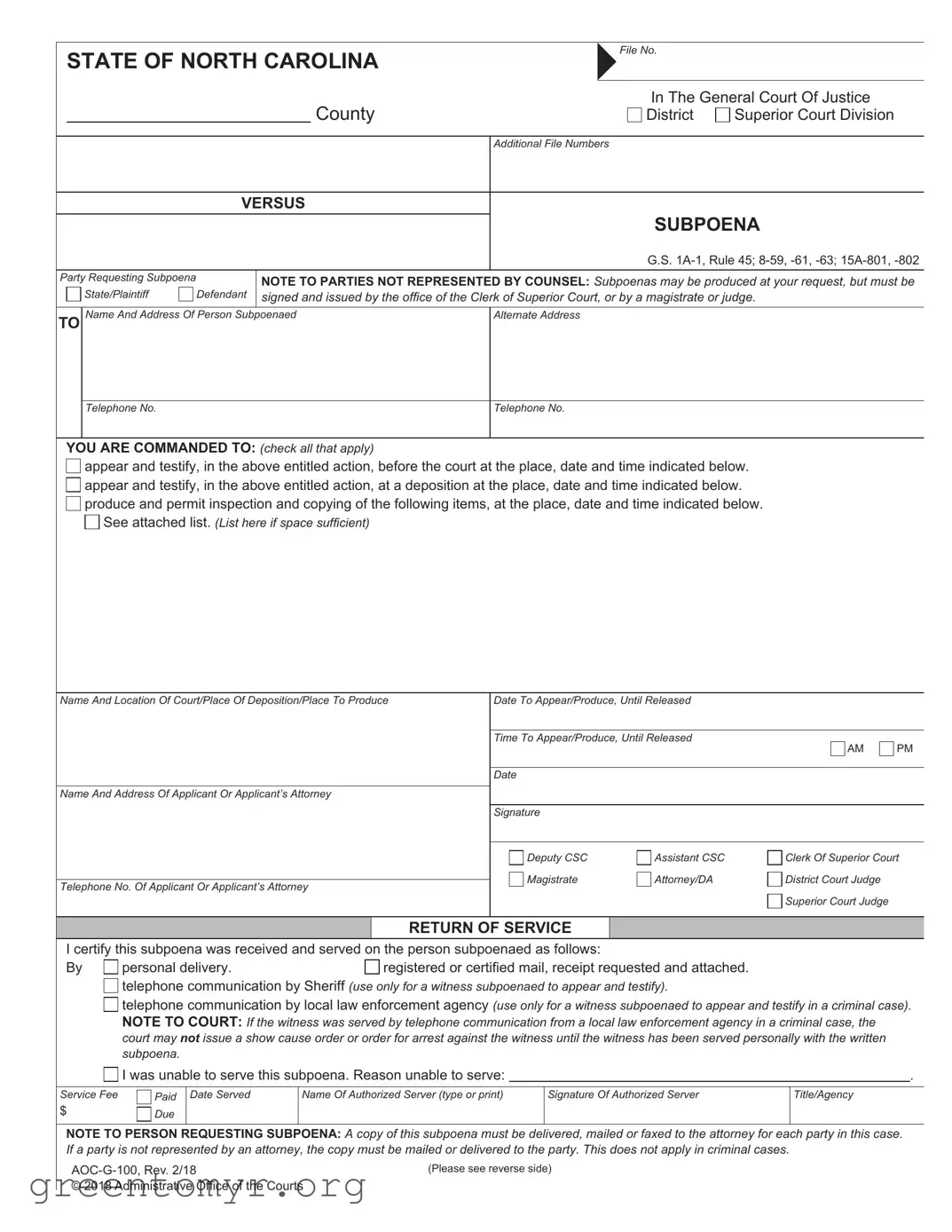
The North Carolina Subpoena form serves as a crucial legal instrument within the judicial system, facilitating the process of compelling individuals to provide testimony or produce evidence in court proceedings. This form is utilized in both civil and criminal cases, and it outlines the responsibilities of the parties involved, including the person issuing the subpoena and the individual being subpoenaed. Key elements of the form include the identification of the parties involved, the specific commands to appear and testify or produce documents, and the designated time and location for compliance. Additionally, the form provides guidelines for service and the return of service, ensuring that the subpoena is delivered appropriately. Notably, it also includes provisions to protect individuals from undue burden or expense, emphasizing the importance of reasonable compliance. Furthermore, the form addresses the rights of individuals to object to subpoenas under certain conditions, ensuring that their legal protections are upheld. By understanding the various components and implications of the North Carolina Subpoena form, individuals can navigate the complexities of the legal system with greater confidence.
STATE OF NORTH CAROLINA
County
File No.
In The General Court Of Justice
District |
Superior Court Division |
|
|
|
Additional File Numbers |
|
|
|
|
|
VERSUS |
SUBPOENA |
|
|
|
|
|
|
|
|
G.S. |
Party Requesting Subpoena |
|
NOTE TO PARTIES NOT REPRESENTED BY COUNSEL: Subpoenas may be produced at your request, but must be |
|
State/Plaintiff |
Defendant |
signed and issued by the office of the Clerk of Superior Court, or by a magistrate or judge. |
|
TO
Name And Address Of Person Subpoenaed
Alternate Address
Telephone No.
Telephone No.
YOU ARE COMMANDED TO: (check all that apply)
appear and testify, in the above entitled action, before the court at the place, date and time indicated below.
appear and testify, in the above entitled action, at a deposition at the place, date and time indicated below. produce and permit inspection and copying of the following items, at the place, date and time indicated below.
See attached list. (List here if space sufficient)
Name And Location Of Court/Place Of Deposition/Place To Produce
Name And Address Of Applicant Or Applicant’s Attorney
Telephone No. Of Applicant Or Applicant’s Attorney
Date To Appear/Produce, Until Released
Time To Appear/Produce, Until Released |
AM |
PM |
|
|
|
||
|
|
|
|
Date |
|
|
|
|
|
|
|
Signature |
|
|
|
|
|
|
|
Deputy CSC |
Assistant CSC |
Clerk Of Superior Court |
|
Magistrate |
Attorney/DA |
District Court Judge |
|
|
|
Superior Court Judge |
|
RETURN OF SERVICE
I certify this subpoena was received and served on the person subpoenaed as follows:
By personal delivery. registered or certified mail, receipt requested and attached.
telephone communication by Sheriff (use only for a witness subpoenaed to appear and testify).
telephone communication by local law enforcement agency (use only for a witness subpoenaed to appear and testify in a criminal case). NOTE TO COURT: If the witness was served by telephone communication from a local law enforcement agency in a criminal case, the court may not issue a show cause order or order for arrest against the witness until the witness has been served personally with the written subpoena.
I was unable to serve this subpoena. Reason unable to serve: |
|
. |
Service Fee
$
Paid Date Served Due
Name Of Authorized Server (type or print)
Signature Of Authorized Server
Title/Agency
NOTE TO PERSON REQUESTING SUBPOENA: A copy of this subpoena must be delivered, mailed or faxed to the attorney for each party in this case. If a party is not represented by an attorney, the copy must be mailed or delivered to the party. This does not apply in criminal cases.
(Please see reverse side) |
|
© 2018 Administrative Office of the Courts |
|

NOTE: Rule 45, North Carolina Rules of Civil Procedure, Subsections (c) and (d).
(c) Protection of Persons Subject to Subpoena
(1)Avoid undue burden or expense. - A party or an attorney responsible for the issuance and service of a subpoena shall take reasonable steps to avoid imposing an undue burden or expense on a person subject to the subpoena. The court shall enforce this subdivision and impose upon the party or attorney in violation of this requirement an appropriate sanction that may include compensating the person unduly burdened for lost earnings and for reasonable attorney’s fees.
(2)For production of public records or hospital medical records. - Where the subpoena commands any custodian of public records or any custodian of hospital medical records, as defined in G.S.
lieu of personal appearance, tender to the court in which the action is pending by registered or certified mail or by personal delivery, on or before the time specified in the subpoena, certified copies of the records requested together with a copy of the subpoena and an affidavit by the custodian testifying that the copies are true and correct copies and that the records were made and kept in the regular course of business, or if no such records are in the custodian’s custody, an affidavit to that effect. When the copies of records are personally delivered under this subdivision, a receipt shall be obtained from the person receiving the records. Any original or certified copy of records or an affidavit delivered according to the provisions of this subdivision, unless otherwise objectionable, shall be admissible in any action or proceeding without further certification or authentication. Copies of hospital medical records tendered under this subdivision shall not be open to inspection or copied by any person, except to the parties to the case or proceedings and their attorneys in depositions, until ordered published by the judge at the time of the hearing or trial. Nothing contained herein shall be construed to waive the
(3)Written objection to subpoenas. - Subject to subsection (d) of this rule, a person commanded to appear at a deposition or to produce and permit the inspection and copying of records, books, papers, documents, electronically stored information, or tangible things may, within 10 days after service of the subpoena or before the time specified for compliance if the time is less than 10 days after service, serve upon the party or the attorney designated in the subpoena written objection to the subpoena, setting forth the specific grounds for the objection. The written objection shall comply with the requirements of Rule 11. Each of the following grounds may be sufficient for objecting to a subpoena:
a.The subpoena fails to allow reasonable time for compliance.
b.The subpoena requires disclosure of privileged or other protected matter and no exception or waiver applies to the privilege or protection.
c.The subpoena subjects a person to an undue burden or expense.
d.The subpoena is otherwise unreasonable or oppressive.
e.The subpoena is procedurally defective.
(4)Order of court required to override objection. - If objection is made under subdivision (3) of this subsection, the party serving the subpoena shall not be entitled to compel the subpoenaed person’s appearance at a deposition or to inspect and copy materials to which an objection has been made except pursuant to an order of the court. If objection is made, the party serving the subpoena may, upon notice to the subpoenaed person, move at any time for an order to compel the subpoenaed person’s appearance at the deposition or the production of the materials designated in the subpoena. The motion shall be filed in the court in the county in which the deposition or production of materials is to occur.
(5)Motion to quash or modify subpoena. - A person commanded to appear at a trial, hearing, deposition, or to produce and permit the inspection and copying of records, books, papers, documents, electronically stored information, or other tangible things, within 10 days after service of the subpoena or before the time specified for compliance if the time is less than 10 days after service, may file a motion to quash or modify the subpoena. The court shall quash or modify the subpoena if the subpoenaed person demonstrates the existence of any of the reasons set forth in subdivision (3) of this subsection. The motion shall be filed in the court in the county in which the trial, hearing, deposition, or production of materials is to occur.
(6)Order to compel; expenses to comply with subpoena. - When a court enters an order compelling a deposition or the production of records, books, papers, documents, electronically stored information, or other tangible things, the order shall protect any person who is not a party or an agent of a party from significant expense resulting from complying with the subpoena. The court may order that the person to whom the subpoena is addressed will be reasonably compensated for the cost of producing the records, books, papers, documents, electronically stored information, or tangible things specified in the subpoena.
(7)Trade secrets; confidential information. - When a subpoena requires disclosure of a trade secret or other confidential research, development, or commercial information, a court may, to protect a person subject to or affected by the subpoena, quash or modify the subpoena, or when the party on whose behalf the subpoena is issued shows a substantial need for the testimony or material that cannot otherwise be met without undue hardship, the court may order a person to make an appearance or produce the materials only on specified conditions stated in the order.
(8)Order to quash; expenses. - When a court enters an order quashing or modifying the subpoena, the court may order the party on whose behalf the subpoena is issued to pay all or part of the subpoenaed person’s reasonable expenses including attorney’s fees.
(d) Duties in Responding to Subpoena
(1)Form of response. - A person responding to a subpoena to produce records, books, documents, electronically stored information, or tangible things shall produce them as they are kept in the usual course of business or shall organize and label them to correspond with the categories in the request.
(2)Form of producing electronically stored information not specified. - If a subpoena does not specify a form for producing electronically stored information, the person responding must produce it in a form or forms in which it ordinarily is maintained or in a reasonably useable form or forms.
(3)Electronically stored information in only one form. - The person responding need not produce the same electronically stored information in more than one form.
(4)Inaccessible electronically stored information. - The person responding need not provide discovery of electronically stored information from sources that the person identifies as not reasonably accessible because of undue burden or cost.
On motion to compel discovery or for a protective order, the person responding must show that the information is not reasonably accessible because of undue burden or cost. If that showing is made, the court may nonetheless order discovery from such sources if the requesting party shows good cause, after considering the limitations of Rule 26(b)(1a).The court may specify conditions for discovery, including requiring the party that seeks discovery from a nonparty to bear the costs of locating, preserving, collecting, and producing the electronically stored information involved.
(5)Specificity of objection. - When information subject to a subpoena is withheld on the objection that it is subject to protection as trial preparation materials, or that it is otherwise privileged, the objection shall be made with specificity and shall be supported by a description of the nature of the communications, records, books, papers, documents, electronically stored information, or other tangible things not produced, sufficient for the requesting party to contest the objection.
INFORMATION FOR WITNESS
NOTE: If you have any questions about being subpoenaed as a witness, you should contact the person named on Page One of this Subpoena in the box labeled “Name And
Address Of Applicant Or Applicant’s Attorney.”
DUTIES OF A WITNESS
•Unless otherwise directed by the presiding judge, you must answer all questions asked when you are on the stand giving testimony.
•In answering questions, speak clearly and loudly enough to be heard.
•Your answers to questions must be truthful.
•If you are commanded to produce any items, you must bring them with you to court or to the deposition.
•You must continue to attend court until released by the court. You must continue to attend a deposition until the deposition is completed.
© 2018 Administrative Office of the Courts
BRIBING OR THREATENING A WITNESS
It is a violation of State law for anyone to attempt to bribe, threaten, harass, or intimidate a witness. If anyone attempts to do any of these things concerning your involvement as a witness in a case, you should promptly report that to the district attorney or the presiding judge.
WITNESS FEE
A witness under subpoena and that appears in court to testify, is entitled to a small daily fee, and to travel expense reimbursement, if it is necessary to travel outside the county in order to testify. (The fee for an “expert witness” will be set by the presiding judge.) After you have been discharged as a witness, if you desire to collect the
statutory fee, you should immediately contact the Clerk’s office and certify your
attendance as a witness so that you will be paid any amount due you.
| Fact Name | Details |
|---|---|
| Governing Laws | The North Carolina Subpoena form is governed by G.S. 1A-1, Rule 45; 8-59, -61, -63; 15A-801, -802. |
| Issuance Authority | Subpoenas must be signed and issued by the Clerk of Superior Court, a magistrate, or a judge. |
| Notification Requirement | A copy of the subpoena must be delivered to each party's attorney or directly to the party if unrepresented. |
| Response Time | Individuals have 10 days to respond to a subpoena or may object before the compliance date if it is less than 10 days. |
| Service Methods | Subpoenas can be served through personal delivery, registered mail, or telephone communication in specific cases. |
| Witness Fees | Witnesses are entitled to a daily fee and travel expense reimbursement if they must travel outside their county to testify. |
Once you have gathered the necessary information, it's time to fill out the North Carolina Subpoena form. This form is essential for compelling a person to appear in court or produce documents relevant to a case. Completing it accurately ensures that the process moves smoothly.
After completing the form, it must be submitted to the Clerk of Superior Court for signing and issuing. Once issued, ensure that the subpoena is served to the person named. This will initiate the legal process, compelling them to comply with your request.
A North Carolina subpoena is a legal document that commands an individual to appear in court or produce certain documents or evidence in a legal proceeding. It is issued by the Clerk of Superior Court, a magistrate, or a judge. The subpoena can require a person to testify, provide documents, or both, depending on the needs of the case.
Subpoenas in North Carolina can be issued by the Clerk of Superior Court, a magistrate, or a judge. This ensures that the subpoena is legally binding and properly authorized. If you are not represented by an attorney, you can request a subpoena, but it must still be signed and issued by one of the aforementioned officials.
If you receive a subpoena, it is important to read it carefully. It will specify what you are required to do, whether it's appearing in court, attending a deposition, or producing documents. You should also note the date and time you are expected to comply. If you have questions or concerns, consider contacting the individual or attorney listed on the subpoena for clarification.
Refusing to comply with a subpoena can lead to legal consequences. However, if you believe the subpoena is unreasonable or imposes an undue burden, you can file a motion to quash or modify it. This must be done within 10 days of receiving the subpoena or before the compliance date if it is less than 10 days. The court will review your objections and decide whether to uphold or modify the subpoena.
Failing to comply with a subpoena can result in penalties, including being held in contempt of court. This can lead to fines or even jail time, depending on the circumstances. It's crucial to take subpoenas seriously and seek legal advice if you are unsure about your obligations.
A subpoena can be served in several ways, including personal delivery, registered or certified mail, or through local law enforcement for witnesses in criminal cases. The person serving the subpoena must complete a return of service, which documents how and when the subpoena was served. This ensures that there is a record of compliance.
Yes, witnesses who appear in court under subpoena are entitled to a small daily fee and reimbursement for travel expenses if they must travel outside their county. If you are an expert witness, the fee will be determined by the presiding judge. To collect your fee, you should contact the Clerk’s office after your testimony to certify your attendance.
Completing the North Carolina Subpoena form requires careful attention to detail. One common mistake is failing to provide complete contact information for the person being subpoenaed. This includes their full name, address, and telephone number. Incomplete information can lead to difficulties in serving the subpoena, which may delay the legal process.
Another frequent error is neglecting to specify the purpose of the subpoena. It is essential to clearly indicate whether the person is being commanded to appear and testify, attend a deposition, or produce documents. This clarity helps ensure that the recipient understands their obligations under the subpoena.
Additionally, individuals often forget to sign the subpoena. The signature of the requesting party is a critical component that validates the document. Without a signature, the subpoena may be considered invalid, leading to complications in court proceedings.
Some people mistakenly check multiple options for the command without understanding the implications. Each checked box should reflect the specific requirements of the case. Misunderstanding these options can result in confusion for the person being subpoenaed.
Another common oversight is the failure to include the date and time for compliance. Clearly stating when the person is required to appear or produce documents is essential. Omitting this information can lead to misunderstandings and potential noncompliance.
Individuals sometimes overlook the requirement to deliver a copy of the subpoena to all parties involved in the case. This step is crucial for maintaining transparency and ensuring that all parties are aware of the proceedings.
Some users also neglect to provide a return of service section. This section confirms that the subpoena was served correctly. Without this documentation, it may be difficult to prove that the subpoena was delivered as required.
Failing to specify the location where the person must appear or where documents must be produced is another mistake. The location should be clearly stated to avoid any ambiguity regarding where the subpoenaed party needs to go.
Moreover, individuals may not fully understand the implications of the subpoena and may not provide the necessary documentation or testimony. It is important for those receiving a subpoena to be aware of their rights and responsibilities to ensure compliance.
Lastly, some may not take the time to review the entire form for accuracy. Simple typographical errors can lead to significant issues down the line. A thorough review can prevent misunderstandings and ensure that all information is correct and complete.
When dealing with a subpoena in North Carolina, several additional forms and documents may be necessary to ensure compliance and proper legal procedures. Each of these documents serves a specific purpose in the legal process. Below is a list of commonly used forms that accompany the NC Subpoena form.
Understanding these documents is crucial for anyone involved in legal proceedings. They help ensure that the process is followed correctly and that all parties are informed of their rights and responsibilities. Proper handling of these forms can lead to a smoother legal experience.
When filling out the North Carolina Subpoena form, there are important guidelines to follow. Here is a list of things you should and shouldn't do:
Following these guidelines can help ensure that the process goes smoothly and respects the rights of all parties involved.
Misconceptions about the North Carolina Subpoena form can lead to confusion and missteps in legal proceedings. Here are five common misconceptions along with clarifications:
Filling out and using the North Carolina Subpoena form requires attention to detail. Here are some key takeaways to consider:
These points can help ensure that the process is handled smoothly and respectfully for all parties involved.