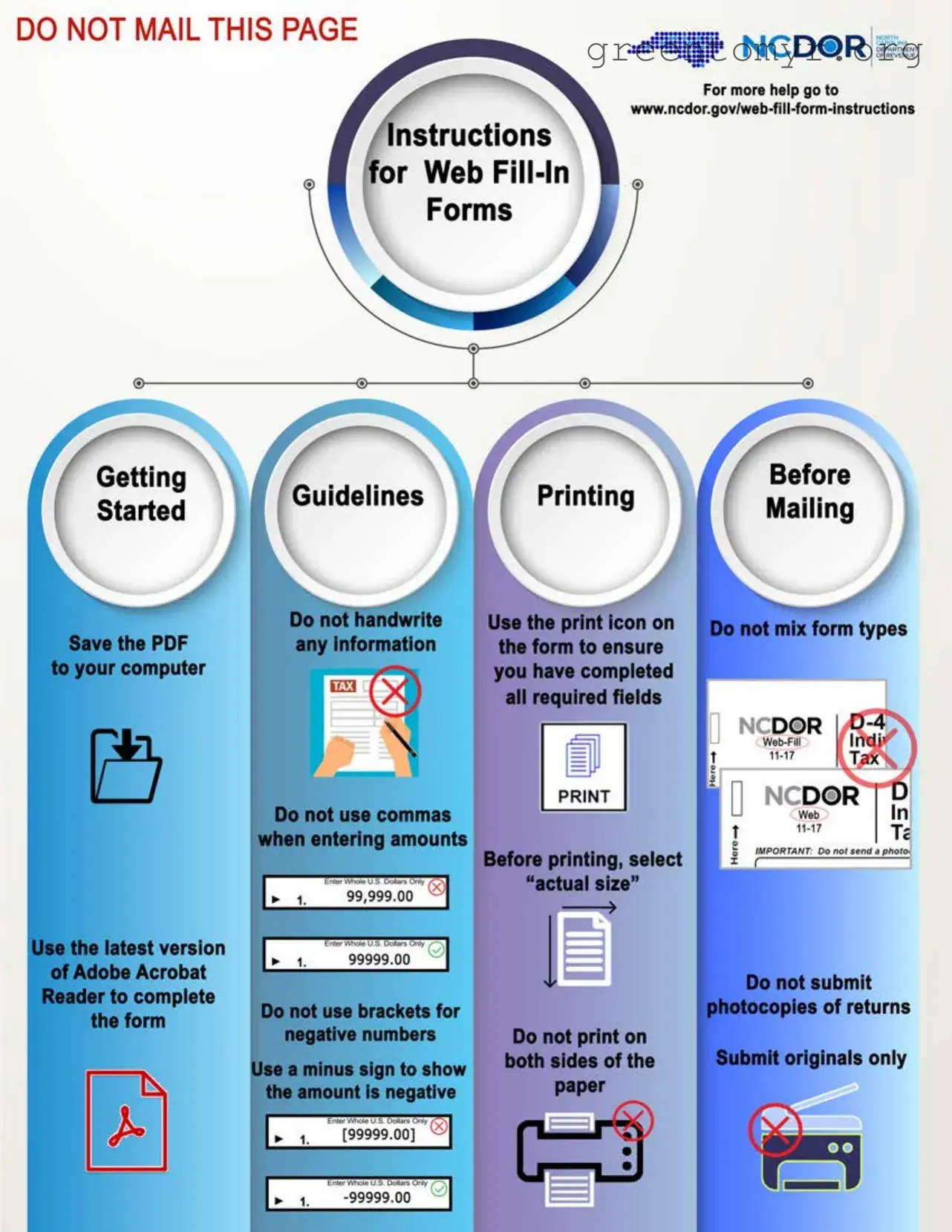
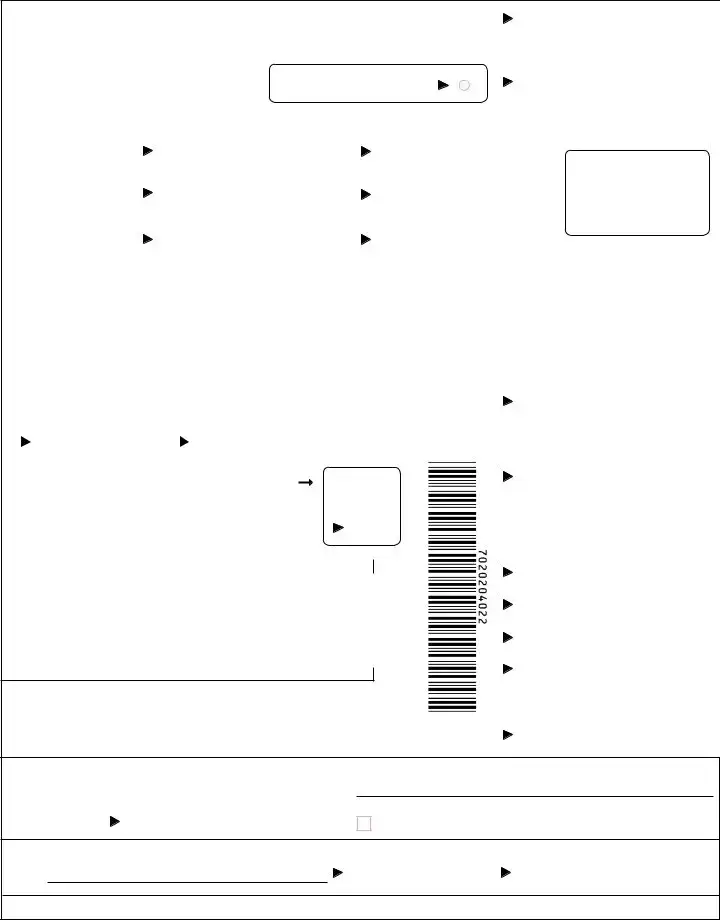
The NCDOR D-400 form serves as a critical document for individuals filing their North Carolina income tax returns. This form is designed for both full-year residents and part-year residents or nonresidents, providing a structured way to report income, deductions, and tax credits. Full-year residents will enter their taxable income directly, while part-year residents and nonresidents must adjust their income based on a specific percentage calculated from a separate schedule. The form also includes sections for personal information, such as Social Security numbers, residency status, and filing status, ensuring that all necessary details are accurately captured. Additionally, taxpayers have the option to contribute to various state funds, such as the N.C. Education Endowment Fund, which supports educational initiatives. Amended returns can also be filed using this form, allowing individuals to correct any previous errors in their tax submissions. The D-400 form is not just a tax return; it is a comprehensive tool that facilitates the accurate reporting of income and compliance with state tax laws.
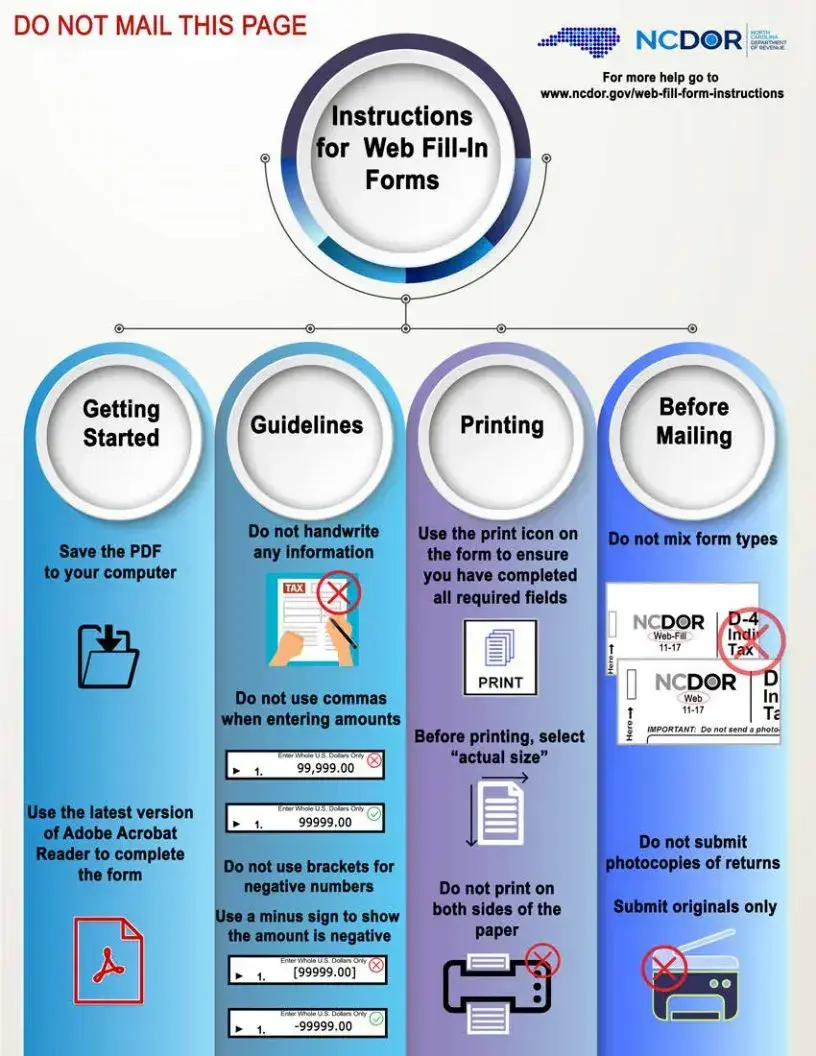
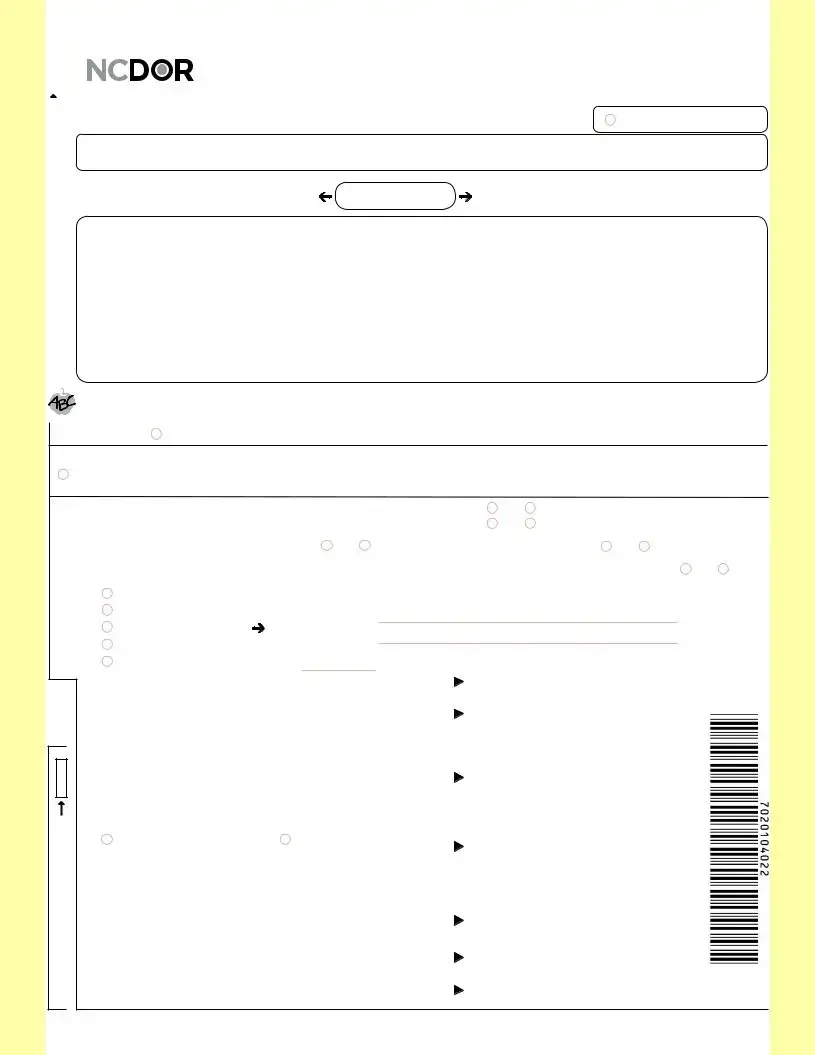
DO NOT HANDWRITE ON THIS FORM
|
|
|
|
|
|
|
|
|
|
|
|
CLEAR |
|
|
|
|
|
|
||||
|
|
|
|
|
|
|
|
|
|
|
4 |
|
|
✖ |
|
|
|
DOR Use Only |
|
|||
|
|
|
|
|
2020 Individual |
|
|
|
|
|
|
|
|
|
|
|
|
|
|
|||
|
|
|
|
|
|
|
|
|
|
|
|
|
|
|
|
|
|
|
||||
|
|
|
|
|
|
|
|
|
|
|
|
|
|
|
|
|
|
|||||
|
|
|
|
Income Tax Return |
|
|
|
|
|
AMENDED RETURN |
||||||||||||
|
|
|
|
|
|
|
|
|||||||||||||||
|
|
|
|
|
|
|
|
|
|
|
|
|
|
|
|
|
|
|
|
|
|
|
Here |
|
|
|
|
|
|
|
|
|
|
|
|
|
|
|
|
|
|
|
|
|
|
|
IMPORTANT: Do not send a photocopy of this form. |
|
|
|
|
|
|
|
|
|
|
|
|
Fill in circle |
(See instructions) |
|||||||
Return |
|
|
|
|
|
|
|
|
|
|
|
|
|
|||||||||
|
For calendar year |
2020, or fiscal year beginning |
|
|
|
|
|
2 0 |
and ending |
|
|
|
||||||||||
|
|
|
|
|
|
|
|
|
|
|
||||||||||||
|
|
|
Your Social Security Number |
You must enter your |
Spouse’s Social Security Number |
|
|
|
||||||||||||||
Your |
|
|
|
|
|
|
|
|
|
|
|
|
|
|
||||||||
|
|
|
|
|
social security number(s) |
|
|
|
|
|
|
|
|
|
||||||||
|
|
|
|
|
|
|
|
|
|
|
|
|
|
|
|
|||||||
of |
|
Your First Name (USE CAPITAL LETTERS FOR YOUR NAME AND ADDRESS) |
M.I. |
|
Your Last Name |
|
|
|
|
|
|
|
|
|
||||||||
|
|
|
|
|
|
|
|
|
|
|
|
|
|
|
|
|
|
|
|
|
||
PagesAll |
|
If a Joint Return, Spouse’s First Name |
|
M.I. |
|
Spouse’s Last Name |
|
|
|
|
|
|
|
|||||||||
|
|
|
|
|
|
|
|
|
|
|
|
|||||||||||
Staple |
|
Mailing Address |
|
|
|
|
|
|
|
|
|
|
|
|
|
|
|
|
Apartment Number |
|||
|
City |
|
|
|
|
State |
|
|
|
Zip Code |
Country (If not U.S.) |
County (Enter first five letters) |
||||||||||
|
|
|
|
|
|
|
|
|
|
|||||||||||||
|
|
|
N.C. Education Endowment Fund: You may contribute to the N.C. Education Endowment Fund by making a contribution or designating some or |
|||||||||||||||||||
|
|
|
all of your overpayment to the Fund. To make a contribution, enclose Form |
|||||||||||||||||||
|
|
|
To designate your overpayment to the Fund, enter the amount of your designation on Page 2, Line 31. (See instructions for information about the Fund.) |
|||||||||||||||||||
|
|
Out of Country |
Fill in circle if you, or if married filing jointly, your spouse were out of the country on April 15, 2021, and a U.S. citizen or resident. |
|||||||||||||||||||
|
|
Deceased Taxpayer Information |
|
|
Enter date of death of deceased taxpayer or deceased spouse. |
|
||||||||||||||||
|
|
|
Fill in circle if return is filed and signed by Executor, |
|
Taxpayer |
|
|
|
|
|
|
|
|
|
Spouse |
|
|
|
||||
|
|
|
Administrator, or |
|
|
|
|
|
|
|
|
|
|
|
|
|||||||
|
|
|
|
|
|
|
|
|
|
|
|
|
|
|
|
|
|
|||||
|
|
Residency Status |
|
Were you a resident of N.C. for the entire year? |
|
|
|
|
|
Yes |
No |
|
If No, complete and attach |
|
||||||||
|
|
|
Was your spouse a resident for the entire year? |
|
|
|
|
|
Yes |
No |
|
|
||||||||||
|
|
|
|
|
|
|
|
|
|
|
Form |
|
||||||||||
|
|
Veteran Information |
Are you a veteran? |
Yes |
No |
|
Is your spouse a veteran? |
|
Yes |
No |
|
|
||||||||||
|
|
|
|
|
|
|
|
|
|
|
|
|
|
|||||||||
|
|
Federal Extension |
|
Were you granted an automatic extension to file your 2020 federal income tax return (Form 1040)? |
Yes |
No |
||||||||||||||||
|
|
|
|
|
|
|
|
|
|
|
|
|
|
|
|
|
|
|
|
|
|
|
DO NOT HANDWRITE ON THIS FORM
THAN YOUR SIGNATURE,
Filing Status (Fill in one circle only)
2s Here
1. |
Single |
|
|
|
2. |
Married Filing Jointly |
(Enter your spouse’s |
Name |
|
3. |
Married Filing Separately |
|||
|
||||
full name and Social |
SSN |
|||
4. |
Head of Household |
Security Number) |
||
|
|
|||
5. |
Qualifying Widow(er) (Year spouse died: |
) |
||
6.Federal Adjusted Gross Income
7.Additions to Federal Adjusted Gross Income (From Form
8.Add Lines 6 and 7
9.Deductions From Federal Adjusted Gross Income (From Form
10. Child Deduction (On Line 10a, enter the number of qualifying children for whom you were allowed a federal child tax credit. On Line 10b, enter the amount of the child deduction. See instructions.)
11. |
N.C. Standard Deduction OR |
N.C. Itemized Deductions |
(Fill in one circle only. See Form
6.
7.
8.
9.
10a.
11.
Enter Whole U.S. Dollars Only
10b.
THAN YOUR SIGNATURE,
OTHER
Staple W-
12.a. Add Lines 9, 10b, and 11.
15.North Carolina Income Tax
Multiply Line 14 by 5.25% (0.0525).
12b.
If zero or less, enter a zero.
Subtract the amount on Line 12a from Line 8.
13.
14.
15.
OTHER
Page 2 |
Last Name (First 10 Characters) |
Tax Year |
Your Social Security Number |
|
2020 |
|
|
|
|
|
16.Tax Credits (From Form
17.Subtract Line 16 from Line 15
18.Consumer Use Tax (See instructions)
19.Add Lines 17 and 18
20. |
North Carolina |
a. |
Your tax withheld |
|
|
||
|
Income Tax Withheld |
|
|
21. |
Other Tax Payments a. |
2020 estimated tax |
|
|
|
c. |
Partnership |
If you certify that no Consumer
Use Tax is due, fill in circle.
b.Spouse’s tax withheld
b.Paid with extension
d.S Corporation
16.
17.
18.
19.
If you claim a
partnership payment
on Line 21c or S
corporation payment on Line 21d, you must attach a copy of the NC
22. Amended Returns Only - Previous payments (See “Amended Returns” in instructions) |
22. |
||||
23. |
Total Payments - Add Lines 20a through 22 |
|
23. |
||
|
|
|
|
24. |
|
24. |
Amended Returns Only - Previous refunds (See “Amended Returns” in instructions) |
||||
|
|||||
25. |
Subtract Line 24 from Line 23. |
(If less than zero, see instructions.) |
25. |
||
26. a. Tax Due - If Line 19 is more than Line 25, subtract Line 25 from Line 19. |
26a. |
||||
|
Otherwise, go to Line 28. |
|
|
||
|
b. Penalties |
c. Interest |
(Add Lines 26b |
|
|
|
|
|
and 26c and |
26d. |
|
|
|
|
enter the total |
||
|
|
|
on Line 26d.) |
|
|
e. Interest on the Underpayment of Estimated Income Tax
(See instructions and enter letter in box, if applicable.)
27. Total Due - Add Lines 26a, 26d, and 26e
Pay in U.S. Currency from a Domestic Bank - You can pay online at www.ncdor.gov.
28. Overpayment - If Line 19 is less than Line 25, subtract Line 19 from Line 25.
When filing an amended return, see instructions.
29.Amount of Line 28 to be applied to 2021 Estimated Income Tax
30.Contribution to the N.C. Nongame and Endangered Wildlife Fund
31.Contribution to the N.C. Education Endowment Fund
32.Contribution to the N.C. Breast and Cervical Cancer Control Program
33.Add Lines 29 through 32
34.Subtract Line 33 from Line 28. This is the Amount To Be Refunded
For direct deposit, file electronically
26e.
27.$
28.
29.
30.
31.
32.
33.
34.
I declare and certify that I have examined this return and accompanying schedules and statements, and to the best of my knowledge and belief, they are true, correct, and complete.
|
Your Signature |
Date |
|
|
Contact Phone Number |
|
|
|
(Include area code) |
|
|
PAID PREPARER USEONLY |
If prepared by a person other than taxpayer, this certification is based on all |
||
Paid Preparer’s Signature |
Date |
||
|
|
information of which the preparer has any knowledge. |
|
Spouse’s Signature (If filing joint return, both must sign.) |
Date |
Check here if you authorize the North Carolina Department of Revenue to discuss this return and attachments with the paid preparer below.
Preparer’s FEIN, SSN, or PTIN |
Preparer’s Contact Phone Number (Include area code) |
If REFUND, mail return to: N.C. DEPT. OF REVENUE, P.O. BOX R, RALEIGH, NC
If you ARE NOT due a refund, mail return, any payment, and
| Fact Name | Fact Description |
|---|---|
| Form Purpose | The D-400 form is used for filing individual income tax returns in North Carolina. |
| Residency Status | Full-year residents report their total income, while part-year residents and nonresidents must adjust their taxable income based on their residency period. |
| Tax Rate | The North Carolina income tax rate is set at 5.25% for the tax year 2020. |
| Amended Returns | Taxpayers can file an amended return using the D-400 form to correct previously submitted information. |
| Contributions | Taxpayers can designate contributions to the N.C. Education Endowment Fund and other charitable programs directly on the form. |
| Filing Deadline | Returns for the 2020 tax year were due on April 15, 2021, unless an extension was granted. |
| Signature Requirement | Both spouses must sign the form if filing jointly. This certifies the accuracy of the information provided. |
| Governing Law | The D-400 form is governed by the North Carolina General Statutes, specifically under Chapter 105, Article 4. |
Completing the NCDOR D-400 form requires careful attention to detail. After filling out the form, you will need to submit it to the appropriate North Carolina Department of Revenue address based on whether you are expecting a refund or not. Follow these steps to ensure that your form is filled out correctly.
Once the form is complete, make sure to review it for accuracy. Submit it to the correct address based on your refund status. Keep a copy for your records.
The NC D-400 form is the North Carolina Individual Income Tax Return. It is used by residents, part-year residents, and nonresidents to report their income and calculate their state tax liability. The form must be completed accurately to ensure compliance with state tax laws.
Anyone who earns income in North Carolina, including full-year residents, part-year residents, and nonresidents, should file this form. If you are a full-year resident, you will report all your income. Part-year residents and nonresidents will need to calculate their taxable income based on the percentage of time they resided in North Carolina.
Full-year residents should enter the amount from Line 12b directly onto Line 14. For part-year residents and nonresidents, you will multiply the amount on Line 12b by the decimal amount on Line 13, which represents your taxable percentage from Form D-400 Schedule PN.
Yes, you can file the NC D-400 form electronically. This method is often faster and more convenient, allowing for direct deposit of any refund. Ensure that you use the official North Carolina Department of Revenue website or authorized e-filing services to submit your return.
If you realize there is an error after submitting your form, you may need to file an amended return. Follow the instructions provided for amended returns on the form. Make sure to clearly indicate that it is an amended return and provide any necessary corrections.
The N.C. Education Endowment Fund supports educational initiatives in North Carolina. You can contribute by enclosing Form NC-EDU along with your payment or by designating some or all of your overpayment to the Fund on Line 31 of the form. This option allows you to support education while filing your taxes.
If you or your spouse were out of the country on April 15, 2021, and are a U.S. citizen or resident, you should fill in the appropriate circle on the form. This indicates your status and may affect your filing deadline or requirements.
Tax credits can significantly reduce your tax liability. Review the instructions for Form D-400TC, which details various tax credits available. Ensure you meet the eligibility criteria for each credit you wish to claim, and provide any necessary documentation when filing.
Where you send your completed form depends on whether you are due a refund. If you expect a refund, mail your return to the N.C. Department of Revenue, P.O. Box R, Raleigh, NC 27634-0001. If you do not expect a refund, send your return and payment to N.C. Department of Revenue, P.O. Box 25000, Raleigh, NC 27640-0640.
Filling out the NCDOR D-400 form can be a straightforward process, but many individuals make common mistakes that can lead to delays or complications. One frequent error occurs when taxpayers fail to use the correct residency status. Full-year residents must enter their taxable income from Line 12b, while part-year residents and nonresidents need to multiply their income by the percentage on Line 13. Misunderstanding this distinction can result in incorrect calculations.
Another common mistake is neglecting to provide accurate Social Security numbers. Each taxpayer must enter their Social Security number, and if filing jointly, the spouse’s number must also be included. Omitting or miswriting these numbers can lead to processing delays and potential issues with the IRS.
Many individuals also overlook the importance of using capital letters when filling out their names and addresses. The instructions clearly state this requirement, and failure to comply can lead to misinterpretations or errors in processing the form. It is crucial to ensure that all personal information is legible and correctly formatted.
Additionally, some taxpayers mistakenly handwrite information on the form. The instructions specify that the form should be filled out using printed text. Handwritten entries can create confusion and may not be processed correctly, so it is essential to adhere to this guideline.
Another area where errors frequently occur is in the calculations of federal adjusted gross income and deductions. Taxpayers must carefully follow the instructions and ensure that all figures are accurate. Adding or subtracting incorrectly can significantly impact the final tax amount owed or refunded.
Moreover, failing to designate contributions to funds, such as the N.C. Education Endowment Fund, can also be a mistake. Taxpayers should be aware of the options available for contributions and ensure that they complete the relevant sections if they wish to contribute. Missing this step can mean missing out on supporting important state initiatives.
Some individuals also forget to check the appropriate boxes regarding their filing status and residency. These selections are crucial for determining the correct tax calculations and can lead to significant discrepancies if not completed accurately. Ensuring that the correct circles are filled can prevent future complications.
Lastly, not signing the form can render it invalid. Both taxpayers must sign if filing jointly, and the date of signature is also important. Neglecting this final step can delay the processing of the return, resulting in potential penalties or interest charges. Always double-check for signatures before submission to avoid this oversight.
The NCDOR D-400 form is a key document for filing individual income tax returns in North Carolina. However, it often requires additional forms and documents to ensure a complete and accurate submission. Below is a list of common forms that accompany the D-400, each serving a specific purpose in the tax filing process.
Understanding these forms can simplify your tax filing experience and help you maximize your deductions and credits. Always ensure that you have the right documents ready when preparing your tax return, as this can save you time and stress during tax season.
The NCDOR D-400 form is essential for filing individual income tax returns in North Carolina. Several other documents serve similar purposes in tax reporting and compliance. Here are five such documents:
When filling out the NCDOR D-400 form, it’s essential to be mindful of certain practices to ensure your tax return is processed smoothly. Here’s a list of things you should and shouldn’t do:
By following these guidelines, you can help ensure that your tax return is accurate and submitted without unnecessary delays. Always refer to the latest instructions provided by the North Carolina Department of Revenue for any updates or changes.
When it comes to the NCDOR D-400 form, there are several misconceptions that can lead to confusion during the tax filing process. Here are four common misunderstandings:
By clarifying these misconceptions, individuals can approach the D-400 form with a better understanding and reduce the likelihood of errors in their tax filings.
Filling out the NCDOR D-400 form can be a crucial step in ensuring your tax obligations are met accurately and efficiently. Here are some key takeaways to keep in mind:
Being thorough and attentive while completing the NCDOR D-400 form will help ensure a smooth filing process. Take these points seriously to avoid complications.