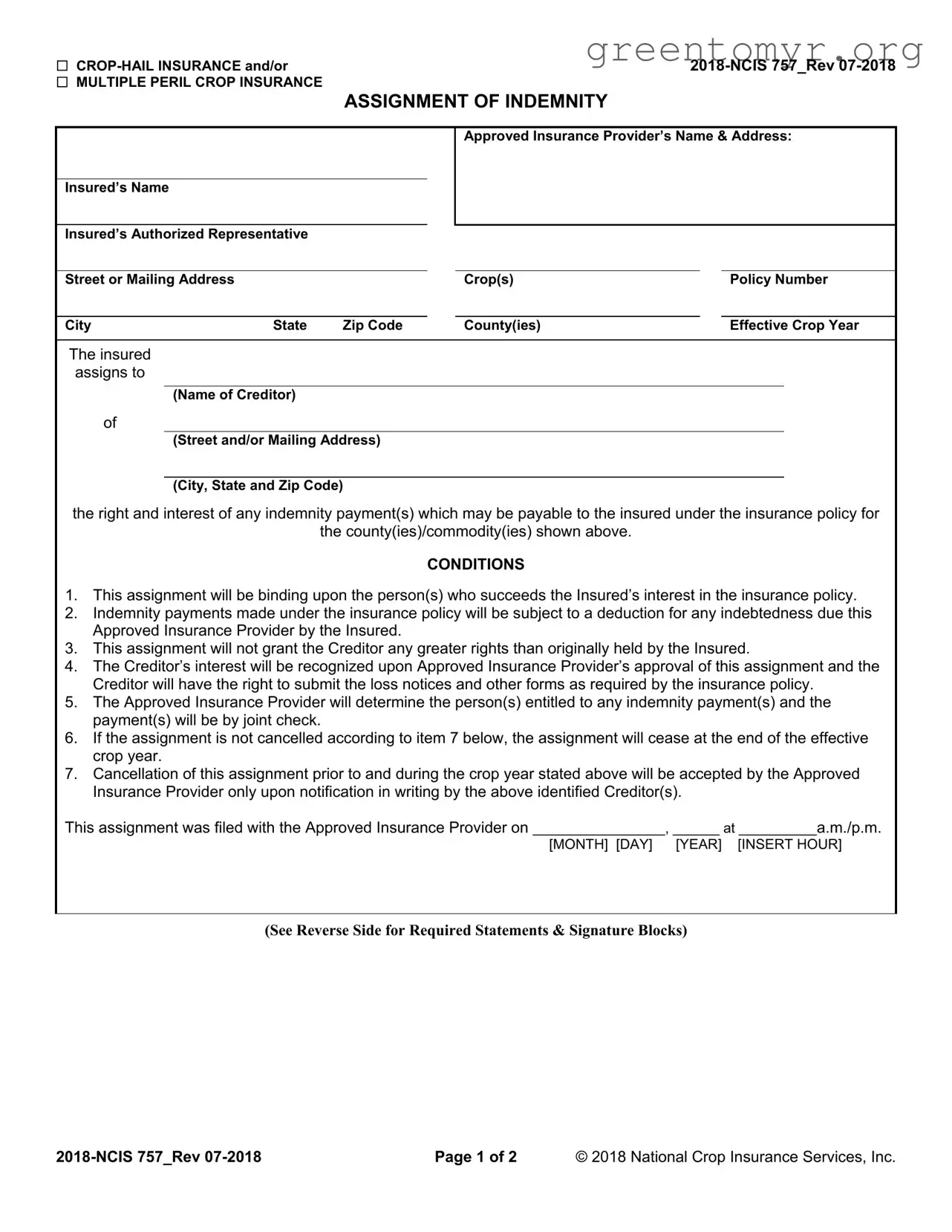
The NCIS 757 form plays a crucial role in the realm of agricultural insurance, specifically focusing on crop-hail insurance and multiple peril crop insurance. This form facilitates the assignment of indemnity payments, allowing insured individuals to transfer their rights to compensation under their insurance policy to a designated creditor. Key components of the form include essential information such as the names and addresses of both the insured and the creditor, details about the insured crops, and the specific policy number. It outlines the conditions under which the assignment is binding, ensuring that any payments made will first address any debts owed to the insurance provider. Additionally, the form stipulates that the creditor's rights are limited to those originally held by the insured, maintaining the integrity of the insurance agreement. The NCIS 757 also includes provisions for cancellation of the assignment, privacy statements regarding the collection of information, and a nondiscrimination statement in compliance with federal regulations. Understanding these elements is vital for anyone involved in agricultural insurance, as it ensures clarity and protection for all parties involved.
|
MULTIPLE PERIL CROP INSURANCE
ASSIGNMENT OF INDEMNITY
Approved Insurance Provider’s Name & Address:
Insured’s Name
Insured’s Authorized Representative
Street or Mailing Address |
|
|
Crop(s) |
Policy Number |
City |
State |
Zip Code |
County(ies) |
Effective Crop Year |
The insured
assigns to
(Name of Creditor)
of
(Street and/or Mailing Address)
(City, State and Zip Code)
the right and interest of any indemnity payment(s) which may be payable to the insured under the insurance policy for
the county(ies)/commodity(ies) shown above.
CONDITIONS
1.This assignment will be binding upon the person(s) who succeeds the Insured’s interest in the insurance policy.
2.Indemnity payments made under the insurance policy will be subject to a deduction for any indebtedness due this Approved Insurance Provider by the Insured.
3.This assignment will not grant the Creditor any greater rights than originally held by the Insured.
4.The Creditor’s interest will be recognized upon Approved Insurance Provider’s approval of this assignment and the Creditor will have the right to submit the loss notices and other forms as required by the insurance policy.
5.The Approved Insurance Provider will determine the person(s) entitled to any indemnity payment(s) and the payment(s) will be by joint check.
6.If the assignment is not cancelled according to item 7 below, the assignment will cease at the end of the effective crop year.
7.Cancellation of this assignment prior to and during the crop year stated above will be accepted by the Approved Insurance Provider only upon notification in writing by the above identified Creditor(s).
This assignment was filed with the Approved Insurance Provider on _________________, ______ at __________a.m./p.m.
[MONTH] [DAY] [YEAR] [INSERT HOUR]
(See Reverse Side for Required Statements & Signature Blocks)
Page 1 of 2 |
© 2018 National Crop Insurance Services, Inc. |
COLLECTION OF INFORMATION AND DATA (PRIVACY ACT) STATEMENT
Agents, Loss Adjusters and Policyholders
The following statements are made in accordance with the Privacy Act of 1974 (5 U.S.C. 552a): The Risk Management Agency (RMA) is authorized by the Federal Crop Insurance Act (7 U.S.C.
NONDISCRIMINATION STATEMENT
In accordance with Federal law and U.S. Department of Agriculture (USDA) civil rights regulations and policies, the USDA, its Agencies, offices, and employees, and institutions participating in or administering USDA programs are prohibited from discriminating on the basis of race, color, national origin, religion, sex, gender identity (including gender expression), sexual orientation, disability, age, marital status, family/parental status, income derived from a public assistance program, political beliefs, or reprisal or retaliation for prior civil rights activity, in any program or activity conducted or funded by USDA (not all bases apply to all programs).
To File a Program Complaint
If you wish to file a Civil Rights program complaint of discrimination, complete the USDA Program Discrimination Complaint Form, found online at
Persons with Disabilities
Persons with disabilities who require alternative means of communication for program information (e.g., Braille, large print, audiotape, American Sign Language, etc.) should contact the responsible State or local Agency that administers the program or USDA's TARGET Center at (202)
Persons with disabilities, who wish to file a program complaint, please see information above on how to contact the Department by mail directly or by email.
It is understood and agreed that this assignment will be subject to the terms and conditions of the insurance policy.
Insured’s Printed Name |
|
Insured’s Signature |
Date |
Witness’ Printed Name |
|
Witness’ Signature |
Date |
Creditor’s Authorized Representative Printed Name |
|
|
|
|
|
Creditor’s Authorized Representative Signature |
Date |
|
|
||
Creditor’s Authorized Representative’s Telephone Number |
||
|
|
|
Witness’ Printed Name |
|
|
|
|
|
Witness’ Signature |
Date |
|
AIP’s Authorized Representative’s Printed Name |
|
AIP’s Authorized Representative’s Signature |
Date |
Page 2 of 2 |
© 2018 National Crop Insurance Services, Inc. |
| Fact Name | Details |
|---|---|
| Form Purpose | The NCIS 757 form is used for assigning indemnity payments from crop insurance to a creditor. |
| Governing Law | This form is governed by the Federal Crop Insurance Act (7 U.S.C. 1501-1524). |
| Binding Nature | The assignment is binding on anyone who succeeds the insured’s interest in the insurance policy. |
| Indemnity Payment Deductions | Indemnity payments are subject to deductions for any debts owed to the insurance provider by the insured. |
| Creditor Rights | The creditor's rights are limited to what the insured originally held and require approval from the insurance provider. |
| Assignment Duration | The assignment lasts until the end of the effective crop year unless cancelled in writing. |
| Privacy Act Compliance | The form complies with the Privacy Act of 1974, ensuring confidentiality of the information provided. |
Filling out the NCIS 757 form is an important step in assigning indemnity payments related to crop insurance. Follow these steps carefully to ensure that all necessary information is provided accurately.
The NCIS 757 form is used for assigning indemnity payments from crop insurance policies. This form allows an insured party to assign their rights to receive insurance payments to a creditor. It applies to both Crop-Hail Insurance and Multiple Peril Crop Insurance.
The form should be filled out by the insured party, which is typically a farmer or agricultural producer. If they have a creditor, such as a bank or lending institution, that creditor must also be involved in the process to ensure they receive any payments owed under the insurance policy.
Key details needed on the form include:
When the insured assigns their rights to indemnity payments to a creditor, the insurance provider will recognize this assignment upon approval. The creditor can then submit loss notices and required forms to receive payments. However, the creditor will not have more rights than the insured originally held.
If the insured owes money to the insurance provider, any indemnity payments will be reduced by the amount of that debt. This means the creditor may receive less than the total amount of the indemnity payment if the insured has outstanding obligations.
Yes, the assignment can be canceled. However, it must be done in writing by the creditor. This cancellation can occur at any time before or during the effective crop year stated on the form.
The assignment will remain in effect until the end of the effective crop year. If not canceled by that time, it will automatically cease.
The Approved Insurance Provider is responsible for determining who is entitled to indemnity payments. Payments will generally be issued as joint checks to both the insured and the creditor, ensuring that all parties are recognized in the process.
The information on the NCIS 757 form is subject to privacy regulations. While it is necessary for processing claims and managing the insurance program, it may also be shared with other agencies as required by law. The information is collected to ensure program integrity and eligibility.
If you have additional questions about the NCIS 757 form, it's best to contact your Approved Insurance Provider. They can provide specific guidance and assistance tailored to your situation.
Filling out the NCIS 757 form can be a straightforward process, but many people stumble along the way. One common mistake is failing to provide complete information. Each section of the form must be filled out thoroughly, including the names and addresses of both the insured and the creditor. Incomplete information can lead to delays or even rejections of the assignment.
Another frequent error involves neglecting to sign the form. Signatures from all required parties, including the insured, the creditor, and any witnesses, are essential for the document to be valid. Without these signatures, the assignment may not be recognized by the insurance provider.
People often overlook the importance of accurate dates. When filling in the date the assignment is filed, it’s crucial to ensure that it reflects the correct month, day, and year. An incorrect date can create confusion about the effective crop year and may complicate claims down the line.
Additionally, many individuals fail to double-check policy numbers. The policy number must be accurate and match the corresponding insurance policy. Any discrepancies can result in the assignment being invalidated or misdirected.
Another mistake is not understanding the conditions of the assignment. The form outlines specific conditions that govern the assignment. Ignoring these can lead to misunderstandings about the rights and responsibilities of all parties involved.
Some people also forget to include the correct county and crop information. This detail is vital, as it specifies the coverage area and the crops involved in the insurance policy. Missing this information can lead to complications when filing a claim.
Moreover, individuals may not realize the necessity of notifying the insurance provider if there are changes or cancellations to the assignment. The form requires that any changes be communicated in writing, and failure to do so can result in complications during the claims process.
Another common issue is not providing contact information for the creditor’s authorized representative. This information is crucial for communication purposes, and omitting it can hinder the processing of the assignment.
People sometimes forget to read the privacy statement included in the form. Understanding how personal information will be used and shared is important for protecting one’s rights and ensuring compliance with regulations.
Lastly, many individuals do not take the time to review the entire form before submission. A thorough review can catch errors that might otherwise lead to issues later. Taking a few extra minutes to check for mistakes can save significant time and hassle in the long run.
The NCIS 757 form plays a crucial role in the world of crop insurance, particularly when it comes to assigning indemnity payments. However, it is often accompanied by several other important forms and documents that help facilitate the insurance process. Understanding these documents can provide clarity and ensure that all parties are well-informed. Below is a list of related forms that you may encounter.
Being aware of these forms can greatly simplify the process of managing crop insurance. Each document serves a specific purpose and contributes to a smoother experience for both the insured and the insurance provider. Familiarity with these forms not only empowers individuals but also fosters a sense of security in navigating the complexities of crop insurance.
The NCIS 757 form is a crucial document for assigning indemnity payments related to crop insurance. Several other forms serve similar purposes in the realm of agricultural insurance and financial agreements. Here are four documents that share similarities with the NCIS 757 form:
When filling out the NCIS 757 form, it's essential to follow certain guidelines to ensure accuracy and compliance. Here are seven key things to do and avoid:
By adhering to these guidelines, you can help facilitate a smoother process when dealing with your crop insurance assignment.
Understanding the NCIS 757 form is crucial for anyone involved in crop insurance. However, several misconceptions can lead to confusion. Here are six common misconceptions, along with clarifications:
This form is applicable to all insured parties, regardless of the size of their farming operation. Small and medium-sized farms can also utilize this assignment of indemnity.
Signing the NCIS 757 form assigns certain rights to a creditor but does not eliminate the insured’s rights entirely. The insured retains some control over the policy and its benefits.
The assignment is not permanent. It will cease at the end of the effective crop year unless canceled in writing by the creditor.
Creditors must have their assignment approved by the Approved Insurance Provider. Without this approval, they do not have access to the indemnity payments.
Filing the NCIS 757 form typically requires accompanying documentation, such as proof of the creditor's interest in the indemnity payments. Failure to provide necessary information may lead to rejection.
This form is relevant throughout the crop year, as it outlines the relationship between the insured and the creditor regarding indemnity payments. It is important to keep it updated and accurate.
Being informed about these misconceptions can help ensure that the NCIS 757 form is used correctly and effectively. Take action to clarify any uncertainties as soon as possible.
Here are some key takeaways regarding the NCIS 757 form: