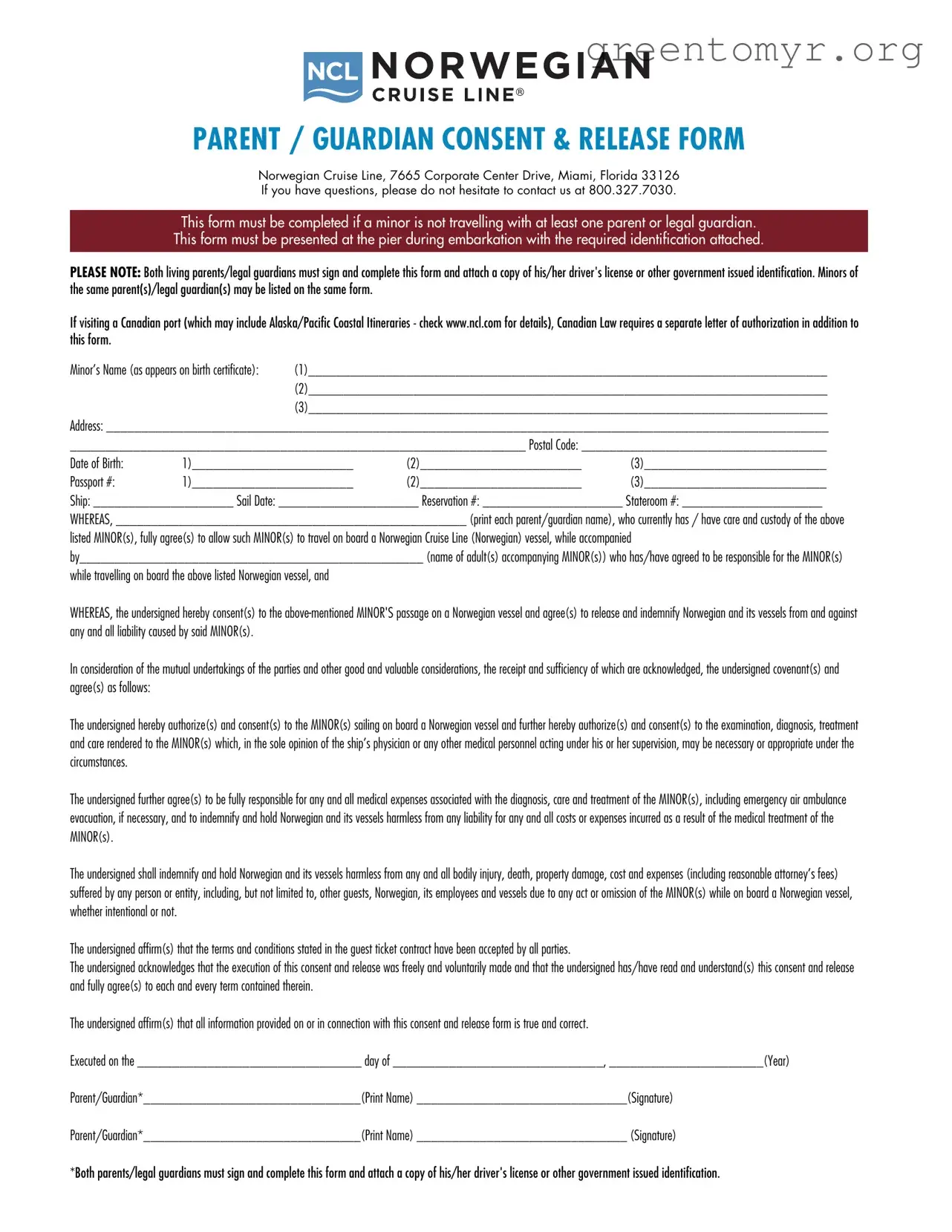
The NCL Parental Consent form plays a crucial role in ensuring that parents and guardians are informed and involved in their children's educational experiences. This form is designed to obtain explicit permission from parents before schools can disclose personally identifiable information about students. It addresses important aspects such as the types of information that may be shared, the purposes for which this information is used, and the rights parents have regarding their child's data. Furthermore, it outlines the procedures for parents to revoke consent if they choose to do so in the future. Understanding the implications of this form is vital for parents who wish to safeguard their child's privacy while also engaging with educational institutions. The form serves not only as a legal requirement but also as a tool for fostering transparency and trust between schools and families.

PARENT / GUARDIAN CONSENT & RELEASE FORM
Norwegian Cruise Line, 7665 Corporate Center Drive, Miami, Florida 33126
If you have questions, please do not hesitate to contact us at 800.327.7030.
This form must be completed if a minor is not travelling with at least one parent or legal guardian.
This form must be presented at the pier during embarkation with the required identification attached.
PLEASE NOTE: Both living parents/legal guardians must sign and complete this form and attach a copy of his/her driver's license or other government issued identification. Minors of the same parent(s)/legal guardian(s) may be listed on the same form.
If visiting a Canadian port (which may include Alaska/Pacific Coastal Itineraries - check www.ncl.com for details), Canadian Law requires a separate letter of authorization in addition to this form.
Minor’s Name (as appears on birth certificate): |
(1)__________________________________________________________________________ |
|
(2)__________________________________________________________________________ |
|
(3)__________________________________________________________________________ |
Address: _______________________________________________________________________________________________________
_________________________________________________________________ Postal Code: ___________________________________
Date of Birth: |
1)_______________________ |
(2)_______________________ |
(3)__________________________ |
Passport #: |
1)_______________________ |
(2)_______________________ |
(3)__________________________ |
Ship: ____________________ Sail Date: ____________________ Reservation #: ____________________ Stateroom #: ____________________
WHEREAS, __________________________________________________ (print each parent/guardian name), who currently has / have care and custody of the above
listed MINOR(s), fully agree(s) to allow such MINOR(s) to travel on board a Norwegian Cruise Line (Norwegian) vessel, while accompanied
by_________________________________________________ (name of adult(s) accompanying MINOR(s)) who has/have agreed to be responsible for the MINOR(s)
while travelling on board the above listed Norwegian vessel, and
WHEREAS, the undersigned hereby consent(s) to the
In consideration of the mutual undertakings of the parties and other good and valuable considerations, the receipt and sufficiency of which are acknowledged, the undersigned covenant(s) and agree(s) as follows:
The undersigned hereby authorize(s) and consent(s) to the MINOR(s) sailing on board a Norwegian vessel and further hereby authorize(s) and consent(s) to the examination, diagnosis, treatment and care rendered to the MINOR(s) which, in the sole opinion of the ship’s physician or any other medical personnel acting under his or her supervision, may be necessary or appropriate under the circumstances.
The undersigned further agree(s) to be fully responsible for any and all medical expenses associated with the diagnosis, care and treatment of the MINOR(s), including emergency air ambulance evacuation, if necessary, and to indemnify and hold Norwegian and its vessels harmless from any liability for any and all costs or expenses incurred as a result of the medical treatment of the MINOR(s).
The undersigned shall indemnify and hold Norwegian and its vessels harmless from any and all bodily injury, death, property damage, cost and expenses (including reasonable attorney’s fees) suffered by any person or entity, including, but not limited to, other guests, Norwegian, its employees and vessels due to any act or omission of the MINOR(s) while on board a Norwegian vessel, whether intentional or not.
The undersigned affirm(s) that the terms and conditions stated in the guest ticket contract have been accepted by all parties.
The undersigned acknowledges that the execution of this consent and release was freely and voluntarily made and that the undersigned has/have read and understand(s) this consent and release and fully agree(s) to each and every term contained therein.
The undersigned affirm(s) that all information provided on or in connection with this consent and release form is true and correct.
Executed on the ________________________________ day of ______________________________, ______________________(Year)
Parent/Guardian*_______________________________(Print Name) ______________________________(Signature)
Parent/Guardian*_______________________________(Print Name) ______________________________ (Signature)
*Both parents/legal guardians must sign and complete this form and attach a copy of his/her driver's license or other government issued identification.
| Fact Name | Description |
|---|---|
| Purpose | The NCL Parental Consent form is designed to obtain permission from parents or guardians for their child's participation in specific activities. |
| Required Information | The form typically requires the child's name, the parent's name, and a description of the activity for which consent is being sought. |
| State-Specific Forms | Some states have their own versions of the consent form, which may include additional requirements based on local laws. |
| Governing Laws | Each state has specific laws that govern parental consent. For example, California follows the California Family Code, while Texas adheres to the Texas Family Code. |
| Submission Process | Parents must complete and submit the form by the specified deadline to ensure their child's participation. |
| Confidentiality | Information provided on the form is typically kept confidential and used solely for the purpose of the activity. |
Completing the NCL Parental Consent form is an important step in ensuring that your child's participation is properly authorized. Once you have filled out the form, it will be submitted for review and processing. This will help facilitate the necessary approvals for your child's involvement.
The NCL Parental Consent form is a document that ensures parents or guardians give their permission for their child to participate in certain activities or programs. This form is often required for educational or extracurricular activities, particularly those that involve research or data collection. It serves to protect the rights of both the child and the parents, ensuring that they are fully informed about what participation entails.
Parental consent is necessary to safeguard the welfare of minors. It ensures that parents are aware of and agree to their child's involvement in specific programs. This is especially important in settings where personal information may be collected or where the child may be exposed to new experiences. By requiring consent, organizations demonstrate their commitment to transparency and the protection of children's rights.
Completing the NCL Parental Consent form is straightforward. Follow these steps:
Make sure to keep a copy for your records, as it may be useful for future reference.
If you have any questions or concerns regarding the NCL Parental Consent form, it is important to reach out for clarification. You can:
Being informed is key to making the best decision for your child.
Filling out the NCL Parental Consent form is an important step for parents and guardians. However, mistakes can occur, potentially delaying the process or causing complications. One common error is failing to provide accurate contact information. Parents should ensure that their phone numbers and email addresses are current and correct. Inaccurate contact details can lead to missed communications regarding the child's educational activities.
Another frequent mistake involves not signing the form. While it may seem obvious, some parents overlook this crucial step. A signature is necessary to validate the consent, and without it, the form may be considered incomplete. Additionally, parents should pay attention to the date of signing. An outdated signature could raise questions about the timeliness of the consent.
Omitting important details about the child is also a common oversight. Parents should provide the child's full name, date of birth, and any other requested identifying information. Incomplete information can hinder the processing of the consent and may lead to unnecessary delays.
Some parents mistakenly assume that the form is self-explanatory and fail to read the instructions thoroughly. Each section of the form may have specific requirements that need to be followed. Taking the time to read through the entire document can help avoid misunderstandings and ensure that all necessary information is included.
Inaccurate or vague responses can also create problems. For instance, when asked about the types of activities for which consent is being granted, parents should provide clear and specific answers. General or ambiguous responses may not be accepted, leading to confusion about what the consent covers.
Another mistake involves not keeping a copy of the completed form. Parents should always retain a copy for their records. This can be useful for future reference and can help clarify any questions that may arise later regarding the consent.
Some individuals forget to check for any additional documents that may need to accompany the consent form. In certain cases, schools or organizations may require supplementary paperwork, such as proof of guardianship or identification. Failing to include these documents can result in delays.
Finally, parents may overlook deadlines for submitting the consent form. Each school or organization may have specific timelines for when the form needs to be submitted. Missing a deadline can impact a child's participation in certain programs or activities. Staying aware of these timelines is essential for ensuring that the consent is processed in a timely manner.
The NCL Parental Consent form is an important document in the context of educational settings, particularly when it comes to obtaining permission from parents or guardians for various activities involving their children. Alongside this form, several other documents may be required to ensure compliance with legal and procedural standards. Below is a list of commonly used forms that often accompany the NCL Parental Consent form.
These documents work together with the NCL Parental Consent form to create a comprehensive framework for student participation in school activities. By ensuring that all necessary forms are completed, schools can foster a safe and supportive environment for students and their families.
The NCL Parental Consent form is an important document for parents or guardians, especially when it comes to their child's participation in certain activities or programs. Here are six other documents that share similarities with the NCL Parental Consent form:
When filling out the NCL Parental Consent form, it's important to approach the process thoughtfully. Here are five things you should and shouldn't do:
By following these guidelines, you can ensure a smoother experience when submitting the NCL Parental Consent form.
Here are some common misconceptions about the NCL Parental Consent form, along with clarifications to help you understand it better.
Understanding these misconceptions can help parents navigate the NCL Parental Consent form with confidence.
When filling out and using the NCL Parental Consent form, there are several important aspects to consider. Here are four key takeaways: