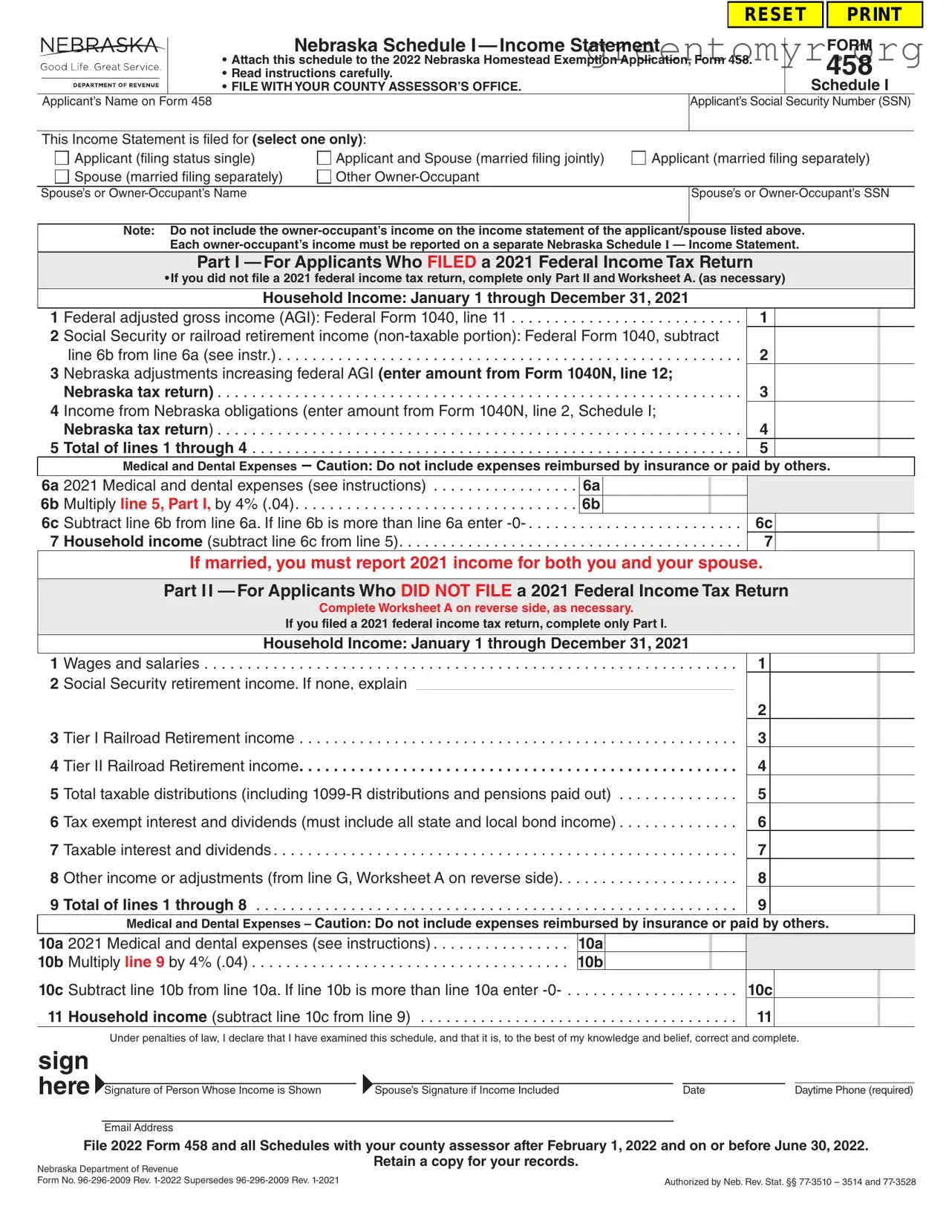
The Nebraska Schedule I Income Statement, also known as Form NE 458, plays a crucial role for individuals applying for the Nebraska Homestead Exemption. This form is designed to capture essential income information for the year 2021, which helps determine eligibility for the exemption. When filling out this form, applicants need to include their federal adjusted gross income, as well as any non-taxable Social Security or railroad retirement income. It's important to note that each owner-occupant must file a separate income statement, ensuring that all household incomes are accurately reported. The form consists of two parts: one for those who filed a federal income tax return and another for those who did not. Specific instructions guide applicants on how to report various types of income, including wages, pensions, and medical expenses. Additionally, the form must be filed with the county assessor's office by June 30, 2022, making timely submission essential for those seeking to benefit from the homestead exemption. Understanding the requirements and processes outlined in Form NE 458 can significantly ease the application process and help ensure that eligible homeowners receive the financial relief they deserve.
|
|
|
|
|
|
|
RESET |
|
|
|
|||
|
|
|
|
Nebraska Schedule |
|
|
|
|
|
FORM |
|
||
|
|
|
|
|
|
|
|
||||||
|
|
|
• Attach this schedule to the 2022 Nebraska Homestead Exemption Application, Form 458. |
|
458 |
|
|
||||||
|
|
|
• Read instructions carefully. |
|
|
|
|
|
|
||||
|
|
|
• FILE WITH YOUR COUNTY ASSESSOR’S OFFICE. |
|
|
|
|
Schedule I |
|
||||
|
Applicant’s Name on Form 458 |
|
|
Applicant’s Social Security Number (SSN) |
|
||||||||
|
|
|
|
|
|
|
|
|
|
|
|
||
|
This Income Statement is filed for (select one only): |
|
|
|
|
|
|
|
|
|
|||
|
Applicant (filing status single) |
Applicant and Spouse (married filing jointly) |
Applicant (married filing separately) |
|
|||||||||
|
Spouse (married filing separately) |
Other |
|
|
|
|
|
|
|
|
|
||
Spouse’s or |
|
|
Spouse’s or |
|
|
||||||||
Note: Do not include the
Part I
• If you did not file a 2021 federal income tax return, complete only Part II and Worksheet A. (as necessary)
|
Household Income: January 1 through December 31, 2021 |
|
|
|
||||||
1 |
Federal adjusted gross income (AGI): Federal Form 1040, line 11 |
. . . . . . . . . |
1 |
|
|
|||||
2 |
Social Security or railroad retirement income |
|
|
|
||||||
|
line 6b from line 6a (see instr.) |
. |
. |
. . . . 對 |
. . . . . . . . . |
2 |
|
|
||
3 |
Nebraska adjustments increasing federal AGI (enter amount from Form 1040N, line 12; |
|
|
|
||||||
|
Nebraska tax return). . . . . . . . . . . . . . . . . . 對 . . . |
. . . . . . . . . . |
3 |
|
|
|||||
4 |
Income from Nebraska obligations (enter amount from Form 1040N, line 2, Schedule I; |
|
|
|
||||||
|
Nebraska tax return) |
. |
. |
. 對 . . . |
. . . . . . . . . . |
4 |
|
|
||
5 |
Total of lines 1 through 4 |
. |
. |
. . . 對 . |
. . . . . . . . . . |
5 |
|
|
||
|
Medical and Dental Expenses – Caution: Do not include expenses reimbursed by insurance or paid by others. |
|||||||||
6a |
2021 Medical and dental expenses (see instructions) |
6a |
|
|
|
|
|
|||
6b |
Multiply line 5, Part I, by 4% (.04) |
|
|
|
6b |
|
|
|
|
|
6c |
Subtract line 6b from line 6a. If line 6b is more than line 6a enter |
. . . . . . . . . |
6c |
|
|
|||||
7 |
Household income (subtract line 6c from line 5). . . . . . . . . . . . . . . . . 對 . . |
|
|
|
7 |
|
|
|||
If married, you must report 2021 income for both you and your spouse.
Part I I
Complete Worksheet A on reverse side, as necessary.
If you filed a 2021 federal income tax return, complete only Part I.
Household Income: January 1 through December 31, 2021
1 |
Wages and salaries |
. 對 |
||||
2 |
Social Security retirement income. If none, explain _______________________________________________ |
|||||
|
_ ________________________________________________________________________________________________ |
|||||
3 |
Tier I Railroad Retirement income |
. |
. |
. |
. |
. . 對 |
4 |
Tier II Railroad Retirement income |
. . . . . . . 對 |
||||
5 |
Total taxable distributions (including |
|||||
6 |
Tax exempt interest and dividends (must include all state and local bond income) |
|||||
7 |
Taxable interest and dividends |
. . . . . 對 |
||||
8 |
Other income or adjustments (from line G, Worksheet A on reverse side) |
|||||
9 |
Total of lines 1 through 8 |
. |
. |
. |
. |
對 |
1
2
3
4
5
6
7
8
9
Medical and Dental Expenses – Caution: Do not include expenses reimbursed by insurance or paid by others.
10a |
2021 Medical and dental expenses (see instructions) |
10a |
|
|
|
|
|
10b |
Multiply line 9 by 4% (.04). . . . . . . . . . . . . . . . . . 對 . |
10b |
|
|
|
|
|
10c |
Subtract line 10b from line 10a. If line 10b is more than line 10a enter |
. . . . . . . . . |
10c |
|
|
||
11 |
Household income (subtract line 10c from line 9) |
. . . . . . . . 對 . |
11 |
|
|
||
Under penalties of law, I declare that I have examined this schedule, and that it is, to the best of my knowledge and belief, correct and complete.
sign here
|
|
|
|
|
|
( |
) |
|
|
|
|
|
|
|
|
|
|
Signature of Person Whose Income is Shown |
|
Spouse’s Signature if Income Included |
|
Date |
Daytime Phone (required) |
|||
Email Address
File 2022 Form 458 and all Schedules with your county assessor after February 1, 2022 and on or before June 30, 2022.
Retain a copy for your records.
Authorized by Neb. Rev. Stat. §§

|
|
|
Worksheet |
|
|
|
FORM 458 |
||
|
|
|
|
|
|||||
|
|
|
Line 8, Other Income or Adjustments |
|
|
|
Schedule I |
||
|
|
|
|
|
|
Worksheet A |
|||
|
|
|
|
|
|
|
|
||
|
.........................................................A Net business income including rental, or farm income, or (loss) |
A |
|
|
|
||||
|
B Capital gain or (loss) |
B |
|
|
|
||||
|
C Other gain or (loss) |
C |
|
|
|
||||
|
D Unemployment compensation |
D |
|
|
|
||||
|
E Any other income or adjustments reducing income. Explain: |
|
|
E |
|
|
|
||
|
F Penalty on early withdrawal of savings |
F |
|
|
|
||||
|
G Total of lines A through E, minus line F (enter this amount here and on Part II, line 8) |
G |
|
|
|
||||
|
|
|
Retain a copy for your records. |
|
|
|
|
|
|
|
|
|
Instructions |
|
|
|
|
|
|
Who Must File. This Form 458 Schedule I must be filed by persons applying for a homestead exemption, who are not filing as a veteran drawing compensation from the Department of Veteran’s Affairs (DVA) or as a paraplegic veteran or multiple amputee whose home was substantially contributed to by the DVA. This form is to be attached to and filed with the Nebraska Homestead Exemption Application or Certification of Status, Form 458. (See Form 458 Instructions). If you filed, or would have filed as married for Nebraska individual income tax purposes for 2021, you must include income for both you and your spouse, even if you filed as “married, filing separately.” Each additional owner who occupied the homestead during any part of 2021 must also report their income on a separate schedule.
When and Where to File. Schedule I must be attached to the Form 458 and FILED WITH YOUR COUNTY ASSESSOR, after February 1, 2022 and on or before June 30, 2022.
Specific Instructions
Note – Do NOT include the following on the income statement:
•Department of Veterans Affairs disability compensation;
•Supplemental Security Disability Income (SSDI);
•Worker’s Compensation Act payments;
•Child support payments;
•Aid to Dependent Children (ADC); and
•Nebraska Department of Health and Human Services aid.
Exclude Social Security payments based on disability for applicants and spouses under their full retirement age (generally age 66) EXCEPT for any portion of the benefits included in federal adjusted gross income (AGI). Disability benefits automatically convert to retirement benefits at full retirement age and must be reported. See SSA Publication No.
Part I
Line 1, Federal AGI. Include income as reported for federal income tax purposes on line 11, Federal Form 1040 for tax year 2021.
Line 2, Social Security Retirement Income and/or Railroad Retirement Income. Enter retirement benefits minus any portion included as taxable in AGI (Line 6b, Federal Form 1040, minus any amount reported on line 6a, Federal Form 1040). Do NOT subtract Medicare premiums or any other adjustments from the amount in Box 6.
Line 3, Nebraska Adjustments Increasing federal AGI. Report the total amount of Nebraska adjustments increasing federal AGI as shown on line 12, Nebraska Form 1040N. Do not reduce this amount. Amounts on line 13 of the Form 1040N are not allowed.
Line 4, Income From Nebraska Obligations. Include the total amount of interest income from Nebraska obligations as shown on line 2, Schedule I, Nebraska Form 1040N.
Line 5, Total of Lines 1 Through 4. Add all amounts listed in lines 1 though 4. Put the total amount on line 5. Line
Line 7. Household Income. This amount represents your household income. Household income table can be located at
Part II
Line 1, Wages and Salaries. Include any wages, salaries, fees, commissions, tips, bonuses, etc. received in 2021, even if you do not have a Federal Form
Line 2, Social Security Retirement Income. Report net benefits received in 2021, as shown in Box 5, Federal Form SSA‑1099. Do NOT subtract Medicare premiums or any other adjustments from the amount in Box 5.
Line 3, Tier I Railroad Retirement Income. Include Tier I net Social Security equivalent benefit received in 2021, as shown in Box 5, Federal Form
Line 4, Tier II Railroad Retirement Income. Include Tier II Railroad retirement income received in 2021, as shown in Box 7, Federal Form
Line 5, Total Taxable Distributions. On line 5, report the taxable amount from Box 2(a), Form 1099‑R. Report any taxable portion of any pensions received. Do not report any amount from a qualified IRA rollover. See Federal Form
Line 6, Tax Exempt Interest and Dividends. Report the total interest received in 2021 on tax exempt obligations as shown in:
1.Box 8, Federal Form
2.Box 11, Federal Form
3.Box 11, Federal Form
State and local bond income from both Nebraska and
Line 7, Taxable Interest and Dividends. Include your total interest and dividends received in 2021, as shown in:
1.Box 1 and Box 3, Federal Form
2.Box 1 and Box 2, Federal Form
3.Box 1a and Box 2a, Federal Form
Interest and dividends from all U.S. government obligations must be included.
Line 8, Other Income or Adjustments. Complete Worksheet A and enter the amount from line G. Line 9, Total of Lines 1 Through 8. Add all amounts listed in lines 1 through 8. Put total amount on line 9. Line
Line 11. Household Income. This amount represents your household income. Household income table can be located at
Medical Expenses Instructions
Part I, Line 6a or Part II, Line 10a
“Medical expenses paid” includes all 2021 medical expenses incurred for and paid by the applicant, spouse, or
In general, medical expenses include any payments you made that would qualify for the income tax medical expenses deduction on Federal Form 1040, Schedule A, line 1; except payments for the treatment of a dependent who is not an
Reimbursements. Do not include any amounts you paid that have been or will be reimbursed by insurance. Doctors, Dentists, Hospitals. Include amounts paid for medical services such as:
1.Payments to doctors, dentists, osteopaths, nurses, chiropractors, and other licensed medical practitioners;
2.Payments to hospitals or licensed nursing care facilities; and
3.Payments for purchases of medical equipment, crutches, hearing aids, eyeglasses, contact lenses, dentures, etc.
Do not include funeral, burial, or cremation costs.
Prescription Medicines. Include payments for prescription medicines and insulin. Prescription medicines are only those drugs and medicines that cannot be purchased without a prescription.
Do not include any medicine that can be purchased
Health Insurance Premiums. Include insurance premiums paid for medical insurance for the applicant, spouse, or
Do not include: Medicare Part A deductions withheld from wages;
Worksheet
Note: Retain a copy for your records.
Line A, Net Business Income Including Rental, or Farm Income, or (Loss). Report your 2021 net
income. For information on computing the income, refer to the following federal schedules and instructions:
1.For business income, see Schedule C, Federal Form 1040, or Schedule
2.For income from rental real estate, royalties, partnerships, S corporations, trusts, REMICs, etc., see Schedule E, Federal Form 1040; and
3.For farm income, see Schedule F, Federal Form 1040.
Line B, Capital Gains or (Loss). Include all income or loss resulting from the sale of stock, bonds, or real estate from
Line C, Other Gains or (Loss). Report all other gains or losses on tangible or intangible property not included on line A or line B. See Federal Form 4797.
Line D, Unemployment Compensation. Include all unemployment compensation received for 2021 from Box 1, Federal Form
Line E, Any Other Income or (Adjustments Reducing Income). Report all other taxable income from Federal Form 1099‑MISC and taxable state income tax refunds reported on Federal Form
Subtract the calculated adjustments from the calculated “other income” and enter the net income or loss on line E.
Line F, Penalty on Early Withdrawal of Savings. Report your total amount of penalties for early withdrawal of savings from Box 2, Federal Form
Note: A homestead exemption percentage is subject to change based upon the review by the Tax Commissioner of any information necessary to determine whether an application is in compliance with Neb. Rev. Stat. §§ 77‑3501 to
For more information, contact your local county assessor’s office, or
visit
| Fact Name | Description |
|---|---|
| Purpose | The NE 458 form is used to apply for the Nebraska Homestead Exemption, allowing eligible homeowners to reduce property taxes. |
| Filing Requirements | Applicants must attach Schedule I to the 2022 Nebraska Homestead Exemption Application, Form 458, and file it with their county assessor's office. |
| Deadline | The form must be filed after February 1, 2022, and on or before June 30, 2022. |
| Governing Laws | This form is governed by Nebraska Revised Statutes §§ 77-3510 – 3514 and 77-3528. |
Completing the Nebraska Schedule I - Income Statement (Form 458) is an essential step for those applying for a homestead exemption. This form gathers important income information that will be used in the application process. Below are the steps to help you fill out the form accurately.
The NE 458 form, also known as the Nebraska Homestead Exemption Application, is used by residents of Nebraska to apply for a homestead exemption. This exemption can provide property tax relief for eligible homeowners. The form requires specific income information and must be filed with your county assessor's office.
Individuals applying for a homestead exemption must file the NE 458 form. This includes homeowners who are not veterans receiving compensation from the Department of Veterans Affairs or those who are paraplegic veterans or multiple amputees. Each owner-occupant of the homestead must report their income on a separate schedule.
The NE 458 form must be filed after February 1, 2022, and on or before June 30, 2022. It is important to submit the form on time to ensure eligibility for the homestead exemption. Late submissions may not be accepted.
To complete the NE 458 form, you will need the following information:
When completing the NE 458 form, do not include certain types of income. These include:
Household income is calculated by adding up all sources of income for you and your spouse (if applicable) for the year 2021. This includes wages, Social Security benefits, and other taxable income. After totaling the income, you may subtract qualifying medical and dental expenses to arrive at your final household income. Be sure to follow the specific instructions provided in the form to ensure accurate calculations.
When completing the Nebraska Schedule I — Income Statement (Form 458), individuals often make several common mistakes that can lead to complications in their homestead exemption application. One significant error is failing to include all required income sources. Applicants must report their federal adjusted gross income accurately, including all applicable income from Social Security, railroad retirement, and other sources. Omitting any of these can result in an inaccurate representation of household income.
Another frequent mistake involves misunderstanding the reporting requirements for medical and dental expenses. Many applicants mistakenly include expenses that have been reimbursed by insurance or paid by others. This can lead to inflated medical expense claims, which ultimately affect the calculation of household income. It is essential to only report out-of-pocket expenses incurred during the year, ensuring that reimbursements are excluded.
Additionally, some individuals fail to file separate income statements for each owner-occupant. The instructions clearly state that each owner-occupant must submit their income on a distinct Nebraska Schedule I. Ignoring this requirement can complicate the review process and delay the approval of the homestead exemption.
Lastly, applicants often neglect to double-check their calculations before submitting the form. Simple arithmetic errors can lead to significant discrepancies in reported income, affecting eligibility for the homestead exemption. It is advisable to review all entries and calculations thoroughly to ensure accuracy. Taking these steps can help streamline the application process and increase the likelihood of a successful exemption claim.
The Nebraska Homestead Exemption Application, Form 458, is often accompanied by several other forms and documents that help in the assessment and approval process. Below is a list of commonly used forms along with brief descriptions of each.
Submitting these forms along with the Nebraska Homestead Exemption Application ensures a complete and accurate assessment of eligibility for the exemption. It is important to gather all necessary documents before filing to avoid delays in processing.
When filling out the Nebraska Schedule I — Income Statement (Form 458), it's important to follow specific guidelines to ensure your application is accurate and complete. Here are seven things you should and shouldn't do:
Misconception 1: The NE 458 form is only for veterans.
This is incorrect. The NE 458 form is designed for individuals applying for a homestead exemption, not just veterans. It can be used by any qualifying homeowner, including those who are not veterans.
Misconception 2: You can file the NE 458 form anytime during the year.
In reality, there are specific deadlines. The form must be filed with your county assessor's office after February 1 and on or before June 30 of the year in which you are applying for the exemption.
Misconception 3: All types of income must be reported on the NE 458 form.
This is misleading. Certain types of income, such as Department of Veterans Affairs disability compensation and Supplemental Security Disability Income, should not be included on the income statement. It’s crucial to know what to exclude.
Misconception 4: Only one income statement is needed for multiple owner-occupants.
This is not true. Each owner-occupant must file a separate Nebraska Schedule I — Income Statement. Combining incomes on one form is not permitted and could lead to complications in the application process.
Key Takeaways for Filling Out and Using the Nebraska Form 458: