When it comes to transferring property ownership in Nebraska, understanding the Nebraska Deed form is essential. This document serves as a legal instrument that facilitates the conveyance of real estate from one party to another. It outlines crucial details such as the names of the grantor and grantee, a clear description of the property being transferred, and the consideration involved in the transaction. Additionally, the form may include important clauses that define the rights and responsibilities of both parties. Whether you’re a seasoned real estate investor or a first-time homebuyer, grasping the nuances of the Nebraska Deed form can empower you to navigate the property transfer process with confidence. From ensuring that all necessary information is accurately captured to understanding the implications of the deed type—be it a warranty deed, quitclaim deed, or special warranty deed—familiarity with this document is key to a smooth transaction. Let's dive deeper into the specifics of the Nebraska Deed form and explore its significance in real estate dealings.
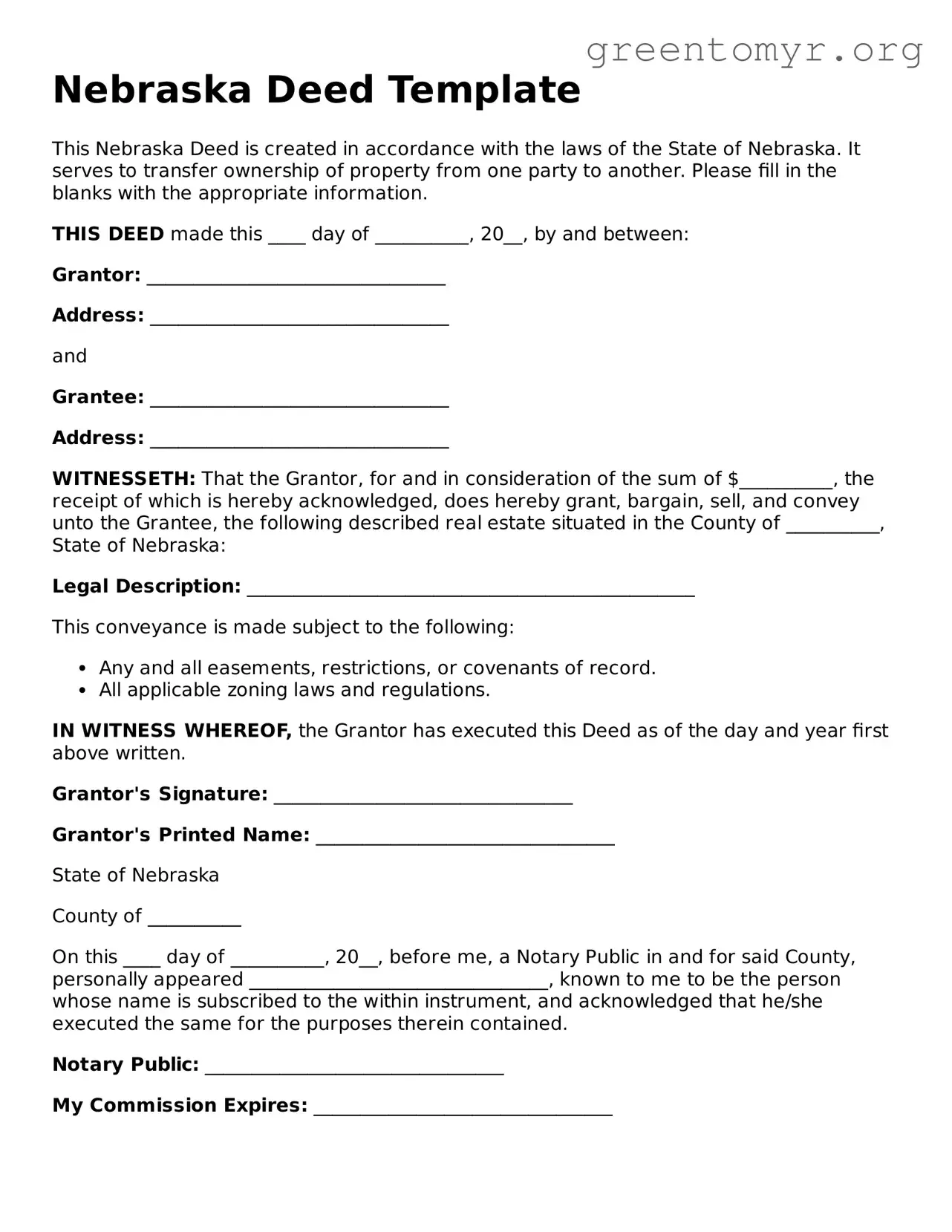
Nebraska Deed Template
This Nebraska Deed is created in accordance with the laws of the State of Nebraska. It serves to transfer ownership of property from one party to another. Please fill in the blanks with the appropriate information.
THIS DEED made this ____ day of __________, 20__, by and between:
Grantor: ________________________________
Address: ________________________________
and
Grantee: ________________________________
Address: ________________________________
WITNESSETH: That the Grantor, for and in consideration of the sum of $__________, the receipt of which is hereby acknowledged, does hereby grant, bargain, sell, and convey unto the Grantee, the following described real estate situated in the County of __________, State of Nebraska:
Legal Description: ________________________________________________
This conveyance is made subject to the following:
IN WITNESS WHEREOF, the Grantor has executed this Deed as of the day and year first above written.
Grantor's Signature: ________________________________
Grantor's Printed Name: ________________________________
State of Nebraska
County of __________
On this ____ day of __________, 20__, before me, a Notary Public in and for said County, personally appeared ________________________________, known to me to be the person whose name is subscribed to the within instrument, and acknowledged that he/she executed the same for the purposes therein contained.
Notary Public: ________________________________
My Commission Expires: ________________________________
| Fact Name | Details |
|---|---|
| Governing Law | The Nebraska Deed form is governed by the Nebraska Revised Statutes, specifically Chapter 76. |
| Types of Deeds | Common types of deeds in Nebraska include Warranty Deeds, Quitclaim Deeds, and Special Warranty Deeds. |
| Signature Requirements | The deed must be signed by the grantor (the person transferring the property) and notarized. |
| Recording Process | To be legally effective against third parties, the deed must be recorded with the county register of deeds. |
| Consideration | The deed should state the consideration (payment) for the property, although it can be nominal. |
Once you have the Nebraska Deed form ready, it's important to complete it accurately to ensure proper transfer of property. After filling out the form, you will need to file it with the appropriate county office to make the transfer official.
A Nebraska Deed form is a legal document used to transfer ownership of real property in the state of Nebraska. This form outlines the details of the transaction, including the names of the parties involved, a description of the property, and the terms of the transfer. It serves as an official record of the change in ownership.
In Nebraska, there are several types of Deed forms, including:
To complete a Nebraska Deed form, follow these steps:
Yes, in Nebraska, a Deed form must be notarized to be legally valid. This step helps verify the identities of the parties involved and ensures that the signatures are authentic. A notary public will witness the signing of the document and affix their seal to it.
After completing and notarizing the Deed form, it must be filed with the Register of Deeds in the county where the property is located. This filing creates a public record of the property transfer, which is important for future transactions and legal matters.
Yes, there is typically a fee associated with filing a Deed form in Nebraska. The fee may vary by county, so it is advisable to check with the local Register of Deeds office for the specific amount. Additionally, there may be transfer taxes applicable to the transaction.
While it is possible to create your own Nebraska Deed form, it is recommended to use a standard form or consult with a legal professional. This ensures that all necessary legal requirements are met and that the document is properly structured to avoid potential issues in the future.
When filling out the Nebraska Deed form, individuals often overlook critical details that can lead to complications down the line. One common mistake is failing to include all required parties. Each grantor and grantee must be clearly identified. Omitting even one person’s name can render the deed invalid. This mistake can create confusion regarding property ownership and may lead to disputes.
Another frequent error involves incorrect legal descriptions of the property. The deed must contain an accurate description that reflects the property’s boundaries. Relying on informal descriptions or vague terms can result in legal challenges later. It is essential to consult a property survey or official records to ensure the description is precise and meets legal standards.
People also often neglect to sign the deed properly. A deed must be signed by the grantor, and in some cases, it may need to be notarized. Failing to obtain a notary’s signature can lead to issues with the deed’s enforceability. Additionally, if multiple grantors are involved, all must sign; otherwise, the deed may not hold up in court.
Another mistake is not including the date of execution. While it may seem minor, the date is crucial for establishing the timeline of ownership. Without it, questions may arise about when the transfer of property occurred, complicating matters in the event of a dispute or if the property is sold again in the future.
Finally, individuals sometimes forget to record the deed with the appropriate county office. Recording the deed is essential for public notice and protects the grantee's interests. If a deed is not recorded, it may be difficult to prove ownership against future claims. This oversight can lead to significant legal issues, especially if the property is sold or contested later.
In the process of transferring property ownership in Nebraska, several documents may accompany the Nebraska Deed form. Each of these documents serves a specific purpose in ensuring that the transaction is legally sound and properly recorded. Below is a list of commonly used forms and documents that may be required.
Understanding these documents is essential for anyone involved in a property transaction in Nebraska. Each form plays a critical role in protecting the interests of all parties and ensuring a smooth transfer of ownership.
The Deed form is a legal document that serves various purposes in property transactions and other legal matters. Several other documents share similarities with the Deed form, each serving specific functions. Below are five documents that are similar to the Deed form, along with explanations of how they relate to it.
When filling out the Nebraska Deed form, it is important to follow certain guidelines to ensure accuracy and compliance. Below is a list of things you should and shouldn't do.
Following these guidelines will help ensure that the deed is properly filled out and accepted by the appropriate authorities.
When dealing with Nebraska Deed forms, it's common to encounter some misconceptions. Understanding these can help individuals navigate the process more effectively. Here are four prevalent misconceptions:
By clarifying these misconceptions, individuals can approach the deed preparation and transfer process with greater confidence and knowledge.
When filling out and using the Nebraska Deed form, several key points should be considered to ensure accuracy and compliance with state requirements.
By keeping these key takeaways in mind, individuals can navigate the process of filling out and using the Nebraska Deed form more effectively.