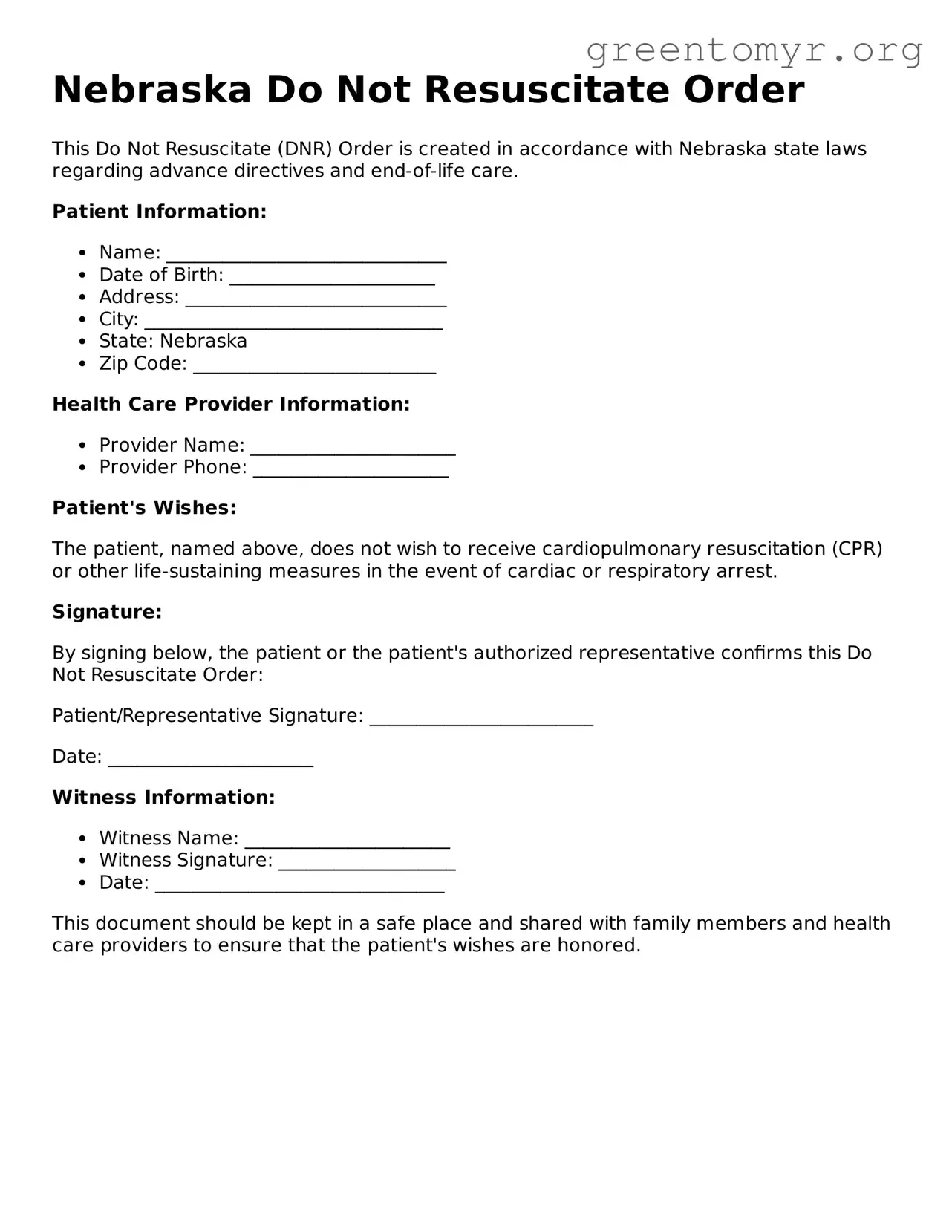
In Nebraska, the Do Not Resuscitate (DNR) Order form serves as a critical document for individuals who wish to express their preferences regarding medical treatment in emergency situations. This form allows patients to indicate their desire not to receive cardiopulmonary resuscitation (CPR) in the event of cardiac arrest or respiratory failure. It is designed to ensure that healthcare providers respect the wishes of patients who may not want aggressive life-saving measures. The DNR Order must be completed and signed by a physician, and it requires the patient’s or their legal representative's consent. Additionally, the form should be prominently displayed or easily accessible to medical personnel to ensure immediate recognition in emergencies. Understanding the implications and requirements of the DNR Order is essential for individuals and families facing serious health conditions, as it empowers them to make informed decisions about end-of-life care and to communicate their wishes clearly to healthcare providers.
Nebraska Do Not Resuscitate Order
This Do Not Resuscitate (DNR) Order is created in accordance with Nebraska state laws regarding advance directives and end-of-life care.
Patient Information:
Health Care Provider Information:
Patient's Wishes:
The patient, named above, does not wish to receive cardiopulmonary resuscitation (CPR) or other life-sustaining measures in the event of cardiac or respiratory arrest.
Signature:
By signing below, the patient or the patient's authorized representative confirms this Do Not Resuscitate Order:
Patient/Representative Signature: ________________________
Date: ______________________
Witness Information:
This document should be kept in a safe place and shared with family members and health care providers to ensure that the patient's wishes are honored.
| Fact Name | Description |
|---|---|
| Purpose | The Nebraska Do Not Resuscitate Order (DNR) form allows individuals to express their wishes regarding resuscitation efforts in case of a medical emergency. |
| Governing Law | The DNR form is governed by Nebraska Revised Statute 71-4810 to 71-4817. |
| Eligibility | Any adult, or a parent or guardian of a minor, can complete a DNR order in Nebraska. |
| Signature Requirement | The form must be signed by the individual or their legal representative to be valid. |
| Medical Confirmation | A physician must confirm that the individual has a terminal condition or is in a state of irreversible coma for the DNR order to be applicable. |
| Distribution | Once completed, copies of the DNR form should be distributed to healthcare providers and kept in a visible location. |
| Revocation | The DNR order can be revoked at any time by the individual or their representative. |
| Emergency Services | Emergency medical services must honor the DNR order if it is properly completed and signed. |
| Variations | Different forms may exist for specific situations, such as for minors or those with certain medical conditions. |
Filling out the Nebraska Do Not Resuscitate Order form is an important step in expressing your healthcare preferences. After completing the form, it should be signed and dated, and copies should be distributed to your healthcare providers and family members to ensure that your wishes are known and respected.
A Do Not Resuscitate Order is a medical order that informs healthcare providers not to perform cardiopulmonary resuscitation (CPR) if a patient stops breathing or their heart stops beating. In Nebraska, this order is intended for individuals who wish to avoid aggressive life-saving measures in certain medical situations. It is an important part of advance care planning, allowing individuals to express their wishes regarding end-of-life care.
In Nebraska, a DNR Order can be completed by a patient who is at least 19 years old and has the capacity to make healthcare decisions. If the patient is unable to make decisions, a legally authorized representative, such as a family member or designated healthcare proxy, may complete the order on their behalf. It is essential that the person completing the order understands the patient's wishes and medical condition.
To document a DNR Order in Nebraska, a specific form must be filled out and signed by the patient and their physician. The form should clearly state the patient's wishes regarding resuscitation. Once completed, the DNR Order should be kept in a visible place, such as on the refrigerator or in a medical file, and copies should be provided to all relevant healthcare providers. This ensures that the order is easily accessible in case of a medical emergency.
Yes, a DNR Order can be revoked at any time by the patient or their authorized representative. Revocation can be done verbally or in writing. It is important to inform healthcare providers of the revocation to ensure that the patient's current wishes are followed. Keeping a record of the revocation and distributing updated copies of the DNR Order can help prevent confusion in medical situations.
Before completing a DNR Order, it is crucial to have an open conversation with your healthcare provider. Consider discussing the following:
These discussions can help ensure that your DNR Order accurately reflects your wishes and that your healthcare team understands your preferences.
Completing a Do Not Resuscitate (DNR) Order form in Nebraska is a critical step for individuals who wish to express their healthcare preferences. However, several common mistakes can undermine the effectiveness of this important document. Awareness of these pitfalls is essential for ensuring that your wishes are honored.
One frequent mistake is failing to have the form properly signed. A DNR Order must be signed by both the patient and a physician. Without these signatures, the document may not be legally recognized. It’s vital to double-check that all required signatures are in place before submitting the form.
Another error involves not providing sufficient details about the patient’s medical condition. The DNR form should clearly reflect the patient's health status and the reasons for requesting the order. A vague or incomplete explanation can lead to confusion among healthcare providers, potentially resulting in unwanted resuscitation efforts.
Additionally, individuals sometimes overlook the importance of discussing their DNR wishes with family members. Without proper communication, loved ones may not understand the patient's preferences, leading to emotional distress during critical moments. Open conversations about end-of-life decisions can help ensure that everyone is on the same page.
Moreover, people often forget to review and update their DNR Orders regularly. As health conditions change, so too may a person’s wishes regarding resuscitation. Failing to keep the document current can lead to situations where healthcare providers act contrary to the patient’s current desires.
Lastly, some individuals mistakenly assume that a DNR Order is universally accepted across all healthcare settings. However, policies may vary by institution. To avoid complications, it is advisable to check with local hospitals or care facilities to ensure they recognize the Nebraska DNR Order. Taking these steps can help safeguard your healthcare preferences and ensure that your wishes are respected.
The Nebraska Do Not Resuscitate Order form is an important document for individuals who wish to express their preferences regarding resuscitation efforts in medical emergencies. However, there are several other forms and documents that often accompany this order to ensure comprehensive healthcare planning and decision-making. Below is a list of related documents that may be useful.
Having these documents in place can help ensure that an individual's healthcare preferences are respected and followed. It is advisable to discuss these forms with family members and healthcare providers to promote understanding and clarity about one's wishes.
Filling out a Do Not Resuscitate (DNR) Order form is a significant decision that requires careful consideration. Here’s a list of essential dos and don’ts to guide you through the process in Nebraska.
Taking these steps will help ensure that your wishes are respected and understood. It is important to approach this matter with the seriousness it deserves.
Understanding the Nebraska Do Not Resuscitate (DNR) Order form is crucial for patients and their families. However, several misconceptions can lead to confusion. Here are five common misconceptions:
This is not true. A DNR order specifically addresses resuscitation efforts in the event of cardiac arrest. Patients can still receive other forms of medical treatment and care, including pain management and comfort measures.
This misconception overlooks the fact that any patient can request a DNR order, regardless of their diagnosis. The decision is based on individual preferences and values regarding end-of-life care.
In reality, DNR orders can be revoked or modified at any time. Patients or their authorized representatives can update their preferences as their situation or wishes change.
This is a misunderstanding. Emergency medical personnel will still provide care to stabilize a patient’s condition, but they will not perform resuscitation efforts if a valid DNR order is present.
DNR orders are valid in various settings, including at home, in nursing facilities, and during transport. It is essential for patients to communicate their wishes clearly to all healthcare providers.
When considering the Nebraska Do Not Resuscitate (DNR) Order form, it is essential to understand its purpose and implications. Here are key takeaways to guide you through the process:
Understanding these key points can help ensure that your healthcare wishes are respected and followed in critical situations. Act promptly to make your preferences known.