In Nebraska, the Durable Power of Attorney form serves as a crucial legal tool for individuals seeking to plan for their future and ensure their wishes are respected in times of incapacity. This document allows a person, known as the principal, to designate another individual, referred to as the agent or attorney-in-fact, to make decisions on their behalf regarding financial and legal matters. The scope of authority granted can be tailored to meet specific needs, whether it involves managing bank accounts, paying bills, or handling real estate transactions. Importantly, the durable aspect of this power of attorney means that it remains effective even if the principal becomes incapacitated, providing peace of mind during challenging times. This form must be executed in accordance with Nebraska law, which includes specific requirements for signing and witnessing, ensuring that the principal's intentions are clear and legally binding. Understanding the nuances of this form is essential for anyone considering their long-term planning, as it not only safeguards their interests but also alleviates potential burdens on family members during difficult situations.
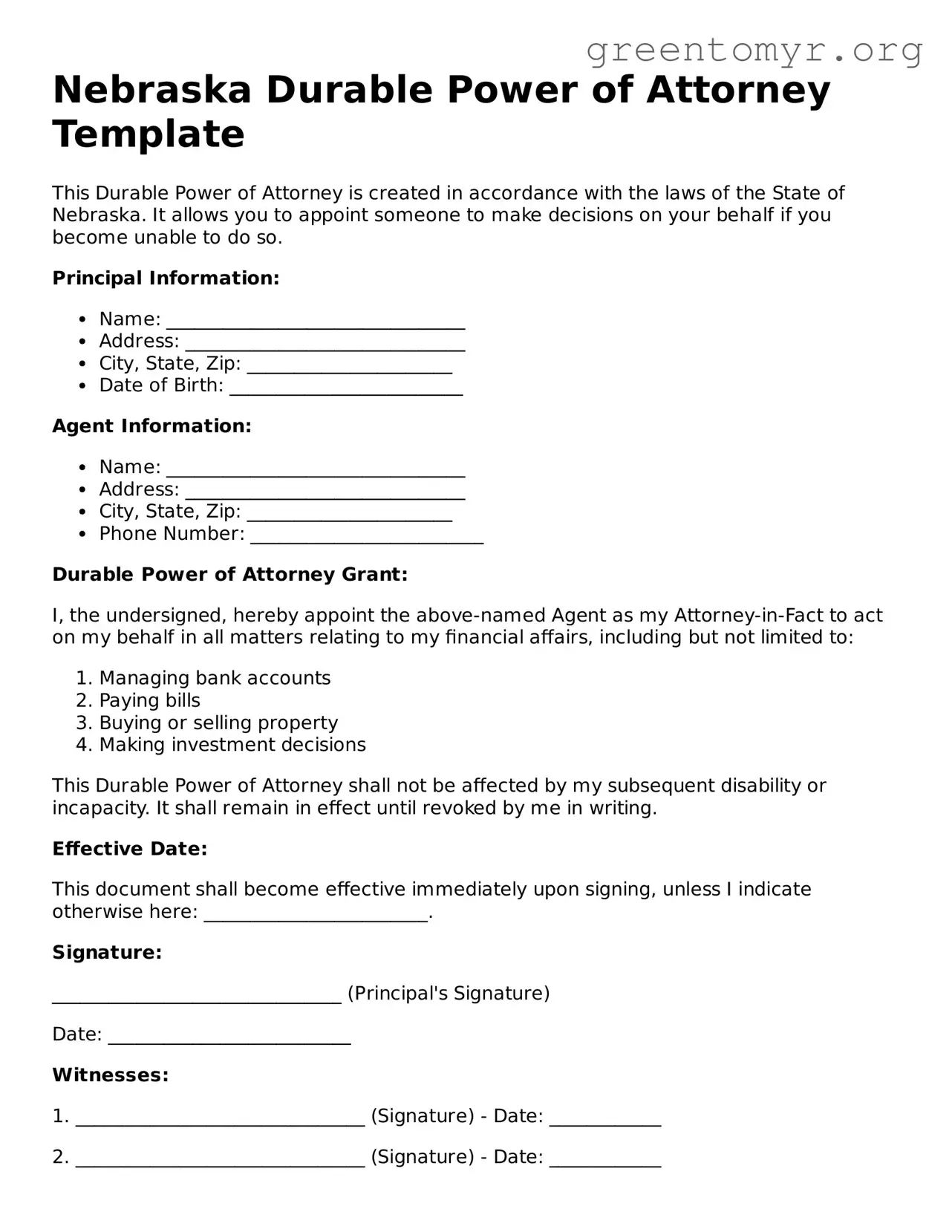
Nebraska Durable Power of Attorney Template
This Durable Power of Attorney is created in accordance with the laws of the State of Nebraska. It allows you to appoint someone to make decisions on your behalf if you become unable to do so.
Principal Information:
Agent Information:
Durable Power of Attorney Grant:
I, the undersigned, hereby appoint the above-named Agent as my Attorney-in-Fact to act on my behalf in all matters relating to my financial affairs, including but not limited to:
This Durable Power of Attorney shall not be affected by my subsequent disability or incapacity. It shall remain in effect until revoked by me in writing.
Effective Date:
This document shall become effective immediately upon signing, unless I indicate otherwise here: ________________________.
Signature:
_______________________________ (Principal's Signature)
Date: __________________________
Witnesses:
1. _______________________________ (Signature) - Date: ____________
2. _______________________________ (Signature) - Date: ____________
Notarization:
State of Nebraska
County of ______________________
Subscribed and sworn to before me this ______ day of __________, 20__.
_______________________________ (Notary Public Signature)
My commission expires: ________________
| Fact Name | Details |
|---|---|
| Definition | A Nebraska Durable Power of Attorney allows an individual to appoint someone to manage their financial and legal matters if they become incapacitated. |
| Governing Law | The form is governed by the Nebraska Revised Statutes, specifically Section 30-2601 to 30-2622. |
| Durability | This power of attorney remains effective even if the principal becomes incapacitated. |
| Principal | The individual who creates the power of attorney is referred to as the principal. |
| Agent | The person designated to act on behalf of the principal is called the agent or attorney-in-fact. |
| Signing Requirements | The form must be signed by the principal and acknowledged before a notary public. |
| Revocation | The principal can revoke the durable power of attorney at any time as long as they are competent. |
| Limitations | Agents cannot make healthcare decisions unless specifically authorized in the document. |
| Use Cases | This form is often used for financial management, real estate transactions, and handling bank accounts. |
Filling out the Nebraska Durable Power of Attorney form is a straightforward process. Once completed, this document allows you to designate someone to make decisions on your behalf regarding financial and legal matters if you become unable to do so yourself.
After filling out the form, ensure that it is stored in a safe place and that your attorney-in-fact knows where to find it. This will help facilitate the process when it needs to be used.
A Durable Power of Attorney (DPOA) in Nebraska is a legal document that allows you to appoint someone to make decisions on your behalf if you become unable to do so. This can include financial, legal, and healthcare decisions. The "durable" aspect means that the authority remains effective even if you become incapacitated.
You can choose any competent adult to act as your agent. This person should be someone you trust, as they will have significant authority over your affairs. It is common to appoint a family member, close friend, or a trusted advisor.
The powers granted can vary based on your needs. Generally, you can authorize your agent to:
It's essential to clearly outline the powers in the document to avoid any confusion.
To create a DPOA, you need to fill out the appropriate form, which can be obtained from legal resources or online. After completing the form, you must sign it in the presence of a notary public. This notarization is crucial for the document to be valid.
Yes, you have the right to revoke or change your DPOA at any time as long as you are competent. To revoke, you should create a written notice stating your intent to revoke the previous document and notify your agent and any relevant institutions.
If you do not have a DPOA and become incapacitated, a court may need to appoint a guardian or conservator to manage your affairs. This process can be lengthy and costly, and it may not align with your wishes.
No, a Durable Power of Attorney and a Living Will serve different purposes. A DPOA allows someone to make decisions on your behalf, while a Living Will outlines your wishes regarding medical treatment and end-of-life care. Both documents are important for comprehensive planning.
A Durable Power of Attorney can take effect immediately upon signing, or you can specify that it only takes effect upon your incapacitation. This choice should be clearly stated in the document to avoid any misunderstandings.
Generally, a DPOA from another state may be recognized in Nebraska, but it is advisable to have a Nebraska-specific form to ensure compliance with state laws. Consulting with a local attorney can provide clarity on this matter.
Filling out a Nebraska Durable Power of Attorney form can be a straightforward process, but many people make mistakes that can lead to complications later. One common error is failing to clearly identify the principal. The principal is the person granting authority, and it’s essential to provide their full legal name and address. Omitting this information can create confusion about who the document is meant to represent.
Another frequent mistake is not properly designating the agent. The agent is the individual who will act on behalf of the principal. It’s important to choose someone trustworthy and capable. Some individuals forget to include the agent's contact information, which can hinder their ability to act when needed.
People often neglect to specify the powers granted to the agent. The form allows for broad or limited powers, and it’s crucial to be clear about what the agent can and cannot do. Vague language can lead to misunderstandings and disputes down the line.
Another mistake is failing to date the document. A Durable Power of Attorney must be dated to be valid. Without a date, there can be questions about when the authority was granted, which may lead to legal challenges.
Some individuals forget to sign the document in the presence of a notary public. Notarization is a critical step in making the document legally binding. Skipping this step can render the form ineffective, leaving the principal without the intended protections.
Additionally, people sometimes overlook the need for witnesses. In Nebraska, certain situations require the presence of witnesses when signing the Durable Power of Attorney. Not including the necessary witnesses can invalidate the document.
Another common oversight is not updating the form when circumstances change. Life events, such as marriage, divorce, or the death of an agent, necessitate a review and possible revision of the document. Failing to keep the form current can lead to confusion and unintended consequences.
Some individuals also make the mistake of not discussing their wishes with their agent. Open communication is vital. If the agent is unaware of the principal's preferences, they may make decisions that do not align with the principal's values or desires.
Finally, people may not keep a copy of the completed form in a safe and accessible location. It’s essential to store the document where it can be easily found when needed. Without access to the form, the agent may struggle to fulfill their responsibilities.
By being aware of these common mistakes, individuals can take steps to ensure that their Nebraska Durable Power of Attorney form is filled out correctly. This preparation can provide peace of mind and help avoid complications in the future.
When creating a Nebraska Durable Power of Attorney, it's often beneficial to consider additional forms and documents that can complement this legal instrument. Each of these documents serves a specific purpose and can enhance your overall estate planning strategy.
By understanding these documents, individuals can create a comprehensive plan that addresses both health and financial matters, ensuring their wishes are respected and their loved ones are prepared to act on their behalf.
Filling out a Durable Power of Attorney form in Nebraska is an important step in planning for the future. Here are some key things to keep in mind:
Taking these steps can help ensure that your Durable Power of Attorney form is filled out correctly and serves its intended purpose. It’s about protecting your interests and ensuring your wishes are respected.
Misconception 1: A Durable Power of Attorney is only for financial matters.
This is not true. While many people use a Durable Power of Attorney (DPOA) primarily for financial decisions, it can also cover health care decisions. The document can grant authority to make medical choices on behalf of the principal if they become incapacitated.
Misconception 2: A Durable Power of Attorney takes away all control from the principal.
In reality, a DPOA allows the principal to maintain control over their affairs. The principal can specify what powers they are granting and can revoke the DPOA at any time, as long as they are mentally competent.
Misconception 3: A Durable Power of Attorney is only valid while the principal is alive.
This is misleading. A DPOA is designed to remain effective even if the principal becomes incapacitated. It is important to understand that the authority granted continues until the principal's death, at which point the DPOA is no longer valid.
Misconception 4: Anyone can serve as an agent under a Durable Power of Attorney.
This is partially correct. While most individuals can serve as an agent, certain restrictions apply. For example, a person who is under a legal disability or has been convicted of a felony may not be eligible to act as an agent.
Filling out and using the Nebraska Durable Power of Attorney form can be a straightforward process, but understanding its key elements is essential. Here are some important takeaways to consider:
Understanding these key aspects can help ensure that your Durable Power of Attorney is executed effectively and serves its intended purpose.