Content Navigation

Creating a Nebraska Employee Handbook is an essential step for any business looking to establish clear guidelines and expectations for its employees. This document serves as a comprehensive resource that outlines company policies, employee rights, and workplace procedures. It covers important topics such as attendance, dress code, workplace safety, and anti-discrimination policies. Additionally, the handbook addresses employee benefits, including vacation time, sick leave, and health insurance options. By providing this information in a clear and organized manner, employers can foster a positive work environment and help employees understand their roles and responsibilities. A well-crafted handbook not only protects the company legally but also promotes transparency and trust within the workplace, making it a vital tool for both employers and employees alike.

Nebraska Employee Handbook Example

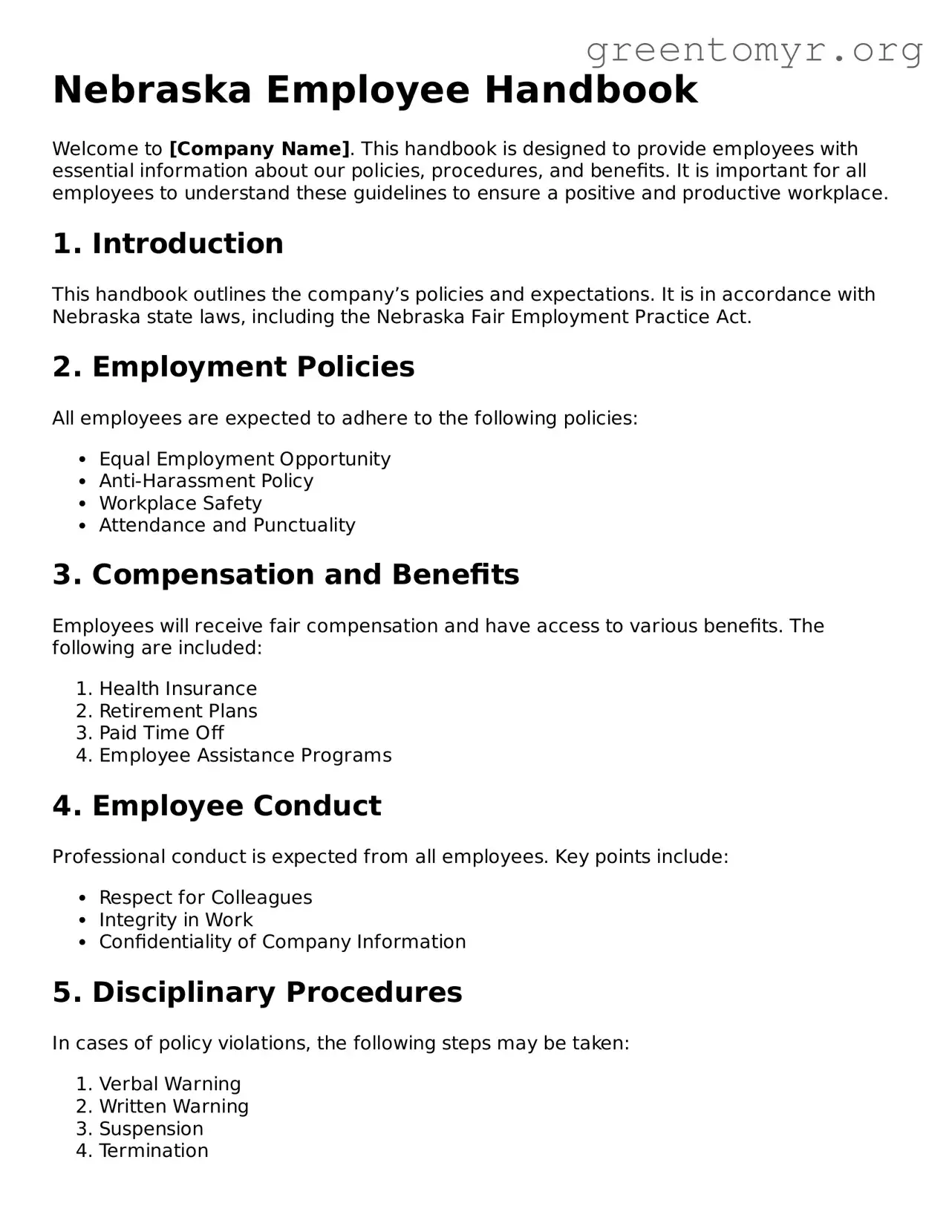
Nebraska Employee Handbook

Welcome to [Company Name]. This handbook is designed to provide employees with essential information about our policies, procedures, and benefits. It is important for all employees to understand these guidelines to ensure a positive and productive workplace.

1. Introduction

This handbook outlines the company’s policies and expectations. It is in accordance with Nebraska state laws, including the Nebraska Fair Employment Practice Act.

2. Employment Policies

All employees are expected to adhere to the following policies:

  • Equal Employment Opportunity
  • Anti-Harassment Policy
  • Workplace Safety
  • Attendance and Punctuality

3. Compensation and Benefits

Employees will receive fair compensation and have access to various benefits. The following are included:

  1. Health Insurance
  2. Retirement Plans
  3. Paid Time Off
  4. Employee Assistance Programs

4. Employee Conduct

Professional conduct is expected from all employees. Key points include:

  • Respect for Colleagues
  • Integrity in Work
  • Confidentiality of Company Information

5. Disciplinary Procedures

In cases of policy violations, the following steps may be taken:

  1. Verbal Warning
  2. Written Warning
  3. Suspension
  4. Termination

6. Acknowledgment

By signing below, you acknowledge that you have received, read, and understood the Nebraska Employee Handbook.

Employee Name: [Employee Name]

Date: [Date]

7. Contact Information

If you have any questions regarding this handbook, please contact:

Human Resources Department: [HR Contact Name]

Phone: [HR Phone Number]

Email: [HR Email]

Thank you for being a part of [Company Name]. We look forward to a successful working relationship.

PDF Form Features

Fact Name Description
Purpose The Nebraska Employee Handbook serves as a guide for employees regarding company policies and procedures.
Legal Requirement While not legally required, having an employee handbook can help clarify expectations and protect the employer.
Governing Laws The handbook should comply with Nebraska labor laws, including the Nebraska Wage and Hour Laws.
Content Areas Common sections include company values, workplace conduct, benefits, and leave policies.
Updates It is important to regularly update the handbook to reflect changes in laws and company policies.
Distribution Employees should receive a copy of the handbook upon hiring and whenever significant changes occur.
Acknowledgment Employees often sign an acknowledgment form to confirm they have received and understood the handbook.
Legal Protection A well-drafted handbook can help protect the company from potential legal disputes by clearly outlining policies.

Guide to Using Nebraska Employee Handbook

Completing the Nebraska Employee Handbook form is an essential step in ensuring that you are familiar with your rights and responsibilities as an employee. Once you have filled out the form, it will be reviewed by your employer to ensure compliance with state regulations and internal policies.

  1. Begin by gathering all necessary personal information, including your full name, address, and contact details.
  2. Locate the section that requires your job title and department. Fill this in accurately, as it helps to identify your role within the organization.
  3. Next, find the area designated for your start date. Enter the date you began your employment.
  4. Review any sections that may require you to acknowledge receipt of the handbook. This often involves signing or initialing specific statements.
  5. Check for any additional information that may be requested, such as emergency contact details or previous employment history.
  6. Before submitting the form, double-check all entries for accuracy. Make sure there are no spelling errors or missing information.
  7. Finally, submit the completed form to the designated HR representative or through the specified submission method outlined by your employer.

Get Answers on Nebraska Employee Handbook

What is the Nebraska Employee Handbook form?

The Nebraska Employee Handbook form is a document designed to outline the policies, procedures, and expectations of an employer towards their employees in the state of Nebraska. It serves as a guide for both employees and management, ensuring that everyone understands the workplace rules, rights, and responsibilities. This handbook typically includes sections on company policies, employee conduct, benefits, and procedures for addressing grievances.

Why is it important to have an Employee Handbook?

An Employee Handbook is crucial for several reasons:

  • It establishes clear guidelines for employee behavior and workplace expectations.
  • It helps protect the employer from potential legal issues by documenting policies and procedures.
  • It ensures consistency in how policies are applied across the organization.
  • It serves as a resource for employees, providing them with information about their rights and responsibilities.

How often should the Employee Handbook be updated?

Updating the Employee Handbook is essential to keep it relevant and compliant with current laws and regulations. It is recommended to review the handbook at least once a year or whenever there are significant changes in the law, company policies, or organizational structure. Keeping the handbook up-to-date helps ensure that employees are aware of any new policies or changes that may affect their employment.

Can employees provide input on the Employee Handbook?

Yes, employees can and should have the opportunity to provide input on the Employee Handbook. Engaging employees in the process can lead to a more comprehensive and effective document. Employers may consider conducting surveys or holding meetings to gather feedback. This collaborative approach can enhance employee morale and foster a sense of ownership regarding workplace policies.

Common mistakes

Filling out the Nebraska Employee Handbook form can seem straightforward, but many people make common mistakes that can lead to confusion down the line. One frequent error is not reading the instructions carefully. It’s easy to overlook specific requirements or details, which can result in incomplete or incorrect submissions.

Another mistake is failing to provide accurate personal information. This includes not using your full legal name or providing outdated contact information. Employers rely on this data to communicate important updates, so accuracy is crucial.

Some individuals skip the section on acknowledgments. This part often requires you to confirm that you have read and understood the handbook. Ignoring this step can create misunderstandings later, especially if questions arise about company policies.

Additionally, people often forget to sign and date the form. A signature is a simple yet essential element that validates your acknowledgment of the handbook’s contents. Without it, the form may be considered incomplete.

Another common issue is neglecting to ask questions. If something is unclear, it’s important to seek clarification. Many people hesitate to reach out, but addressing uncertainties upfront can prevent problems later.

Some individuals also fail to keep a copy of the completed form for their records. Having a personal copy can be helpful if there are any disputes or if you need to reference the information in the future.

Lastly, many overlook the importance of updating the form when personal circumstances change. Whether it’s a new address, a name change, or a change in emergency contacts, keeping this information current is vital for effective communication.

Documents used along the form

When it comes to managing employees effectively, having a comprehensive set of documents is crucial. Alongside the Nebraska Employee Handbook, several other forms and documents can help streamline communication and clarify policies within an organization. Here’s a list of ten essential documents that often accompany the Employee Handbook.

  • Job Description Form: This document outlines the responsibilities, qualifications, and expectations for each position within the organization, ensuring employees understand their roles clearly.
  • Employee Application Form: Used during the hiring process, this form collects essential information about candidates, including their work history, education, and references.
  • Employee Performance Review Form: This form helps managers assess employee performance periodically, providing a structured way to give feedback and set future goals.
  • Incident Report Form: In the event of an accident or workplace incident, this form is used to document what occurred, helping to maintain safety and compliance.
  • Leave of Absence Request Form: Employees can use this form to formally request time off for personal reasons, ensuring that requests are documented and processed appropriately.
  • Non-Disclosure Agreement (NDA): This legal document protects sensitive company information by ensuring employees understand their obligation to keep certain information confidential.
  • Employee Acknowledgment Form: This form confirms that employees have received, read, and understood the Employee Handbook and other relevant policies.
  • Direct Deposit Authorization Form: Employees complete this form to authorize the automatic deposit of their paychecks into their bank accounts, simplifying payroll processes.
  • Workplace Safety Policy: This document outlines the safety protocols and procedures employees must follow to maintain a safe working environment.
  • Termination Checklist: When an employee leaves the company, this checklist ensures all necessary steps are taken, including return of company property and final pay processing.

These documents, when used in conjunction with the Nebraska Employee Handbook, create a solid framework for employee management. They foster clear communication, set expectations, and help maintain a professional workplace environment. By having these forms readily available, organizations can ensure a smoother operation and a more engaged workforce.

Similar forms

The Employee Handbook serves as a crucial resource for both employees and employers, outlining policies, procedures, and expectations within the workplace. Several other documents share similarities with the Employee Handbook, each serving specific purposes in the realm of employment. Below is a list of nine such documents, along with a brief explanation of how they are similar.

  • Code of Conduct: Like the Employee Handbook, the Code of Conduct establishes guidelines for acceptable behavior within the workplace, ensuring that all employees understand the standards expected of them.
  • Employee Policy Manual: This document is akin to the Employee Handbook, providing detailed policies on various topics such as attendance, leave, and workplace safety, thus serving as a comprehensive guide for employees.
  • Onboarding Materials: Onboarding documents share similarities with the Employee Handbook by introducing new hires to company culture, values, and policies, helping them acclimate to their new environment.
  • Safety Manual: The Safety Manual, much like the Employee Handbook, outlines safety protocols and procedures to ensure a safe working environment, emphasizing the importance of employee well-being.
  • Performance Evaluation Guidelines: These guidelines mirror the Employee Handbook by detailing the performance review process, expectations for employee performance, and criteria for evaluations.
  • Employee Benefits Guide: Similar to the Employee Handbook, this guide provides information on employee benefits, including health insurance, retirement plans, and other perks, ensuring employees are informed about their entitlements.
  • Disciplinary Procedures Document: This document outlines the steps and processes involved in addressing employee misconduct, paralleling the Employee Handbook in its aim to promote fairness and transparency.
  • Grievance Policy: The Grievance Policy serves a similar purpose as the Employee Handbook by providing a framework for employees to voice concerns or complaints, thereby fostering an open and communicative workplace culture.
  • Training Manual: Like the Employee Handbook, the Training Manual offers guidance on job-specific skills and responsibilities, ensuring that employees are equipped with the necessary knowledge to perform their roles effectively.

Dos and Don'ts

When filling out the Nebraska Employee Handbook form, it is important to approach the task with care. Here are some guidelines to help you navigate the process effectively.

  • Do read the entire form carefully before starting to fill it out.
  • Do provide accurate and truthful information in all sections.
  • Do ask for clarification if you do not understand a question.
  • Do keep a copy of the completed form for your records.
  • Don't rush through the form; take your time to ensure accuracy.
  • Don't leave any required fields blank; fill in all necessary information.

Following these guidelines will help ensure that your form is filled out correctly and completely. If you have any concerns or questions, consider reaching out for assistance.

Misconceptions

Understanding the Nebraska Employee Handbook form is essential for both employers and employees. However, several misconceptions can lead to confusion. Here are ten common misunderstandings about this important document:

  1. It is optional for employers to have an employee handbook. Many believe that an employee handbook is not necessary. In reality, having one can help set clear expectations and protect both the employer and employees.
  2. The handbook must be a legal document. While the handbook should contain policies that comply with the law, it does not need to be a formal legal document. It serves more as a guide for workplace behavior and procedures.
  3. All handbooks are the same. Each employee handbook should be tailored to the specific needs of the organization. Different industries and company cultures will require different policies and procedures.
  4. Once created, the handbook never needs to be updated. This is a common misconception. Employee handbooks should be reviewed and updated regularly to reflect changes in laws and company policies.
  5. Employees are not required to read the handbook. While there may not be a legal requirement for employees to read it, it is in their best interest to do so. Understanding the handbook helps employees know their rights and responsibilities.
  6. The handbook guarantees employment. A handbook does not create a contract of employment. It outlines policies but does not guarantee job security or employment duration.
  7. Only HR can address handbook issues. While HR plays a key role, all managers and supervisors should be familiar with the handbook to ensure consistent application of policies.
  8. Handbooks only cover disciplinary actions. In addition to disciplinary procedures, handbooks should address a variety of topics, including workplace conduct, benefits, and safety policies.
  9. There are no legal consequences for handbook violations. Misunderstanding this can be dangerous. Failure to follow the policies outlined in the handbook can lead to legal issues for both the employer and employees.
  10. Handbooks are only for larger companies. Small businesses can benefit just as much from having an employee handbook. It helps establish a professional environment and sets clear expectations from the start.

By addressing these misconceptions, both employers and employees can better understand the significance of the Nebraska Employee Handbook form and how it can contribute to a positive workplace culture.

Key takeaways

Filling out and using the Nebraska Employee Handbook form is an important process for both employers and employees. Here are some key takeaways to consider:

  • Understand the Purpose: The handbook serves as a comprehensive guide for employees regarding company policies, procedures, and expectations.
  • Customize the Content: Tailor the handbook to reflect the specific culture and needs of your organization.
  • Include Essential Policies: Make sure to cover crucial topics such as attendance, conduct, and benefits.
  • Review Regularly: Update the handbook periodically to ensure compliance with changing laws and regulations.
  • Seek Legal Guidance: Consider consulting a legal expert to ensure all policies are compliant with state and federal laws.
  • Distribute to Employees: Provide each employee with a copy of the handbook and obtain their acknowledgment of receipt.
  • Encourage Questions: Foster an environment where employees feel comfortable asking questions about the handbook’s contents.
  • Maintain Accessibility: Ensure that the handbook is easily accessible to all employees, whether in print or digital format.