In Nebraska, the General Power of Attorney form serves as a crucial legal tool that allows individuals to designate someone they trust to make decisions on their behalf. This document can cover a wide range of financial and legal matters, from managing bank accounts and real estate transactions to handling tax matters and business dealings. By granting this authority, you empower your chosen agent to act in your best interest, even if you become unable to make decisions due to illness or other circumstances. It’s important to note that the authority granted is broad, but it can be tailored to fit your specific needs. Additionally, the form must be properly executed, which typically involves signing it in the presence of a notary public. Understanding the nuances of this form can help ensure that your financial and legal affairs are handled according to your wishes, providing peace of mind for you and your loved ones.
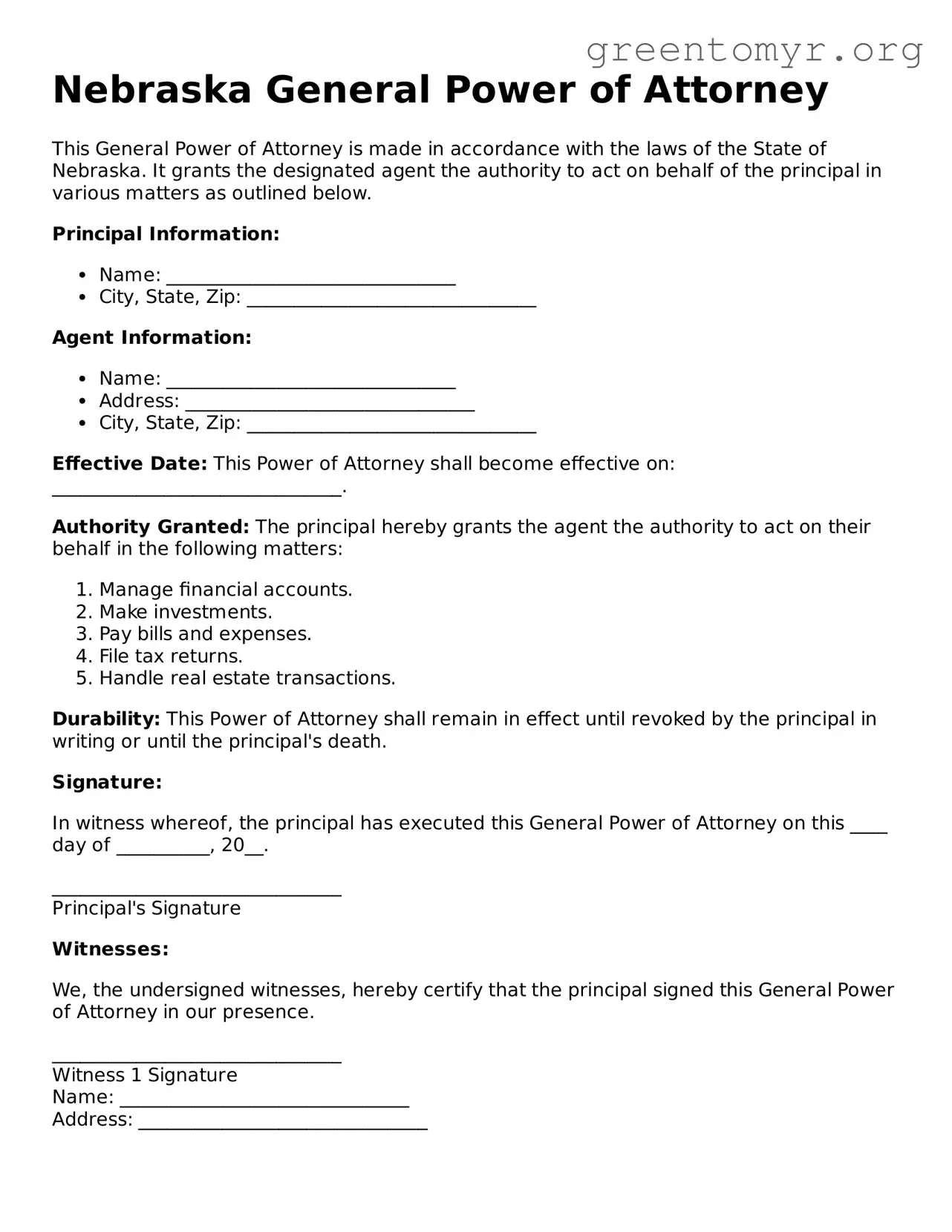
Nebraska General Power of Attorney
This General Power of Attorney is made in accordance with the laws of the State of Nebraska. It grants the designated agent the authority to act on behalf of the principal in various matters as outlined below.
Principal Information:
Agent Information:
Effective Date: This Power of Attorney shall become effective on: _______________________________.
Authority Granted: The principal hereby grants the agent the authority to act on their behalf in the following matters:
Durability: This Power of Attorney shall remain in effect until revoked by the principal in writing or until the principal's death.
Signature:
In witness whereof, the principal has executed this General Power of Attorney on this ____ day of __________, 20__.
_______________________________
Principal's Signature
Witnesses:
We, the undersigned witnesses, hereby certify that the principal signed this General Power of Attorney in our presence.
_______________________________
Witness 1 Signature
Name: _______________________________
Address: _______________________________
_______________________________
Witness 2 Signature
Name: _______________________________
Address: _______________________________
Notarization:
State of Nebraska
County of _______________________________
On this ____ day of __________, 20__, before me, a Notary Public, personally appeared _______________________________, known to me to be the person whose name is subscribed to this document, and acknowledged that they executed the same.
_______________________________
Notary Public Signature
My Commission Expires: ________________
| Fact Name | Details |
|---|---|
| Definition | A General Power of Attorney allows an individual to appoint someone else to manage their financial and legal affairs. |
| Governing Law | The Nebraska Uniform Power of Attorney Act governs the use of Power of Attorney forms in Nebraska. |
| Durability | This form can be made durable, meaning it remains effective even if the principal becomes incapacitated. |
| Agent's Authority | The agent can perform a wide range of actions, including managing bank accounts, signing checks, and handling real estate transactions. |
| Revocation | The principal can revoke the General Power of Attorney at any time, as long as they are mentally competent. |
| Notarization Requirement | The form must be signed in the presence of a notary public to be valid in Nebraska. |
| Limitations | Some actions, like making medical decisions, typically require a separate medical power of attorney. |
Filling out the Nebraska General Power of Attorney form is a straightforward process. This document allows you to designate someone to make decisions on your behalf. After completing the form, you will need to sign it in front of a notary public to ensure its validity.
A General Power of Attorney (GPOA) in Nebraska is a legal document that allows one person, known as the principal, to authorize another person, called the agent or attorney-in-fact, to act on their behalf. This document grants broad powers to the agent, enabling them to manage financial, legal, and business matters for the principal.
The powers granted can vary based on the principal's needs. Common powers include:
It’s important to note that the principal can specify which powers to grant or limit in the document.
To create a GPOA in Nebraska, follow these steps:
Having the document notarized is crucial for it to be legally valid.
Yes, in Nebraska, a General Power of Attorney must be notarized to be legally effective. This requirement helps to verify the identity of the principal and confirms that they are signing the document voluntarily.
Yes, a principal can revoke a General Power of Attorney at any time, as long as they are mentally competent. To revoke, the principal should create a written notice of revocation and provide it to the agent and any relevant third parties who may rely on the GPOA.
If the principal becomes incapacitated, the General Power of Attorney typically remains in effect unless it is explicitly stated to terminate upon incapacity. However, it is advisable to consider a Durable Power of Attorney if the intent is for the agent to continue acting on behalf of the principal during periods of incapacity.
Yes, the main difference lies in the durability of the powers granted. A General Power of Attorney ceases to be effective if the principal becomes incapacitated. In contrast, a Durable Power of Attorney remains in effect even if the principal loses the ability to make decisions. This distinction is critical for long-term planning.
Absolutely. The principal has the flexibility to limit the powers granted to the agent. This can include specifying certain transactions or types of decisions that the agent is not authorized to make. Clearly outlining these limitations in the document is essential to ensure the principal's wishes are respected.
Filling out a Nebraska General Power of Attorney form can be a straightforward process, but there are common mistakes that individuals often make. One frequent error is failing to specify the powers granted to the agent. Without clear instructions, the agent may not know what actions they are authorized to take on behalf of the principal. This ambiguity can lead to confusion and potential disputes.
Another mistake is neglecting to date the document. A date provides context for when the powers were granted and can be crucial in determining the validity of the document. If the form is not dated, it may raise questions about its enforceability, especially if there are changes in the principal's circumstances.
People sometimes forget to sign the form. A signature is essential for the document to be considered valid. Additionally, some individuals may not realize that the signature must be witnessed or notarized, depending on the specific requirements of Nebraska law. Omitting these steps can invalidate the power of attorney.
It is also common for individuals to overlook the need for clarity in the agent's identification. Providing insufficient information about the agent, such as their full name and address, can create complications. Clear identification ensures that the intended person is recognized as the agent, reducing the likelihood of disputes.
In some cases, individuals may not consider the potential for revocation. Failing to include a statement about revocation can lead to confusion if the principal decides to change their mind later. It is important to clarify that this power of attorney can be revoked at any time, as long as the principal is competent to do so.
Another mistake involves not discussing the power of attorney with the chosen agent. It is advisable for individuals to communicate with their agents about their wishes and expectations. Without this conversation, the agent may act in ways that do not align with the principal's intentions.
Some people do not seek legal advice when filling out the form. While it is possible to complete the power of attorney without professional assistance, consulting an attorney can provide valuable insights. Legal professionals can help ensure that the document meets all legal requirements and reflects the principal's desires accurately.
Additionally, individuals may not keep copies of the completed form. After signing and notarizing the document, it is essential to distribute copies to the agent and any relevant institutions. Without copies, the agent may face difficulties in exercising their powers when needed.
Finally, people sometimes fail to review the form periodically. Life circumstances can change, and the powers granted may no longer reflect the principal's current wishes. Regularly reviewing the power of attorney ensures that it remains relevant and aligned with the principal's intentions.
A General Power of Attorney (POA) in Nebraska allows an individual to designate someone else to manage their financial and legal affairs. While the POA is a crucial document, it is often accompanied by other forms that can help clarify roles and responsibilities. Below are four commonly used documents that may complement the Nebraska General Power of Attorney.
These documents work together to provide a comprehensive approach to managing both financial and healthcare decisions. By understanding and utilizing these forms, individuals can ensure their preferences are honored and that trusted agents are empowered to act on their behalf when necessary.
When filling out the Nebraska General Power of Attorney form, it is important to follow certain guidelines to ensure the document is valid and effective. Here are four things you should and shouldn't do:
Misconception 1: A General Power of Attorney is only for financial matters.
Many people believe that a General Power of Attorney (GPOA) can only be used for managing financial affairs. In reality, while it does cover financial decisions, it can also grant authority for health care and other personal matters, depending on how it is drafted.
Misconception 2: The agent must be a lawyer or a financial professional.
This is not true. The agent, or attorney-in-fact, can be anyone you trust, such as a family member or friend. It is essential that this person understands your wishes and can act in your best interest.
Misconception 3: A General Power of Attorney is permanent and cannot be revoked.
Some people think that once a GPOA is signed, it cannot be changed or revoked. This is incorrect. You can revoke or amend your GPOA at any time, as long as you are mentally competent to do so.
Misconception 4: A General Power of Attorney is effective immediately and cannot be limited.
While many GPOAs become effective immediately upon signing, you can specify conditions or limitations. For example, you can choose for it to take effect only if you become incapacitated.
When considering the Nebraska General Power of Attorney form, it is essential to understand its significance and the implications of its use. Here are some key takeaways to keep in mind: