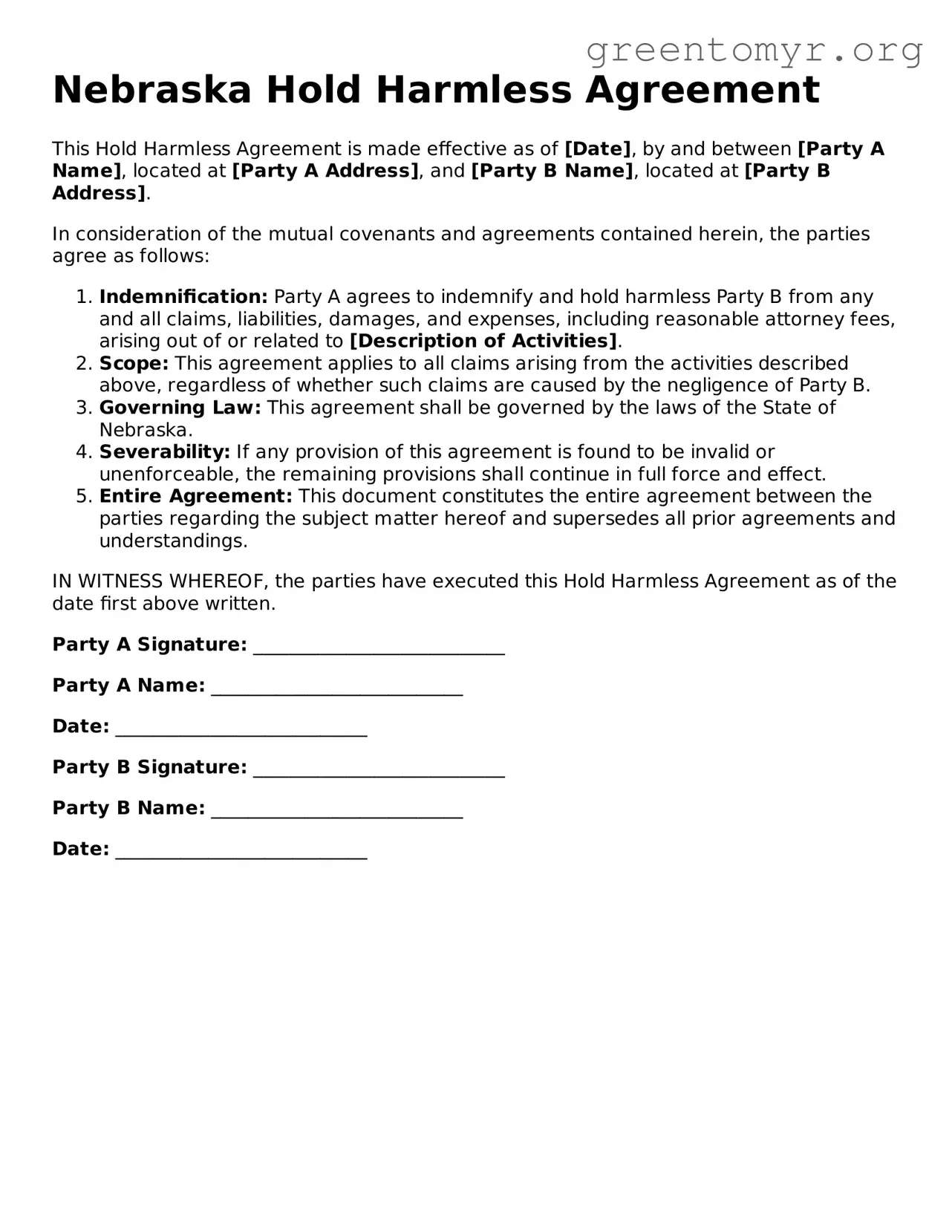
The Nebraska Hold Harmless Agreement form serves as a vital tool for individuals and organizations seeking to protect themselves from liability in various situations. This agreement allows one party to agree not to hold the other party responsible for any potential damages, injuries, or losses that may arise during specific activities or events. It is commonly used in contexts such as rental agreements, sports events, and community gatherings, where risks may be present. By signing this form, participants acknowledge their understanding of the risks involved and accept responsibility for their own safety. The document outlines the responsibilities of each party, ensuring clarity and mutual understanding. Importantly, it emphasizes the need for transparency, encouraging open communication about potential hazards. Utilizing this agreement can foster a sense of security, allowing individuals and organizations to engage in activities with greater peace of mind, knowing that they have taken steps to mitigate potential legal issues.
Nebraska Hold Harmless Agreement
This Hold Harmless Agreement is made effective as of [Date], by and between [Party A Name], located at [Party A Address], and [Party B Name], located at [Party B Address].
In consideration of the mutual covenants and agreements contained herein, the parties agree as follows:
IN WITNESS WHEREOF, the parties have executed this Hold Harmless Agreement as of the date first above written.
Party A Signature: ___________________________
Party A Name: ___________________________
Date: ___________________________
Party B Signature: ___________________________
Party B Name: ___________________________
Date: ___________________________
| Fact Name | Details |
|---|---|
| Purpose | The Nebraska Hold Harmless Agreement is designed to protect one party from liability for certain actions or events. |
| Parties Involved | This agreement typically involves two parties: the indemnitor (the one who agrees to hold harmless) and the indemnitee (the one being protected). |
| Legal Basis | The agreement is governed by Nebraska state law, specifically under the principles of contract law. |
| Common Uses | It is often used in contexts such as events, construction projects, and rental agreements. |
| Enforceability | For the agreement to be enforceable, it must be clear, specific, and signed by all parties involved. |
| Limitations | Some limitations exist; for instance, it cannot protect against gross negligence or willful misconduct. |
| Written vs. Oral | A written agreement is recommended to ensure clarity and avoid disputes, although oral agreements may be valid in some cases. |
| Duration | The duration of the agreement should be specified, as it can vary based on the context and needs of the parties. |
| Modification | Any changes to the agreement must be documented in writing and signed by both parties to be valid. |
Filling out the Nebraska Hold Harmless Agreement form is a straightforward process. Once you have the form in front of you, you will need to provide specific information to ensure that it is completed correctly. Follow these steps to make the process easier.
After completing the form, make sure to keep a copy for your records. You may need to submit it to the relevant party or organization as outlined in the agreement. Ensure that all information is accurate to avoid any issues later on.
A Nebraska Hold Harmless Agreement is a legal document designed to protect one party from liability for any damages or injuries that may occur during a specific activity or event. This agreement is often used in various contexts, such as rental agreements, construction projects, or events where one party may assume risks associated with the actions of another party.
This agreement is commonly utilized by individuals, businesses, and organizations. For instance, landlords may use it to protect themselves from claims made by tenants, while event organizers may require participants to sign it to limit their liability in case of accidents. It is essential for anyone engaging in activities that carry potential risks.
A Hold Harmless Agreement generally includes the following components:
Yes, a Hold Harmless Agreement can be legally binding in Nebraska, provided it meets certain criteria. The agreement must be clear, specific, and voluntarily signed by all parties involved. It is advisable to consult with a legal professional to ensure that the agreement is properly drafted and enforceable.
Yes, while Hold Harmless Agreements are generally enforceable, they can be challenged in court under certain circumstances. For example, if the agreement is found to be unconscionable, ambiguous, or if one party did not fully understand the terms, a court may invalidate it. Additionally, agreements that attempt to waive liability for gross negligence or intentional misconduct may not be enforceable.
To ensure the effectiveness of your Hold Harmless Agreement, consider the following tips:
You can find templates for Nebraska Hold Harmless Agreements through various online legal document services, local legal aid offices, or by consulting with an attorney. It is important to choose a template that fits your specific needs and to modify it as necessary to reflect the unique circumstances of your situation.
Filling out the Nebraska Hold Harmless Agreement form can be straightforward, but several common mistakes can lead to issues. One frequent error is failing to provide accurate personal information. Ensure that names, addresses, and contact details are correct. Inaccurate information can delay processing or lead to disputes later.
Another mistake involves overlooking the date. It’s crucial to date the agreement properly. An undated form may be considered invalid, which can nullify the protections intended by the agreement.
Many individuals also neglect to read the entire form thoroughly. Understanding the terms and conditions is essential. Misinterpretation can lead to signing away rights unintentionally. Take the time to review every section.
Some people fail to include all necessary signatures. The agreement may require signatures from multiple parties. Omitting a signature can render the document incomplete and unenforceable.
In addition, using unclear or vague language can create problems. Be specific about the terms of the agreement. Ambiguities can lead to different interpretations, resulting in potential conflicts.
Another common oversight is not including a witness or notary when required. Certain agreements may need a witness to be valid. Check the requirements to ensure compliance.
People often forget to keep a copy of the signed agreement. Retaining a copy is essential for future reference. Without it, proving the terms of the agreement may become challenging.
Additionally, failing to update the agreement when circumstances change is a mistake. If any details about the parties or the agreement itself change, a new form should be completed to reflect those changes.
Some individuals also underestimate the importance of consulting with a legal professional. While the form may seem simple, seeking advice can help clarify any uncertainties and ensure that the agreement meets all legal requirements.
Lastly, neglecting to follow up on the agreement’s implementation can lead to problems. Ensure that all parties understand their responsibilities and that the terms are being upheld. Regular communication can prevent misunderstandings.
A Hold Harmless Agreement is a crucial document that helps protect one party from legal liability for certain actions or incidents. In Nebraska, this agreement is often accompanied by various other forms and documents that serve different purposes. Below is a list of commonly used documents that may accompany a Hold Harmless Agreement.
Understanding these documents can help individuals and organizations better navigate the legal landscape surrounding liability and risk management. Each form serves a specific purpose and can enhance the effectiveness of a Hold Harmless Agreement in protecting parties from unforeseen incidents.
A Hold Harmless Agreement is a legal document that protects one party from liability for certain actions or events. Several other documents serve similar purposes in various contexts. Below are seven documents that share similarities with a Hold Harmless Agreement:
When filling out the Nebraska Hold Harmless Agreement form, it’s important to follow certain guidelines to ensure clarity and compliance. Here’s a list of things you should and shouldn’t do:
When discussing the Nebraska Hold Harmless Agreement, several misconceptions often arise. Understanding these misunderstandings can help clarify the purpose and implications of this important legal document. Below is a list of seven common misconceptions:
By addressing these misconceptions, individuals can better understand the Nebraska Hold Harmless Agreement and its implications. Clarity in these matters can lead to more informed decisions and better protection for all parties involved.
When filling out and using the Nebraska Hold Harmless Agreement form, keep these key takeaways in mind: