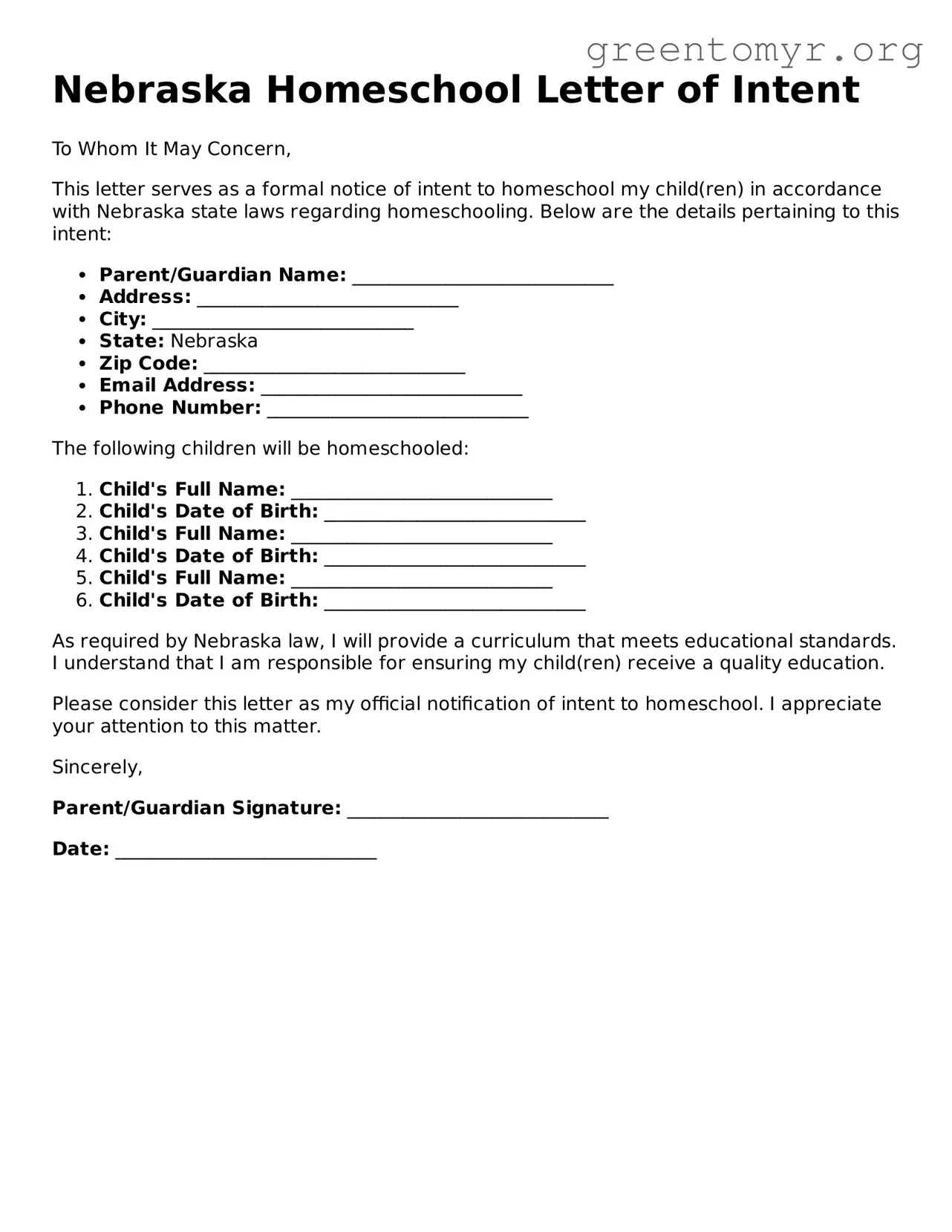
In Nebraska, families choosing to homeschool their children must submit a Homeschool Letter of Intent to comply with state regulations. This form serves as a formal notification to the local school district of the family's decision to educate their child at home. It typically requires essential information, including the names and ages of the children being homeschooled, as well as the address of the homeschooling residence. While the process is designed to be straightforward, it is important for parents to ensure that all required details are accurately filled out to avoid any potential issues with the school district. Additionally, the letter may need to be submitted annually, so understanding the timeline for submission is crucial. By completing this form, families take an important step in establishing their homeschooling journey, demonstrating their commitment to providing an educational experience tailored to their children's needs.
Nebraska Homeschool Letter of Intent
To Whom It May Concern,
This letter serves as a formal notice of intent to homeschool my child(ren) in accordance with Nebraska state laws regarding homeschooling. Below are the details pertaining to this intent:
The following children will be homeschooled:
As required by Nebraska law, I will provide a curriculum that meets educational standards. I understand that I am responsible for ensuring my child(ren) receive a quality education.
Please consider this letter as my official notification of intent to homeschool. I appreciate your attention to this matter.
Sincerely,
Parent/Guardian Signature: ____________________________
Date: ____________________________
| Fact Name | Details |
|---|---|
| Governing Law | The Nebraska Homeschool Letter of Intent is governed by Nebraska Revised Statute 79-1601. |
| Form Purpose | This form notifies the local school district of the intent to homeschool a child. |
| Submission Deadline | The form must be submitted within 30 days of starting the homeschool program. |
| Required Information | Parents must provide the child's name, age, and address on the form. |
| Annual Submission | The Letter of Intent does not need to be submitted annually unless there is a change in the child's educational status. |
| Record Keeping | Parents are advised to keep a copy of the submitted form for their records. |
| Educational Requirements | Parents must ensure that the homeschooling curriculum meets state educational standards. |
| Contact Information | The form should be submitted to the school district where the child resides. |
Once you have the Nebraska Homeschool Letter of Intent form ready, it’s time to fill it out accurately. Completing this form is a straightforward process, and following the steps below will help ensure that you provide all necessary information.
After submitting the form, keep a copy for your records. You may also want to follow up with the school district to confirm they received it and to address any questions they may have.
The Nebraska Homeschool Letter of Intent form is a document that parents or guardians must submit to their local school district to officially notify them of their intention to homeschool their children. This form is a crucial step in the homeschooling process, as it establishes the family's commitment to providing an educational environment outside of traditional public or private schools.
Any parent or guardian who wishes to homeschool their child in Nebraska must submit the Letter of Intent. This requirement applies to children who are of compulsory school age, typically between the ages of 5 and 18. It is important to ensure that the form is submitted for each child being homeschooled.
The Letter of Intent should be submitted at the beginning of the homeschooling year. In Nebraska, it is recommended to submit the form at least 14 days before the start of the school year. If a family decides to begin homeschooling mid-year, they should submit the form as soon as the decision is made to homeschool.
The Letter of Intent typically requires the following information:
It is advisable to ensure that all information is accurate and complete to avoid any delays in the approval process.
While there is no mandated format for the Letter of Intent, it is recommended to follow a clear and organized structure. Many families choose to draft a simple letter that includes all required information. Some school districts may provide a template, so checking with the local district can be helpful.
Once the Letter of Intent is submitted, the school district will typically acknowledge receipt of the form. While there is no formal approval process, it is important for families to maintain a copy of the submitted letter for their records. Additionally, families should be prepared to provide any further information if requested by the school district.
Failing to submit the Letter of Intent can lead to complications. Without this notification, the local school district may consider the child absent from school, which could result in truancy issues. To avoid any legal complications, it is essential to submit the form in a timely manner.
Filling out the Nebraska Homeschool Letter of Intent form can be a straightforward process, but there are common mistakes that individuals often make. Awareness of these pitfalls can help ensure that the submission is accurate and complete. One frequent error is neglecting to include all required information. The form requires specific details about the student, such as their full name and date of birth. Omitting any of this information can lead to delays or rejection of the application.
Another mistake is failing to sign and date the form. A signature is essential as it verifies the intent to homeschool. Without it, the form may be considered incomplete. Additionally, individuals sometimes forget to notify the appropriate school district. It is crucial to send the completed form to the correct district office to ensure proper processing.
Some people mistakenly assume that the form can be submitted electronically. However, Nebraska law typically requires a physical copy to be mailed or delivered in person. This misunderstanding can result in delays in the approval process. Furthermore, individuals may not keep a copy of the submitted form for their records. Retaining a copy is important for future reference and to confirm that the intent was communicated.
Another common oversight involves not adhering to submission deadlines. The form must be submitted within a specific timeframe to comply with state regulations. Missing this deadline can lead to complications in the homeschooling process. Additionally, some applicants may overlook the importance of providing accurate contact information. This can hinder communication between the school district and the homeschooling family.
Lastly, individuals sometimes fail to update the form when there are changes in the homeschooling situation. If a family moves to a different district or changes their educational approach, it is essential to submit an updated Letter of Intent. Keeping the school district informed helps maintain compliance with state laws and ensures that the family remains in good standing as homeschooling families.
When parents decide to homeschool their children in Nebraska, submitting the Homeschool Letter of Intent is just the first step. Along with this form, there are several other documents that can help ensure a smooth homeschooling experience. Here are some important forms and documents you may need to consider.
By preparing these documents alongside the Nebraska Homeschool Letter of Intent, you can create a comprehensive educational plan that supports your child's learning journey. This proactive approach not only helps you stay organized but also ensures compliance with state regulations.
When filling out the Nebraska Homeschool Letter of Intent form, it is important to follow specific guidelines to ensure a smooth process. Here are some dos and don'ts to consider:
When it comes to homeschooling in Nebraska, many individuals hold misconceptions about the Letter of Intent form. Understanding the facts can help clarify the process and ensure compliance with state regulations. Here are seven common misconceptions:
By addressing these misconceptions, parents can better navigate the homeschooling process in Nebraska and ensure they are meeting all legal requirements.
Filling out and using the Nebraska Homeschool Letter of Intent form is an important step for families choosing to educate their children at home. Here are some key takeaways to consider:
By following these guidelines, families can navigate the homeschooling process in Nebraska more effectively.