In Nebraska, the Last Will and Testament form serves as a crucial legal document that allows individuals to outline their wishes regarding the distribution of their assets after death. This form typically includes essential elements such as the identification of the testator, the appointment of an executor, and specific bequests to beneficiaries. It provides a framework for addressing debts and taxes, ensuring that the estate is settled according to the testator's intentions. Additionally, the form may incorporate provisions for guardianship of minor children, reflecting the testator's preferences for their care. It is important for individuals to understand the requirements for executing a valid will in Nebraska, including the necessity for witnesses and the legal capacity of the testator. By completing this form, individuals can gain peace of mind knowing that their wishes will be respected and that their loved ones will be provided for in accordance with their desires.
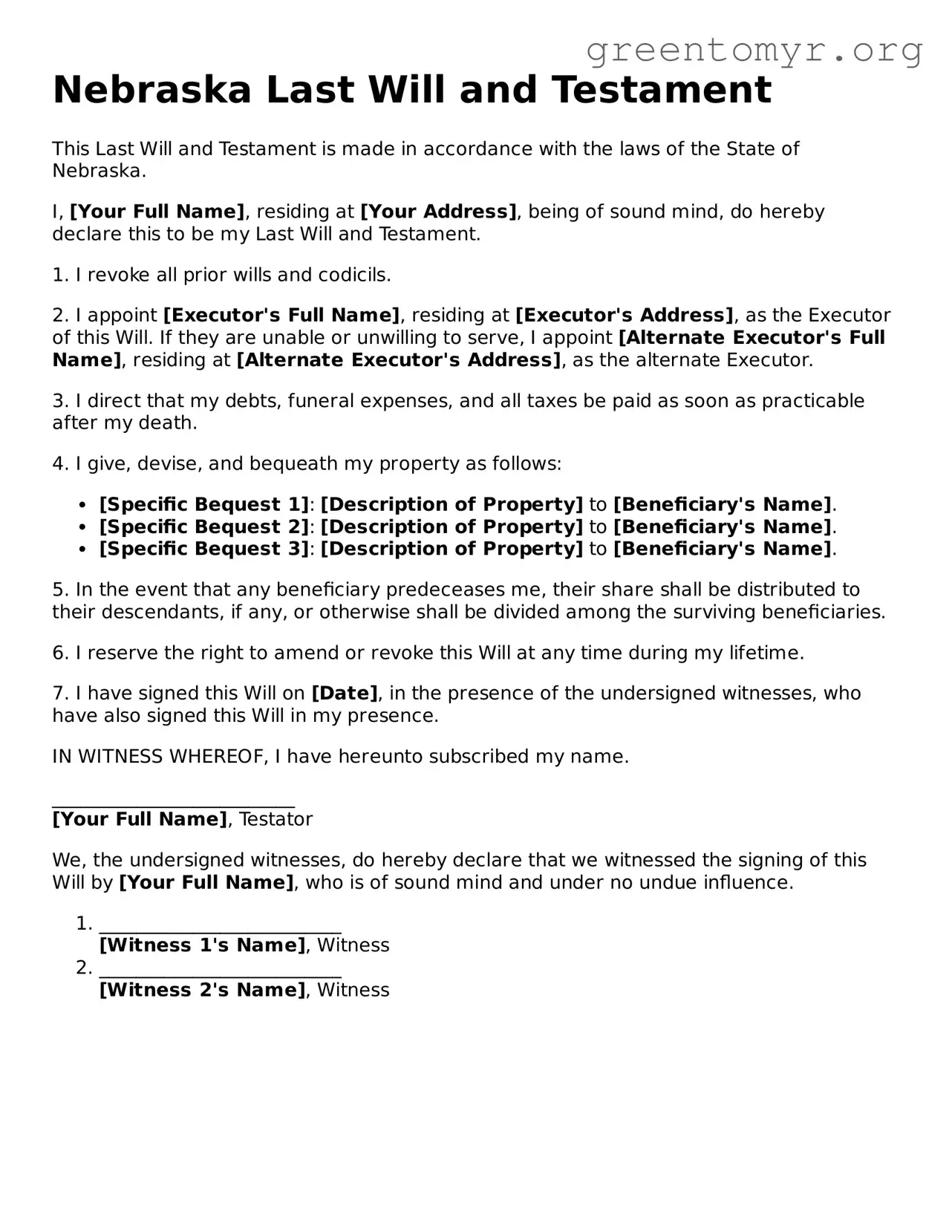
Nebraska Last Will and Testament
This Last Will and Testament is made in accordance with the laws of the State of Nebraska.
I, [Your Full Name], residing at [Your Address], being of sound mind, do hereby declare this to be my Last Will and Testament.
1. I revoke all prior wills and codicils.
2. I appoint [Executor's Full Name], residing at [Executor's Address], as the Executor of this Will. If they are unable or unwilling to serve, I appoint [Alternate Executor's Full Name], residing at [Alternate Executor's Address], as the alternate Executor.
3. I direct that my debts, funeral expenses, and all taxes be paid as soon as practicable after my death.
4. I give, devise, and bequeath my property as follows:
5. In the event that any beneficiary predeceases me, their share shall be distributed to their descendants, if any, or otherwise shall be divided among the surviving beneficiaries.
6. I reserve the right to amend or revoke this Will at any time during my lifetime.
7. I have signed this Will on [Date], in the presence of the undersigned witnesses, who have also signed this Will in my presence.
IN WITNESS WHEREOF, I have hereunto subscribed my name.
__________________________
[Your Full Name], Testator
We, the undersigned witnesses, do hereby declare that we witnessed the signing of this Will by [Your Full Name], who is of sound mind and under no undue influence.
| Fact Name | Description |
|---|---|
| Legal Requirement | A Last Will and Testament in Nebraska must be in writing and signed by the testator. |
| Witnesses | At least two witnesses are required to validate the will. They must sign in the presence of the testator. |
| Age Requirement | The testator must be at least 18 years old to create a valid will in Nebraska. |
| Revocation | A will can be revoked by a subsequent will or by physically destroying the document. |
| Governing Law | The Nebraska Last Will and Testament is governed by the Nebraska Revised Statutes, Chapter 30. |
Once you have the Nebraska Last Will and Testament form, you are ready to begin filling it out. This form will help you outline your wishes regarding the distribution of your assets after your passing. Follow these steps carefully to ensure that your will is completed correctly.
After completing the form, store it in a safe place. Inform your executor and trusted family members about its location. Consider discussing your wishes with them to ensure clarity.
A Last Will and Testament is a legal document that outlines how a person wishes their assets to be distributed after their death. In Nebraska, this document allows individuals to specify beneficiaries for their property, appoint guardians for minor children, and outline any final wishes regarding funeral arrangements. Having a will helps ensure that a person's wishes are respected and can simplify the probate process for their loved ones.
In Nebraska, any person who is at least 19 years old and of sound mind can create a Last Will and Testament. This means that the individual must be able to understand the nature of the document and the implications of their decisions. Additionally, the person must not be under undue influence or coercion when making their will.
For a Last Will and Testament to be considered valid in Nebraska, it must meet certain criteria:
These requirements help ensure that the will is executed properly and can withstand challenges in court.
Yes, individuals in Nebraska can change or revoke their Last Will and Testament at any time while they are still alive. This can be done by creating a new will that explicitly revokes the previous one or by physically destroying the old will. It is important to ensure that any new will meets the legal requirements to avoid confusion or disputes among beneficiaries.
If a person dies without a will in Nebraska, they are considered to have died "intestate." In this case, the state's intestacy laws will determine how their assets are distributed. Typically, assets will be divided among surviving relatives according to a predetermined hierarchy, which may not align with the deceased's wishes. This can lead to complications and disputes among family members, making it advisable to have a will in place to ensure that one's wishes are followed.
Filling out a Last Will and Testament form in Nebraska is a significant step in ensuring that your wishes are respected after your passing. However, many individuals make common mistakes that can lead to confusion or legal challenges. One frequent error is failing to properly identify the testator. The testator is the person creating the will. Omitting their full name or using nicknames can create ambiguity about who the will belongs to.
Another mistake involves not clearly designating beneficiaries. It is crucial to specify who will inherit your assets. Vague language or failing to name individuals can result in disputes among family members. Additionally, if you name a beneficiary but do not provide a backup plan, complications may arise if that individual predeceases you.
People often overlook the importance of signing the will correctly. In Nebraska, a will must be signed by the testator and witnessed by at least two individuals. If these requirements are not met, the will may be deemed invalid. Furthermore, witnesses should not be beneficiaries of the will to avoid potential conflicts of interest.
Another common oversight is failing to update the will after major life changes. Events such as marriage, divorce, or the birth of a child can significantly impact your wishes. Not reflecting these changes in your will can lead to unintended distributions of your assets.
Additionally, individuals sometimes neglect to include a residuary clause. This clause addresses any assets not specifically mentioned in the will. Without it, any unaccounted assets may be distributed according to Nebraska's intestacy laws, which may not align with your wishes.
Lastly, some people do not seek legal advice when necessary. While it is possible to fill out the form independently, consulting with a legal expert can help ensure that your will is valid and comprehensive. This step can prevent potential issues that may arise in the future, providing peace of mind for you and your loved ones.
When individuals prepare a Last Will and Testament in Nebraska, they often consider additional documents that can help ensure their wishes are honored and their estate is managed effectively. Each of these documents serves a specific purpose in the estate planning process.
These documents, when used in conjunction with a Last Will and Testament, can provide comprehensive estate planning. They help ensure that an individual's wishes are clearly expressed and respected, while also facilitating the management of their affairs during and after their lifetime.
A Last Will and Testament is an important legal document that outlines how a person's assets and affairs should be managed after their passing. Several other documents serve similar purposes in estate planning and management. Here are five documents that share similarities with a Last Will and Testament:
When filling out the Nebraska Last Will and Testament form, it's essential to approach the task with care and attention to detail. Here’s a list of things you should and shouldn't do:
By following these guidelines, you can help ensure that your Last Will and Testament accurately reflects your wishes and stands up to legal scrutiny.
Understanding the Nebraska Last Will and Testament form is essential for effective estate planning. However, several misconceptions can lead to confusion. Below is a list of common misconceptions and clarifications regarding the Nebraska Last Will and Testament form.
In Nebraska, a will does not need to be notarized to be valid. However, having it notarized can help streamline the probate process.
Oral wills, or nuncupative wills, are not recognized in Nebraska except under very specific circumstances, such as being made by a member of the armed forces during a time of conflict.
While it is advisable to consult a lawyer, individuals can create a valid will on their own as long as they follow Nebraska's legal requirements.
Handwritten wills, also known as holographic wills, are valid in Nebraska but must meet certain criteria, including being signed and dated by the testator.
A will can be amended or revoked at any time before the testator’s death, as long as the changes are made according to Nebraska law.
Not all assets need to be listed in a will. Assets held in joint tenancy or those with designated beneficiaries typically pass outside of the will.
Everyone can benefit from having a will, regardless of their financial status. A will helps ensure that personal wishes are honored after death.
Minors can also benefit from having a will, especially when it comes to appointing guardianship or managing inheritance.
A will becomes a public document only after the testator passes away and it is submitted for probate.
While debts are typically settled during the probate process, it is essential to follow Nebraska law regarding the order of payment and distribution of assets.
By addressing these misconceptions, individuals can make informed decisions about their estate planning needs in Nebraska.
When it comes to filling out and using the Nebraska Last Will and Testament form, several important points should be kept in mind. Understanding these can help ensure that your wishes are honored after your passing.
By keeping these key takeaways in mind, you can navigate the process of creating a will in Nebraska with greater confidence and clarity.