Content Navigation

The Nebraska Motor Vehicle Power of Attorney form serves as a crucial legal document that empowers an individual to act on behalf of another person regarding motor vehicle transactions. This form is particularly important for those who may be unable to attend to their vehicle-related matters due to various reasons, such as illness or being out of state. By designating an agent through this form, the principal grants the agent the authority to perform specific tasks, including signing titles, registering vehicles, and handling other essential paperwork associated with motor vehicle ownership. It is vital for individuals to understand the responsibilities and limitations that come with this authority. The form requires clear identification of both the principal and the agent, along with a detailed description of the powers being granted. Completing this form correctly ensures that the agent can effectively manage the necessary transactions while protecting the principal's interests. Understanding the nuances of this document can help individuals navigate the complexities of vehicle ownership with greater ease and confidence.

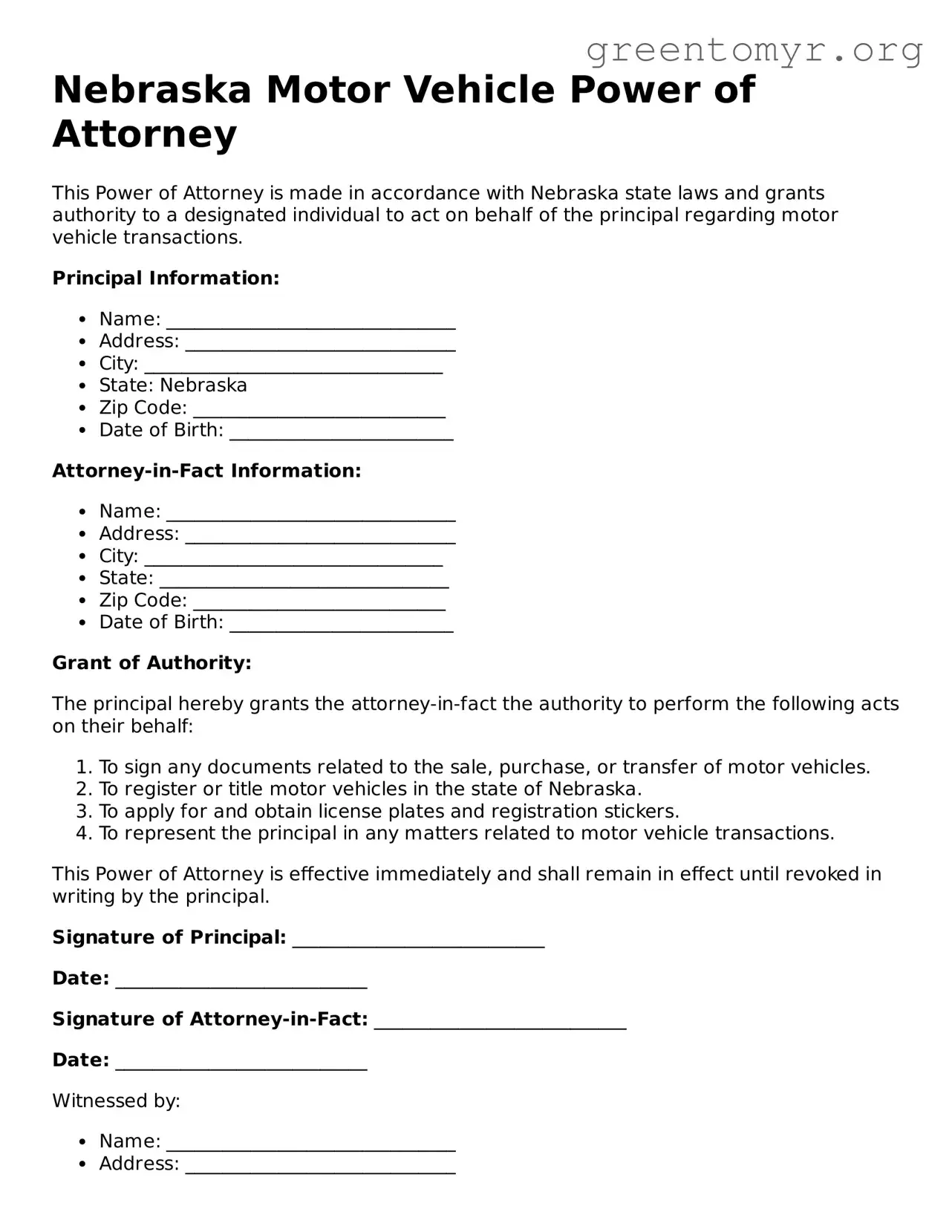
Nebraska Motor Vehicle Power of Attorney Example

Nebraska Motor Vehicle Power of Attorney

This Power of Attorney is made in accordance with Nebraska state laws and grants authority to a designated individual to act on behalf of the principal regarding motor vehicle transactions.

Principal Information:

  • Name: _______________________________
  • Address: _____________________________
  • City: ________________________________
  • State: Nebraska
  • Zip Code: ___________________________
  • Date of Birth: ________________________

Attorney-in-Fact Information:

  • Name: _______________________________
  • Address: _____________________________
  • City: ________________________________
  • State: _______________________________
  • Zip Code: ___________________________
  • Date of Birth: ________________________

Grant of Authority:

The principal hereby grants the attorney-in-fact the authority to perform the following acts on their behalf:

  1. To sign any documents related to the sale, purchase, or transfer of motor vehicles.
  2. To register or title motor vehicles in the state of Nebraska.
  3. To apply for and obtain license plates and registration stickers.
  4. To represent the principal in any matters related to motor vehicle transactions.

This Power of Attorney is effective immediately and shall remain in effect until revoked in writing by the principal.

Signature of Principal: ___________________________

Date: ___________________________

Signature of Attorney-in-Fact: ___________________________

Date: ___________________________

Witnessed by:

  • Name: _______________________________
  • Address: _____________________________
  • Signature: ___________________________
  • Date: ________________________________

PDF Form Features

Fact Name Description
Purpose The Nebraska Motor Vehicle Power of Attorney form allows an individual to authorize another person to handle motor vehicle transactions on their behalf.
Governing Law This form is governed by Nebraska Revised Statutes, specifically § 30-3401 through § 30-3430.
Signatures Required The form must be signed by the principal (the person granting authority) and may require notarization to be valid.
Usage It is commonly used for tasks such as transferring vehicle titles, registering vehicles, and obtaining license plates.
Validity The Power of Attorney remains valid until revoked by the principal or until the specified tasks are completed.

Guide to Using Nebraska Motor Vehicle Power of Attorney

Filling out the Nebraska Motor Vehicle Power of Attorney form is a straightforward process. This form allows you to designate someone to handle specific vehicle-related matters on your behalf. Once completed, it should be submitted to the appropriate authorities or kept for your records, depending on your needs.

  1. Begin by downloading the Nebraska Motor Vehicle Power of Attorney form from the Nebraska Department of Motor Vehicles website or obtain a physical copy.
  2. In the first section, provide your name, address, and contact information. Ensure that all details are accurate and up-to-date.
  3. Next, enter the name and address of the person you are appointing as your attorney-in-fact. This individual will have the authority to act on your behalf.
  4. Specify the powers you are granting. This may include signing documents, transferring ownership, or handling registration matters.
  5. Include the vehicle information, such as the make, model, year, and Vehicle Identification Number (VIN) for clarity.
  6. Sign and date the form. Your signature confirms that you are granting the specified powers to your attorney-in-fact.
  7. If required, have the form notarized. Notarization may be necessary for the document to be considered valid.
  8. Make copies of the completed form for your records and provide a copy to your attorney-in-fact.

Get Answers on Nebraska Motor Vehicle Power of Attorney

What is a Nebraska Motor Vehicle Power of Attorney form?

The Nebraska Motor Vehicle Power of Attorney form is a legal document that allows one person (the principal) to authorize another person (the agent) to act on their behalf regarding motor vehicle transactions. This includes activities such as registering a vehicle, transferring ownership, or applying for a title. This form is particularly useful when the principal cannot be present to complete these tasks themselves.

Who can be designated as an agent in the Power of Attorney?

Any competent adult can be designated as an agent in the Nebraska Motor Vehicle Power of Attorney form. This could be a family member, friend, or even a professional, such as an attorney or a car dealership representative. It is important to choose someone you trust, as they will have the authority to make decisions regarding your vehicle.

How do I complete the form?

Completing the Nebraska Motor Vehicle Power of Attorney form is straightforward. Follow these steps:

  1. Download the form from the Nebraska Department of Motor Vehicles website or obtain a physical copy.
  2. Fill in your name and contact information as the principal.
  3. Provide the name and contact information of the agent you are designating.
  4. Specify the powers you are granting to the agent, such as selling, transferring, or registering a vehicle.
  5. Sign and date the form in the presence of a notary public, if required.

Make sure to keep a copy of the completed form for your records.

Is the Power of Attorney form valid indefinitely?

No, the Nebraska Motor Vehicle Power of Attorney form is not valid indefinitely. The authority granted to the agent is typically effective until the specified task is completed or until you revoke the power of attorney. You can revoke it at any time by notifying your agent and, if necessary, submitting a revocation form to the Nebraska Department of Motor Vehicles.

What should I do if my agent is unable to fulfill their duties?

If your agent is unable to fulfill their duties, you have a couple of options. First, you can choose to revoke the existing Power of Attorney and designate a new agent. If the original agent is unable to perform their tasks due to unforeseen circumstances, it is advisable to act quickly to ensure that your vehicle-related matters are still managed effectively. Always keep your records updated and inform the new agent of their responsibilities.

Common mistakes

Filling out the Nebraska Motor Vehicle Power of Attorney form can be straightforward, but many individuals make common mistakes that can lead to delays or complications. Understanding these pitfalls can help ensure that the process goes smoothly.

One frequent mistake is failing to provide the correct identification information. The form requires specific details about both the principal and the agent, including full names and addresses. Omitting any of this information can render the document invalid. It is essential to double-check that all names are spelled correctly and that addresses are complete.

Another error occurs when individuals forget to sign the form. A signature is crucial for validating the Power of Attorney. Without it, the document does not hold any legal weight. Additionally, the signature must be that of the principal, not the agent. This is a common point of confusion.

Some people neglect to date the form. Including a date is important as it indicates when the authority is granted. If a dispute arises later, the date can clarify the timeline of authority. Always remember to fill in the date clearly.

In some cases, individuals may choose to leave sections blank, thinking that it will not matter. However, incomplete forms can lead to significant issues. Each section should be filled out entirely to avoid any ambiguity regarding the powers being granted.

Another mistake is not specifying the powers being granted to the agent. The form allows for a range of powers, and failing to articulate these can lead to misunderstandings. Be clear about what actions the agent is authorized to take on behalf of the principal.

Some individuals may overlook the need for witnesses or notarization. In Nebraska, while notarization is not always required, having the document notarized can provide an extra layer of protection. It is wise to check the latest requirements to ensure compliance.

Another common error is using outdated forms. Laws and requirements can change, and using an old version of the Power of Attorney form may lead to complications. Always obtain the most current version from a reliable source.

People often forget to communicate with their agents about the authority granted. This lack of communication can lead to confusion when the agent attempts to act on behalf of the principal. It is beneficial to discuss the scope of the authority and any specific wishes regarding the use of the Power of Attorney.

Finally, some individuals fail to keep copies of the completed form. Retaining a copy is vital for both the principal and the agent. It ensures that both parties are aware of the granted powers and can refer back to the document if needed.

Documents used along the form

When dealing with vehicle transactions in Nebraska, the Motor Vehicle Power of Attorney form is an important document that allows one person to authorize another to act on their behalf. However, this form is often accompanied by other documents that facilitate the process and ensure that all legal requirements are met. Below is a list of additional forms and documents commonly used in conjunction with the Nebraska Motor Vehicle Power of Attorney form.

  • Vehicle Title Transfer Form: This document is essential for transferring ownership of a vehicle from one party to another. It includes information about the vehicle, the seller, and the buyer.
  • Bill of Sale: A bill of sale serves as a receipt for the transaction. It outlines the details of the sale, including the purchase price and the condition of the vehicle at the time of sale.
  • Odometer Disclosure Statement: This form is required by federal law to disclose the vehicle's mileage at the time of sale. It helps prevent fraud related to odometer tampering.
  • Application for Title: When a vehicle is purchased, this application is submitted to the Nebraska Department of Motor Vehicles to obtain a new title in the buyer's name.
  • Affidavit of Heirship: In cases where a vehicle is inherited, this affidavit can help establish the rightful ownership of the vehicle among heirs.
  • Release of Liability: This document protects the seller by notifying the DMV that they are no longer responsible for the vehicle after the sale has been completed.
  • Insurance Verification Form: This form confirms that the vehicle is insured, which is a requirement for registration and operation on public roads.
  • Notarized Signature: In some cases, having a notary public witness the signatures on the Power of Attorney or other related documents can add an extra layer of authenticity and legal protection.

Utilizing these documents alongside the Nebraska Motor Vehicle Power of Attorney form can help streamline the process of vehicle transactions and ensure compliance with state regulations. It is always advisable to consult with a legal expert to ensure that all necessary paperwork is completed accurately and thoroughly.

Similar forms

  • General Power of Attorney: This document allows an individual to grant broad authority to another person to act on their behalf in various matters, including financial and legal decisions. Similar to the Motor Vehicle Power of Attorney, it enables the appointed person to handle specific tasks, but it covers a wider range of responsibilities.
  • Limited Power of Attorney: This form is used to give someone authority to act on behalf of another for a specific purpose or time frame. Like the Motor Vehicle Power of Attorney, it is limited in scope, focusing on particular tasks, such as selling a vehicle.
  • Health Care Power of Attorney: This document allows an individual to designate someone to make medical decisions on their behalf if they become unable to do so. While it pertains to health care rather than vehicle matters, it shares the principle of granting authority to another person to act in specific situations.
  • Durable Power of Attorney: This type of power of attorney remains effective even if the person who created it becomes incapacitated. It parallels the Motor Vehicle Power of Attorney in that it allows the appointed individual to manage affairs, ensuring continuity of decision-making.
  • Financial Power of Attorney: This document specifically grants authority to manage financial matters. Similar to the Motor Vehicle Power of Attorney, it allows another person to handle specific financial transactions, such as managing vehicle-related expenses.
  • Real Estate Power of Attorney: This form allows an individual to authorize someone to act on their behalf in real estate transactions. While it focuses on property rather than vehicles, it operates under the same principle of granting authority for specific legal actions.

Dos and Don'ts

When filling out the Nebraska Motor Vehicle Power of Attorney form, it's important to follow specific guidelines to ensure accuracy and compliance. Here’s a list of things to do and avoid:

  • Do read the entire form carefully before filling it out.
  • Do provide accurate information for both the principal and the agent.
  • Do sign and date the form in the appropriate sections.
  • Do keep a copy of the completed form for your records.
  • Do ensure that the agent understands their responsibilities.
  • Don't leave any required fields blank.
  • Don't use white-out or erasers on the form.
  • Don't sign the form without understanding its contents.
  • Don't provide false information.
  • Don't forget to check for any additional state requirements.

Misconceptions

Understanding the Nebraska Motor Vehicle Power of Attorney form is essential for anyone looking to manage vehicle transactions on behalf of another person. However, several misconceptions can lead to confusion. Here are ten common misconceptions:

  1. It can only be used for selling vehicles. Many believe this form is limited to sales, but it can also be used for registration, title transfers, and other vehicle-related tasks.
  2. Only a lawyer can fill it out. While legal advice can be helpful, individuals can complete the form themselves as long as they provide accurate information.
  3. It must be notarized to be valid. Notarization is not always required for the form to be effective, although it can add an extra layer of authenticity.
  4. It is only valid in Nebraska. The form is designed for use in Nebraska, but similar documents may be recognized in other states for specific transactions.
  5. It expires after a short period. The power of attorney remains valid until the specified tasks are completed or the principal revokes it.
  6. It can be used for any type of vehicle. This form is specific to motor vehicles, and cannot be used for boats, trailers, or other types of vehicles.
  7. All parties must be present when signing. Only the principal needs to sign the form, not the agent or any other parties involved.
  8. It cannot be revoked once signed. The principal has the right to revoke the power of attorney at any time, as long as they are competent to do so.
  9. It requires a specific format. While there are recommended formats, as long as the essential information is included, variations can be acceptable.
  10. It is a permanent document. The authority granted can be limited to specific tasks or timeframes, making it flexible based on the principal's needs.

Being informed about these misconceptions can help individuals effectively use the Nebraska Motor Vehicle Power of Attorney form and avoid potential pitfalls.

Key takeaways

Filling out and using the Nebraska Motor Vehicle Power of Attorney form can be straightforward if you keep a few key points in mind. Here are some important takeaways:

  • The form allows you to designate someone else to handle motor vehicle transactions on your behalf.
  • Ensure that the person you choose as your agent is trustworthy and understands your needs.
  • Fill out the form completely, including all required information about both you and your agent.
  • Sign the form in front of a notary public to make it legally binding.
  • Keep a copy of the signed form for your records after it has been notarized.
  • Be aware that the power of attorney can be limited to specific tasks, such as selling a vehicle or transferring ownership.
  • This document is valid until you revoke it or until the specific task is completed.
  • Check with the Nebraska Department of Motor Vehicles for any additional requirements or updates to the form.