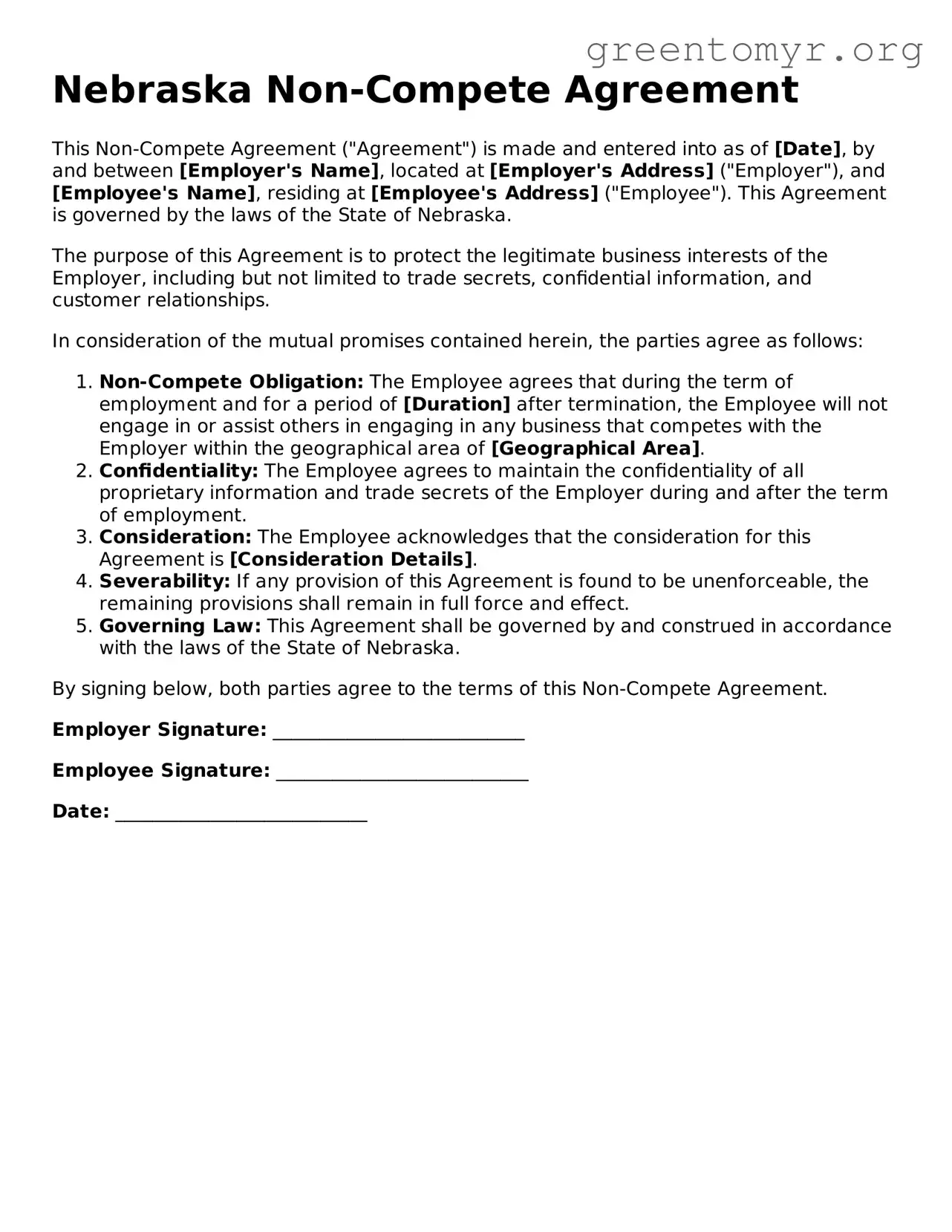
In Nebraska, the Non-compete Agreement form plays a crucial role in protecting business interests while balancing employee rights. This form outlines the terms under which an employee agrees not to engage in competitive activities after leaving a company. Key aspects include the duration of the restriction, the geographical area it covers, and the specific activities that are prohibited. Employers often use this agreement to safeguard trade secrets, client relationships, and proprietary information. However, it is essential for both parties to understand that such agreements must be reasonable in scope and duration to be enforceable. Clarity in the language of the form helps prevent misunderstandings and potential legal disputes. As businesses navigate this complex area, the Non-compete Agreement form serves as a vital tool in establishing boundaries and expectations for both employers and employees.
Nebraska Non-Compete Agreement
This Non-Compete Agreement ("Agreement") is made and entered into as of [Date], by and between [Employer's Name], located at [Employer's Address] ("Employer"), and [Employee's Name], residing at [Employee's Address] ("Employee"). This Agreement is governed by the laws of the State of Nebraska.
The purpose of this Agreement is to protect the legitimate business interests of the Employer, including but not limited to trade secrets, confidential information, and customer relationships.
In consideration of the mutual promises contained herein, the parties agree as follows:
By signing below, both parties agree to the terms of this Non-Compete Agreement.
Employer Signature: ___________________________
Employee Signature: ___________________________
Date: ___________________________
| Fact Name | Description |
|---|---|
| Governing Law | Nebraska law governs non-compete agreements, specifically under Nebraska Revised Statutes § 48-101. |
| Enforceability | Non-compete agreements are enforceable in Nebraska if they are reasonable in scope and duration. |
| Duration Limit | The duration of a non-compete agreement should generally not exceed five years. |
| Geographic Scope | The geographic area covered by the agreement must be reasonable and not overly broad. |
| Consideration | There must be adequate consideration for the agreement, such as employment or access to trade secrets. |
| Industry Restrictions | Non-compete agreements are more likely to be enforced in certain industries, such as technology and healthcare. |
| Public Policy | Nebraska courts may void non-compete agreements that are deemed against public policy. |
| Employee Rights | Employees have the right to negotiate the terms of a non-compete agreement before signing. |
Filling out the Nebraska Non-compete Agreement form is a straightforward process that requires careful attention to detail. Once you have completed the form, it will need to be reviewed and signed by all parties involved. This ensures that everyone understands the terms outlined in the agreement.
A Non-compete Agreement is a legal contract between an employer and an employee. This agreement restricts the employee from working for a competitor or starting a similar business for a certain period after leaving the company. In Nebraska, these agreements are generally enforceable, but they must be reasonable in scope, duration, and geographic area.
For a Non-compete Agreement to be enforceable in Nebraska, it typically needs to include the following elements:
Yes, employees can negotiate the terms of a Non-compete Agreement before signing it. It’s important to discuss any concerns or desired changes with the employer. Common points of negotiation include:
Having a clear understanding and agreement on these terms can help prevent future disputes.
If you believe your Non-compete Agreement is unfair, it’s advisable to seek legal advice. A legal professional can review the agreement and help you understand your rights. They may suggest:
Taking proactive steps can help protect your career while addressing any concerns about the agreement.
Filling out a Non-compete Agreement in Nebraska can be straightforward, but many people still make common mistakes that can undermine the document's effectiveness. One frequent error is failing to specify the scope of the agreement. It’s essential to clearly outline what activities are restricted. Vague language can lead to confusion and potential legal disputes down the line.
Another mistake is not considering the duration of the agreement. Many individuals either set the time frame too long or too short. A reasonable duration is crucial for enforceability. Courts often look for a balance, so ensure the time period is justifiable based on the industry and position.
Additionally, people often overlook the geographic limitations of the agreement. It’s important to define where the restrictions apply. A broad geographic scope may be seen as unreasonable, while a very narrow one could render the agreement ineffective. Tailoring this aspect to your specific situation is vital.
Another common pitfall is neglecting to include consideration for the agreement. This means that both parties should receive something of value in exchange for signing the document. Without this, the agreement may not hold up in court. Ensure that both sides understand what they are gaining.
Finally, many individuals fail to review the agreement thoroughly before signing. Rushing through the process can lead to missed details or misunderstandings. It’s wise to take the time to read the entire document and, if necessary, consult with a legal professional to clarify any confusing terms.
When entering into a Non-compete Agreement in Nebraska, several other forms and documents may be relevant to ensure a comprehensive understanding of the terms and conditions involved. These documents help clarify the relationship between the parties and protect their interests. Below is a list of common forms that are often used in conjunction with a Non-compete Agreement.
Understanding these related forms can help individuals and businesses navigate their agreements more effectively. Each document serves a specific purpose and contributes to a clearer, more secure contractual relationship.
A Non-compete Agreement is a legal document that restricts an individual from engaging in certain activities that could compete with their employer after leaving the job. Several other documents serve similar purposes in protecting business interests. Here are six documents that share similarities with a Non-compete Agreement:
When filling out the Nebraska Non-compete Agreement form, it is important to follow certain guidelines to ensure the document is completed correctly. Below is a list of things to do and things to avoid during this process.
Non-compete agreements can be a source of confusion for many individuals and businesses in Nebraska. Below are some common misconceptions about these agreements, along with clarifications to help you understand their true nature.
This is not true. In Nebraska, non-compete agreements must meet specific criteria to be enforceable. They should be reasonable in scope, duration, and geographic area. If they are overly restrictive, a court may choose not to enforce them.
Many believe that these agreements can last forever. However, Nebraska law generally requires that the duration of a non-compete agreement be reasonable. Typically, agreements lasting one to two years are more likely to be upheld.
This is a common misconception. While they are often used for higher-level positions, non-compete agreements can apply to various roles, depending on the nature of the business and the information an employee may access.
Many people fear that signing a non-compete will prevent them from ever working in their industry again. In reality, these agreements typically restrict employees from working for direct competitors or starting similar businesses only for a limited time and within a specific area.
Employers cannot simply impose a non-compete agreement whenever they choose. In Nebraska, these agreements should ideally be presented at the time of hiring or when there is a significant change in employment status, such as a promotion.
This is a significant misunderstanding. While both types of agreements aim to protect business interests, a non-compete agreement restricts an employee's ability to work in a certain field after leaving the company, whereas a non-disclosure agreement focuses on protecting confidential information during and after employment.
Many believe that signing a non-compete agreement is a final commitment. However, employees can challenge the enforceability of these agreements in court, especially if they believe the terms are unreasonable or unfair.
When dealing with a Non-compete Agreement in Nebraska, it is important to understand the key aspects of the process. Here are some essential takeaways:
By keeping these points in mind, you can effectively navigate the process of filling out and using a Non-compete Agreement in Nebraska.