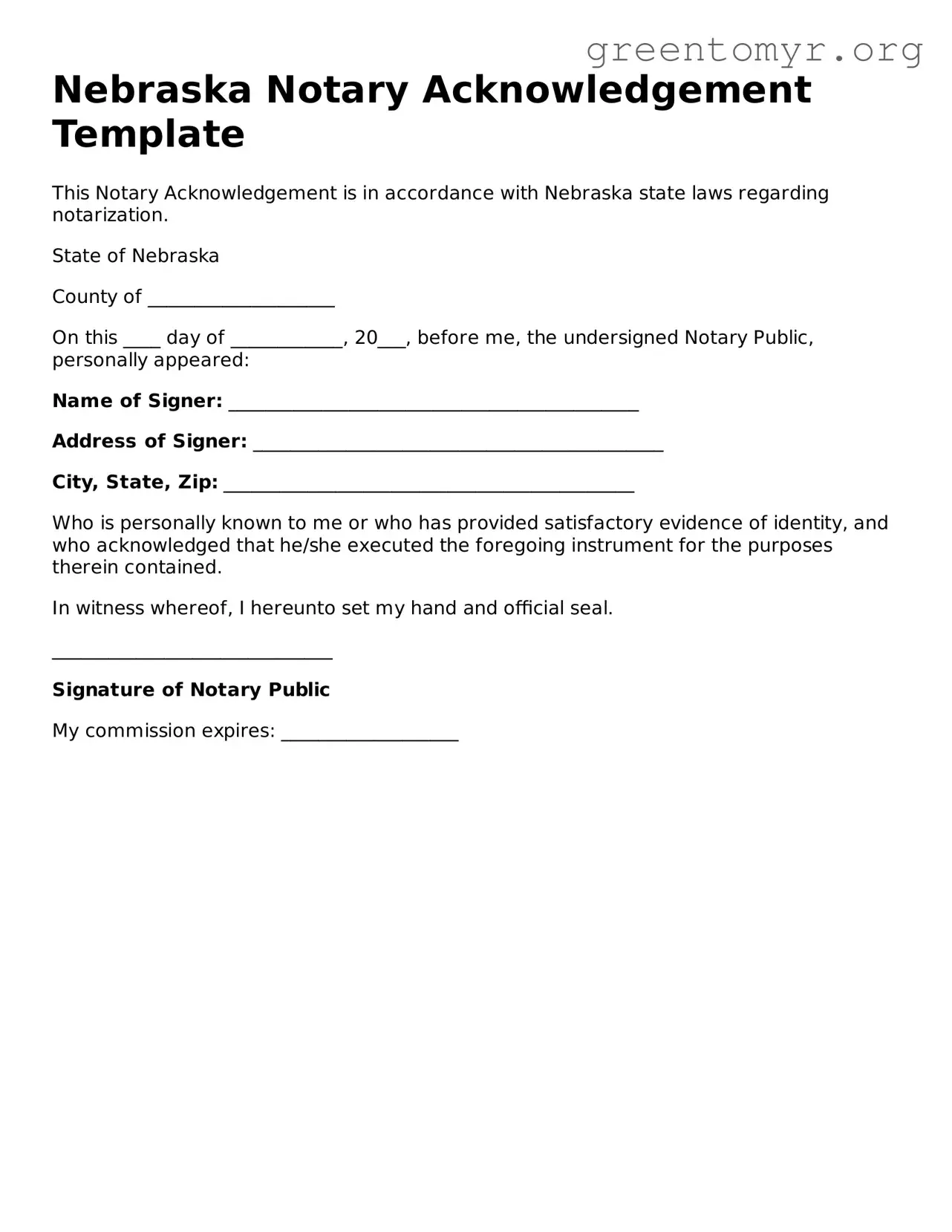
The Nebraska Notary Acknowledgement form serves a crucial role in the notarization process, ensuring that signatures on important documents are verified and authenticated. This form is typically used when an individual signs a document in the presence of a notary public, who then certifies that the signer is who they claim to be. Key elements of the form include the name and address of the signer, the name of the notary, and details about the document being acknowledged. The notary public must also include their official seal and signature, which adds an extra layer of legitimacy to the process. It is important for individuals to understand the significance of this form, as it can be required for various legal documents, such as deeds, contracts, and affidavits. By providing a clear record of the acknowledgment, the form helps protect against fraud and ensures that all parties involved have a reliable reference point.
Nebraska Notary Acknowledgement Template
This Notary Acknowledgement is in accordance with Nebraska state laws regarding notarization.
State of Nebraska
County of ____________________
On this ____ day of ____________, 20___, before me, the undersigned Notary Public, personally appeared:
Name of Signer: ____________________________________________
Address of Signer: ____________________________________________
City, State, Zip: ____________________________________________
Who is personally known to me or who has provided satisfactory evidence of identity, and who acknowledged that he/she executed the foregoing instrument for the purposes therein contained.
In witness whereof, I hereunto set my hand and official seal.
______________________________
Signature of Notary Public
My commission expires: ___________________
| Fact Name | Details |
|---|---|
| Purpose | The Nebraska Notary Acknowledgment form is used to verify the identity of individuals signing documents and to confirm that they signed willingly. |
| Governing Law | This form is governed by the Nebraska Revised Statutes, specifically Chapter 64, which outlines the duties and powers of notaries public in Nebraska. |
| Signature Requirement | For the acknowledgment to be valid, the signer must appear in person before the notary and provide a valid form of identification. |
| Record Keeping | Notaries in Nebraska are required to keep a record of all acknowledgments performed, including details about the signer and the document involved. |
Once you have the Nebraska Notary Acknowledgement form in hand, you will need to carefully fill it out to ensure that all necessary information is provided. This process is straightforward, but attention to detail is crucial. After completing the form, it will be ready for submission or use as required.
The Nebraska Notary Acknowledgement form is a document that serves as proof that a specific individual has appeared before a notary public and acknowledged their signature on a particular document. This form is often used in legal and financial transactions to ensure that the person signing a document is doing so voluntarily and understands the contents of what they are signing. It provides an additional layer of authenticity and can help prevent fraud.
You may need to use a Notary Acknowledgement form in various situations, including:
Essentially, any time you need to confirm that a signature is genuine and that the signer is aware of the document's purpose, a Notary Acknowledgement can be helpful.
Completing a Notary Acknowledgement form involves several straightforward steps:
It’s important to remember that the notary cannot provide legal advice, so if you have questions about the document itself, consider consulting a legal professional.
Yes, there is typically a fee associated with notarization in Nebraska. The maximum fee a notary public can charge for an acknowledgment is set by state law. As of now, the fee is usually around $5 per signature. However, some notaries may charge additional fees for travel or other services. It’s a good idea to confirm the fee with the notary before proceeding with the acknowledgment to avoid any surprises.
Filling out the Nebraska Notary Acknowledgement form can seem straightforward, but many individuals make common mistakes that can lead to delays or complications. One frequent error is failing to properly identify the signer. It’s essential to ensure that the name listed on the form matches the name on the identification presented. Discrepancies can raise questions about the validity of the acknowledgment.
Another mistake often seen is the omission of the date. The notary acknowledgment must clearly indicate when the document was signed. Without this information, the acknowledgment may be considered incomplete. It’s important to remember that the date of the acknowledgment is separate from the date the document was executed.
Many people also overlook the requirement for the notary’s signature and seal. The notary must sign the form and affix their official seal for it to be valid. Neglecting to do so can invalidate the acknowledgment, leaving the document unrecognized in legal contexts.
In addition, some individuals fail to provide the correct venue. The venue refers to the location where the acknowledgment takes place, typically including the county and state. This detail is crucial, as it establishes jurisdiction and can impact the enforceability of the document.
Another common oversight is not having the signer present at the time of acknowledgment. The signer must personally appear before the notary to confirm their identity and willingness to sign. If the signer is absent, the acknowledgment cannot be completed legally.
People sometimes misinterpret the role of the notary. A notary public is not responsible for verifying the content of the document; their role is to confirm the identity of the signer and their willingness to sign. Misunderstanding this can lead to frustration and errors in the acknowledgment process.
Lastly, many individuals neglect to review the completed form before submission. Taking a moment to double-check all entries can prevent mistakes that might otherwise go unnoticed. Ensuring that everything is filled out correctly before finalizing the acknowledgment can save time and effort in the long run.
When engaging in legal transactions in Nebraska, the Notary Acknowledgement form is often accompanied by various other documents. Each of these forms plays a crucial role in ensuring that agreements are valid and enforceable. Below is a list of common forms and documents used alongside the Notary Acknowledgement form.
Understanding these documents is essential for anyone involved in legal matters in Nebraska. Each form serves a specific purpose and can significantly impact the rights and responsibilities of the parties involved. Proper use of these documents, along with the Notary Acknowledgement form, ensures that legal processes are carried out smoothly and effectively.
The Notary Acknowledgment form serves a specific purpose in the notarization process, but it shares similarities with several other legal documents. Below are six documents that are comparable to the Notary Acknowledgment form, along with a brief explanation of their similarities:
Filling out the Nebraska Notary Acknowledgement form can seem daunting, but it doesn’t have to be. Here’s a handy list of things to keep in mind to ensure you complete the form correctly.
By following these guidelines, you can fill out the Nebraska Notary Acknowledgement form with confidence. Taking the time to do it right ensures that your document will be accepted without issues.
When it comes to the Nebraska Notary Acknowledgement form, several misconceptions can lead to confusion. Understanding these misconceptions can help ensure that the notarial process is carried out correctly. Here are five common misunderstandings:
By addressing these misconceptions, individuals can better navigate the notarial process in Nebraska and ensure that their documents are properly executed.
When filling out and using the Nebraska Notary Acknowledgement form, several important points should be considered to ensure its proper execution and acceptance.