Content Navigation

In Nebraska, the Notice to Quit form plays a crucial role in the landlord-tenant relationship, serving as a formal communication tool that signals the end of a tenancy. This document is typically used by landlords when they wish to terminate a rental agreement, often due to non-payment of rent or lease violations. It outlines specific details such as the reason for termination, the required notice period, and any actions the tenant must take to avoid eviction. Understanding this form is essential for both landlords and tenants, as it sets the stage for the next steps in the eviction process, should it become necessary. By adhering to the legal requirements associated with this notice, landlords can protect their rights while ensuring that tenants are given fair warning and the opportunity to address any issues. Familiarity with the Notice to Quit form can empower both parties, promoting better communication and a clearer understanding of their respective rights and responsibilities.

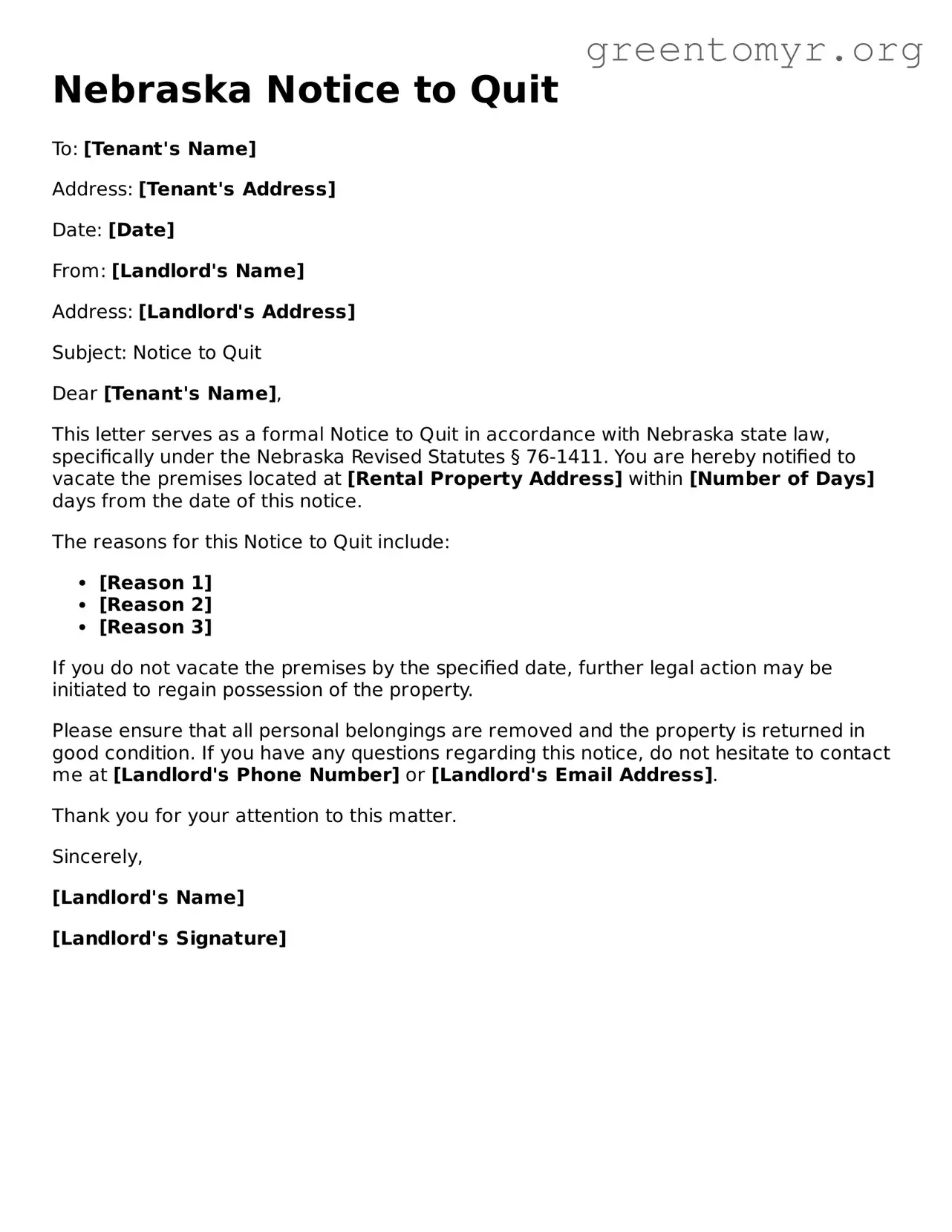
Nebraska Notice to Quit Example

Nebraska Notice to Quit

To: [Tenant's Name]

Address: [Tenant's Address]

Date: [Date]

From: [Landlord's Name]

Address: [Landlord's Address]

Subject: Notice to Quit

Dear [Tenant's Name],

This letter serves as a formal Notice to Quit in accordance with Nebraska state law, specifically under the Nebraska Revised Statutes § 76-1411. You are hereby notified to vacate the premises located at [Rental Property Address] within [Number of Days] days from the date of this notice.

The reasons for this Notice to Quit include:

  • [Reason 1]
  • [Reason 2]
  • [Reason 3]

If you do not vacate the premises by the specified date, further legal action may be initiated to regain possession of the property.

Please ensure that all personal belongings are removed and the property is returned in good condition. If you have any questions regarding this notice, do not hesitate to contact me at [Landlord's Phone Number] or [Landlord's Email Address].

Thank you for your attention to this matter.

Sincerely,

[Landlord's Name]

[Landlord's Signature]

PDF Form Features

Fact Name Description
Purpose The Nebraska Notice to Quit form serves as a formal notification to tenants to vacate the rental property.
Governing Law This form is governed by Nebraska Revised Statutes, specifically sections 76-1410 to 76-1415.
Delivery Method The notice can be delivered in person, by mail, or through other methods that ensure the tenant receives it.
Timeframe Tenants typically have a minimum of 3 days to vacate the premises after receiving the notice, depending on the reason for eviction.
Contents Required The form must include the tenant's name, the address of the rental property, and the reason for the notice.

Guide to Using Nebraska Notice to Quit

After you have obtained the Nebraska Notice to Quit form, you will need to fill it out accurately to ensure it serves its purpose. Follow these steps carefully to complete the form correctly.

  1. Start with the date at the top of the form. Write the date you are filling out the notice.
  2. In the section for the landlord's information, provide your full name and address. This identifies you as the person issuing the notice.
  3. Next, fill in the tenant's information. Include the tenant's full name and the address of the rental property.
  4. Specify the reason for the notice. Be clear and concise about why you are issuing this notice to quit.
  5. Indicate the date by which the tenant must vacate the property. This should align with the notice period required by Nebraska law.
  6. Sign the form at the bottom. This signature confirms that you are the landlord and that the information provided is accurate.
  7. Make a copy of the completed form for your records before delivering it to the tenant.

Once you have filled out the form, you will need to deliver it to the tenant, either in person or via certified mail. Ensure you keep a record of how and when the notice was delivered, as this may be important later.

Get Answers on Nebraska Notice to Quit

What is a Nebraska Notice to Quit form?

The Nebraska Notice to Quit form is a legal document that a landlord uses to inform a tenant that they must vacate the rental property. This notice is typically issued when the tenant has violated the lease agreement or has not paid rent. The form serves as a formal request for the tenant to leave the premises within a specified timeframe.

What are the reasons a landlord might issue a Notice to Quit?

Landlords may issue a Notice to Quit for several reasons, including but not limited to:

  1. Non-payment of rent.
  2. Violation of lease terms, such as unauthorized pets or subletting.
  3. Engaging in illegal activities on the property.
  4. Failure to maintain the property in accordance with lease obligations.

Each of these reasons must be clearly stated in the notice to provide the tenant with an understanding of the situation.

How much notice must a landlord give before a tenant must vacate?

The notice period can vary based on the reason for the eviction. Generally, Nebraska law requires the following notice periods:

  • For non-payment of rent: 3 days.
  • For lease violations: 30 days.
  • For illegal activities: 3 days.

It is important for landlords to adhere to these timelines to ensure compliance with state laws.

What should a tenant do upon receiving a Notice to Quit?

Upon receiving a Notice to Quit, a tenant should take the following steps:

  1. Read the notice carefully to understand the reason for eviction and the timeframe given.
  2. Review the lease agreement to determine if the landlord's claims are valid.
  3. Consider communicating with the landlord to discuss the situation and explore potential resolutions.
  4. If necessary, seek legal advice to understand rights and options.

Acting promptly can help tenants protect their rights and possibly resolve the issue without further escalation.

Common mistakes

Filling out the Nebraska Notice to Quit form can be a straightforward process, but there are common mistakes that people often make. Being aware of these pitfalls can help ensure that the form is completed correctly, ultimately leading to a smoother process.

One common mistake is not providing the correct tenant information. It’s essential to include the full name of the tenant as it appears on the lease agreement. Missing or incorrect names can lead to confusion and may even delay the eviction process. Always double-check that the information matches official documents.

Another frequent error involves failing to specify the reason for the eviction. The Notice to Quit requires a clear explanation of why the tenant is being asked to leave. Whether it's due to non-payment of rent or a lease violation, providing a specific reason is crucial. A vague or incomplete explanation can weaken your case if it goes to court.

People also sometimes neglect to include the correct date when serving the notice. The form should clearly state when the tenant must vacate the property. If this date is not accurate or not filled out, it can create legal complications. It’s important to ensure that the date gives the tenant the appropriate amount of time to respond.

Additionally, some individuals forget to sign and date the form. A Notice to Quit is not valid unless it is signed by the landlord or their representative. This simple step is often overlooked, but it’s vital for the document to be legally binding. Always remember to include your signature and the date before serving the notice.

Lastly, people may not keep a copy of the completed form for their records. After filling out the Notice to Quit, it’s wise to make a copy for yourself. This can serve as important documentation in case there are disputes later on. Having a record of what was served and when can be invaluable.

Documents used along the form

When dealing with rental agreements and potential evictions in Nebraska, several forms and documents may accompany the Nebraska Notice to Quit. Understanding these documents can help both landlords and tenants navigate the process more effectively. Below is a list of commonly used forms that you may encounter.

  • Lease Agreement: This document outlines the terms and conditions of the rental arrangement between the landlord and tenant. It typically includes details such as rent amount, duration of the lease, and responsibilities of both parties.
  • Rental Application: Before entering into a lease, landlords often require potential tenants to fill out a rental application. This form gathers personal information, rental history, and financial details to help landlords make informed decisions.
  • Notice of Non-Renewal: If a landlord decides not to renew a lease at the end of its term, this notice informs the tenant of that decision, allowing them time to prepare for moving out.
  • Eviction Notice: Also known as a summons, this document formally informs a tenant that legal action is being taken against them for non-payment of rent or lease violations. It typically includes a timeline for response.
  • Rent Payment Receipt: This is a record provided by the landlord to the tenant upon receiving rent payment. It serves as proof of payment and can be important for both parties.
  • Security Deposit Agreement: This document details the amount of the security deposit, the conditions under which it may be withheld, and the process for returning it at the end of the lease.
  • Inspection Report: Conducted at the beginning or end of a tenancy, this report documents the condition of the rental property. It can be useful for resolving disputes over security deposits.
  • Repair Request Form: Tenants can use this form to formally request repairs from the landlord. It outlines the issue and helps ensure that the request is documented and addressed.
  • Written Agreement for Repairs: If a landlord agrees to make repairs, this document outlines the specifics of what will be done, when, and any responsibilities of the tenant during the process.
  • Tenant's Response to Eviction: If a tenant receives an eviction notice, they may choose to respond formally. This document outlines their reasons for contesting the eviction and can be submitted to the court.

Familiarity with these documents can empower both landlords and tenants to understand their rights and responsibilities. Being informed helps ensure that everyone involved can approach the situation with clarity and confidence.

Similar forms

  • Eviction Notice: This document formally informs a tenant that their landlord intends to terminate the lease agreement. It outlines the reasons for eviction, similar to how a Notice to Quit specifies the need to vacate the premises.
  • Lease Termination Letter: A lease termination letter notifies a tenant that their lease will end. Like a Notice to Quit, it serves as a formal communication regarding the end of occupancy.
  • Demand for Possession: This document is used by landlords to request that a tenant vacate the property. It shares the same goal as a Notice to Quit, emphasizing the need for the tenant to leave.
  • Notice of Default: A notice of default is issued when a tenant fails to meet lease obligations, such as not paying rent. It is similar to a Notice to Quit in that it alerts the tenant of a serious issue requiring resolution.
  • Notice of Non-Renewal: This notice informs a tenant that their lease will not be renewed at the end of its term. Like a Notice to Quit, it communicates the end of the tenancy.
  • Right to Cure Notice: This document gives tenants a chance to fix a lease violation before further action is taken. It parallels a Notice to Quit by addressing issues that could lead to eviction.
  • Notice of Rent Increase: While this document primarily addresses changes in rent, it can lead to a tenant's decision to vacate. Its purpose aligns with a Notice to Quit by informing the tenant of significant changes.
  • Notice of Intent to Vacate: This notice is typically given by tenants to inform landlords of their decision to leave. It mirrors a Notice to Quit in that both documents signify a change in tenancy status.

Dos and Don'ts

When filling out the Nebraska Notice to Quit form, it's essential to approach the task with care. Here’s a guide to help you navigate this process effectively.

Things You Should Do:

  • Ensure that all information is accurate and complete. Double-check names, addresses, and dates.
  • Use clear and concise language. Avoid ambiguity to ensure the recipient understands the notice.
  • Sign and date the form. An unsigned notice may not be considered valid.
  • Keep a copy for your records. Documenting your actions can be helpful in case of future disputes.
  • Follow the specific guidelines outlined by Nebraska law. Familiarize yourself with the legal requirements for notices to quit.

Things You Shouldn't Do:

  • Do not use vague or confusing language. Clarity is key to avoid misunderstandings.
  • Never leave the form incomplete. Omitting information can lead to delays or invalid notices.
  • Avoid making threats or using aggressive language. Maintain a professional tone throughout.
  • Do not forget to deliver the notice properly. Ensure it is served in accordance with state regulations.
  • Refrain from assuming the recipient knows the details. Provide all necessary information to avoid confusion.

Misconceptions

When it comes to the Nebraska Notice to Quit form, there are several misconceptions that can lead to confusion. Understanding the truth behind these myths can help landlords and tenants navigate the rental process more effectively. Here’s a list of common misconceptions:

  1. It is the same as an eviction notice. Many people think a Notice to Quit is an eviction notice. In reality, it is a formal request for a tenant to leave the property, often used before legal eviction proceedings begin.
  2. It can be issued for any reason. Some believe that landlords can issue a Notice to Quit for any reason. However, specific grounds must be established, such as non-payment of rent or lease violations.
  3. It must be delivered in person. There's a misconception that the Notice to Quit must be handed directly to the tenant. In Nebraska, it can also be sent via certified mail, providing a documented delivery method.
  4. Tenants have no rights after receiving it. Many tenants think that once they receive a Notice to Quit, they must leave immediately. However, tenants have the right to contest the notice and may have a certain period to respond.
  5. It can be ignored. Some tenants believe they can simply ignore the Notice to Quit. Ignoring it can lead to further legal action, so it’s crucial to address it promptly.
  6. All Notices to Quit are the same. People often think that all Notices to Quit are identical. In reality, the form can vary based on the reason for the notice and specific local requirements.
  7. Landlords can issue it without warning. There's a belief that landlords can issue a Notice to Quit without any prior communication. However, it's often best practice for landlords to discuss issues with tenants before taking this step.
  8. It’s only for non-payment of rent. While many associate the Notice to Quit with non-payment, it can also be issued for lease violations, property damage, or illegal activities on the premises.
  9. Once served, the tenant has no recourse. Some tenants think they have no options after receiving a Notice to Quit. In fact, tenants can seek legal advice and may have defenses available to them.
  10. It automatically leads to eviction. Lastly, many assume that receiving a Notice to Quit means eviction is inevitable. However, if the issue is resolved, such as paying overdue rent, eviction can often be avoided.

Understanding these misconceptions can empower both landlords and tenants to make informed decisions and handle rental situations more effectively.

Key takeaways

Filling out and using the Nebraska Notice to Quit form is an important step for landlords who wish to terminate a rental agreement. Understanding how to properly complete and utilize this form can help ensure a smoother process. Here are some key takeaways to keep in mind:

  1. Understand the Purpose: The Notice to Quit serves as a formal communication from the landlord to the tenant, indicating the desire to terminate the tenancy.
  2. Know the Requirements: Nebraska law requires specific information to be included in the Notice to Quit, such as the tenant's name, the address of the rental property, and the reason for termination.
  3. Provide Adequate Notice: Depending on the reason for the termination, landlords must provide a certain amount of notice. For example, non-payment of rent typically requires a 14-day notice.
  4. Be Clear and Concise: The language used in the Notice to Quit should be straightforward. Avoid ambiguous terms to prevent misunderstandings.
  5. Delivery Method Matters: The Notice must be delivered to the tenant in a manner that complies with Nebraska law. Options include personal delivery or sending it via certified mail.
  6. Keep Records: It is essential to keep a copy of the Notice to Quit and any related correspondence. This documentation may be necessary for future legal proceedings.
  7. Seek Legal Guidance if Needed: If there are uncertainties about the process or the legal implications, consulting with a legal professional can provide clarity and assistance.

By following these guidelines, landlords can navigate the process of using the Nebraska Notice to Quit form more effectively, ensuring that their rights and responsibilities are upheld.